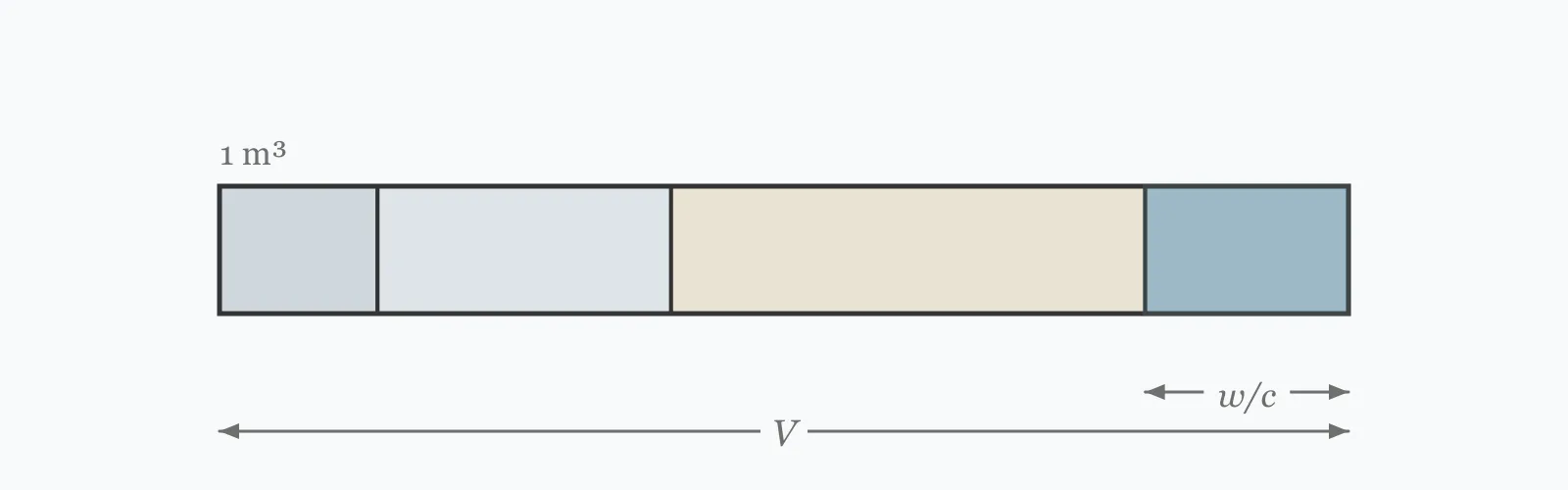
Concrete mix design starts from two decisions: the water-cement ratio, which sets strength and durability, and the water content, which sets workability. Enter your target strength, slump and volume to get the w/c ratio and quantities of cement, water, sand and coarse aggregate. It is a preliminary estimate — a production mix must be confirmed by trial batching.
Press Calculate for the water-cement ratio and the mass of each constituent for your volume. Treat these as trial batch quantities — actual proportions depend on the specific gravity, moisture content and grading of your aggregates.
Step-by-Step Solution
Preliminary design aid. Results follow the published formulas cited
below and are intended for estimating, study and early design. Final design must be
verified by a licensed Professional Engineer against the code in force for your project.
Key Benefits
✓Derives the water-cement ratio from the target strength, the way mix design actually proceeds
✓Adjusts water content for the specified slump rather than assuming one
✓Returns quantities for your whole pour, not just per cubic metre
✓Includes the standard strength-class comparison table
✓Sensitivity chart shows how cement content climbs with target strength
✓Shareable links and CSV export for a batching record
What Is Concrete Mix Design?
Mix design is the process of choosing proportions of cement, water, fine aggregate and coarse aggregate that will produce concrete of a specified strength, workability and durability at the lowest reasonable cost. The ACI 211.1 procedure works in a fixed order: choose the water content from the required slump and aggregate size, choose the water-cement ratio from the required strength and exposure, divide one by the other to get the cement content, then fill the remaining volume with aggregate.
Why the water-cement ratio governs everything
Cement hydration consumes only about a quarter of its own mass in water. Anything beyond that remains in the mix as free water, and when it eventually evaporates it leaves capillary pores. Those pores are what strength, permeability and freeze-thaw resistance all depend on, which is why a single number — the ratio of water to cement by mass — predicts so much. Abrams established the relationship in 1918 and it has not needed revision since.
Slump is not a quality measure
Slump measures consistency, not strength. A higher slump makes concrete easier to place around congested reinforcement, but reaching it by adding water raises the w/c ratio and weakens the result. The correct way to increase workability at constant strength is a water-reducing admixture, which is why almost all modern structural concrete contains one. Adding water on site to a truck that has stiffened is the single most damaging thing that can be done to a delivered mix.
Formula
w/c = f(f'c)
Water-cement ratio selected from the target strength, after ACI 211.1 Table 6.3.4
Related Formulas
Cement = Water / (w/c)
Sand = ρ_concrete − Cement − Water − Coarse aggregate
f'c = 120 / 13.8^(w/c)
f'cr = f'c + 1.34s
Variable Definitions
Symbol
Variable
Unit
Description
f'c
Target Strength
MPa
Specified 28-day compressive strength. The mix should be designed for a higher average to allow for variability.
w/c
Water-Cement Ratio
—
Mass of water divided by mass of cement. The single most influential parameter in the mix.
Slump
Slump
mm
Measure of consistency. Higher slump needs more water, or an admixture to avoid raising w/c.
Cement
Cement Content
kg
Mass of cementitious material. Follows from water content divided by the w/c ratio.
Water
Water Content
kg
Free water available for hydration and workability, excluding water absorbed by aggregate.
V
Volume Required
m³
Total concrete volume, used to scale the per-cubic-metre quantities.
How to Use This Calculator
Design for more than the specified strengthACI 318 requires the mix to target an average strength above the specified value, to allow for production variability — f'cr = f'c + 1.34s, where s is the standard deviation of the plant's test record. Where no record exists, the margin is larger still.
Choose the slump from the placing conditions25 to 50 mm for pavements and mass concrete, 75 to 100 mm for slabs and beams, 100 to 150 mm for columns and congested sections. Do not specify more workability than the placing method needs.
Check the durability requirement as well as strengthExposure classes impose a maximum w/c ratio independently of strength. Concrete exposed to freeze-thaw with de-icing salts is commonly capped at 0.45 regardless of the strength that implies, and marine exposure at 0.40.
Adjust for aggregate moisture before batchingThe water figure is free water. Aggregates carry moisture, and damp sand can hold 4 to 6% by mass — enough to change the effective w/c ratio by 0.05 or more. Batch plants correct for this continuously; site mixing rarely does.
Confirm with a trial batchThese quantities are a starting point. Local aggregates differ in grading, absorption and specific gravity, so a trial batch tested at 7 and 28 days is what turns an estimate into a mix design.
Worked Examples
Example 1
Estimate a mix for 1 m³ of C25 concrete — a 25 MPa target strength — at 75 mm slump, using 20 mm maximum aggregate.
Step-by-Step Solution
Target strength 25 MPa gives a water-cement ratio of 0.55
A 75 mm slump requires about 185 kg of water per cubic metre
Cement content: 185 / 0.55 = 336 kg/m³
Coarse aggregate for 20 mm maximum size: about 1,050 kg/m³
Fine aggregate fills the remainder: 2,400 − 336 − 185 − 1,050 = 829 kg/m³
For 1 m³: cement 336 kg, water 185 L, sand 829 kg, coarse aggregate 1,050 kg
Approximate mix ratio by mass: 1 : 2.47 : 3.13 (cement : sand : aggregate)
Check: total mass = 336 + 185 + 829 + 1,050 = 2,400 kg, consistent with normalweight concrete density.
Example 2
The same slump and volume, but the target strength raised from 25 to 40 MPa. This shows where the extra cost of high-strength concrete comes from.
Step-by-Step Solution
Target strength 40 MPa requires a water-cement ratio of 0.38
The slump requirement is unchanged, so water stays at 185 kg/m³
Comparison against the C25 mix: cement rose from 336 to 487 kg/m³, a 45% increase, while sand fell from 829 to 678 kg/m³
That is the whole economics of strength class. Water is fixed by workability, so raising strength means lowering w/c, which means more cement — and cement is by far the most expensive constituent.
It also has a consequence beyond cost: 487 kg/m³ of cement generates substantially more heat of hydration, which in a thick section risks thermal cracking and may require a supplementary cementitious material to control.
Strength Sensitivity
Cement content climbs as the target strength rises, because water is held roughly constant by the slump requirement and the w/c ratio must fall. Switch to the w/c curve to see the same relationship from the other side. The marker shows your current target strength.
Cement vs Target Strength (f'c)
Recomputed live from your inputs. The marker shows your current value.
Line chart of Cement against Target Strength (f'c). The same
values are listed in the data table below.
Values plotted above, sampled across the target strength (f'c) range.
How to Interpret Your Results
The water-cement ratio is the number to read first, because durability codes cap it independently of strength. A mix can satisfy its strength requirement and still be rejected on exposure grounds.
Water-Cement Ratio: < 0.4Low w/c — high strength and durability
A water-cement ratio of your result produces dense, impermeable concrete suitable for aggressive exposure including marine and de-icing salt conditions. Expect a high cement content, significant heat of hydration, and a real need for a water-reducing admixture to keep it placeable.
Water-Cement Ratio: 0.4 – 0.5Standard structural range
A water-cement ratio of your result is the normal range for structural concrete and satisfies most exposure classes, including freeze-thaw with air entrainment. Good balance of strength, durability and cost.
Water-Cement Ratio: 0.5 – 0.6Moderate w/c — check the exposure class
A water-cement ratio of your result suits mild internal exposure but exceeds the cap for several durability classes: severe freeze-thaw is commonly limited to 0.45 and marine exposure to 0.40. Verify the exposure requirement before accepting this ratio.
Water-Cement Ratio: ≥ 0.6High w/c — durability will be poor
A water-cement ratio of your result produces permeable concrete with limited durability. It suits only mass fill and non-structural work. For anything reinforced or exposed, reduce the ratio — carbonation and chloride ingress both accelerate sharply above 0.55.
Cement: ≥ 450High cement content — watch the heat
A cement content of your result kg generates substantial heat of hydration. In sections thicker than about 500 mm this risks thermal cracking as the core cools. Consider replacing part of the cement with fly ash or slag, which lowers the peak temperature and improves long-term durability.
Common Mistakes to Avoid
Adding water on site to restore slump
Why it matters:Every litre added raises the w/c ratio and lowers strength. Adding 20 litres to a 6 m³ load raises w/c by about 0.02 and can cost several MPa — enough to fail the specified strength.
✓How to avoid it:Never add water after batching without the supplier's authorisation and a recorded adjustment. Where workability has been lost in transit, a superplasticiser redoses the load without touching the w/c ratio.
Designing for the specified strength rather than the required average
Why it matters:Concrete strength varies batch to batch. A mix targeting exactly f'c will fail its acceptance criteria about half the time, since half of all results fall below the mean.
✓How to avoid it:Design for f'cr = f'c + 1.34s using the plant's standard deviation, per ACI 318 §26.4.3. Where no test record exists, the code specifies a larger fixed margin.
Ignoring aggregate moisture
Why it matters:Damp sand can carry 4 to 6% moisture by mass. On 800 kg of sand that is 30 to 50 litres of unaccounted water, which shifts the effective w/c ratio by 0.05 or more — a meaningful strength loss.
✓How to avoid it:Measure aggregate moisture and deduct it from the added water. Batch plants do this automatically; site mixing needs it done by hand, and it is the main reason site-mixed concrete underperforms.
Treating slump as a strength indicator
Why it matters:Slump measures consistency, not quality. Two mixes at the same slump can differ by 20 MPa depending on their w/c ratio, and a stiff mix is not necessarily a strong one.
✓How to avoid it:Specify strength and slump independently. Use admixtures to achieve workability rather than water, which is what allows both to be satisfied at once.
Selecting w/c on strength alone
Why it matters:Durability requirements impose their own maximum w/c, often stricter than strength demands. A mix at 0.55 may reach 25 MPa comfortably and still be unacceptable for a marine or de-icing salt exposure.
✓How to avoid it:Check both. Take the lower of the strength-derived ratio and the exposure class cap from ACI 318 Table 19.3.2.1 or EN 206 Table F.
Skipping the trial batch
Why it matters:Aggregate grading, particle shape, absorption and specific gravity all vary locally, and all shift the proportions. A mix designed on generic assumptions can miss its target strength or be unplaceable.
✓How to avoid it:Trial batch with the actual materials and test at 7 and 28 days. It is a small cost against the consequence of a non-compliant pour.
Practical Applications
▸Preliminary mix proportioning for structural concrete
▸Estimating cement and aggregate quantities for procurement
▸Comparing the material cost of different strength classes
▸Checking a supplier's proposed mix against first principles
▸Teaching the ACI 211 mix design sequence
▸Site-mixed concrete on projects without a batching plant
Industry Use Cases
Ready-mix production
Plants hold a library of approved mixes rather than designing each order. A first-principles estimate is used when a specification falls outside that library, to judge whether a new trial mix is needed or an existing one can be adjusted.
Precast manufacturing
Precast works demand high early strength so units can be demoulded and the beds turned around daily. That pushes w/c ratios well below what the 28-day specification requires, and the mix is designed around the demoulding strength instead.
Infrastructure and marine construction
Durability rather than strength sets the mix. Exposure classes cap the w/c ratio at 0.40 or lower and mandate supplementary cementitious materials, so the resulting strength is often well above what the structural design needs.
Expert Tips
💡Water content is set by workability, so raising strength always means more cement, not less water.
💡Use a water reducer rather than water to gain slump — it is the only way to have both workability and strength.
💡Check the exposure class cap on w/c before accepting the strength-derived value; durability often governs.
💡Above about 450 kg/m³ of cement, heat of hydration becomes a design issue in thick sections.
💡Replacing 25 to 40% of cement with slag or fly ash lowers peak temperature, cost and long-term permeability together.
💡Aggregate moisture is the largest uncontrolled variable in site-mixed concrete — measure it.
Advantages & Limitations
Advantages
✓Follows the ACI 211 sequence, so the logic is inspectable at every step
✓Derives w/c from strength rather than requiring it as an input
✓Adjusts water content for the specified slump instead of assuming one
✓Scales directly to the pour volume for procurement
✓Fast enough to compare strength classes during design
Limitations
!A preliminary estimate only — production mixes require trial batching and testing
!Assumes 20 mm maximum aggregate size and normalweight materials
!Uses a nominal concrete density of 2,400 kg/m³ rather than absolute volumes of the actual materials
!Takes no account of aggregate specific gravity, absorption or moisture content
!Does not include air entrainment, which displaces paste and reduces strength
!Omits supplementary cementitious materials and chemical admixtures
!Does not apply the required average strength margin over the specified value
Mix Proportions by Strength Class
All at 75 mm slump and 20 mm aggregate, per cubic metre. Water stays constant because slump does; every other quantity moves to accommodate the falling water-cement ratio.
Preliminary quantities per cubic metre at 75 mm slump. Confirm by trial batch with the actual aggregates.
The mass of water divided by the mass of cement in a mix. It is the single most influential parameter in concrete, governing strength, permeability and durability together. Lower ratios give stronger, denser concrete but need more cement and admixtures to stay placeable.
What is the mix ratio for C25 concrete?
Roughly 1 : 2.5 : 3.1 by mass — cement, sand, coarse aggregate — with a water-cement ratio of 0.55. Per cubic metre that is about 336 kg cement, 185 litres water, 829 kg sand and 1,050 kg of 20 mm aggregate.
How much cement is in a cubic metre of concrete?
Between roughly 260 and 530 kg depending on strength class. C25 needs about 336 kg/m³ and C40 about 487 kg/m³. Cement content rises with strength because water is fixed by the workability requirement.
Does adding water make concrete weaker?
Yes, and quickly. Every litre added raises the water-cement ratio and lowers strength. Adding 20 litres to a 6 m³ load raises w/c by about 0.02, which can cost several MPa — enough to fail the specified strength.
What slump should I specify?
25 to 50 mm for pavements and mass concrete, 75 to 100 mm for slabs and beams, 100 to 150 mm for columns and congested reinforcement. Specify only what the placing method needs — excess workability has to be paid for in cement or admixture.
How do I increase workability without losing strength?
Use a water-reducing admixture or superplasticiser. These disperse cement particles so the mix flows at a lower water content, letting you raise slump without touching the w/c ratio. Almost all modern structural concrete contains one.
Why design for a higher strength than specified?
Because concrete strength varies between batches. A mix targeting exactly the specified strength fails acceptance about half the time. ACI 318 requires a target average of f'c + 1.34s, where s is the plant's standard deviation.
Does aggregate moisture matter?
Considerably. Damp sand can carry 4 to 6% moisture by mass, which on 800 kg is 30 to 50 litres of unaccounted water. That shifts the effective water-cement ratio by 0.05 or more, and it is the main reason site-mixed concrete underperforms.
What is the maximum water-cement ratio for durability?
It depends on exposure. ACI 318 caps it at 0.50 for freeze-thaw exposure, 0.45 for freeze-thaw with de-icing chemicals, and 0.40 for concrete exposed to chlorides. These limits apply regardless of what the strength requirement alone would allow.
Should I use fly ash or slag in the mix?
Frequently yes. Replacing 25 to 40% of the cement lowers peak hydration temperature, reduces cost and improves long-term permeability and chloride resistance. The trade-off is slower early strength gain, which matters where formwork is struck early.
Glossary
Water-cement ratio (w/c)
The mass of free water divided by the mass of cementitious material, governing strength and durability.
Slump
A measure of concrete consistency, taken as the settlement of a standard cone of fresh concrete.
Abrams' law
The relationship establishing that concrete strength is a function of the water-cement ratio alone for fully compacted concrete.
Free water
Water available for hydration and workability, excluding water absorbed into aggregate pores.
Fine aggregate
Sand, the material passing a 4.75 mm sieve, which fills the voids between coarse particles.
Coarse aggregate
Gravel or crushed stone retained on a 4.75 mm sieve, forming the bulk of the concrete volume.
Water-reducing admixture
A chemical that disperses cement particles, allowing a given workability at lower water content.
Supplementary cementitious material
Fly ash, slag or silica fume replacing part of the cement, altering strength gain and durability.
Trial batch
A test mix made with the actual materials and tested for strength, confirming a design before production.
Required average strength (f'cr)
The mean strength a mix must target so that individual results satisfy the specified value with adequate confidence.
Scientific & Standards References
ACI 211.1 — Standard Practice for Selecting Proportions for Normal, Heavyweight, and Mass Concrete — American Concrete Institute
ACI 318-19 §19.3 and §26.4 — Concrete Durability Requirements and Mixture Proportioning — American Concrete Institute
Abrams, D. A., Design of Concrete Mixtures, Bulletin 1, Structural Materials Research Laboratory (1918) — Lewis Institute, Chicago
EN 206 Table F — Recommended limiting values for concrete composition — CEN
Neville, A. M., Properties of Concrete, 5th Edition — Pearson
ASTM C143/C143M — Standard Test Method for Slump of Hydraulic-Cement Concrete — ASTM International
Conclusion
Mix design resolves to a sequence: water content from the slump, water-cement ratio from the strength and exposure, cement from dividing one by the other, aggregate to fill what remains. The water-cement ratio is the number that matters, because it governs strength, permeability and durability simultaneously — and because durability codes cap it independently of strength, a mix can meet its strength requirement and still be unacceptable for its exposure. Two practical points follow. Raising strength always means more cement rather than less water, since workability fixes the water content; and adding water on site to a stiffened load undoes the whole design in a way nothing downstream can recover.
Estimate your own mix above, then sweep the target strength in the chart to see how sharply cement content climbs.