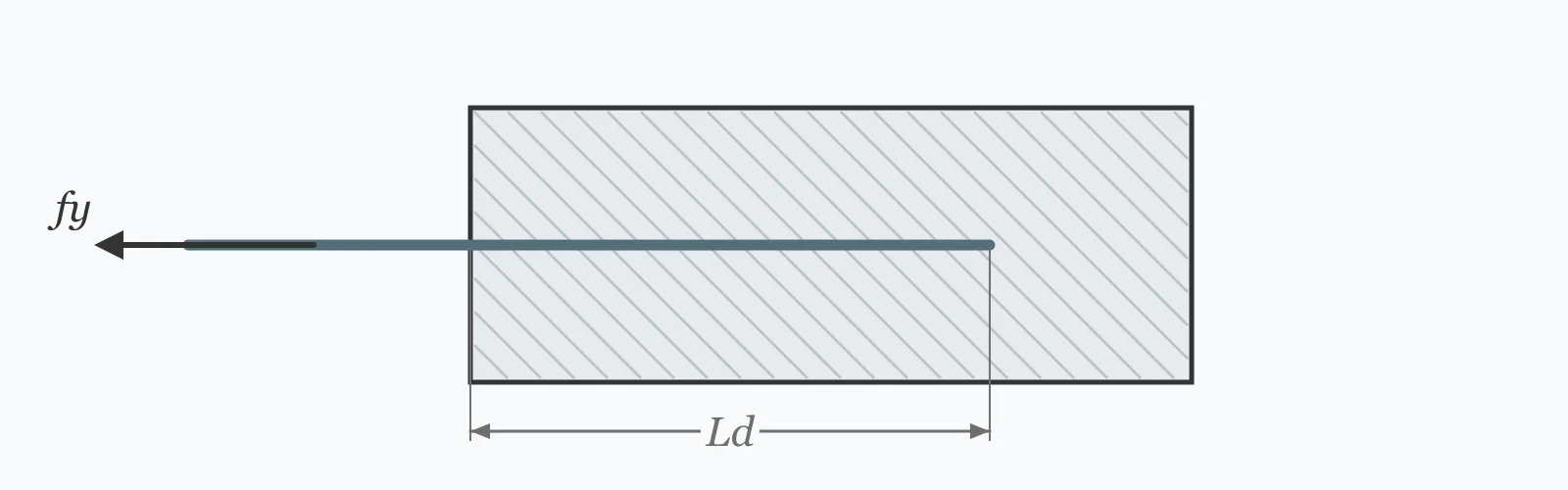
Development length is the embedment a bar needs before it can be assumed to reach yield. ACI 318's simplified form gives Ld = fy·ψt·db/(2.1√f'c), subject to a 300 mm minimum. Enter the bar diameter, steel and concrete strengths, and whether the bar is a top bar, to get the required length in millimetres.
Calculator
Units:
mm
Nominal bar diameter — 12, 16, 20, 25, 32 mm are standard
MPa
Grade 60 / B500 = 420–500 MPa
MPa
Specified 28-day compressive strength
0=No, 1=Yes
1 if more than 300 mm of concrete is cast below the bar
Calculation Result
Press Calculate for the required straight development length in millimetres and metres. This is the tension development length for a deformed bar with adequate cover and spacing; lap splices and hooks are derived from it as described below.
Step-by-Step Solution
Preliminary design aid. Results follow the published formulas cited
below and are intended for estimating, study and early design. Final design must be
verified by a licensed Professional Engineer against the code in force for your project.
Key Benefits
✓Applies the ACI 318 simplified expression including the 300 mm floor
✓Handles the top-bar factor, worth 30% and frequently overlooked
✓Expresses the result in bar diameters as well as millimetres, the form detailers use
✓Sets out how lap splice and hook lengths follow from it
✓Sensitivity chart shows the inverse square-root relationship with concrete strength
✓Shareable links and CSV export for detailing records
What Is Development Length?
Force is transferred between a reinforcing bar and the concrete around it by bond — chemical adhesion, friction, and above all the mechanical bearing of the bar's ribs against the concrete. That transfer is distributed along the bar's length, so a bar cannot develop its full strength at a point. Development length is the embedment required for bond to build up the bar's yield force, and it scales with bar diameter because a larger bar carries more force per unit of surface area.
Why concrete strength enters as a square root
Bond failure is a splitting failure: the ribs push outward on the surrounding concrete, and the concrete either splits along the bar or is crushed locally. Both mechanisms are governed by tensile strength, which is itself proportional to the square root of compressive strength. That is why f'c appears under a root, and why doubling concrete strength shortens the development length by only 29% rather than halving it.
The top-bar effect
Bars with more than 300 mm of fresh concrete cast beneath them require 30% more development length. As concrete settles and bleed water rises, a layer of weakened paste collects under horizontal bars near the top of a deep pour, degrading bond exactly where the bar needs it. The 1.3 factor is empirical, and it applies to any horizontal bar with that much concrete below it — not only bars in the top mat.
Formula
L_d = (f_y · ψ_t · d_b) / (2.1 · √f'c)
Tension development length for deformed bars, ACI 318 simplified expression (SI units)
Related Formulas
L_d ≥ 300 mm
L_st = 1.3 · L_d
L_dh = (0.24 · ψ_e · f_y · d_b) / √f'c
ψ_t = 1.3
Variable Definitions
Symbol
Variable
Unit
Description
L_d
Development Length
mm
Straight embedment required to develop the bar's yield strength in tension.
d_b
Bar Diameter
mm
Nominal diameter of the reinforcing bar. Development length is directly proportional to it.
f_y
Steel Yield Strength
MPa
Specified yield strength of the reinforcement. 420 MPa is Grade 60 or B500 equivalent.
f'c
Concrete Strength
MPa
Specified compressive strength. Enters under a square root, so its effect is muted.
ψ_t
Top-Bar Factor
—
1.3 where more than 300 mm of concrete is cast below the bar, 1.0 otherwise.
How to Use This Calculator
Enter the nominal bar diameterDevelopment length is directly proportional to diameter, so a 25 mm bar needs 25% more embedment than a 20 mm bar in the same concrete. Where anchorage is tight, several smaller bars often fit where one large bar will not develop.
Set the top-bar flag correctlyThe 1.3 factor applies to any horizontal bar with more than 300 mm of concrete cast beneath it — including bars part-way up a deep beam or a wall, not only the top mat of a slab.
Use the specified concrete strengthUse f'c from the specification rather than an expected or measured value. The relationship is a square root, so overestimating strength shortens the anchorage far less than it might seem — and in the unsafe direction.
Apply the minimum and check the geometryThe computed length is subject to a 300 mm floor. Then confirm the bar physically fits: a length that runs past the end of the member has to become a hook, a mechanical anchor or a headed bar.
Derive splices and hooks from the resultA Class B lap splice is 1.3 times the development length, and is the default where more than half the bars are spliced at one section. A standard 90-degree hook develops the bar in roughly 40 to 50% of the straight length.
Worked Examples
Example 1
A 20 mm bottom bar in Grade 420 steel is cast into 28 MPa concrete. Find the tension development length.
Step-by-Step Solution
The bar is a bottom bar, so the top-bar factor ψt = 1.0
Check the minimum: 756 mm exceeds the 300 mm floor, so it governs
Development length = 756 mm, or 0.76 m
For a Class B lap splice: 1.3 × 756 = 983 mm, which is what would be shown on the drawing for a spliced bar.
Example 2
The same bar, but now in the top mat of a 600 mm deep slab, so more than 300 mm of concrete is cast beneath it. This is the case detailers most often miss.
Step-by-Step Solution
The bar has over 300 mm of concrete below, so the top-bar factor ψt = 1.3
Comparison against the bottom bar: 983 mm against 756 mm — 30% longer, exactly the factor
The practical consequence: in a 3 m bay, a top bar needing 983 mm of anchorage each side leaves only about 1 m of clear span between anchorage zones.
This is why top steel over supports is often detailed with hooks. A standard 90-degree hook develops the same bar in roughly 400 to 450 mm, less than half the straight length, and fits where the straight bar does not.
Concrete Strength Sensitivity
Development length falls with the square root of concrete strength, so the curve flattens quickly — going from 28 to 56 MPa buys only a 29% reduction. Specifying stronger concrete is rarely the efficient way to shorten an anchorage. The marker shows your current strength.
Development Length (Ld) vs Concrete Strength (f'c)
Recomputed live from your inputs. The marker shows your current value.
Line chart of Development Length (Ld) against Concrete Strength (f'c). The same
values are listed in the data table below.
Values plotted above, sampled across the concrete strength (f'c) range.
How to Interpret Your Results
Development length is a detailing dimension, so what matters is whether it physically fits in the member. The bands below relate the computed length to the geometry it has to live inside.
Development Length (Ld): < 400Short anchorage — fits easily
A development length of your result mm is short and will fit within most members without difficulty. Note the 300 mm code minimum: below that, the floor governs rather than the calculation.
Development Length (Ld): 400 – 900Typical detailing range
A development length of your result mm is normal for structural reinforcement. Confirm it fits past the point of maximum stress, and remember a Class B lap splice needs 1.3 times this figure.
Development Length (Ld): 900 – 1500Long anchorage — check it fits
A development length of your result mm is substantial and may not fit within a short span or near a member end. Consider a standard hook, which develops the bar in roughly 40 to 50% of this length, or several smaller bars in place of one large one.
Development Length (Ld): ≥ 1500Very long anchorage
A development length of your result mm will rarely fit as a straight bar. Use hooked ends, headed bars or a mechanical anchorage. Reducing the bar diameter helps proportionally; raising the concrete strength helps only as its square root.
Common Mistakes to Avoid
Forgetting the top-bar factor
Why it matters:It adds 30% to the required length, and it applies to any horizontal bar with more than 300 mm of concrete below — not just the top mat. Missing it leaves the bar under-anchored by that margin.
✓How to avoid it:Check the depth of concrete cast beneath every horizontal bar, not just its position in the section. In deep beams and walls, intermediate bars often qualify.
Measuring the anchorage from the wrong point
Why it matters:Development length runs from the section where the bar is required to carry its full stress, not from the face of the support or the end of the bar. Measuring from the wrong datum can shorten the effective anchorage substantially.
✓How to avoid it:Identify the critical section from the moment diagram — usually the face of the support for top steel and the point of maximum moment for bottom steel — and measure from there.
Using a lap splice length equal to the development length
Why it matters:Most splices are Class B, requiring 1.3 times the development length, because more than half the bars are typically spliced at the same location. Using Ld directly under-laps by 30%.
✓How to avoid it:Use 1.3·Ld unless you can demonstrate the splice qualifies as Class A — no more than half the bars spliced within the lap length, and at least twice the required steel area provided.
Expecting stronger concrete to solve an anchorage problem
Why it matters:The square root relationship mutes the benefit. Going from 28 to 56 MPa concrete — doubling it — shortens the development length by only 29%, at considerable cost.
✓How to avoid it:Reduce the bar diameter, or use hooks or headed bars. Diameter has a linear effect and hooks roughly halve the length, both far more effective than a strength increase.
Applying the simplified expression outside its conditions
Why it matters:The simplified equation assumes adequate cover and clear spacing. Where bars are congested or cover is minimal, the general expression of ACI 318 §25.4.2.4 gives a longer length, since splitting becomes more likely.
✓How to avoid it:Confirm clear spacing of at least db and cover of at least db, with minimum stirrups. Otherwise use the general expression with the confinement term.
Assuming a hook develops the bar instantly
Why it matters:A hook shortens the anchorage but does not eliminate it. The hook still needs its own development length Ldh, and it needs enough concrete around the bend to resist the bearing force the hook generates.
✓How to avoid it:Compute Ldh per ACI 318 §25.4.3 and check the side cover and tail extension. A hook in a thin edge member can fail by splitting the cover off.
Practical Applications
▸Detailing bar cut-off points in beams and slabs
▸Sizing lap splices in columns and walls
▸Checking anchorage of top steel over supports
▸Detailing starter bars from foundations into columns
▸Verifying anchorage of shear reinforcement into flanges
▸Assessing whether existing reinforcement is adequately anchored
Industry Use Cases
Reinforced concrete detailing
Detailers work from tabulated development and lap lengths for each bar size and concrete grade rather than recalculating. The calculation is run when a project uses a non-standard grade, or when a bar has to be anchored in a space the table's length does not fit.
Precast concrete
Connection zones in precast elements are dimensionally tight, so straight development lengths rarely fit. Headed bars and mechanical couplers are the norm, sized against the straight length as the benchmark they must equal.
Structural assessment
Older structures were detailed to superseded codes with shorter anchorages, and plain round bars had far worse bond than modern deformed bars. Checking existing anchorage against current requirements often reveals it as the governing deficiency.
Expert Tips
💡Development length is proportional to bar diameter — several smaller bars anchor in less length than one large one.
💡Concrete strength enters as a square root, so it is the least effective lever available.
💡A standard hook develops a bar in roughly 40 to 50% of the straight length, and is the usual answer when space is tight.
💡Class B laps are 1.3·Ld and are the default; treat Class A as the exception you have to justify.
💡The top-bar factor depends on concrete cast below the bar, not on where the bar sits in the section.
💡Where anchorage genuinely will not fit, headed bars develop the full force in a fraction of the length.
Advantages & Limitations
Advantages
✓Single expression covering the common detailing case
✓Result expressed in bar diameters, matching how detailers think
✓Extends directly to lap splices and hooks by fixed multipliers
✓Fast enough to check a drawing detail while reviewing it
✓Matches ACI 318's simplified provision, so results are defensible
Limitations
!Uses the simplified expression, valid only with adequate cover and clear spacing
!Assumes uncoated deformed bars — epoxy coating adds a factor of up to 1.5
!Assumes normalweight concrete; lightweight requires a further factor
!Covers tension development only, not compression, which is shorter
!Does not compute hook development length, which follows a different expression
!Takes no account of excess reinforcement, which permits a reduction
!Does not check whether the anchorage physically fits in the member
Development Length by Concrete Strength
A 20 mm Grade 420 bottom bar at increasing concrete strengths. The square root relationship is why the column falls so slowly — this is the clearest argument against solving an anchorage problem with a stronger mix.
Tension development length for a 20 mm Grade 420 bottom bar. Multiply by 1.3 for a top bar, and again by 1.3 for a Class B splice.
The embedment a reinforcing bar needs before it can be assumed to carry its full yield stress. Force transfers from bar to concrete gradually through bond, so the bar must extend beyond the point of peak stress by this length.
How do I calculate development length?
Use Ld = fy·ψt·db/(2.1√f'c) in SI units, subject to a 300 mm minimum. A 20 mm Grade 420 bottom bar in 28 MPa concrete needs 756 mm, or 37.8 bar diameters.
What is the top-bar factor?
A 1.3 multiplier applied where more than 300 mm of fresh concrete is cast below a horizontal bar. Bleed water and settlement leave a weakened layer beneath such bars, degrading bond exactly where it is needed.
How long should a lap splice be?
1.3 times the development length for a Class B splice, which is the normal case. Class A at 1.0·Ld applies only where no more than half the bars are spliced within the lap and at least twice the required steel is provided.
Why does concrete strength have so little effect?
Because it enters under a square root. Bond failure is a splitting failure governed by tensile strength, which itself scales with the square root of compressive strength. Doubling f'c shortens the anchorage by only 29%.
How much shorter is a hooked bar?
A standard 90-degree hook typically develops a bar in 40 to 50% of the straight length. The hook still needs its own development length and adequate side cover around the bend, so it is a reduction rather than an elimination.
Does epoxy coating change the development length?
Yes, it increases it. Coating reduces bond, and ACI applies a factor of 1.2 or 1.5 depending on cover and spacing. Combined with the top-bar factor, the total multiplier is capped at 1.7.
Where do I measure development length from?
From the section where the bar is required to develop its full stress — normally the face of the support for top steel, or the point of maximum moment for bottom steel. Measuring from the bar end or the member face is the common error.
Is compression development length shorter?
Yes, considerably. In compression there is no splitting from flexural cracking and end bearing contributes, so ACI gives a separate and shorter expression. Compression anchorage rarely governs a detail.
What if the development length does not fit?
Use a standard hook, a headed bar or a mechanical anchorage. Reducing the bar diameter helps proportionally. Extending the bar into an adjacent member is also acceptable where continuity exists and the concrete is cast monolithically.
Glossary
Development length (Ld)
The embedment required for a bar to develop its specified yield strength through bond with the concrete.
Bond
The mechanism transferring force between reinforcement and concrete, dominated by mechanical bearing of the bar ribs.
Top-bar factor
A 1.3 multiplier for horizontal bars with more than 300 mm of concrete cast beneath them.
Lap splice
A connection formed by overlapping two bars so force transfers between them through the surrounding concrete.
Class B splice
The standard lap splice at 1.3 times the development length, used where most bars are spliced at one location.
Standard hook
A 90 or 180 degree bend at a bar end, developing the bar in a shorter length than a straight extension.
Headed bar
A bar with a forged or welded plate at its end, transferring force by bearing rather than bond.
Critical section
The location where a bar is required to carry its full design stress, from which development length is measured.
Splitting failure
Bond failure in which the bar ribs crack the concrete cover along the bar rather than crushing it locally.
Scientific & Standards References
ACI 318-19 §25.4.2 — Development of Deformed Bars in Tension — American Concrete Institute
ACI 318-19 §25.4.3 — Development of Standard Hooks in Tension — American Concrete Institute
ACI 318-19 §25.5 — Splices — American Concrete Institute
ACI 408R — Bond and Development of Straight Reinforcing Bars in Tension — American Concrete Institute
EN 1992-1-1 §8.4 — Anchorage of longitudinal reinforcement — CEN
Conclusion
Development length is the embedment a bar needs to reach yield, given by fy·ψt·db/(2.1√f'c) with a 300 mm floor. Three things follow from the structure of that expression. Bar diameter has a linear effect, so several smaller bars anchor in less length than one large one. Concrete strength enters as a square root, making it the weakest available lever — doubling f'c buys only 29%. And the top-bar factor adds 30% to any horizontal bar with more than 300 mm of concrete cast below it, which includes bars part-way up a deep beam, not only the top mat. Where the length will not fit, hooks and headed bars are the answer, not a stronger mix.
Check your own bar above, then sweep the concrete strength in the chart to see how little it changes the answer.