Concrete stiffness follows from strength and density: ACI 318 gives Ec = 0.043·wc^1.5·√f'c, with density in kg/m³ and strength in MPa. Enter both to get the modulus in MPa and GPa. The density term is the reason lightweight concrete is so much more flexible than its strength alone would suggest.
Press Calculate for the modulus in MPa and in GPa. This is the static chord modulus used in deflection and stiffness calculations — not the dynamic modulus obtained from ultrasonic testing, which is around 20% higher.
Step-by-Step Solution
Preliminary design aid. Results follow the published formulas cited
below and are intended for estimating, study and early design. Final design must be
verified by a licensed Professional Engineer against the code in force for your project.
Key Benefits
✓Uses the ACI density-based expression, which covers lightweight as well as normalweight concrete
✓Returns MPa and GPa together, matching how the value is quoted in different contexts
✓Compares against the 4700√f'c simplification and explains where they diverge
✓Sensitivity chart shows the square-root relationship with strength
✓Includes the modular ratio guidance needed for composite sections
✓Shareable links and CSV export for design records
What Is Concrete Modulus of Elasticity?
The modulus of elasticity relates stress to strain in the elastic range. For concrete the stress-strain curve is not straight, so what codes define is a secant or chord modulus taken between fixed stress points on the curve — typically from near zero to about 40% of the compressive strength, the range concrete actually works in under service load. ACI 318 §19.2.2.1 gives Ec = 0.043·wc^1.5·√f'c for densities between 1,440 and 2,560 kg/m³.
Why density enters to the power of 1.5
Concrete stiffness comes overwhelmingly from its aggregate, which occupies about 70% of the volume and is far stiffer than the cement paste around it. Density is a proxy for how much stiff aggregate is present and how dense that aggregate is, and the 1.5 exponent is empirical. The practical consequence is large: a lightweight concrete at 1,800 kg/m³ has roughly 65% of the modulus of a normalweight mix at 2,400 kg/m³ of the same strength.
Strength enters only as a square root
Doubling the compressive strength raises the modulus by only 41%. Concrete gets much stronger far faster than it gets stiffer, which is why high-strength concrete does comparatively little for deflection. It is also why a designer facing a deflection problem reaches for section depth rather than a stronger mix — depth enters the deflection calculation cubed, while strength enters it under a square root.
Formula
E_c = 0.043 · w_c^1.5 · √f'c
Static modulus of elasticity in MPa, with density in kg/m³ and strength in MPa (ACI 318 §19.2.2.1)
Related Formulas
E_c = 4700 √f'c
E_cm = 22 (f_cm/10)^0.3 × 1000
n = E_s / E_c
E_eff = E_c / (1 + φ)
Variable Definitions
Symbol
Variable
Unit
Description
E_c
Modulus of Elasticity
MPa
Static chord modulus of the concrete, used in deflection and stiffness calculations.
f'c
Compressive Strength
MPa
Specified 28-day cylinder strength. Enters under a square root, so its influence is muted.
w_c
Density
kg/m³
Unit weight of the hardened concrete. Normalweight is 2,300 to 2,500; structural lightweight 1,400 to 2,000.
n
Modular Ratio
—
Es/Ec, typically 6 to 9 for normalweight structural concrete with steel at 200 GPa.
φ
Creep Coefficient
—
Ratio of creep strain to elastic strain, typically 1.5 to 3.0, used to obtain the effective long-term modulus.
How to Use This Calculator
Use the specified strength for designUse f'c from the specification for design calculations. For assessing an existing structure, use the measured in-situ strength — but note that strength gained after 28 days raises the modulus only as its square root.
Enter the actual densityThis is the hardened density including reinforcement-free concrete only. Normalweight concrete runs 2,300 to 2,500 kg/m³; structural lightweight aggregate concrete 1,400 to 2,000. The density term dominates the difference between them.
Compare against the simplified expressionFor normalweight concrete, ACI also permits Ec = 4700√f'c, which corresponds to a density of about 2,320 kg/m³. At 2,400 kg/m³ the density-based form gives roughly 7% more, so the two are not interchangeable when precision matters.
Reduce for sustained loadUnder sustained load, creep increases strain at constant stress, effectively lowering the modulus. Divide by (1 + φ) with a creep coefficient of 1.5 to 3.0 to obtain the effective long-term value for deflection calculations.
Use it for the modular ratio in composite workDivide the steel modulus by this value to obtain the modular ratio n, which converts steel area to equivalent concrete area in transformed section calculations. For long-term effects, use the effective modulus rather than the short-term one.
Worked Examples
Example 1
Find the modulus of elasticity of 30 MPa normalweight concrete with a density of 2,400 kg/m³.
Step-by-Step Solution
Density raised to the power 1.5: 2,400^1.5 = 2,400 × √2,400 = 2,400 × 48.99 = 117,576
Square root of strength: √30 = 5.477
Ec = 0.043 × 117,576 × 5.477
Ec = 27,691 MPa
In gigapascals: 27.69 GPa
Compare with the simplified normalweight form: 4700 × 5.477 = 25,742 MPa, or 25.74 GPa
The density-based value is 7.6% higher, because 4700√f'c assumes a density near 2,320 kg/m³ rather than 2,400.
Modular ratio against steel at 200 GPa: n = 200,000 / 27,691 = 7.2.
Example 2
The same 30 MPa strength, but a structural lightweight concrete at 1,800 kg/m³. This is where the density term earns its exponent.
Step-by-Step Solution
Density raised to the power 1.5: 1,800^1.5 = 1,800 × √1,800 = 1,800 × 42.43 = 76,368
Comparison against the normalweight case: 17.99 against 27.69 GPa — only 65% of the stiffness at identical strength
The ratio follows the exponent directly: (1800/2400)^1.5 = 0.75^1.5 = 0.6495
Design consequence: a lightweight slab of the same strength and section deflects roughly 54% more than a normalweight one, since deflection is inversely proportional to Ec.
That is the real trade in lightweight concrete. It saves 25% of the dead load, which is valuable in long-span and seismic work, but it buys that saving with a stiffness penalty that must be carried through every deflection check.
Strength Sensitivity
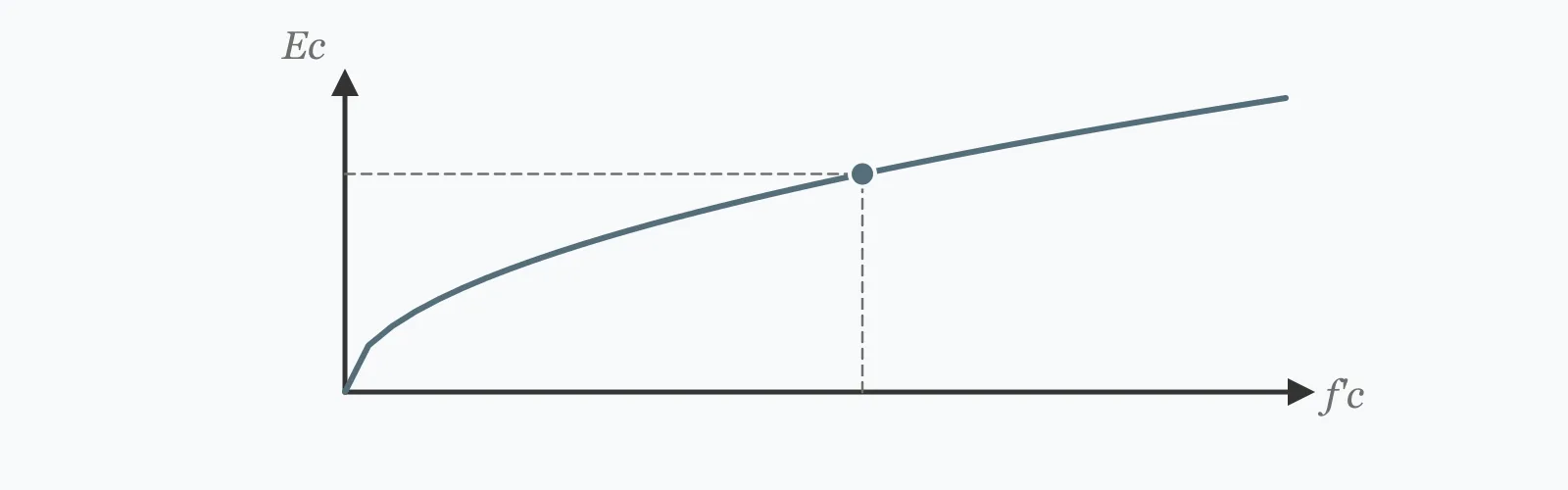
Modulus follows the square root of strength, so the curve flattens steadily — the stiffness gained from 60 to 90 MPa is far less than from 15 to 45. This is why high-strength concrete solves strength problems but not deflection ones. The marker shows your current strength.
Modulus in GPa vs Concrete Strength (f'c)
Recomputed live from your inputs. The marker shows your current value.
Line chart of Modulus in GPa against Concrete Strength (f'c). The same
values are listed in the data table below.
Values plotted above, sampled across the concrete strength (f'c) range.
How to Interpret Your Results
The modulus itself has no pass-or-fail threshold; it is an input to other calculations. The bands below relate the computed value to the concrete type it implies and to the modular ratio it produces.
Modulus in GPa: < 20Lightweight or low-strength concrete
A modulus of your result GPa indicates lightweight aggregate concrete or a low-strength mix. Deflections will be substantially larger than a normalweight equivalent — a modulus 35% lower means 54% more deflection for the same section and load.
Modulus in GPa: 20 – 30Typical normalweight range
A modulus of your result GPa is the normal range for structural concrete between 20 and 40 MPa. The modular ratio against steel is around 7 to 9, which is the figure to use for transformed section calculations.
Modulus in GPa: 30 – 40High-strength or dense concrete
A modulus of your result GPa corresponds to high-strength concrete or a dense aggregate. Stiffness gains flatten from here, since the modulus follows the square root of strength — further strength increases buy proportionally less.
Modulus in GPa: ≥ 40Very high modulus — verify by test
A modulus of your result GPa is at the top of the range achievable with conventional materials. Values this high depend strongly on the specific aggregate, and the ACI expression can be several percent adrift. Confirm by test where the value materially affects the design.
Common Mistakes to Avoid
Using a fixed value such as 25 or 30 GPa for all concrete
Why it matters:The modulus spans roughly 18 to 40 GPa across the range of ordinary structural concrete. Assuming a round number can be 30% adrift, and deflection is inversely proportional to it.
✓How to avoid it:Compute it from the actual strength and density. For a first estimate on normalweight concrete, 4700√f'c is defensible; a fixed number is not.
Applying the normalweight simplification to lightweight concrete
Why it matters:The 4700√f'c form embeds a density of about 2,320 kg/m³. For lightweight concrete at 1,800 kg/m³ it overstates the modulus by more than 40%, and therefore understates deflection by a similar margin.
✓How to avoid it:Use the density-based expression whenever the concrete is not normalweight. The density term is what distinguishes the two cases.
Using the short-term modulus for sustained load
Why it matters:Creep increases strain at constant stress over months and years. Long-term deflection under sustained load can be two or three times the immediate value, and using the short-term modulus misses all of it.
✓How to avoid it:Use the effective modulus Ec/(1 + φ), with a creep coefficient of 1.5 to 3.0 depending on age at loading, humidity and section size.
Confusing the static and dynamic modulus
Why it matters:The dynamic modulus from ultrasonic or resonance testing is typically 15 to 25% higher than the static value, because it is measured at negligible strain where the stress-strain curve is steepest.
✓How to avoid it:Use the static modulus for structural calculations. Where a dynamic value has been measured, convert it before use rather than substituting it directly.
Ignoring the aggregate
Why it matters:The ACI expression is a fit across common aggregates, and the actual modulus varies with the aggregate's own stiffness. Limestone, granite and basalt give different results, and lightweight aggregates differ more still.
✓How to avoid it:Where stiffness materially affects the design — long spans, deflection-sensitive finishes, composite sections — measure it on the actual mix rather than relying on the code expression.
Using gross section stiffness for a cracked member
Why it matters:The modulus describes the material, not the section. Once a reinforced concrete member cracks in tension, its effective stiffness drops sharply regardless of what Ec is.
✓How to avoid it:Combine Ec with the effective moment of inertia Ie from ACI 318 §24.2.3 rather than the gross value, for any member expected to crack under service load.
Practical Applications
▸Computing deflection of reinforced concrete beams and slabs
▸Distributing stiffness between members in a frame analysis
▸Determining the modular ratio for transformed section calculations
▸Estimating prestress losses from elastic shortening
▸Predicting settlement interaction between structure and foundation
Industry Use Cases
Building structural design
Frame analysis distributes moment by relative stiffness, so Ec appears in every member. Because it is common to all concrete members, small errors largely cancel in the distribution — but they do not cancel in the deflection results that follow.
Lightweight and long-span construction
Lightweight concrete saves around 25% of dead load, which is decisive in long-span and seismic design. The stiffness penalty of roughly 35% at the same strength is the cost, and it makes deflection rather than strength the governing check.
Prestressed concrete
Elastic shortening loss depends directly on the modular ratio at transfer, when the concrete is young and its modulus lower than the 28-day value. Using the 28-day modulus understates the loss and therefore overstates the effective prestress.
Expert Tips
💡Strength enters as a square root: doubling f'c raises stiffness by only 41%.
💡Density enters to the power 1.5, which is why lightweight concrete is so much more flexible.
💡For a quick normalweight estimate, 4700√f'c is fine — but it assumes 2,320 kg/m³.
💡Divide by (1 + φ) for sustained load; creep coefficients of 1.5 to 3.0 are typical.
💡The modular ratio for ordinary structural concrete lands between 6 and 9.
💡Deflection problems are solved with section depth, not a stronger mix — depth is cubed, strength is a square root.
Advantages & Limitations
Advantages
✓Covers lightweight and normalweight concrete from one expression
✓Directly matches ACI 318 §19.2.2.1, so results are defensible
✓Returns MPa and GPa together for different downstream uses
✓Needs only two inputs, both of which are specified anyway
✓Simple enough to check by hand in a review
Limitations
!An empirical fit; the actual modulus varies with aggregate type by several percent
!Valid for densities between roughly 1,440 and 2,560 kg/m³
!Gives the short-term static modulus, ignoring creep under sustained load
!Not the dynamic modulus, which is 15 to 25% higher
!Assumes 28-day strength; young concrete is significantly less stiff
!Describes the material, not the cracked stiffness of a reinforced section
!Accuracy falls for high-strength concrete above about 60 MPa
Modulus by Strength and Density
The density column shows why the exponent matters. At any given strength, a lightweight mix has around two thirds the stiffness of a normalweight one — and deflection is inversely proportional to that.
Static modulus from ACI 318 §19.2.2.1. Modular ratio uses Es = 200 GPa. Values above 60 MPa should be confirmed by test.
How do I calculate the modulus of elasticity of concrete?
Use Ec = 0.043·wc^1.5·√f'c, with density in kg/m³ and strength in MPa, giving the modulus in MPa. For 30 MPa concrete at 2,400 kg/m³ that gives 27,691 MPa, or 27.69 GPa.
What is the modulus of elasticity of concrete in GPa?
Typically 22 to 32 GPa for normalweight structural concrete between 20 and 40 MPa. Lightweight concrete of the same strength runs around 15 to 21 GPa. Steel, by comparison, is 200 GPa.
What is the difference between 4700√f'c and the density formula?
The simplified form embeds a density of about 2,320 kg/m³. At an actual 2,400 kg/m³ the density-based expression gives roughly 7.6% more. For lightweight concrete the difference exceeds 40%, and the simplification cannot be used.
Why does concrete density affect stiffness so much?
Because stiffness comes mainly from the aggregate, which occupies most of the volume. Density is a proxy for how much stiff aggregate is present, and it enters to the power 1.5 — so a 25% density reduction costs 35% of the modulus.
Does higher-strength concrete deflect less?
Somewhat, but far less than intuition suggests. The modulus follows the square root of strength, so doubling f'c raises stiffness by only 41%. Increasing section depth is a much more effective response to a deflection problem.
What is the modular ratio?
The ratio of steel modulus to concrete modulus, n = Es/Ec, used to convert steel area into equivalent concrete area in transformed section calculations. For ordinary structural concrete it lands between 6 and 9.
How does creep affect the modulus?
Creep increases strain at constant stress, so under sustained load the concrete behaves as if it were less stiff. Design uses an effective modulus Ec/(1 + φ), where the creep coefficient φ is typically 1.5 to 3.0 depending on age at loading, humidity and section size.
What is the difference between static and dynamic modulus?
The dynamic modulus, from ultrasonic or resonance testing, is 15 to 25% higher because it is measured at negligible strain where the stress-strain curve is steepest. Structural calculations use the static value.
Does the modulus change with concrete age?
Yes, following strength. Young concrete is significantly less stiff, which matters for prestress transfer and early formwork striking. Because the relationship is a square root, though, the modulus matures faster than the strength does.
Which modulus does Eurocode 2 use?
Eurocode 2 gives Ecm = 22(fcm/10)^0.3 in GPa, based on the mean rather than characteristic strength. It generally yields values close to the ACI expression for normalweight concrete, but the two are formulated differently and should not be mixed within one calculation.
Glossary
Modulus of elasticity (Ec)
The ratio of stress to strain in the working range of concrete, taken as a secant or chord modulus.
Secant modulus
The slope of a line from the origin to a specified point on the stress-strain curve, used because concrete is non-linear.
Static modulus
The modulus measured from a load test at normal loading rates, used for structural calculations.
Dynamic modulus
The modulus obtained from ultrasonic or resonance testing, 15 to 25% higher than the static value.
Modular ratio (n)
Es/Ec, used to transform steel into equivalent concrete area in composite section calculations.
Creep coefficient (φ)
The ratio of creep strain to elastic strain, used to obtain the effective long-term modulus.
Effective modulus
Ec/(1 + φ), the reduced stiffness representing concrete behaviour under sustained load.
Lightweight concrete
Concrete using lightweight aggregate, typically 1,400 to 2,000 kg/m³, with correspondingly lower stiffness.
Flexural rigidity (EcI)
The product of modulus and moment of inertia, the quantity that actually governs deflection.
Scientific & Standards References
ACI 318-19 §19.2.2.1 — Modulus of Elasticity — American Concrete Institute
ACI 363R — Report on High-Strength Concrete — American Concrete Institute
ASTM C469 — Standard Test Method for Static Modulus of Elasticity and Poisson's Ratio of Concrete in Compression — ASTM International
EN 1992-1-1 Table 3.1 — Strength and deformation characteristics for concrete — CEN
Neville, A. M., Properties of Concrete, 5th Edition — Chapter 6: Elasticity, Shrinkage and Creep — Pearson
Conclusion
Concrete stiffness follows Ec = 0.043·wc^1.5·√f'c, and the two exponents tell the whole story. Strength enters under a square root, so doubling it buys only 41% more stiffness — which is why high-strength concrete is a poor answer to a deflection problem, and section depth a good one. Density enters to the power 1.5, so a lightweight mix at 1,800 kg/m³ has around two thirds the modulus of a normalweight mix of identical strength, and deflects roughly 54% more. Two adjustments are easy to forget: sustained load requires the effective modulus Ec/(1 + φ), and a cracked reinforced section needs the effective moment of inertia rather than the gross value.
Compute your own mix above, then sweep the strength in the chart to see how quickly the stiffness gains flatten out.