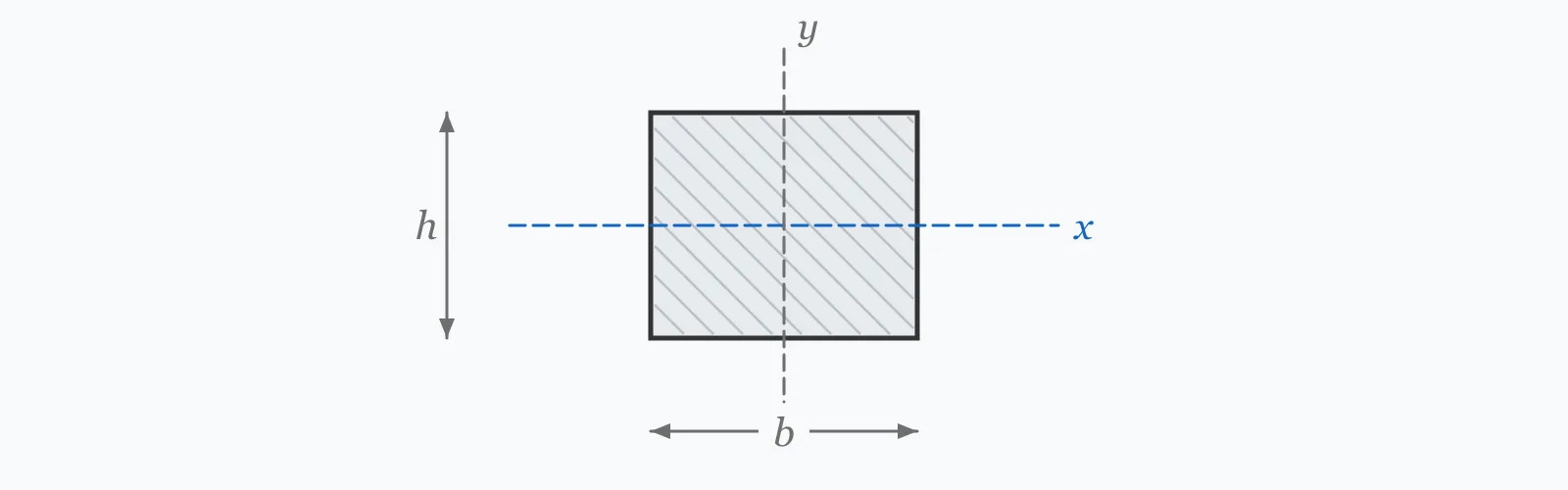
Moment of inertia measures how efficiently a cross-section distributes material away from its bending axis. For a rectangle it is I = bh³/12. Enter the outer dimensions — and inner dimensions for a hollow section — and this calculator returns Ixx, Iyy, the area and the radius of gyration, the four properties every beam and column check depends on.
Calculator
Units:
mm
Outer horizontal dimension
mm
Outer vertical dimension, parallel to the load
mm
Leave at 0 for a solid section
mm
Leave at 0 for a solid section
Calculation Result
Press Calculate to get the moment of inertia about both axes, the cross-sectional area and the radius of gyration. Leave the inner dimensions at zero for a solid section; enter them to model a rectangular hollow section.
Step-by-Step Solution
Preliminary design aid. Results follow the published formulas cited
below and are intended for estimating, study and early design. Final design must be
verified by a licensed Professional Engineer against the code in force for your project.
Key Benefits
✓Handles both solid and hollow rectangular sections from the same form
✓Returns Ixx and Iyy together, so the weak axis is never overlooked
✓Also gives area and radius of gyration, the inputs a buckling check needs
✓Shows the substitution, so the result can be reproduced by hand
✓Sensitivity chart makes the cubic effect of depth immediately visible
✓Results export to CSV or share as a link that reproduces your section
What Is Moment of Inertia?
The second moment of area is the integral of y²·dA over a cross-section, where y is the distance from the neutral axis. The square inside that integral is the whole story: material sitting twice as far from the axis contributes four times as much. Carrying out the integration for a rectangle of width b and depth h about its horizontal centroidal axis gives the familiar I = bh³/12, and rotating the section ninety degrees gives I = hb³/12 about the vertical axis.
Why depth dominates
Because h is cubed and b is only linear, depth is the variable worth spending material on. A 100 × 200 mm rectangle standing upright has four times the stiffness of the same rectangle lying flat. This asymmetry explains the shape of nearly every structural member: joists are deep and narrow, I-sections concentrate area in the flanges furthest from the axis, and a hollow tube removes exactly the material nearest the centre where it contributes least.
Hollow sections and subtraction
For a symmetric hollow rectangle the inner void shares the same centroid as the outer shape, so the result is simply the outer moment of inertia minus the inner one: I = (BH³ − bh³)/12. A rectangular hollow section can therefore keep most of its bending stiffness while shedding a large fraction of its weight. When the parts of a built-up shape do not share a centroid, this simple subtraction no longer works and the parallel axis theorem is required.
Formula
I_xx = bh³ / 12
Second moment of area of a solid rectangle about its horizontal centroidal axis
Related Formulas
I_yy = hb³ / 12
I_xx = (BH³ − bh³) / 12
I = I_c + A·d²
r = √(I / A)
Variable Definitions
Symbol
Variable
Unit
Description
I_xx
Moment of Inertia, x-axis
×10⁶ mm⁴
Resistance to bending about the horizontal axis — the strong axis for an upright rectangle.
I_yy
Moment of Inertia, y-axis
×10⁶ mm⁴
Resistance to bending about the vertical axis. This is the value a buckling check normally needs.
b
Width
mm
Horizontal dimension of the section, measured perpendicular to the depth.
h
Height (Depth)
mm
Vertical dimension, parallel to the applied load. Cubed in the formula, so it dominates stiffness.
A
Cross-Sectional Area
mm²
Gross area of the section, used for axial capacity and for the radius of gyration.
r
Radius of Gyration
mm
The quantity √(I/A), describing how far the area is effectively spread from the axis.
How to Use This Calculator
Orient the section the way it will be loadedWidth is measured perpendicular to the load and depth parallel to it. Getting this the wrong way round for an upright rectangle understates stiffness by a factor of (h/b)², which for a 100 × 400 section is a factor of sixteen.
Enter outer dimensions firstFor a solid section, enter width and height and leave both inner fields at zero. The calculator will return the solid values.
Add inner dimensions for a hollow sectionFor a rectangular hollow section, enter the internal clear dimensions. The calculator subtracts the void, which is valid because the outer and inner rectangles share a centroid.
Read both axesIxx governs bending about the strong axis, Iyy the weak axis. A column check needs the smaller of the two, since buckling happens in the direction of least resistance.
Carry the values into the dependent checksIxx feeds directly into deflection and bending calculations; the radius of gyration and area feed the buckling check. The related calculators below take these numbers as inputs.
Worked Examples
Example 1
A solid rectangular timber beam measures 200 mm wide by 400 mm deep. Find its section properties about both axes.
Radius of gyration: r_x = √(Ixx/A) = √(1,066,666,667 / 80,000) = √13,333.3 = 115.5 mm
Note the ratio: Ixx is exactly four times Iyy, because (h/b)² = (400/200)² = 4. Laying this beam flat would cost three quarters of its bending stiffness.
Example 2
The same 200 × 400 mm outline, but as a rectangular hollow section with a 150 × 350 mm void — a 25 mm wall all round. This shows how much stiffness survives when the core is removed.
Radius of gyration: r_x = √(530.73×10⁶ / 27,500) = √19,299 = 138.9 mm
The comparison is the point: removing 66% of the material costs only 50% of the bending stiffness, and the radius of gyration actually improves from 115.5 mm to 138.9 mm — which is why hollow sections are so effective in compression.
Depth Sensitivity
Because depth is cubed, Ixx rises far faster than area does. Sweep the section depth while holding the width constant to see the two curves diverge — that gap is precisely why deep sections are efficient. The marker shows your current depth.
I_xx (about x-axis) vs Height (h)
Recomputed live from your inputs. The marker shows your current value.
Line chart of I_xx (about x-axis) against Height (h). The same
values are listed in the data table below.
Values plotted above, sampled across the height (h) range.
How to Interpret Your Results
Moment of inertia is a geometric property rather than a pass-or-fail check, so it has no code limit of its own. What matters is the relationship between the numbers: the ratio between the two axes tells you how directional the section is, and the radius of gyration tells you how it will behave in compression.
A radius of gyration of your result mm is small, so any appreciable unbraced length will produce a high slenderness ratio. Check buckling carefully before using this section in compression.
Radius of Gyration r_x: 30 – 150Typical structural proportions
A radius of gyration of your result mm is in the normal range for structural members. Combine it with the unbraced length to form KL/r and check the result against the column curve.
Radius of Gyration r_x: ≥ 150Efficiently distributed section
A radius of gyration of your result mm is high, meaning the area sits well away from the neutral axis. Sections like this resist buckling efficiently for their weight — the reason hollow and wide-flange shapes are preferred in compression.
Common Mistakes to Avoid
Swapping width and depth
Why it matters:The formula is not symmetric: bh³/12 and hb³/12 differ by (h/b)². For a 100 × 300 section that is a factor of nine, which is the difference between a beam that works and one that fails.
✓How to avoid it:Depth is always the dimension parallel to the applied load, measured perpendicular to the bending axis. Sketch the section with the load arrow before substituting.
Using I_xx for a buckling check
Why it matters:Columns buckle about the axis of least resistance. Taking the strong-axis value overstates capacity — often by an order of magnitude for an I-section.
✓How to avoid it:Use the smaller of I_xx and I_yy for buckling, unless the weak axis is genuinely braced along its length.
Subtracting a void that does not share the centroid
Why it matters:The simple subtraction (BH³ − bh³)/12 is valid only when inner and outer shapes have the same centroidal axis. An off-centre hole or an asymmetric built-up shape breaks that assumption.
✓How to avoid it:Locate the composite centroid first, then apply the parallel axis theorem I = Ic + A·d² to each part before summing.
Confusing second moment of area with mass moment of inertia
Why it matters:They share a name but are different quantities: one has units of length⁴ and governs bending stiffness, the other has units of mass × length² and governs rotational dynamics.
✓How to avoid it:For structural bending, always use the second moment of area in mm⁴ or in⁴. If your units involve kilograms, you have the wrong quantity.
Using gross section properties for a cracked concrete member
Why it matters:Once a reinforced concrete section cracks in tension, the concrete below the neutral axis stops contributing and effective stiffness drops sharply.
✓How to avoid it:Use the transformed cracked section, or the effective moment of inertia Ie from ACI 318-19 §24.2.3, when computing concrete deflections.
Practical Applications
▸Computing beam deflection, where I appears directly in the denominator
▸Determining bending stress through the section modulus S = I/c
▸Supplying I and r to column buckling checks
▸Comparing candidate sections by stiffness per unit weight
▸Designing built-up and composite members via the parallel axis theorem
▸Checking whether a notched or drilled member retains adequate stiffness
Industry Use Cases
Structural steel design
Section tables list I, S, Z and r for every rolled shape, but engineers recompute properties by hand whenever a section is reinforced with cover plates or weakened by a service penetration, since neither case appears in the tables.
Timber engineering
Joists and rafters are usually plain rectangles, so bh³/12 is applied directly. Notching at a bearing reduces the effective depth locally, and because depth is cubed, a notch of a quarter the depth removes well over half the local stiffness.
Product and machine design
Extrusion designers iterate on wall thickness and rib placement to maximise I per unit mass. Because area grows linearly while inertia grows cubically with depth, adding height to a rib is almost always more efficient than thickening it.
Expert Tips
💡Doubling depth multiplies stiffness by eight; doubling width only doubles it. Spend material on depth.
💡Material near the neutral axis contributes almost nothing — this is exactly what a hollow section exploits.
💡The ratio Ixx/Iyy for a rectangle is simply (h/b)², a useful sanity check on any computed pair.
💡Keep everything in millimetres. Values in the 10⁶ to 10⁹ mm⁴ range are normal, and a result three orders of magnitude away usually means a unit slip.
💡For a built-up section, the A·d² term usually dwarfs the individual Ic terms — compute the offsets carefully.
💡A higher radius of gyration at the same area is always the better compression member, whatever the shape.
Advantages & Limitations
Advantages
✓Exact closed-form result for rectangular geometry, solid or hollow
✓Produces every property the downstream deflection and buckling checks require
✓Independent of material, so one calculation serves steel, timber, concrete and plastics
✓Extends to arbitrary built-up shapes through the parallel axis theorem
✓Simple enough to verify by hand in a design review
Limitations
!Covers rectangular and symmetric hollow rectangular shapes only, not circles, tees or angles
!Assumes the void in a hollow section shares the outer centroid
!Gives gross properties, ignoring holes, notches and net-section reductions
!Takes no account of concrete cracking or composite action between materials
!Does not compute torsional constant J or warping constant, which govern twisting rather than bending
!Assumes the axes entered are the principal axes, which is untrue for an unsymmetric shape such as an angle
Moment of Inertia by Cross-Section Shape
Every shape distributes area differently. The efficiency column compares stiffness per unit area against a solid rectangle of the same depth, which is the fair way to judge whether a shape earns its weight.
Standard results for bending about the horizontal centroidal axis. Efficiency compares stiffness per unit cross-sectional area at equal depth.
About its horizontal centroidal axis, I = bh³/12, where b is the width and h the depth. About the vertical axis the two swap, giving I = hb³/12. A 200 × 400 mm rectangle therefore has 1,066.67 ×10⁶ mm⁴ about the strong axis and 266.67 ×10⁶ mm⁴ about the weak axis.
Why is height cubed in the formula?
The definition integrates y²·dA across the section, so contribution grows with the square of distance from the neutral axis. Integrating that square across the depth produces a third power. It is the reason depth is the most valuable dimension in any bending member.
What is the difference between moment of inertia and section modulus?
Moment of inertia governs stiffness and appears in deflection formulas. Section modulus, S = I/c where c is the distance to the extreme fibre, governs bending stress and appears in strength checks. Both come from the same geometry but answer different questions.
How do I find the moment of inertia of a composite section?
Split it into simple rectangles, locate the composite centroid, then apply the parallel axis theorem I = Ic + A·d² to each part and sum the results. The A·d² terms usually dominate, so accurate centroid offsets matter more than the individual Ic values.
What is the parallel axis theorem?
It states that a shape's moment of inertia about any axis parallel to its centroidal axis equals Ic + A·d², where d is the distance between the two axes. It is what allows built-up shapes to be assembled from tabulated parts.
Is moment of inertia the same as the second moment of area?
In structural engineering, yes — the two names describe the same quantity, with units of length to the fourth power. It is distinct from the mass moment of inertia used in dynamics, which has units of mass times length squared.
Which moment of inertia should I use for a column?
The smaller of the two, because a column buckles about the axis offering least resistance. The only exception is when the weak axis is braced along its length, in which case the strong axis with its longer unbraced length may govern instead.
How much stiffness does a hollow section lose?
Less than you might expect. Material near the neutral axis contributes almost nothing, so a rectangular hollow section can shed around two thirds of its area while keeping roughly half its bending stiffness — and its radius of gyration actually improves.
Does the material affect the moment of inertia?
No. It is purely geometric and identical for steel, timber or plastic of the same shape. Material enters through the modulus of elasticity E, and it is the product EI, the flexural rigidity, that determines actual deflection.
How does a notch affect a timber joist?
Severely, because depth is cubed. Notching a quarter of the depth from a joist leaves (0.75)³ = 42% of the local stiffness. This is why timber codes restrict notch depth and location, and why notches near midspan are generally prohibited.
Glossary
Second moment of area
The integral of y²·dA over a cross-section, quantifying resistance to bending. Units of length to the fourth power.
Neutral axis
The line through a cross-section where bending stress is zero, passing through the centroid for a homogeneous elastic section.
Centroid
The geometric centre of a cross-section, about which centroidal moments of inertia are measured.
Parallel axis theorem
The relation I = Ic + A·d², used to transfer a part's moment of inertia to an axis offset by distance d.
Radius of gyration
The quantity √(I/A), representing the distance at which the whole area could be concentrated to give the same moment of inertia.
Principal axes
The pair of perpendicular axes through the centroid about which the product of inertia vanishes, giving the maximum and minimum values of I.
Section modulus
I divided by the distance to the extreme fibre, S = I/c, used for bending stress rather than stiffness.
Flexural rigidity
The product EI of modulus of elasticity and moment of inertia — the quantity that actually governs deflection.
Rectangular hollow section
A closed rectangular tube whose inner void shares the outer centroid, allowing its inertia to be found by simple subtraction.
Scientific & Standards References
AISC Steel Construction Manual, 16th Edition — Part 1: Dimensions and Properties — American Institute of Steel Construction
Gere, J. M. & Goodno, B. J., Mechanics of Materials, 9th Edition — Appendix D: Properties of Plane Areas — Cengage Learning
Hibbeler, R. C., Structural Analysis, 10th Edition — Appendix A: Geometric Properties of an Area — Pearson
EN 1993-1-1 §6.2 — Resistance of cross-sections — CEN
Roark's Formulas for Stress and Strain, 9th Edition — Table A.1: Properties of Sections — McGraw-Hill
Conclusion
The second moment of area is the geometric property behind every bending and buckling check, and for a rectangle it reduces to I = bh³/12. The cubic dependence on depth is the practical lesson: depth buys stiffness far more cheaply than width, material near the neutral axis earns almost nothing, and removing that core is why hollow sections outperform solid ones per unit weight. Compute both axes as a matter of routine — the weak-axis value is the one a column check needs, and it is the one most often overlooked.
Enter your own section above, then sweep the depth in the chart to see stiffness and area diverge.