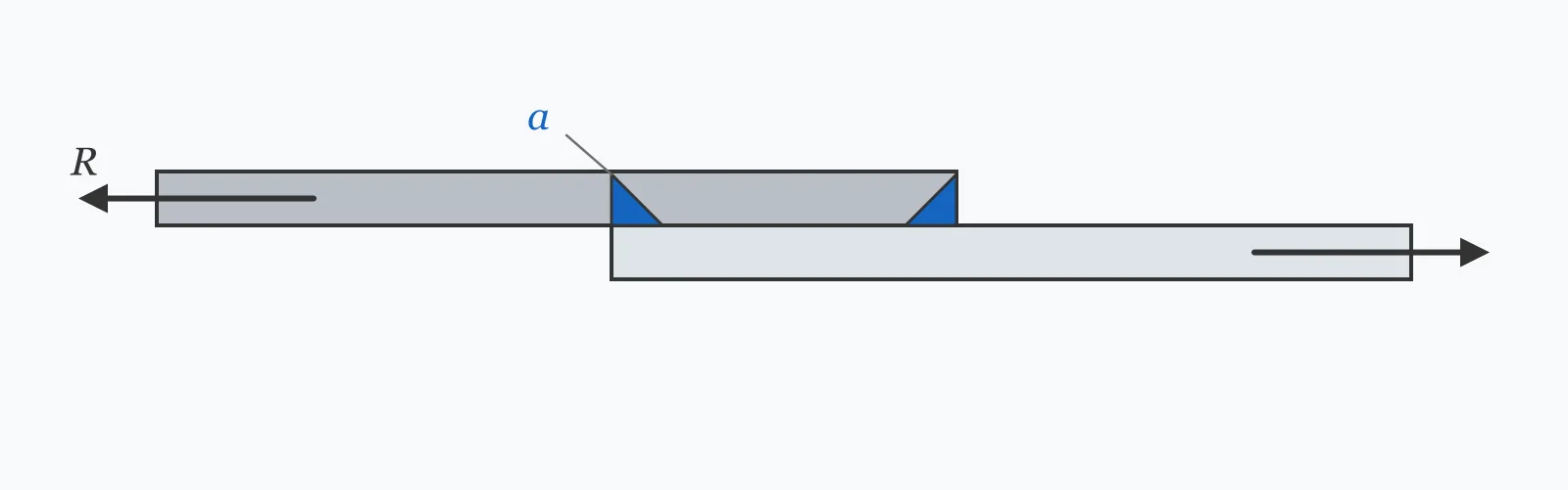
A fillet weld fails by shear across its effective throat, which for an equal-leg weld is 0.707 times the leg size. Nominal shear stress is 0.6·Fexx. Enter the leg size, length and electrode strength to get capacity per millimetre and total nominal capacity. Apply ϕ = 0.75 for LRFD, and check the base metal separately.
Calculator
Units:
mm
Leg length of the fillet — check against the minimum size table below
Press Calculate for the capacity per millimetre of weld and the total nominal capacity over the length entered. Multiply by ϕ = 0.75 for LRFD design strength, and verify the base metal can deliver the load into the weld.
Step-by-Step Solution
Preliminary design aid. Results follow the published formulas cited
below and are intended for estimating, study and early design. Final design must be
verified by a licensed Professional Engineer against the code in force for your project.
Key Benefits
✓Applies AISC 360 §J2.4 directly, using the 0.707 throat and 0.6·Fexx shear stress
✓Returns capacity per millimetre, the figure used to size weld runs on a drawing
✓Includes the minimum weld size table keyed to the thicker connected part
✓Makes the ϕ = 0.75 factor and the base metal check explicit
✓Sensitivity chart shows the linear capacity gain against quadratic cost of leg size
✓Shareable links and CSV export for connection records
What Is Fillet Weld Strength?
A fillet weld is a triangular deposit laid in the corner between two members meeting at right angles. It is assumed to fail in shear across its effective throat, the shortest distance from the root to the theoretical face. For an equal-leg fillet that distance is the leg size divided by √2, or 0.707 times the leg. AISC 360 §J2.4 gives the nominal shear stress on that throat as 0.6·Fexx, where Fexx is the electrode classification strength.
Why direction does not change the basic expression
Fillet welds are checked in shear on the throat regardless of the direction of loading, which keeps the calculation simple. AISC does allow an increase for transversely loaded welds — the directional strength factor of §J2.4(a) raises capacity by up to 50% for a weld loaded perpendicular to its axis — but taking that benefit requires care when a weld group has runs in several directions, since the more ductile longitudinal welds and stiffer transverse welds do not reach peak capacity simultaneously.
Size, length and cost
Weld metal volume is proportional to the square of the leg size, while capacity is proportional to the first power. A 12 mm fillet has twice the capacity of a 6 mm fillet but takes four times the weld metal, four times the deposition time, and puts four times the heat into the joint. Detailers therefore reach for longer welds before larger ones, and codes reinforce this with a maximum single-pass size beyond which multiple passes become necessary.
Formula
R_n = 0.6 · F_exx · (0.707a) · L
Nominal shear capacity of a fillet weld of leg size a and length L, AISC 360 §J2.4
Related Formulas
t_e = 0.707a
ϕR_n = 0.75 · 0.6 · F_exx · t_e · L
R_n = 0.6 · F_exx · t_e · (1.0 + 0.5 sin^1.5 θ)
a_max = t − 2 mm
Variable Definitions
Symbol
Variable
Unit
Description
R_n
Nominal Weld Capacity
kN
Shear capacity of the weld metal over the length entered, before the resistance factor.
a
Leg Size
mm
The length of the fillet's leg along either fusion face, the dimension called up on the drawing.
t_e
Effective Throat
mm
Shortest distance from root to weld face, 0.707a for an equal-leg fillet made by shielded arc welding.
F_exx
Electrode Strength
MPa
Classification tensile strength of the filler metal. E70XX is 483 MPa, E60XX is 414 MPa.
L
Weld Length
mm
Effective length of the weld run. Deduct start and stop craters where they are not full size.
ϕ
Resistance Factor
—
0.75 for weld metal in LRFD. The corresponding ASD safety factor is Ω = 2.00.
How to Use This Calculator
Enter the leg size, not the throatDrawings and inspection both work in leg size, so that is what the calculator takes. It converts to the effective throat internally using the 0.707 factor for an equal-leg fillet.
Check the size against the code minimumMinimum fillet size is set by the thicker of the two connected parts, to ensure enough heat input to avoid rapid cooling and cracking. See the table below — the minimum is a fabrication requirement, not a strength one.
Enter the effective weld lengthUse the length of full-size weld. Where runs terminate without an end return, some specifications require a deduction of one leg size at each end for craters.
Select the electrode strengthE70XX at 483 MPa covers most structural work in ordinary grades. The filler metal should match or slightly overmatch the base metal; consult AWS D1.1 Table 5.4 for the correct pairing.
Apply the resistance factor and check the base metalMultiply nominal capacity by ϕ = 0.75 for LRFD. Then verify the base metal at the fusion face can carry the same load — a weld stronger than the plate it sits on delivers no benefit.
Worked Examples
Example 1
A 6 mm fillet weld 100 mm long is made with E70XX electrode, taken here as Fexx = 480 MPa. Find the capacity per millimetre and the total nominal and design capacity.
Step-by-Step Solution
Effective throat: te = 0.707 × 6 = 4.24 mm
Nominal shear stress on the throat: 0.6 × Fexx = 0.6 × 480 = 288.00 MPa
For a double-sided fillet, both runs contribute: 2 × 91.63 = 183.26 kN
The base metal must still be checked — a 6 mm fillet on a thin plate can outstrip what the plate itself can deliver.
Example 2
Comparing two ways to reach the same capacity: doubling the leg size versus doubling the length. The strength is identical; the cost is not.
Step-by-Step Solution
Option A — 12 mm fillet, 100 mm long: te = 0.707 × 12 = 8.48 mm
Capacity per mm = 8.48 × 288 / 1000 = 2.443 kN/mm; total = 244.34 kN nominal
Option B — 6 mm fillet, 200 mm long: capacity per mm = 1.222 kN/mm; total = 244.34 kN nominal
Both options deliver exactly the same 244.34 kN, and both give ϕRn = 183.26 kN
Now the cost. Weld metal area is roughly a²/2: Option A is 12²/2 = 72 mm² over 100 mm = 7,200 mm³
Option B is 6²/2 = 18 mm² over 200 mm = 3,600 mm³ — exactly half the weld metal
The conclusion generalises: for equal strength, the longer smaller weld uses half the consumable, half the deposition time and puts far less heat into the joint. Reach for length before size whenever the geometry allows it.
Leg Size Sensitivity
Capacity rises linearly with leg size while weld metal volume rises with its square — so the straight line below is bought at an accelerating cost. Sweep the leg size to see how little a larger weld actually buys. The marker shows your current size.
Total Nominal Capacity vs Weld Size (leg)
Recomputed live from your inputs. The marker shows your current value.
Line chart of Total Nominal Capacity against Weld Size (leg). The same
values are listed in the data table below.
Values plotted above, sampled across the weld size (leg) range.
How to Interpret Your Results
Capacity per millimetre is the number detailers actually work with, because it converts a required force directly into a required weld length. The bands below relate the computed per-millimetre value to the weld sizes used in ordinary steelwork.
Capacity per mm: < 0.9Small weld — check the minimum size requirement
A capacity of your result kN/mm corresponds to a fillet of about 4 mm or less. Confirm this meets the code minimum for the thicker connected part: on material above 12 mm thick, a 5 mm minimum applies regardless of what the strength calculation permits.
Capacity per mm: 0.9 – 2Standard structural fillet
A capacity of your result kN/mm is the normal range for 5 to 10 mm fillets in building steelwork, and these sizes are usually achievable in a single pass. Divide your factored load by 0.75 × this value to get the required weld length.
Capacity per mm: ≥ 2Large weld — consider length instead
A capacity of your result kN/mm implies a fillet above about 10 mm, which needs multiple passes and puts substantial heat into the joint. Since weld metal grows with the square of leg size, a longer smaller weld usually gives the same strength for far less cost and distortion.
Common Mistakes to Avoid
Entering the throat dimension instead of the leg size
Why it matters:The calculator applies the 0.707 factor itself. Entering a throat that has already been converted applies the reduction twice and understates capacity by about 29%.
✓How to avoid it:Always enter the leg size — the dimension shown on the drawing and measured by an inspection gauge.
Ignoring the minimum weld size requirement
Why it matters:Minimum sizes exist to control cooling rate. A small weld on thick material cools too fast, hardening the heat-affected zone and risking cracking, no matter how light the load.
✓How to avoid it:Check the leg size against the minimum for the thicker connected part before finalising. It is a fabrication requirement that the strength calculation cannot override.
Forgetting to check the base metal
Why it matters:A weld can be stronger than the material it joins. If the base metal at the fusion face cannot deliver the load, the joint fails there and the weld capacity is irrelevant.
✓How to avoid it:Check base metal shear rupture at the fusion face per AISC §J4, and take the lesser of weld metal and base metal capacity.
Reporting nominal capacity as design capacity
Why it matters:Nominal strength omits the resistance factor, overstating the usable value by a third — enough to make a failing connection appear adequate.
✓How to avoid it:Multiply by ϕ = 0.75 for LRFD, or divide by Ω = 2.00 for ASD, before comparing against the applied load.
Upsizing the weld when length would do
Why it matters:Weld metal volume scales with the square of leg size, so a 12 mm fillet costs four times as much to deposit as a 6 mm one while carrying only twice the load. It also introduces far more heat and distortion.
✓How to avoid it:Increase length before size wherever the joint geometry allows. Two 6 mm runs beat one 12 mm run on cost, time and distortion for the same capacity.
Taking the transverse directional increase for a mixed weld group
Why it matters:The 1.5 factor for transversely loaded welds assumes the weld reaches peak capacity in that direction. In a group with both longitudinal and transverse runs, the stiffer transverse welds peak while the longitudinal ones are still developing, so the increases do not simply add.
✓How to avoid it:Follow AISC §J2.4(b), which sets out how to combine weld segments loaded at different angles, rather than applying the increase across the whole group.
Practical Applications
▸Sizing fillet welds in shear connections and end plates
▸Designing welded gusset and bracing connections
▸Checking base plate to column welds
▸Verifying stiffener and doubler plate attachments
▸Sizing welds in fabricated plate girders and box sections
▸Assessing existing welded joints against increased loading
Industry Use Cases
Structural steel fabrication
Shops standardise on a small set of fillet sizes to keep welder qualification and consumables simple. Designers work backwards from capacity per millimetre to a required length in the standard size, rather than specifying an unusual leg.
Heavy plant and pressure equipment
Attachment welds on vessels and skids are frequently governed by fatigue rather than static strength. The static check sets a floor, then the detail category from the fatigue code decides the final geometry and any need for weld toe grinding.
Shipbuilding and offshore
Weld metal volume drives both cost and distortion on large plate assemblies. Minimising leg size while extending runs is a routine optimisation, since a millimetre saved across kilometres of weld is significant in both consumables and rework.
Expert Tips
💡Double the length rather than double the leg: same strength, half the weld metal, far less distortion.
💡Capacity per millimetre is the useful working number — divide the load by it to get the length you need.
💡A double-sided fillet doubles capacity and balances shrinkage, reducing angular distortion of the joint.
💡Keep single-pass sizes where possible, generally up to about 8 mm; beyond that multiple passes slow fabrication sharply.
💡Match or slightly overmatch the base metal with the filler; heavily overmatched electrodes gain nothing and can reduce toughness.
💡Where a run terminates at a corner, an end return improves both capacity and fatigue behaviour at negligible cost.
Advantages & Limitations
Advantages
✓One expression covers fillet welds loaded in any direction
✓Gives capacity per unit length, which converts directly to a weld run on a drawing
✓Requires no joint preparation data — leg size, length and electrode are enough
✓Applies equally to shop and site welds of the same specification
✓Simple enough to verify by hand during a connection review
Limitations
!Covers weld metal only; base metal at the fusion face is a separate check
!Returns nominal capacity, so ϕ = 0.75 must be applied by the user
!Assumes an equal-leg fillet made by shielded arc welding — the 0.707 factor differs for submerged arc and unequal legs
!Omits the directional strength increase available for transversely loaded welds
!Does not cover groove or partial-penetration welds, which use a different effective throat
!Takes no account of fatigue, which governs many welded details under cyclic load
!Assumes uniform stress along the run; long welds and eccentric groups need an elastic or instantaneous-centre analysis
Minimum Fillet Weld Size by Material Thickness
Minimum sizes control cooling rate rather than strength: a small weld on thick material chills too quickly, hardening the heat-affected zone and risking cracking. The thickness governing the requirement is that of the thicker part joined.
Minimum sizes after AISC 360 Table J2.4. Capacities are nominal; multiply by ϕ = 0.75 for LRFD design strength.
Find the effective throat as 0.707 times the leg size, multiply by the nominal shear stress 0.6·Fexx, and multiply by the weld length. A 6 mm fillet with E70XX gives about 1.22 kN per millimetre nominal, or 0.92 kN/mm after the ϕ = 0.75 factor.
Why is the effective throat 0.707 times the leg?
For an equal-leg fillet the cross-section is a right triangle, and the shortest distance from the root to the hypotenuse is the leg divided by √2, which is 0.7071. That plane is where shear failure occurs, so it is the dimension the capacity is based on.
What is Fexx for E70XX electrode?
The 70 in the classification means 70 ksi tensile strength, or 483 MPa. The nominal shear stress used in design is 0.6 times that, giving 290 MPa on the effective throat. E60XX is 414 MPa and E80XX is 552 MPa.
What is the minimum fillet weld size?
It depends on the thicker part being joined: 3 mm up to 6 mm material, 5 mm from 6 to 12 mm, 6 mm from 12 to 20 mm, and 8 mm above 20 mm. The requirement controls cooling rate to avoid cracking, so it applies regardless of how light the load is.
Is it better to increase weld size or weld length?
Length, almost always. Capacity rises linearly with leg size but weld metal volume rises with its square, so a 6 mm fillet twice as long gives the same strength as a 12 mm fillet using half the consumable, half the time and far less heat input.
Does the loading direction affect fillet weld capacity?
The basic check treats all directions the same, in shear on the throat. AISC does permit an increase of up to 50% for welds loaded transversely to their axis, but combining that benefit across a group with runs in different directions requires the compatibility provisions of §J2.4(b).
What resistance factor applies to welds?
ϕ = 0.75 for weld metal in LRFD, so the design capacity is 0.75·Rn. In ASD the safety factor is Ω = 2.00. The same factors apply to bolt shear, which makes comparing bolted and welded options straightforward.
Do I need to check the base metal as well?
Yes. The weld can easily be stronger than the material it joins, in which case failure occurs in the base metal at the fusion face and the weld capacity never comes into play. Check base metal shear rupture per AISC §J4 and design on the lesser of the two.
What is the maximum fillet weld size along a plate edge?
For material 6 mm thick or more, the maximum is the plate thickness minus 2 mm, so that the plate edge remains visible for inspection. For material under 6 mm the fillet may equal the thickness.
How do I convert a required force into a weld length?
Divide the factored force by the design capacity per millimetre, ϕ × 0.6·Fexx × 0.707a. For a 6 mm E70XX fillet at 0.92 kN/mm design, a 150 kN force needs about 164 mm of weld, or 82 mm on each side of a double-sided joint.
Glossary
Fillet weld
A triangular weld deposited in the corner between two members, typically meeting at right angles.
Effective throat
The shortest distance from the weld root to the theoretical face, taken as 0.707 times the leg for an equal-leg fillet.
Leg size
The length of the fillet along either fusion face — the dimension specified on drawings and measured by gauge.
Fexx
The classification tensile strength of the filler metal, such as 483 MPa for E70XX electrode.
Root
The point at the back of the fillet where the two fusion faces meet, and the origin of the effective throat.
Heat-affected zone
Base metal adjacent to the weld whose microstructure has been altered by welding heat without melting.
Groove weld
A weld made in a prepared groove between members, with an effective throat based on the preparation rather than a leg size.
End return
A short continuation of a fillet weld around a corner, improving capacity and fatigue performance at the termination.
Directional strength increase
The AISC allowance of up to 50% additional capacity for a fillet weld loaded transverse to its axis.
Scientific & Standards References
AISC 360-22 §J2.4 — Strength of Welded Joints — American Institute of Steel Construction
AISC 360-22 Table J2.4 — Minimum Size of Fillet Welds — American Institute of Steel Construction
AISC 360-22 Table J2.5 — Available Strength of Welded Joints — American Institute of Steel Construction
AWS D1.1/D1.1M — Structural Welding Code, Steel — American Welding Society
EN 1993-1-8 §4.5 — Design resistance of fillet welds — CEN
AISC Steel Construction Manual, 16th Edition — Part 8: Design Considerations for Welds — American Institute of Steel Construction
Conclusion
Fillet weld capacity comes from shear across the effective throat: 0.707 times the leg size, carrying a nominal stress of 0.6·Fexx, multiplied by the run length. Apply ϕ = 0.75 for LRFD, and check the base metal at the fusion face — a weld stronger than the plate it sits on buys nothing. The detailing lesson is in the geometry: capacity grows linearly with leg size while weld metal grows with its square, so for equal strength a longer smaller weld consistently costs less consumable, less time and less distortion than a shorter larger one.
Size your own weld above, then sweep the leg size in the chart to see exactly how little a larger fillet buys.