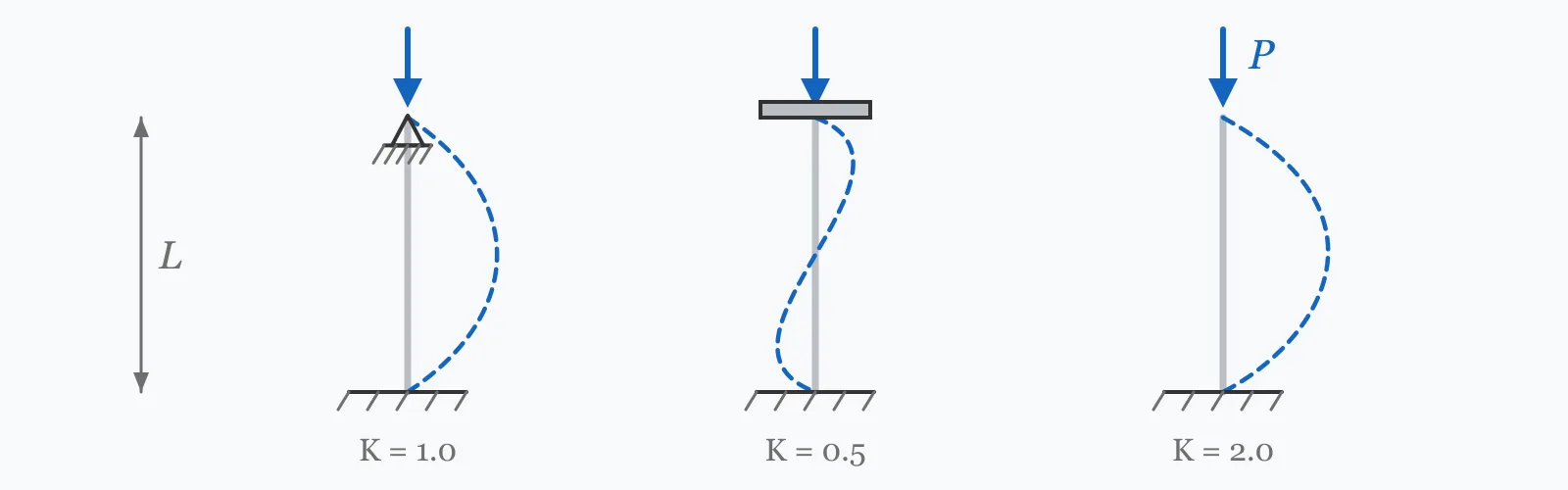
Buckling is a stiffness failure, not a strength one — a stronger steel in the same section buckles at exactly the same load. Only the end restraint moves it.
A slender column fails by buckling long before its material is crushed. The Euler critical load is Pcr = π²EI/(KL)². Enter the modulus, moment of inertia, effective length factor, length and area, and this calculator returns the critical load, the critical stress and the slenderness ratio KL/r that decides whether Euler's formula actually applies.
Use the minimum (weak-axis) value unless that axis is braced
—
See the K-factor table below for standard end conditions
m
Unbraced length about the axis being checked
mm²
Gross cross-sectional area of the member
Calculation Result
Press Calculate to get the critical buckling load, the critical stress, the effective length KL and the slenderness ratio KL/r. Read the slenderness ratio first — it tells you whether Euler's elastic formula governs.
Step-by-Step Solution
Preliminary design aid. Results follow the published formulas cited
below and are intended for estimating, study and early design. Final design must be
verified by a licensed Professional Engineer against the code in force for your project.
Key Benefits
✓Returns critical load, critical stress, effective length and slenderness in one pass
✓Flags when critical stress exceeds yield, meaning inelastic buckling actually governs
✓Warns on slenderness above 200, the practical limit for compression members
✓Includes the full AISC effective length factor table for the standard end conditions
✓Sensitivity chart shows how sharply capacity collapses as the column lengthens
✓Works in Metric and Imperial units, with shareable links and CSV export
What Is Column Buckling?
Column buckling is the sudden lateral deflection of a compression member at a load well below its crushing strength. Leonhard Euler solved the problem in the eighteenth century: for an ideal pin-ended column, the smallest axial load at which a bent shape becomes possible is Pcr = π²EI/L². Below that load the column returns to straight when disturbed; at it, the straight shape stops being stable and any imperfection grows without bound. Real end conditions are handled by replacing L with an effective length KL — the length of the equivalent pin-ended column that buckles at the same load.
Why slenderness decides everything
Dividing the critical load by the area gives the critical stress, σcr = π²E/(KL/r)², where r = √(I/A) is the radius of gyration. Everything about the column's geometry collapses into the single dimensionless number KL/r. A stocky column with a low slenderness ratio reaches yield stress before it can buckle and simply squashes; a slender one buckles elastically while the steel is nowhere near yield. The formula is meaningful only in the second case.
Where Euler stops being valid
If the calculator returns a critical stress higher than the material's yield strength, the column cannot reach that stress and Euler's result is fictitious. Real columns also carry residual rolling stresses and an initial out-of-straightness of roughly L/1000, which cause yielding to start early and reduce capacity in the intermediate range. AISC 360 handles this by splitting at KL/r = 4.71√(E/Fy) — about 113 for 345 MPa steel — using an inelastic curve below that and 0.877 times the Euler load above it.
Formula
P_cr = π²EI / (KL)²
Euler critical buckling load for an ideal elastic column of effective length KL
Related Formulas
σ_cr = π²E / (KL/r)²
r = √(I / A)
KL/r ≥ 4.71√(E/F_y)
Variable Definitions
Symbol
Variable
Unit
Description
P_cr
Critical Buckling Load
kN
Axial load at which the straight configuration ceases to be stable.
E
Modulus of Elasticity
GPa
Material stiffness. 200 GPa for all structural steels — strength grade does not enter the formula.
I
Moment of Inertia
×10⁶ mm⁴
Second moment of area about the buckling axis. Use the minimum value unless the weak axis is braced.
K
Effective Length Factor
—
Multiplier converting real length to the equivalent pin-ended length. 1.0 pinned, 0.65 fixed-fixed, 2.10 for a cantilever.
L
Unbraced Length
m
Distance between points of lateral restraint about the axis considered.
A
Cross-Sectional Area
mm²
Gross area, used to convert critical load into critical stress and to compute the radius of gyration.
KL/r
Slenderness Ratio
—
The dimensionless measure of buckling susceptibility. AISC recommends keeping it at or below 200.
How to Use This Calculator
Choose the axis you are checkingA column buckles about whichever axis gives the lowest capacity. Unless the weak axis is braced, use the minimum moment of inertia — for an I-section that is I_y, which can be an order of magnitude below I_x.
Enter the unbraced length for that axisLength runs between points of effective lateral restraint, not between floors. A column braced at mid-height about its weak axis has half the unbraced length in that direction.
Select the effective length factorTake K from the table below. Where a connection is nominally fixed but not detailed to develop full moment, use the recommended design value rather than the theoretical one — AISC gives 0.65 for fixed-fixed rather than 0.50.
Enter the modulus and the gross areaModulus is 200 GPa for all steel grades. Area is used for the radius of gyration and critical stress, so use the gross section rather than a net area.
Read the slenderness ratio before the loadIf KL/r is below roughly 113 for 345 MPa steel, inelastic buckling governs and the Euler load overstates real capacity. If critical stress comes out above yield, treat the result as a theoretical upper bound only.
Worked Examples
Example 1
A steel column 4.0 m long is pinned at both ends (K = 1.0). The section has I = 12.1 ×10⁶ mm⁴ about the weak axis and a gross area of 2,860 mm², in 355 MPa steel with E = 200 GPa. Find the Euler critical load.
Step-by-Step Solution
Effective length: KL = 1.0 × 4.0 m = 4,000 mm
Convert: E = 200 GPa = 200,000 MPa; I = 12.1 ×10⁶ = 12,100,000 mm⁴
Check: σcr of 522 MPa is well above the 355 MPa yield strength, and KL/r = 61.5 is below the AISC threshold of about 113 — so the column yields before it can buckle elastically. Inelastic buckling governs and the true capacity is lower than this Euler value.
Example 2
The same section, but the column is now 9.0 m long instead of 4.0 m. This moves it out of the inelastic range and into genuine Euler territory.
Check: σcr of 103 MPa is far below yield and KL/r = 138.4 exceeds the 113 threshold, so elastic buckling genuinely governs and the Euler result is meaningful.
Note the scaling: length rose by a factor of 2.25 and capacity fell by 2.25² = 5.06, from 1,493 kN to 295 kN. Length is by far the most powerful variable.
Length Sensitivity
Critical load falls with the square of length, so the curve drops steeply and then flattens into a long tail. Sweep the column length while holding the section constant to see how quickly capacity disappears. The marker shows your current length.
Critical Buckling Load (P_cr) vs Column Length (L)
Recomputed live from your inputs. The marker shows your current value.
Line chart of Critical Buckling Load (P_cr) against Column Length (L). The same
values are listed in the data table below.
Values plotted above, sampled across the column length (l) range.
How to Interpret Your Results
The slenderness ratio KL/r is the number that decides how to read everything else. It sorts columns into three regimes — stocky members that crush, intermediate members that fail inelastically, and slender members that buckle elastically as Euler predicted.
Slenderness Ratio (KL/r): < 25Stocky member — buckling does not govern
A slenderness ratio of your result is very low. This member is short enough to fail by material crushing rather than by buckling, and the Euler load is not the governing check. Verify the squash load, A × Fy, instead.
Slenderness Ratio (KL/r): 25 – 113Intermediate range — inelastic buckling governs
A slenderness ratio of your result falls below the AISC 360 threshold of about 113 for 345 MPa steel, so failure occurs after partial yielding. The Euler load overstates real capacity here; use the inelastic column curve of AISC 360 §E3 or the equivalent Eurocode 3 buckling curve.
Slenderness Ratio (KL/r): 113 – 200Slender member — Euler governs
A slenderness ratio of your result sits in the elastic range where Euler's formula genuinely applies. AISC still applies a 0.877 reduction to account for initial out-of-straightness, so take 0.877 × Pcr as the design basis.
Slenderness Ratio (KL/r): ≥ 200Beyond the practical slenderness limit
A slenderness ratio of your result exceeds 200, the limit AISC recommends for compression members. Capacity is so low that the member is vulnerable to damage in handling and erection, and small imperfections dominate behaviour. Brace it, shorten it, or use a stiffer section.
Common Mistakes to Avoid
Using the strong-axis moment of inertia
Why it matters:A column buckles about the axis that offers least resistance. For an I-section, I_y can be five to fifteen times smaller than I_x, so using I_x can overstate capacity by an order of magnitude.
✓How to avoid it:Use the minimum moment of inertia unless the weak axis is genuinely braced. Where bracing differs by axis, check both KL/r ratios and take the larger.
Expecting a higher steel grade to raise buckling capacity
Why it matters:The Euler formula contains E and I but no strength term. All structural steels have E ≈ 200 GPa, so switching from S275 to S460 changes elastic buckling capacity by nothing.
✓How to avoid it:Increase I — a larger or hollower section — or reduce the effective length by adding bracing. Grade only helps stocky members governed by yielding.
Applying Euler's formula to a stocky column
Why it matters:When the calculated critical stress exceeds yield, the column cannot reach it. The result is a mathematical artefact, and treating it as capacity is unconservative by a wide margin.
✓How to avoid it:Compare critical stress against yield strength. If it is higher, the column is governed by yielding or inelastic buckling; use the code column curve instead.
Using theoretical K values for real connections
Why it matters:The theoretical K of 0.5 for fixed-fixed assumes perfect rotational restraint that bolted and welded joints do not deliver. Real capacity falls short of the theoretical prediction.
✓How to avoid it:Use the recommended design values from AISC Commentary Table C-A-7.1: 0.65 for fixed-fixed, 0.80 for fixed-pinned, 2.10 for a cantilever.
Measuring length between floors rather than between braces
Why it matters:Effective length runs between points of lateral restraint. Using storey height when a mid-height brace exists doubles the assumed length and cuts calculated capacity to a quarter.
✓How to avoid it:Identify the restraint points for each axis separately and measure the unbraced length between them for the axis being checked.
Practical Applications
▸Preliminary sizing of steel columns and struts in braced frames
▸Checking scaffold standards and shoring legs against buckling
▸Verifying truss compression chords and web members
▸Sizing bracing members and tie rods loaded in compression
▸Assessing slender masonry and concrete piers
▸Checking machine push rods, jacks and screw columns
Industry Use Cases
Steel building construction
During scheme design, engineers run the slenderness check across candidate sections before any analysis. A KL/r above 120 usually signals that adding bracing will be cheaper than upsizing every column in the grid.
Temporary works and falsework
Shoring legs are governed almost entirely by buckling, and their effective length depends on how often lacing is provided. Adjusting brace spacing is the primary design lever, since halving the unbraced length quadruples capacity.
Mechanical and plant design
Hydraulic cylinder rods, jack screws and push rods are slender compression members where buckling, not material strength, sets the stroke limit. Vendors publish capacity curves derived directly from the Euler expression.
Expert Tips
💡Halving the unbraced length quadruples capacity — bracing is almost always cheaper than a bigger section.
💡Hollow sections are efficient in compression because they push area away from the centroid in both directions, giving a high r for a given weight.
💡Compare KL/r about both axes and design for the larger value; the two are often governed by different bracing arrangements.
💡Keep slenderness below about 120 in building columns to stay clear of the steepest part of the capacity curve.
💡When critical stress lands near yield, small changes in length shift the governing failure mode entirely — check both.
💡Record the assumed K factor on the calculation. Most disagreements about column capacity are really disagreements about end restraint.
Advantages & Limitations
Advantages
✓A single closed-form expression covering all elastic buckling cases
✓Reduces geometry to one dimensionless number, KL/r, comparable across sections
✓Provides an upper-bound check fast enough to use while sizing
✓Underpins the column curves in AISC 360 and Eurocode 3, so results are consistent with code methods
✓Needs only section properties available from standard tables
Limitations
!Valid only in the elastic range — invalid whenever critical stress exceeds yield
!Assumes a perfectly straight, concentrically loaded, prismatic member
!Ignores residual stresses from rolling and welding, which reduce intermediate-slenderness capacity
!Takes no account of initial out-of-straightness, typically around L/1000 in practice
!Does not cover torsional or flexural-torsional buckling, which can govern for thin-walled and singly-symmetric sections
!Assumes idealised end restraint that real connections only approximate
Effective Length Factors by End Condition
The K factor converts real length into the equivalent pin-ended length. Theoretical values assume perfect restraint; the recommended values allow for the flexibility of real connections and are what design codes expect you to use.
Effective length factors after AISC 360 Commentary Table C-A-7.1. Capacity ratios are computed from the recommended values as 1/K².
Pcr = π²EI/(KL)², where E is the modulus of elasticity, I the moment of inertia about the buckling axis, L the unbraced length and K the effective length factor. It gives the axial load at which an ideal elastic column stops being stable in its straight configuration.
What is a good slenderness ratio for a column?
AISC recommends keeping KL/r at or below 200 for compression members, and most building columns fall between 40 and 120. Below about 25 the member is stocky and crushes rather than buckles; above 200 it is too fragile to handle safely during erection.
Does Euler's formula apply to short columns?
No. It assumes elastic behaviour, so it is valid only while critical stress stays below yield. For a short column the formula returns a stress the material can never reach, and the real failure mode is crushing or inelastic buckling. Compare σcr against Fy before trusting the result.
How do I choose the effective length factor K?
K depends on rotational and translational restraint at each end. Use 1.0 for pinned-pinned, 0.65 for fixed-fixed, 0.80 for fixed-pinned and 2.10 for a cantilever. For columns in unbraced frames K exceeds 1.0 and is normally found from an alignment chart or a buckling analysis.
Why does buckling capacity drop so fast with length?
Capacity is inversely proportional to the square of effective length, so doubling the length quarters the critical load. This is why adding a single mid-height brace, which halves the unbraced length, quadruples capacity — usually far cheaper than upsizing the section.
What is the radius of gyration?
r = √(I/A), a length describing how far the cross-sectional area is spread from the bending axis. It combines area and moment of inertia into the single dimension needed to form the slenderness ratio KL/r.
Which axis does a column buckle about?
The one with the higher slenderness ratio, usually the weak axis with the smaller radius of gyration. If bracing differs between axes, the governing direction may be the strong axis with a longer unbraced length, so check both.
Does a higher steel grade increase buckling resistance?
Not for slender columns. Elastic buckling depends on stiffness, and all structural steels share a modulus of about 200 GPa. Grade only helps stocky members whose capacity is set by yielding. For slender members, add stiffness or reduce effective length.
What is inelastic buckling?
Failure in the intermediate slenderness range, where yielding begins in the most stressed fibres — helped along by residual stresses — before the elastic critical load is reached. Codes handle it with an empirical curve, such as the 0.658^(Fy/Fe) expression in AISC 360 §E3.
How do residual stresses affect column capacity?
Hot rolling and welding leave locked-in stresses that can reach 30% of yield. They cause parts of the section to yield early under load, reducing effective stiffness and lowering capacity in the intermediate range — which is why code curves sit below the Euler line there.
Glossary
Buckling
A stability failure in which a compression member deflects laterally at a load below its material crushing strength.
Critical load (Pcr)
The axial load at which the straight configuration of a column ceases to be stable.
Effective length (KL)
The length of an equivalent pin-ended column that buckles at the same load as the real member with its actual end restraints.
Effective length factor (K)
The multiplier applied to real length to obtain effective length, determined by end restraint conditions.
Slenderness ratio (KL/r)
Effective length divided by radius of gyration; the dimensionless measure of a column's susceptibility to buckling.
Radius of gyration (r)
The quantity √(I/A), describing how far cross-sectional area is distributed from the bending axis.
Elastic buckling
Buckling that occurs while the material remains fully elastic — the regime Euler's formula describes.
Inelastic buckling
Buckling at intermediate slenderness after partial yielding has begun, requiring an empirical code curve rather than Euler's expression.
Residual stress
Self-equilibrating stress locked into a section by uneven cooling during rolling or welding, which lowers buckling capacity.
Squash load
The load A × Fy at which a column would fail purely by material yielding — the upper bound for very stocky members.
Scientific & Standards References
AISC 360-22 §E3 — Flexural Buckling of Members without Slender Elements — American Institute of Steel Construction
AISC 360 Commentary Table C-A-7.1 — Approximate Values of Effective Length Factor K — American Institute of Steel Construction
EN 1993-1-1 §6.3.1 — Buckling resistance of uniform members in compression — CEN
Timoshenko, S. P. & Gere, J. M., Theory of Elastic Stability, 2nd Edition — McGraw-Hill
Galambos, T. V. (ed.), Guide to Stability Design Criteria for Metal Structures, 6th Edition — Structural Stability Research Council / Wiley
Gere, J. M. & Goodno, B. J., Mechanics of Materials, 9th Edition — Chapter 11: Columns — Cengage Learning
Conclusion
Euler's expression Pcr = π²EI/(KL)² gives the elastic critical load of a column, but the slenderness ratio KL/r decides whether that number means anything. Below roughly 113 for 345 MPa steel the member fails inelastically and the Euler load is an overestimate; above it, elastic buckling genuinely governs and codes apply a modest reduction for out-of-straightness. Because capacity falls with the square of effective length and the formula contains no strength term, the effective design levers are bracing and section stiffness — not steel grade.
Try your own section above, then sweep the length in the chart to find where your column crosses from crushing into buckling.