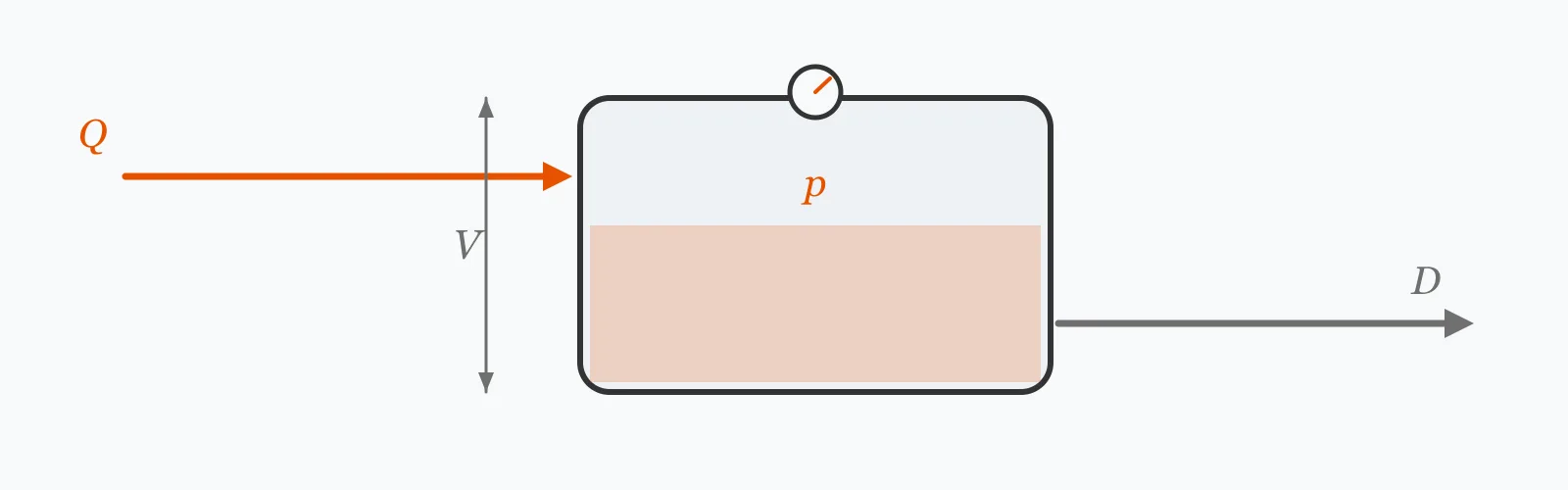
A receiver stores air between the cut-out and cut-in pressures, and that stored volume determines how often the compressor starts. Enter the receiver volume, the pressure band, the compressor's free air delivery and the demand to get the stored free air, the pump-up time, the starts per hour and the duty cycle.
Calculator
Units:
L
Physical volume of the air receiver
bar
Gauge pressure at which the compressor restarts
bar
Gauge pressure at which the compressor stops
L/min
Actual delivery at the outlet, not the swept volume
L/min
Average free air consumption of the connected equipment
Calculation Result
Press Calculate for the free air stored in the pressure band, the time to pump up, the resulting starts per hour, and the duty cycle. Starts per hour is usually the governing criterion.
Step-by-Step Solution
Preliminary design aid. Results follow the published formulas cited
below and are intended for estimating, study and early design. Final design must be
verified by a licensed Professional Engineer against the code in force for your project.
Key Benefits
✓Works in free air, which is how compressor capacity is actually rated
✓Reports starts per hour, the criterion that usually sizes the receiver
✓Shows the duty cycle, which decides the compressor type
✓Warns when demand exceeds delivery, where a receiver cannot help
✓Sensitivity chart shows the cycling peak at half capacity
✓Shareable links and CSV export for design records
What Is Air Receiver Sizing?
An air receiver is a pressure vessel storing compressed air between the compressor and the demand. It does three things: it buffers short peaks so the compressor need not be sized for them, it lengthens the compressor's on and off periods so the motor starts less often, and it allows moisture and oil carryover to settle out. Its useful capacity is not its physical volume but the free air stored between the cut-out and cut-in pressures.
Why stored air is more than the receiver volume
A 270 litre receiver working between 6 and 8 bar gauge holds far more than 270 litres of usable air, because the air is compressed. The difference of 2 bar over atmospheric pressure means the receiver stores 270 × 2 / 1.013 = 533 litres of free air — nearly twice its physical volume. Widening the pressure band stores proportionally more, which is the cheapest way to reduce cycling if the system tolerates the lower cut-in pressure.
Why cycling peaks at half capacity
The cycle has two halves: the receiver drains at the demand rate, then refills at the difference between delivery and demand. Total cycle time is S/d + S/(F−d), which is smallest when d(F−d) is largest — and that product peaks at exactly d = F/2. So a compressor running at 50% duty starts more often than one at either 20% or 80%. Verified on the default receiver, 200 and 300 L/min demand both give 13.5 starts an hour, while 100 and 400 both give 9.0.
Formula
V_free = V_receiver · (p_max − p_min) / 1.013
Free air stored between cut-out and cut-in, from gauge pressures in bar
Related Formulas
t_draw = V_free / demand
t_fill = V_free / (FAD − demand)
starts/hour = 60 / (t_draw + t_fill)
duty = demand / FAD
Variable Definitions
Symbol
Variable
Unit
Description
V
Receiver Volume
L
Physical volume of the pressure vessel.
p_min
Cut-In Pressure
bar
Gauge pressure at which the compressor restarts.
p_max
Cut-Out Pressure
bar
Gauge pressure at which it stops.
FAD
Free Air Delivery
L/min
What the compressor actually delivers, typically 20 to 30% below its displacement.
demand
Air Demand
L/min
Average free air consumed by the tools and equipment.
V_free
Stored Free Air
L
Usable air in the pressure band, larger than the receiver volume.
How to Use This Calculator
Use free air delivery, not displacementFAD is what the compressor actually delivers at the outlet, and it is typically 20 to 30% below the swept volume because of clearance volume, valve losses and heating. Sizing on displacement overstates capacity by roughly that margin.
Use the average demand, not the peakThe receiver exists precisely to buffer peaks. Sizing the compressor on the instantaneous peak of every tool running together leads to a machine that spends most of its life unloaded, which wastes energy continuously.
Set the pressure band as wide as the system toleratesStored air is proportional to the difference between cut-out and cut-in. Widening the band from 6–8 bar to 5.5–8.5 bar stores 50% more air and cuts the cycling proportionally, for no extra vessel cost — provided the lowest tool still works at the cut-in pressure.
Check starts per hour, not just capacitySix to ten starts an hour is the usual limit for a direct-on-line compressor motor. This is what normally sizes the receiver, and a compressor with ample capacity can still be badly served by a receiver that is too small.
Remember the worst cycling is at half loadThe cycling rate peaks when demand is half the delivery, so check that condition rather than the maximum demand. A system that cycles acceptably at full load may cycle excessively at half.
Worked Examples
Example 1
A 270 litre receiver working between 6 and 8 bar, fed by a compressor delivering 500 L/min free air, against an average demand of 300 L/min.
That is nearly twice the receiver's physical volume, because the air is compressed
Draw-down time: 533 / 300 = 1.78 min from cut-out to cut-in
Net refill rate: 500 − 300 = 200 L/min, since demand continues while the compressor runs
Pump-up time: 533 / 200 = 2.67 min
Cycle time: 1.78 + 2.67 = 4.44 min, so 60/4.44 = 13.5 starts per hour
Duty cycle: 300/500 = 60%
Interpretation: 13.5 starts an hour exceeds the six to ten usually permitted. The compressor has ample capacity at 60% duty — the receiver is the problem, not the machine.
Example 2
The same compressor and receiver at different demands, which reveals where the worst cycling actually occurs.
Step-by-Step Solution
At 100 L/min demand (20% duty): 9.0 starts per hour
At 200 L/min (40% duty): 13.5 starts per hour
At 300 L/min (60% duty): 13.5 starts per hour
At 400 L/min (80% duty): 9.0 starts per hour
At 450 L/min (90% duty): 5.1 starts per hour
The pattern is symmetric about 250 L/min — exactly half the compressor's 500 L/min delivery. The 200 and 300 cases give an identical 13.5, and so do the 100 and 400 cases at 9.0.
This falls straight out of the arithmetic. Cycle time is S/d + S/(F−d), which simplifies to S·F/(d(F−d)). Minimising it means maximising d(F−d), and that product peaks at d = F/2.
The practical consequence is that checking the maximum demand is checking the wrong case. A system that cycles nine times an hour at full load may cycle fourteen times at half load, and half load is where most compressed air systems spend their time.
Doubling the receiver to 540 litres halves the cycling everywhere on that curve, because stored air is directly proportional to volume. It is usually cheaper than any other remedy.
Demand Sensitivity
Starts per hour rise to a peak and then fall away, because the cycle time is smallest when demand is exactly half the delivery. This is the single most useful shape on the page — the worst cycling case is not the busiest one. The marker shows your current demand.
Starts per Hour vs Air Demand
Recomputed live from your inputs. The marker shows your current value.
Line chart of Starts per Hour against Air Demand. The same
values are listed in the data table below.
Values plotted above, sampled across the air demand range.
How to Interpret Your Results
Starts per hour is the criterion that normally governs. The duty cycle decides the compressor type, and the two are related in a way that is easy to get backwards.
Starts per Hour: < 6Comfortable cycling
At your result starts per hour the motor has ample time to cool between runs. The receiver is generously sized for this duty, which also means smoother pressure and better moisture separation.
Starts per Hour: 6 – 10Within the usual limit
At your result starts per hour the compressor is within the six to ten usually permitted for a direct-on-line motor. Check the half-load condition too, since that is where cycling peaks rather than at the current demand.
Starts per Hour: 10 – 20Cycling too frequently
At your result starts per hour the motor is starting more often than most manufacturers allow. Each start draws heavy inrush and the motor has limited capacity to shed that heat. A larger receiver or a wider pressure band both help, and both are cheaper than a larger compressor.
Starts per Hour: ≥ 20Excessive cycling
At your result starts per hour the motor will overheat and contactors will wear rapidly. The receiver is substantially undersized for this duty. Stored air is directly proportional to volume, so doubling the receiver halves the cycling.
Duty Cycle: ≥ 75High duty cycle
At your result% duty there is little margin for demand growth or for a compressor running below its rated output as it ages. Piston compressors are commonly rated for 60 to 75% duty and need the remainder to cool; a screw compressor is designed to run continuously.
Duty Cycle: < 25Compressor oversized
At your result% duty the compressor is substantially larger than the demand requires. That costs energy continuously, because an unloaded compressor still consumes a significant fraction of its full-load power rather than nothing.
Common Mistakes to Avoid
Sizing on displacement instead of free air delivery
Why it matters:Displacement is the swept volume of the cylinders; FAD is what actually reaches the outlet after clearance volume, valve losses and heating are accounted for. The gap is typically 20 to 30%.
✓How to avoid it:Use FAD, which reputable manufacturers state to a recognised standard. A compressor quoted only in displacement is quoting the more flattering number.
Checking cycling only at maximum demand
Why it matters:Cycling peaks at half the compressor's delivery, not at full load. In the example above, 400 L/min gives 9.0 starts an hour while 250 would give the maximum — so the busiest condition is not the worst one.
✓How to avoid it:Check the half-capacity case explicitly. It is the governing condition for receiver sizing and it is easy to miss.
Expecting a receiver to fix an undersized compressor
Why it matters:A receiver buffers peaks; it does not create air. If average demand exceeds free air delivery, the receiver empties and system pressure falls regardless of how large it is.
✓How to avoid it:Compare average demand against FAD first. A receiver only helps where the compressor can meet the average and the problem is the peaks or the cycling.
Setting too narrow a pressure band
Why it matters:Stored air is proportional to the difference between cut-out and cut-in. A 1 bar band stores half what a 2 bar band does, and doubles the cycling for the same receiver.
✓How to avoid it:Widen the band as far as the lowest-pressure tool permits. It is the cheapest available remedy for excessive cycling, costing nothing but a pressure switch adjustment.
Ignoring what oversizing costs
Why it matters:An unloaded compressor still draws a substantial fraction of its full-load power — often 20 to 40% for a screw machine. Oversizing therefore wastes energy continuously, not just at peak.
✓How to avoid it:Size to the actual average demand and use the receiver for peaks. Where demand varies widely, a variable speed compressor follows it instead of loading and unloading.
Overlooking leakage in the demand figure
Why it matters:Leakage is commonly 20 to 30% of total consumption in an established compressed air system, and it runs continuously including outside working hours. A demand figure derived from tool ratings alone omits it entirely.
✓How to avoid it:Measure the actual consumption, or run the compressor with all tools isolated to quantify the leak rate. Fixing leaks is almost always cheaper than compressing air to replace them.
Practical Applications
▸Sizing an air receiver for a compressed air system
▸Checking compressor cycling against motor start limits
▸Assessing whether a compressor is correctly sized for its demand
▸Evaluating the effect of widening the pressure band
▸Estimating stored air for peak demand events
▸Comparing receiver options during a system upgrade
Industry Use Cases
Workshop and general industry
Receivers are sized primarily to limit motor starts rather than to store air, because the compressor usually has ample capacity for the average demand. Widening the pressure band is the first remedy tried, since it costs nothing and stored air scales directly with it.
Manufacturing plant
Large systems use multiple compressors staged to follow demand, with one variable speed machine trimming and the rest running fully loaded or off. This avoids both the cycling problem and the energy cost of running machines unloaded.
Energy management
Compressed air is one of the most expensive utilities per unit of useful work, and leakage of 20 to 30% is common in established systems. Leak surveys and pressure reduction typically deliver larger savings than any change to the compressor itself.
Expert Tips
💡Stored free air is roughly twice the receiver volume at a 2 bar band.
💡Cycling peaks at exactly half the compressor's delivery, not at full load.
💡Six to ten starts an hour is the usual limit for a direct-on-line motor.
💡Stored air scales directly with both receiver volume and pressure band.
💡FAD is 20 to 30% below displacement — use the former.
💡Leakage is commonly 20 to 30% of total consumption and runs continuously.
Advantages & Limitations
Advantages
✓Works in free air, matching how compressors are rated
✓Reports starts per hour, which is the criterion that usually governs
✓Makes the half-load cycling peak visible rather than leaving it to be discovered
✓Warns when a receiver cannot help because the compressor is undersized
✓Fast enough to compare receiver sizes and pressure bands during design
Limitations
!Assumes a steady average demand rather than a realistic varying profile
!Uses isothermal expansion, ignoring the heating that occurs during compression
!Takes no account of pipework volume, which adds to the effective storage
!Does not model unloaded running, which many compressors use instead of stopping
!Assumes a simple load-unload control rather than variable speed
!Ignores pressure drop between receiver and point of use
!Does not address moisture, filtration or air quality requirements
Where the Cycling Peak Falls
A 270 litre receiver at a 6–8 bar band, with a 500 L/min compressor. Demand rises down the table but the starts per hour rise, peak and fall — symmetrically about half capacity.
270 L receiver, 6–8 bar, 500 L/min FAD, 533 L stored free air. The 200 and 300 rows give an identical 13.5 starts per hour, and so do the 100 and 400 rows at 9.0 — the curve is symmetric about 250 L/min, where the two halves of the cycle are equal. Checking only the maximum demand would miss the worst case entirely.
Work out the free air stored in the pressure band, V × (p_max − p_min)/1.013, then check the resulting starts per hour against the motor's limit. Receivers are usually sized by cycling rather than by capacity.
How much air does a receiver actually store?
More than its volume, because the air is compressed. A 270 litre receiver between 6 and 8 bar stores 533 litres of free air — nearly twice its physical size.
How many starts per hour can a compressor motor take?
Six to ten for a direct-on-line motor. Each start draws heavy inrush current, and the motor has limited thermal capacity to shed that heat before the next one.
Why does cycling peak at half load?
Because cycle time is S/d + S/(F−d), which simplifies to S·F/(d(F−d)). That is smallest when d(F−d) is largest, and the product peaks at exactly half the delivery.
What is free air delivery?
The volume of atmospheric air the compressor actually delivers at its outlet, typically 20 to 30% below the swept volume because of clearance, valve losses and heating.
Will a bigger receiver fix low pressure?
Only if the compressor can meet the average demand. A receiver buffers peaks but does not create air — if demand exceeds delivery, pressure falls no matter how large the vessel is.
How does the pressure band affect cycling?
Directly. Stored air is proportional to the difference between cut-out and cut-in, so doubling the band halves the cycling rate. Widening it is the cheapest remedy available.
What duty cycle can a compressor sustain?
Piston compressors are commonly rated for 60 to 75% and need the remainder to cool. Screw compressors are designed to run continuously and are the better choice above that level.
Does an unloaded compressor use much energy?
Yes — often 20 to 40% of full-load power for a screw machine. This is why oversizing costs energy continuously, and why variable speed control pays back well on varying demand.
How much air do leaks waste?
Commonly 20 to 30% of total consumption in an established system, running continuously including outside working hours. A leak survey usually saves more than any change to the compressor.
Glossary
Air receiver
A pressure vessel storing compressed air between the compressor and the demand.
Free air delivery
Atmospheric-equivalent volume actually delivered at the compressor outlet.
Displacement
Swept volume of the compressor cylinders, higher than free air delivery.
Cut-in pressure
The pressure at which the compressor restarts.
Cut-out pressure
The pressure at which the compressor stops.
Duty cycle
The fraction of time or capacity the compressor is working.
Pump-up time
Time to refill the receiver from cut-in to cut-out while demand continues.
Load-unload control
Running the compressor continuously but venting when pressure is reached, instead of stopping.
Pressure band
The difference between cut-out and cut-in, which sets the stored air.
Leak rate
Continuous air loss from the distribution system, commonly 20 to 30% of consumption.
Scientific & Standards References
ISO 1217 — Displacement compressors: Acceptance tests (definition of free air delivery) — International Organization for Standardization
EN 286-1 — Simple unfired pressure vessels designed to contain air or nitrogen — CEN
Compressed Air and Gas Institute — Compressed Air and Gas Handbook — Compressed Air and Gas Institute
US Department of Energy — Improving Compressed Air System Performance: A Sourcebook for Industry — US Department of Energy
ISO 8573-1 — Compressed air: Contaminants and purity classes — International Organization for Standardization
Conclusion
An air receiver is sized by how often the compressor starts, not by how much air it holds. The stored volume is the useful quantity — 533 litres of free air in a 270 litre vessel at a 2 bar band, nearly twice the physical size — and it scales directly with both the volume and the width of the pressure band, which makes widening the band the cheapest remedy for excessive cycling. The result worth carrying away is where the worst case falls. Cycling peaks at exactly half the compressor's delivery, and the table above shows the curve symmetric about that point: 200 and 300 L/min both give 13.5 starts an hour, 100 and 400 both give 9.0. Checking only the maximum demand therefore checks the wrong condition, and since most compressed air systems spend their time somewhere near half load, that is the condition they actually live in.
Enter your receiver, pressure band and demand above to check the cycling rate.