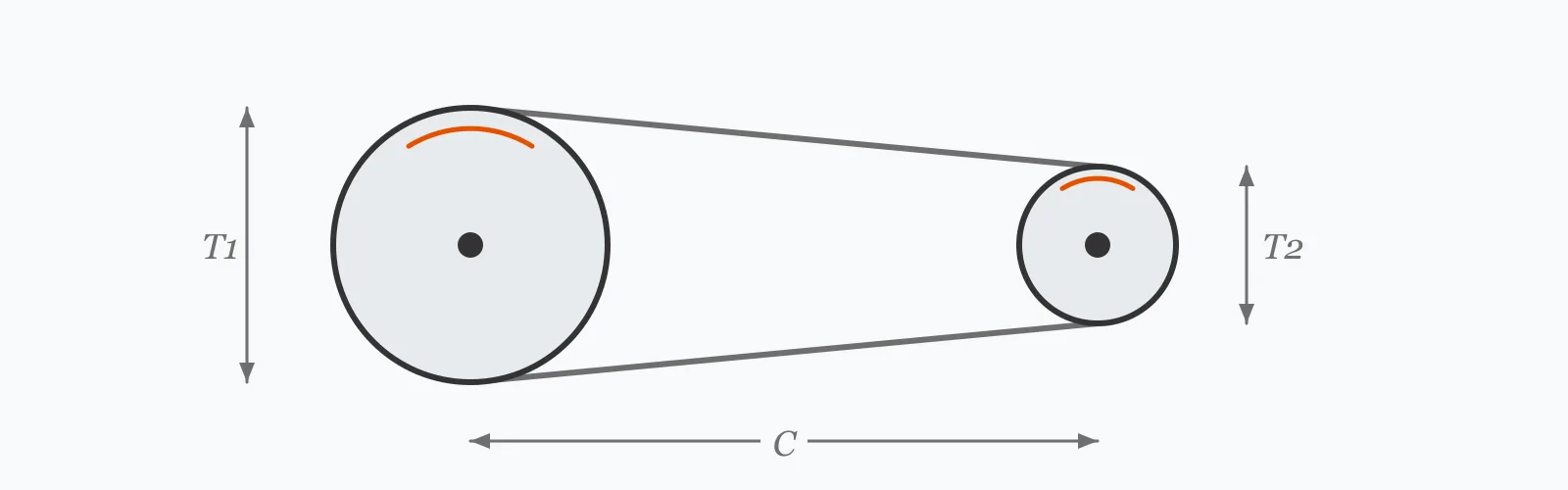
The force transmitting power is simply P/v, but it divides between a tight and a slack side according to the capstan equation. Enter the power, belt speed, number of belts, arc of contact and groove angle to get the effective tension, both side tensions and the resultant load imposed on the shafts.
Calculator
Units:
kW
Design power including any service factor
m/s
Surface speed. Standard V-belts run 5 to 30 m/s
Belts sharing the load in a multi-groove drive
°
Wrap on the smaller pulley. 180° for equal pulleys, less as the ratio grows
°
Included V-groove angle. 38° is standard; 180 would model a flat belt
Calculation Result
Press Calculate for the effective tension transmitting the power, the tight and slack side tensions at the point of incipient slip, and the resultant static load on the shafts.
Step-by-Step Solution
Preliminary design aid. Results follow the published formulas cited
below and are intended for estimating, study and early design. Final design must be
verified by a licensed Professional Engineer against the code in force for your project.
Key Benefits
✓Applies the capstan equation with the V-groove wedging factor
✓Separates effective tension from the two side tensions
✓Reports the resultant shaft load, which sizes the bearings
✓Shows how the arc of contact changes both tension and shaft load
✓Sensitivity chart shows tensions rising as wrap falls
✓Shareable links and CSV export for design records
What Is V-Belt Tension?
A belt transmits power by pulling harder on one side than the other. The difference between the two — the effective tension — is what does the work, and it equals the power divided by the belt speed. How that difference divides between a high tight-side tension and a low slack-side one depends on how much friction is available, which is set by the wrap angle and the coefficient of friction.
The V-groove multiplies the friction
A flat belt presses on the pulley with a normal force equal to its tension component. A V-belt wedges into a groove, so the same radial force produces a much larger normal force against the two flank faces — larger by 1/sin(β/2). For a standard 38° groove that is 1/sin(19°) = 3.07, so the effective coefficient of friction becomes 0.92 instead of 0.30. This is why a V-belt of modest width outperforms a much wider flat belt.
Why the arc of contact matters
The capstan equation gives T1/T2 = e^(μ'θ), so the tension ratio grows exponentially with wrap angle. More wrap means the same effective tension can be carried with a lower tight side, and therefore a lower shaft load. Reducing the arc from 180° to 120° raises the tight side by 10.5% and the shaft load by 13.1% for the same transmitted power — which is why 120° is treated as the practical minimum.
Formula
Te = P / v
Effective tension — the force difference that transmits the power
Related Formulas
μ' = μ / sin(β/2)
T1 / T2 = e^(μ'·θ)
T1 = Te · e^(μ'θ) / (e^(μ'θ) − 1)
Variable Definitions
Symbol
Variable
Unit
Description
P
Transmitted Power
kW
Power the drive must carry, including any service factor.
v
Belt Speed
m/s
Surface speed. Effective tension is inversely proportional to it.
Te
Effective Tension
N
The difference between the two side tensions, equal to P/v.
θ
Arc of Contact
°
Wrap angle on the smaller pulley. 120° is the practical minimum.
β
Groove Angle
°
Included angle of the V-groove, typically 34 to 40°.
T1, T2
Side Tensions
N
Tight and slack side tensions, whose difference is Te.
How to Use This Calculator
Include the service factor in the powerBelt drives are rated on a design power that multiplies the nominal by a service factor for the driver and driven machine — typically 1.0 to 1.8 depending on shock loading and running hours. Using the nominal power alone understates every tension in the result.
Take the arc of contact from the drive geometryIt is 180° only when the pulleys are equal, and falls as the ratio grows or the centre distance shrinks. Below 120° the friction available drops sharply and the tensions needed climb steeply.
Use the actual groove angle38° is standard for classical V-belts but small pulleys often use 34° or 36° to compensate for the belt distorting as it bends. A smaller angle wedges harder, giving more effective friction.
Read the shaft load, not just the belt tensionsThe resultant of the two side tensions is what the shaft and bearings actually carry, and it is the largest number on the page. It feeds directly into the bearing life calculation, where it acts with a cube law.
Treat the result as a minimum, not an installation settingThese tensions are the theoretical values at incipient slip. Real drives are tensioned above them so they do not operate at the slip limit, and manufacturers specify installation tension by belt deflection under a stated force.
Worked Examples
Example 1
A three-belt drive transmitting 11 kW at 15 m/s belt speed, with 165° of wrap on the small pulley and a standard 38° groove.
Across three belts: 263 N per belt on the tight side
Resultant shaft load: 843 N
Interpretation: the tension ratio of 14:1 is very high, which is the wedge effect at work. A flat belt at the same wrap would manage only about 2.4:1 and would need far higher tensions to transmit the same power.
Example 2
The same drive with the arc of contact reduced from 180° to 120° — what happens when the pulley ratio grows or the centres come closer.
Step-by-Step Solution
At 180° wrap: tight side 776 N, slack side 43 N, shaft load 819 N
At 165°: tight side 789 N, slack side 56 N, shaft load 843 N
At 140°: tight side 820 N, slack side 86 N, shaft load 887 N
At 120°: tight side 858 N, slack side 125 N, shaft load 926 N
The effective tension is 733 N in every case, because power and belt speed have not changed. Only the split between the two sides moves.
From 180° to 120° the tight side rises 10.5% and the shaft load 13.1%. That is modest in itself, but it feeds a bearing life calculation that works with a cube law — so a 13% higher load costs about 31% of the bearing's rating life.
The slack side rises much more sharply, from 43 to 125 N, because less wrap means the belt needs more residual tension to avoid slipping.
This is why 120° is treated as the practical floor. Below it the curve steepens rapidly, and the tensions needed to avoid slip start loading the shafts more than the power being transmitted justifies.
Arc of Contact Sensitivity
Effective tension is flat, since it depends only on power and speed. The tight side and the shaft load both rise as wrap falls, because less friction is available and the tensions must grow to compensate. The marker shows your current arc.
Tight Side Tension vs Arc of Contact
Recomputed live from your inputs. The marker shows your current value.
Line chart of Tight Side Tension against Arc of Contact. The same
values are listed in the data table below.
Values plotted above, sampled across the arc of contact range.
How to Interpret Your Results
The effective tension is fixed by the duty. What the drive geometry decides is how much extra tension is needed to carry it without slipping — and that surplus is what the shafts and bearings pay for.
Resultant Shaft Load: < 500Light shaft load
A resultant load of your result N is modest. At this level the belt drive is unlikely to govern the shaft or bearing sizing, and other loads on the shaft probably dominate.
A resultant load of your result N is normal for a mid-range belt drive. Feed it into the bearing life calculation, where it acts with a cube law — a 20% overtension costs about 42% of the rating life.
A resultant load of your result N will size the bearings and may govern the shaft diameter too. Check the shaft deflection and the slope at the bearings, since a belt pull applied close to a bearing is often the largest load in a machine.
Resultant Shaft Load: ≥ 15000Very high shaft load
At your result N the belt drive dominates the mechanical design of both shafts. Raising the belt speed with larger pulleys reduces the tension in direct proportion, and is usually a better answer than heavier bearings.
Slack Side Tension: ≥ 200High slack side — check the wrap
A slack side of your result N indicates limited friction is available, usually from a small arc of contact. More wrap, achieved with a larger centre distance or an idler on the slack side, would lower both tensions and the shaft load with them.
Common Mistakes to Avoid
Overtensioning the belt
Why it matters:It is the commonest installation fault. Once slip is eliminated, more tension adds nothing to the transmitted power but loads the bearings continuously — and bearing life falls with the cube of load, so a 20% overtension costs about 42% of the rating life.
✓How to avoid it:Tension to the manufacturer's figure, measured as belt deflection under a specified force. Retension after the first few hours of running, when new belts have bedded in.
Ignoring the arc of contact
Why it matters:The capstan relationship is exponential in wrap angle, so a small arc requires disproportionately higher tensions. A drive with a large ratio and short centres can need far more tension than the power alone suggests.
✓How to avoid it:Compute the actual wrap from the pulley diameters and centre distance. Keep it above 120°, using a longer centre distance or a slack-side idler if necessary.
Using the nominal power without a service factor
Why it matters:Belt drives are rated on design power, which multiplies the nominal by a factor for shock loading, running hours and the character of the driven machine. Factors of 1.4 to 1.8 are common for reciprocating or heavily shock-loaded duties.
✓How to avoid it:Apply the service factor from the manufacturer's table before entering the power. Every tension in the result scales directly with it.
Running the belt too slowly
Why it matters:Effective tension is power divided by speed, so a low belt speed means high tension for the same power. Halving the belt speed doubles every tension and the shaft load with them.
✓How to avoid it:Use larger pulleys to raise the belt speed towards the 15 to 25 m/s range, where V-belts are most effective. This is usually cheaper than adding belts or heavier bearings.
Mixing old and new belts on a multi-groove drive
Why it matters:Belts stretch in service, so a new belt beside used ones takes a disproportionate share of the load and fails early. The set does not share as the calculation assumes.
✓How to avoid it:Replace all belts in a set together, and use matched sets where the manufacturer supplies them. The per-belt figures here assume equal sharing.
Treating the calculated tensions as installation settings
Why it matters:These are the theoretical values at the point of incipient slip. A drive tensioned exactly to them would be on the verge of slipping, with no margin for load variation, belt stretch or wear.
✓How to avoid it:Use them to understand the drive and to size shafts and bearings, but set installation tension by the manufacturer's deflection method, which includes the necessary margin.
Practical Applications
▸Calculating belt tensions for a drive design
▸Determining shaft and bearing loads from a belt drive
▸Assessing the effect of reduced wrap angle
▸Comparing V-belt against flat belt performance
▸Checking whether a drive has adequate grip margin
▸Diagnosing belt slip on an existing installation
Industry Use Cases
Industrial power transmission
Belt drives are selected from manufacturer power-rating tables, but the shaft load has to be calculated separately because it feeds the bearing and shaft design. It is frequently the dominant radial load on both shafts.
Maintenance
Belt slip shows as glazing, heat and a squeal on start-up, and the reflex is to tension harder. Where the real cause is inadequate wrap or too low a belt speed, extra tension destroys bearings without curing the slip.
Machine design
Raising belt speed with larger pulleys reduces tension in direct proportion, so a drive that seems to need heavier bearings often needs bigger pulleys instead. The trade is against the space the larger pulleys occupy.
Expert Tips
💡Effective tension is simply power divided by belt speed.
💡A 38° groove multiplies the friction by 3.07 over a flat belt.
💡Keep the arc of contact above 120°; below it the tensions climb steeply.
💡Halving the belt speed doubles every tension and the shaft load.
💡Overtensioning does not improve grip once slip is eliminated — it only kills bearings.
💡Bearing life falls with the cube of load, so 20% overtension costs 42% of it.
Advantages & Limitations
Advantages
✓Applies the capstan equation with the correct V-groove wedging factor
✓Reports the shaft load, which is what sizes the bearings
✓Shows the split between tight and slack sides explicitly
✓Makes the effect of wrap angle visible rather than implicit
✓States clearly that the tensions are a minimum, not an installation setting
Limitations
!Gives tensions at the point of incipient slip, below real installation values
!Assumes a friction coefficient of 0.30 for rubber on cast iron
!Ignores centrifugal tension, which is significant above about 20 m/s
!Assumes all belts in a set share the load equally
!Does not check belt power rating, which comes from manufacturer tables
!The shaft load is static — it does not include starting or shock transients
!Does not account for belt stretch or the retensioning it requires
How Wrap Angle Changes the Tensions
11 kW at 15 m/s through a 38° groove. The effective tension never changes, because power and speed do not. Only the division between the two sides moves — and the shaft load with it.
11 kW, 15 m/s, 38° groove, three belts. From 180° to 120° the tight side rises 10.5% and the shaft load 13.1% — modest in itself, but bearing life falls with the cube of load, so that 13% costs about 31% of the rating life.
Effective tension is power divided by belt speed. The split between tight and slack sides follows the capstan equation T1/T2 = e^(μ'θ), with μ' amplified by the V-groove wedge.
Why is a V-belt better than a flat belt?
The wedge shape multiplies the normal force by 1/sin(β/2). For a 38° groove that is 3.07, so the effective friction coefficient becomes 0.92 instead of 0.30 — allowing the same power at far lower tension.
What is effective tension?
The difference between the tight and slack side tensions, which is the force actually transmitting power. It equals P/v and depends on nothing else.
What arc of contact do I need?
At least 120°. Below that the friction available falls sharply and the tensions needed climb steeply, loading the shafts more than the transmitted power justifies.
What load does a belt drive put on the shaft?
The vector resultant of the two side tensions, which for the example here is 843 N against an effective tension of 733 N. It is usually the largest radial load on both shafts.
Is overtensioning a belt harmful?
Yes. Once slip is eliminated, extra tension adds nothing to the power transmitted but loads the bearings continuously. Bearing life falls with the cube of load, so a 20% overtension costs about 42% of it.
How does belt speed affect tension?
Inversely and directly. Effective tension is P/v, so halving the speed doubles every tension. Larger pulleys raising the belt speed are often a better fix than heavier bearings.
Why do V-belt grooves use 38 degrees?
It balances the wedging benefit against the force needed to release the belt as it leaves the pulley. Smaller angles wedge harder but risk the belt jamming, and small pulleys often use 34 or 36° to allow for the belt distorting as it bends.
Should I replace all belts in a set together?
Yes. Belts stretch in service, so a new belt beside used ones carries a disproportionate share and fails early. Matched sets exist precisely to ensure equal load sharing.
How should I tension a belt in practice?
By the manufacturer's deflection method — a specified force applied at midspan producing a stated deflection. The calculated tensions here are the theoretical minimum at incipient slip, with no margin for load variation or wear.
Glossary
Effective tension
The difference between tight and slack side tensions, equal to power divided by belt speed.
Tight side
The higher-tension span of the belt, pulling the driven pulley.
Slack side
The lower-tension return span.
Capstan equation
T1/T2 = e^(μθ), relating tension ratio to wrap angle and friction.
Arc of contact
The angle over which the belt wraps the smaller pulley.
Groove angle
The included angle of the V-groove, typically 34 to 40°.
Wedging factor
1/sin(β/2), by which a V-groove multiplies the effective friction.
Service factor
A multiplier on nominal power for shock loading and running hours.
Shaft load
The vector resultant of both belt tensions, carried by the shaft and bearings.
Centrifugal tension
Additional tension from the belt's own mass at speed, significant above about 20 m/s.
Scientific & Standards References
ISO 5292 — Belt drives: V-belts and V-ribbed belts, calculation of power ratings — International Organization for Standardization
ISO 4184 — Belt drives: Classical and narrow V-belts, lengths in datum system — International Organization for Standardization
Shigley, J. E. and Mischke, C. R., Mechanical Engineering Design — Flexible Mechanical Elements — McGraw-Hill
Machinery's Handbook — Belt Drives: Tensioning and Power Rating — Industrial Press
Conclusion
A V-belt works because its wedge shape multiplies the available friction by 1/sin(β/2) — 3.07 for a standard 38° groove, turning a coefficient of 0.30 into an effective 0.92. That gives a tension ratio of 14:1 at 165° of wrap, against roughly 2.4:1 for a flat belt in the same geometry, and it is why a V-belt transmits its power at far lower tension. The force doing the work is fixed by the duty at P/v; what the geometry decides is how much surplus tension is needed to carry it without slipping, and that surplus is what the shafts and bearings pay for. The table above shows the effective tension unchanged across every wrap angle while the shaft load rises 13.1% as the arc falls from 180° to 120° — which sounds small until it meets a bearing life calculation working with a cube law, where it costs about 31% of the rating life. The same arithmetic condemns overtensioning: past the point where slip stops, extra tension buys nothing and costs bearings.
Enter your power, belt speed and wrap angle above to get the tensions and the shaft load.