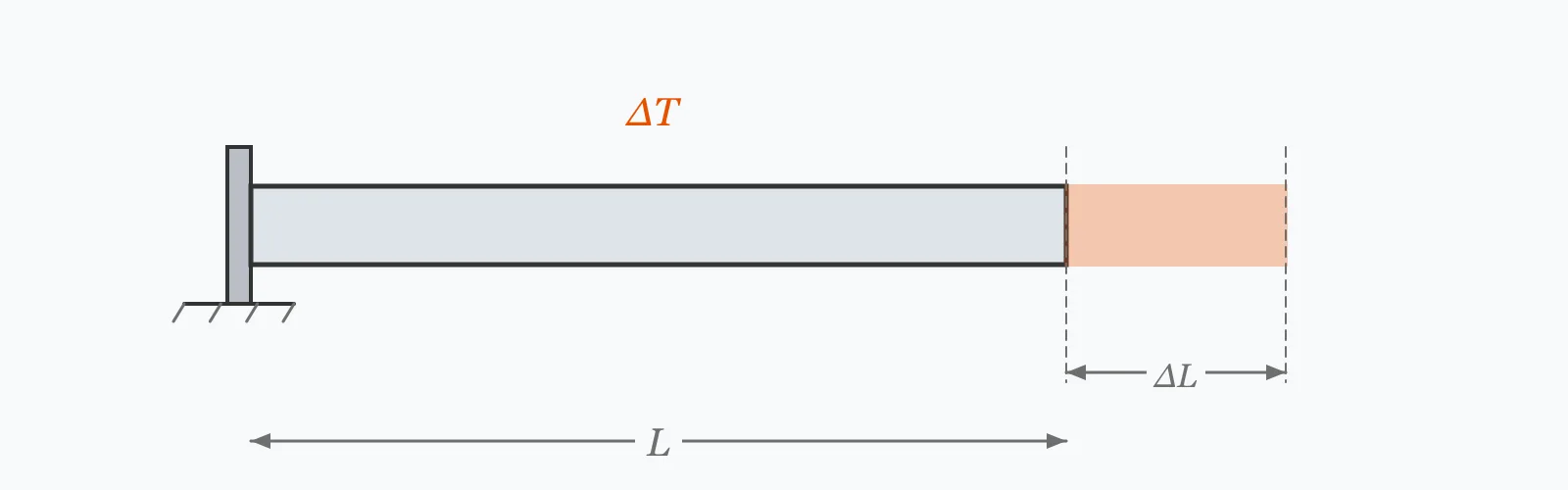
A free member changes length by ΔL = α·L·ΔT. A fully restrained one cannot, and instead develops a stress σ = E·α·ΔT that is completely independent of its length. Enter the expansion coefficient, length, temperature change and modulus to get both — and to see why a short restrained member is just as stressed as a long one.
Length between fixed points at the reference temperature
°C
Full design range, not the average temperature
GPa
Steel 200, aluminium 69, copper 110, concrete 30
Calculation Result
Press Calculate for the length change, the final length, the thermal strain and the stress that would develop under full restraint. The two extremes are free expansion with no stress, and full restraint with no movement — real details fall between them.
Step-by-Step Solution
Preliminary design aid. Results follow the published formulas cited
below and are intended for estimating, study and early design. Final design must be
verified by a licensed Professional Engineer against the code in force for your project.
Key Benefits
✓Returns both the free movement and the fully restrained stress
✓Makes explicit that restrained stress is independent of member length
✓Reports thermal strain in microstrain, the form gauges measure in
✓Warns automatically above 200 MPa, where expansion provision becomes essential
✓Includes expansion coefficients for the common engineering materials
✓Shareable links and CSV export for design records
What Is Thermal Expansion?
Almost all materials expand when heated, because rising temperature increases the mean separation of their atoms. Over the temperature range engineering usually cares about, the relationship is close enough to linear that a single coefficient describes it: ΔL = α·L·ΔT, where α is the coefficient of linear thermal expansion, typically quoted in units of 10⁻⁶ per degree Celsius.
Why restrained stress ignores length
Thermal strain is α·ΔT — a strain, and therefore dimensionless. If the member cannot move, that strain must be cancelled by an equal and opposite elastic strain, which by Hooke's law requires a stress of E·α·ΔT. Length appears nowhere. Steel restrained through a 50 °C rise develops 120 MPa whether it is a metre long or a kilometre, and that is why expansion provision is about accommodating movement rather than about limiting it.
Free, restrained, and the reality between
Real details are rarely at either extreme. A slab on ground has friction restraint that grows with length; a pipe run has anchors and guides that permit movement in some directions only; a bridge deck slides on bearings with a friction coefficient. The two calculations here bracket the answer — free movement at one end, full restraint stress at the other — and the design task is to choose details that keep the real case near the free end.
Formula
ΔL = α · L · ΔT
Change in length of an unrestrained member under a temperature change
Related Formulas
ε = α · ΔT
σ = E · α · ΔT
F = E · α · ΔT · A
ΔV / V ≈ 3α · ΔT
Variable Definitions
Symbol
Variable
Unit
Description
ΔL
Length Change
mm
Movement of a free member. Positive for a temperature rise.
α
Expansion Coefficient
×10⁻⁶/°C
Fractional length change per degree. Steel is 12, aluminium 23, concrete about 10.
L
Original Length
m
Length at the reference temperature. Affects movement but not restrained stress.
ΔT
Temperature Change
°C
Rise or fall from the reference temperature. Use the full design range, not the average.
E
Modulus of Elasticity
GPa
Material stiffness, used only for the restrained stress calculation.
ε
Thermal Strain
×10⁻⁶
Strain produced by the temperature change, equal to α·ΔT.
How to Use This Calculator
Use the full design temperature rangeDesign against the difference between the extremes the member will see, not an average. For external steelwork that can mean −20 °C to +60 °C including solar gain on dark surfaces, a range of 80 °C rather than the 30 °C of ambient air.
Enter the length between fixed pointsWhat matters is the distance between anchors, not the overall length of the element. A 100 m pipe run with an anchor every 20 m expands in 20 m segments, and each expansion joint sees only that segment's movement.
Read the movement and the stress as two separate answersThe movement is what a free member does; the stress is what a fully restrained one develops instead. They are alternatives, not additions — a member that moves freely carries no thermal stress at all.
Note that restrained stress ignores the lengthIf your restrained stress seems surprisingly high for a short member, that is correct. Stress depends on α, ΔT and E only. Shortening a restrained member reduces the movement it would have made, not the stress it develops.
Design the detail, not the memberWhere restrained stress is unacceptable, the answer is an expansion joint, a slip connection or a flexible loop — a detail that lets the movement happen. Strengthening the member to resist the stress is almost always the more expensive route.
Worked Examples
Example 1
A 10 m steel member (α = 12 ×10⁻⁶/°C, E = 200 GPa) is subjected to a 50 °C temperature rise. Find the free expansion and the stress if it were fully restrained.
Assessment: 6 mm of movement is easily accommodated by a sliding connection. 120 MPa of restrained stress, by contrast, is around a third of the yield strength of ordinary structural steel — from a temperature change alone, before any applied load.
Example 2
The same steel member and the same temperature rise, but only 1 m long instead of 10 m. This is the result that surprises people.
Step-by-Step Solution
Free expansion: ΔL = 12×10⁻⁶ × 1,000 × 50 = 0.600 mm — one tenth of the 10 m case, as expected
Thermal strain: ε = α × ΔT = 600 ×10⁻⁶ — identical, because strain is dimensionless
So a 1 m restrained bar carries exactly the same stress as a 10 m one under the same temperature change.
The reason is that stress depends on strain, and strain is a proportion rather than an amount. The short bar wants to grow by less, but it also has less length over which to accommodate the same fractional change.
The design consequence is direct: making a restrained member shorter does nothing for its thermal stress. Only reducing the temperature range, choosing a material with a lower α or E, or — decisively — releasing the restraint will help.
Temperature Sensitivity
Both movement and stress rise linearly with temperature change, passing through zero at the reference temperature. Watch where the stress curve crosses 200 MPa, beyond which expansion provision stops being optional. The marker shows your current temperature change.
Thermal Stress (if restrained) vs Temperature Change (ΔT)
Recomputed live from your inputs. The marker shows your current value.
Line chart of Thermal Stress (if restrained) against Temperature Change (ΔT). The same
values are listed in the data table below.
Values plotted above, sampled across the temperature change (δt) range.
How to Interpret Your Results
Free movement and restrained stress answer different questions. Movement tells you how big a joint or gap must be; stress tells you what happens if you do not provide one. The bands below relate the restrained stress to the provision it demands.
A restrained stress of your result MPa is modest and can often be carried alongside the applied loads without special provision. Confirm it against the material's allowable stress, and note that partial restraint will produce something between this and zero.
A restrained stress of your result MPa is a substantial fraction of the working stress of most structural materials, arising from temperature alone before any applied load. Combine it with the load case and consider whether an expansion detail is the cheaper answer.
Thermal Stress (if restrained): 200 – 400High thermal stress — provide for movement
A restrained stress of your result MPa approaches or exceeds the yield strength of ordinary structural steel. Full restraint at this level is not a viable design. Provide expansion joints, sliding bearings or flexible loops so the movement can occur.
Thermal Stress (if restrained): ≥ 400Thermal stress exceeds material capacity
A restrained stress of your result MPa is beyond what any ordinary structural material will carry elastically. The member will yield, buckle or fracture. The temperature range or the restraint condition must change — this is not a case that can be designed around by strengthening.
Length Change (ΔL): ≥ 25Large movement to accommodate
A movement of your result mm requires a properly engineered expansion detail. Standard sliding connections and joint fillers have limited travel, and beyond about 25 mm the detail usually becomes a designed component rather than a nominal gap.
Common Mistakes to Avoid
Assuming a short member has low thermal stress
Why it matters:Restrained thermal stress is E·α·ΔT and contains no length term. A 1 m restrained bar carries exactly the same stress as a 100 m one under the same temperature change.
✓How to avoid it:Use length only to size the movement. For stress, only the material properties and the temperature range matter — and the restraint condition.
Using the ambient temperature range for exposed elements
Why it matters:Solar gain raises the surface temperature of dark steelwork well above air temperature, sometimes by 25 to 30 °C. Designing on air temperature alone understates the range substantially.
✓How to avoid it:Use the effective member temperature range from the relevant code, which accounts for solar gain, surface colour and thermal mass — often 80 °C or more for exposed dark steel.
Adding the free movement and the restrained stress
Why it matters:They are alternative outcomes, not simultaneous ones. A member that moves fully carries no thermal stress; one that is fully restrained does not move. Partial restraint gives a share of each.
✓How to avoid it:Treat them as the two bounds. Where restraint is partial, the stress and movement divide in proportion to the relative stiffness of member and restraint.
Ignoring differential expansion between materials
Why it matters:Aluminium expands roughly twice as much as steel, and glass a third less than concrete. Where dissimilar materials are connected, the mismatch produces stress even at uniform temperature.
✓How to avoid it:Compare the coefficients of the connected materials and design the connection for the relative movement. This is why curtain walling uses slotted fixings almost everywhere.
Forgetting that cooling matters too
Why it matters:Contraction is as damaging as expansion and often more so, because it puts brittle materials into tension. Concrete cracks on cooling and rarely on heating, and welded rail buckles in summer but pulls apart in winter.
✓How to avoid it:Check both extremes of the temperature range. The governing case is frequently the cold one, particularly for concrete and for welded connections.
Treating an expansion joint as maintenance-free
Why it matters:Joints only work while they are free to move. Blocked with debris, corroded or painted over, they transfer exactly the load they were installed to release, and the structure has no warning of the change.
✓How to avoid it:Detail joints for inspection and cleaning, and include them in the maintenance schedule. A seized expansion joint is a common finding in structural investigations of thermal cracking.
Practical Applications
▸Sizing expansion joints in buildings, bridges and pipework
▸Checking thermal stress in restrained structural members
▸Designing sliding bearings and slip connections
▸Assessing rail buckling and pull-apart risk
▸Calculating clearance for hot pipework and ducting
▸Evaluating differential movement between dissimilar materials
Industry Use Cases
Building structures
Expansion joints divide long buildings into independently moving blocks, typically every 30 to 60 m depending on structure type and climate. The spacing follows directly from how much movement the chosen joint detail can accommodate.
Pipework and process plant
Hot pipe runs use expansion loops, bellows and sliding guides between fixed anchors. Because restrained stress is length-independent, the design task is placing anchors so each segment's movement suits the flexibility provided, not shortening the runs.
Rail infrastructure
Continuously welded rail is deliberately restrained by ballast and fastenings, so it develops large thermal forces instead of moving. Rail is installed pre-stressed at a chosen neutral temperature, balancing summer buckling risk against winter pull-apart.
Expert Tips
💡Restrained stress is E·α·ΔT — no length term. Shortening a restrained member does not reduce its stress.
💡Steel expands about 12 microstrain per degree: roughly 1.2 mm per 10 m per 10 °C.
💡Aluminium moves about twice as much as steel; design connections between them for the difference.
💡Use the effective member temperature range including solar gain, not the ambient air range.
💡Check the cooling case as well — contraction puts brittle materials into tension.
💡The cheapest fix for thermal stress is almost always a detail that permits movement, not a stronger member.
Advantages & Limitations
Advantages
✓Gives both bounding cases — free movement and full restraint — from the same inputs
✓Makes the length-independence of restrained stress explicit
✓Reports strain in microstrain, matching gauge measurements
✓Applies to any material through its coefficient and modulus
✓Simple enough to verify by hand during a review
Limitations
!Assumes a constant expansion coefficient, whereas α varies with temperature over wide ranges
!Covers linear expansion only; area and volume change need the appropriate multiple
!Gives the two bounding cases, not the partial restraint of a real detail
!Assumes uniform temperature through the member, ignoring gradients that cause bowing
!Takes no account of creep, which relieves thermal stress in concrete and at high temperature
!Assumes elastic behaviour, so results above yield are notional
!Does not address buckling, which often governs a restrained compression member before yield does
Movement and Restrained Stress by Material
A 10 m member through a 50 °C temperature rise. Note that the largest movement and the largest stress belong to different materials — aluminium moves most, but stainless steel is the most highly stressed, because stress depends on the product of α and E.
10 m member, 50 °C rise, fully restrained for the stress column. Concrete's low stress is why it tolerates restraint far better than steel.
Use ΔL = α·L·ΔT, where α is the coefficient of linear expansion, L the original length and ΔT the temperature change. A 10 m steel member through 50 °C expands 6 mm.
What is the thermal expansion coefficient of steel?
About 12 ×10⁻⁶ per degree Celsius for structural carbon steel, so roughly 1.2 mm per 10 m per 10 °C. Stainless steel is higher at around 17, which matters where the two are connected.
Does thermal stress depend on the member's length?
No, and this surprises most people. Restrained stress is E·α·ΔT, with no length term. A 1 m restrained bar carries exactly the same stress as a 100 m one, because stress follows strain and strain is a proportion.
How much stress does restrained steel develop?
About 2.4 MPa per degree Celsius, from E·α = 200,000 × 12×10⁻⁶. So a 50 °C rise gives 120 MPa, and a 150 °C rise reaches yield in ordinary structural steel from temperature alone.
How far apart should expansion joints be?
It depends on how much movement the joint can take. In buildings, 30 to 60 m is typical. Work backwards: divide the joint's movement capacity by α·ΔT to get the maximum length it can serve.
Why does concrete crack from temperature?
Because it is restrained and weak in tension. Its restrained stress is low — around 15 MPa for a 50 °C change — but its tensile strength is only 2 to 4 MPa, so even modest restraint cracks it. Cooling is the governing case, since that puts it into tension.
What temperature range should I design for?
The full range the member will experience, including solar gain. For external dark steelwork that can mean −20 °C to +60 °C, a range of 80 °C, well beyond the ambient air variation.
Does aluminium expand more than steel?
Nearly twice as much: 23 against 12 ×10⁻⁶/°C. But its restrained stress is lower, at 79 MPa against 120 MPa for a 50 °C change, because its modulus is only about a third of steel's.
What happens when an expansion joint seizes?
The structure becomes restrained where it was designed to move, and thermal stress appears where none was allowed for. Seized joints are a common finding behind unexplained cracking, and they give no warning of having stopped working.
Is contraction as important as expansion?
Often more so. Contraction puts materials into tension, which is where brittle materials such as concrete are weakest, and it opens welded joints rather than closing them. Always check both ends of the temperature range.
Glossary
Coefficient of linear thermal expansion (α)
The fractional change in length per degree of temperature change, typically quoted in 10⁻⁶ per °C.
Thermal strain
The strain α·ΔT produced by a temperature change, dimensionless and independent of length.
Thermal stress
The stress E·α·ΔT developed when thermal movement is fully restrained.
Full restraint
A condition in which a member cannot change length, so all thermal strain becomes elastic stress.
Expansion joint
A detail permitting relative movement between parts of a structure to relieve thermal stress.
Neutral temperature
The temperature at which a restrained member such as welded rail carries zero thermal stress.
Differential expansion
Relative movement between connected materials with different expansion coefficients.
Thermal gradient
A temperature difference through the depth of a member, which causes bowing rather than simple length change.
Microstrain
Strain expressed in units of 10⁻⁶, the form strain gauge measurements are usually reported in.
Scientific & Standards References
ASHRAE Handbook — Fundamentals, Chapter 33: Physical Properties of Materials — American Society of Heating, Refrigerating and Air-Conditioning Engineers
EN 1991-1-5 — Eurocode 1: Actions on structures, Part 1-5: Thermal actions — CEN
ASME B31.3 — Process Piping, Chapter II Part 5: Flexibility and Support — American Society of Mechanical Engineers
Gere, J. M. & Goodno, B. J., Mechanics of Materials, 9th Edition — Chapter 2: Thermal Effects — Cengage Learning
ACI 224.3R — Joints in Concrete Construction — American Concrete Institute
Conclusion
Free thermal movement is α·L·ΔT and restrained thermal stress is E·α·ΔT — and the absence of a length term in the second is the fact worth carrying away. A short restrained member is exactly as stressed as a long one, so shortening spans does nothing for thermal stress; only reducing the temperature range, changing material, or releasing the restraint will. The two results bracket reality: a member free to move carries no thermal stress, one fully restrained does not move, and real details fall between. Design the detail rather than the member, check the cooling case as carefully as the heating one, and remember that an expansion joint only works while it is still free to move.
Try your own member above, then sweep the temperature change in the chart to see where the restrained stress crosses 200 MPa.