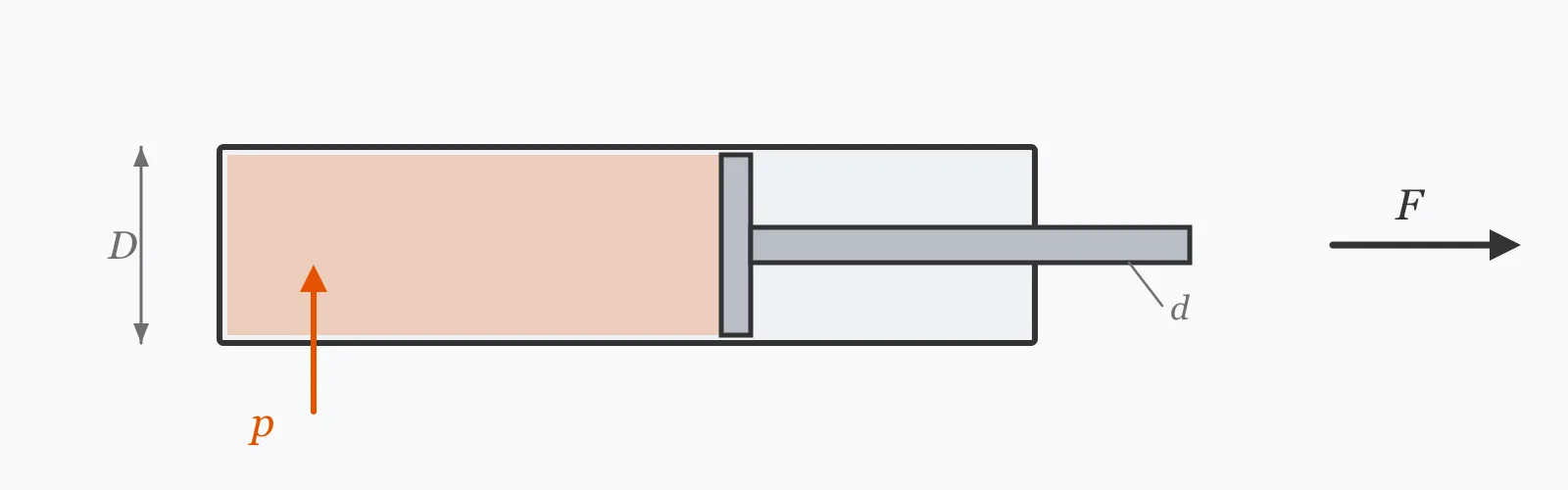
A hydraulic cylinder pushes on its full bore area but pulls on the bore minus the rod, so it is always stronger extending than retracting. Enter the bore, rod diameter, pressure and flow rate to get both forces and both speeds. The force ratio and the speed ratio are exact inverses of each other.
Calculator
Units:
mm
Internal diameter of the cylinder barrel
mm
Piston rod diameter. Must be less than the bore
bar
System pressure at the cylinder
L/min
Fluid delivered to the cylinder
Calculation Result
Press Calculate for the extend and retract forces and the rod speed in each direction at the flow you entered. Retract is always weaker and always faster, in exactly inverse proportion.
Step-by-Step Solution
Preliminary design aid. Results follow the published formulas cited
below and are intended for estimating, study and early design. Final design must be
verified by a licensed Professional Engineer against the code in force for your project.
Key Benefits
✓Gives both directions, which a single force figure obscures
✓Reports speeds alongside forces, since the same geometry sets both
✓Makes the force-speed inversion explicit
✓Warns where the rod ratio makes the cylinder strongly asymmetric
✓Sensitivity chart shows force scaling with the square of bore
✓Shareable links and CSV export for design records
What Is Hydraulic Cylinder Force?
Force in a hydraulic cylinder is pressure times area, and the area differs between the two directions. Extending, fluid acts on the full bore. Retracting, it acts on the annulus — the bore area less the rod area — because the rod itself occupies the rest. A 80 mm bore with a 45 mm rod has 5,027 mm² extending and 3,436 mm² retracting, so at 100 bar it pushes with 50.3 kN and pulls with 34.4 kN.
Why speed inverts the force ratio
Rod speed is flow divided by area, and force is pressure times area. Both depend on the same area, so whichever direction has less area has less force and more speed — by exactly the same factor. The 80/45 cylinder above extends at 99.5 mm/s and retracts at 145.5 mm/s on 30 L/min, a ratio of 1.463 that matches the force ratio precisely. Nothing is gained or lost; the same hydraulic power is simply delivered in a different combination.
What the return line has to handle
The inversion has a practical consequence that catches people out. When the cylinder extends, the annulus side is discharging, and it discharges a smaller volume than is entering — fine. When it retracts, the full bore side discharges, and that volume is larger than what is being pumped in. A return line sized for the pump flow will be undersized for the retract stroke, and the resulting back-pressure reduces the retract force further.
Formula
F_extend = p · π·D²/4
Extend force from pressure and full bore area
Related Formulas
F_retract = p · π·(D² − d²)/4
v = Q / A
F_ext/F_ret = v_ret/v_ext = D²/(D² − d²)
Variable Definitions
Symbol
Variable
Unit
Description
D
Bore Diameter
mm
Internal diameter of the cylinder barrel. Force goes with its square.
d
Rod Diameter
mm
Diameter of the piston rod, which reduces the retract area.
p
Pressure
bar
Working pressure. 1 bar equals 0.1 N/mm².
Q
Flow Rate
L/min
Fluid delivered to the cylinder, which sets the rod speed.
A_bore
Bore Area
mm²
Full piston area, acting on extension.
A_ann
Annulus Area
mm²
Bore area less rod area, acting on retraction.
How to Use This Calculator
Use the actual working pressure, not the relief settingThe relief valve setting is a ceiling, not an operating point. A cylinder only develops the pressure the load demands, so the force available is what matters for sizing while the force developed is what the load determines.
Check the rod diameter against the boreStandard rod-to-bore ratios give force ratios between about 1.2 and 2.0. A larger rod means more asymmetry — less retract force but more retract speed — and it also means a stiffer rod, which matters for buckling on long strokes.
Read both directions before sizingIf the working stroke is the retract direction, the annulus force is the one that must meet the load. Sizing on the extend force and then discovering the retract stroke is 30% weaker is a common and avoidable mistake.
Size the return line for the discharge, not the supplyOn the retract stroke the full bore side discharges more volume than the pump delivers, in the same ratio as the speeds. A return line sized for pump flow throttles that discharge and creates back-pressure that subtracts from the retract force.
Check buckling on long strokesA cylinder in compression is a strut, and rod buckling rather than force capacity often governs a long-stroke cylinder. The rod diameter that satisfies force may be well below what stability requires.
Worked Examples
Example 1
An 80 mm bore cylinder with a 45 mm rod, operating at 100 bar with 30 L/min flow.
Step-by-Step Solution
Bore area: π × 80²/4 = 5,026.5 mm²
Rod area: π × 45²/4 = 1,590.4 mm²
Annulus area: 5,026.5 − 1,590.4 = 3,436.1 mm²
Extend force: 100 bar × 5,026.5 mm² / 10 = 50,265 N = 50.27 kN
Speed ratio: 145.5 / 99.5 = 1.463 — the same number, inverted
Interpretation: the cylinder pushes 46% harder than it pulls, and pulls 46% faster than it pushes. The rod occupies 32% of the bore area, and that single figure sets both.
Example 2
The same rod ratio at four standard bore sizes, at constant pressure and flow — the comparison that shows how strongly bore dominates.
Step-by-Step Solution
63 mm bore with 36 mm rod: 31.17 kN extending, 20.99 kN retracting, 160.4 and 238.2 mm/s
80 mm bore with 45 mm rod: 50.27 kN and 34.36 kN, at 99.5 and 145.5 mm/s
100 mm bore with 56 mm rod: 78.54 kN and 53.91 kN, at 63.7 and 92.7 mm/s
125 mm bore with 70 mm rod: 122.72 kN and 84.23 kN, at 40.7 and 59.4 mm/s
From 63 mm to 125 mm the bore doubles and the extend force rises from 31.17 to 122.72 kN — a factor of 3.94, which is the square of the diameter ratio.
The speed falls by the same factor, from 160.4 to 40.7 mm/s. Force times speed is constant, because both are set by the same flow and pressure: the hydraulic power has not changed.
That is the fundamental trade. A larger bore buys force and spends speed, and the only way to have both is more flow — which means a larger pump and more installed power.
Bore Sensitivity
Force rises with the square of bore while speed falls with it, so the two pairs of curves move in opposite directions. A cylinder twice the bore gives four times the force at a quarter the speed for the same flow. The marker shows your current bore.
Extend Force vs Bore Diameter
Recomputed live from your inputs. The marker shows your current value.
Line chart of Extend Force against Bore Diameter. The same
values are listed in the data table below.
Values plotted above, sampled across the bore diameter range.
How to Interpret Your Results
The forces size the cylinder against the load; the speeds size the pump and the return line. Both come from the same two areas, so they cannot be chosen independently.
Extend Force: < 10Light duty
An extend force of your result kN suits light positioning and clamping work. At this scale the cylinder is often not the constraint — mounting, rod end bearings and the structure carrying the reaction usually govern.
Extend Force: 10 – 100General industrial range
An extend force of your result kN covers most industrial applications. Confirm the retract force separately if the working stroke is in that direction, since it is always the weaker one.
Extend Force: 100 – 500Heavy duty — check the structure
An extend force of your result kN imposes a substantial reaction on whatever the cylinder is mounted to. Mounting design, pin sizing and rod buckling on long strokes typically become the governing considerations rather than the cylinder itself.
Extend Force: ≥ 500Very high force
At your result kN every element of the circuit and the structure needs deliberate design. Stored energy is also considerable — an uncontrolled release at this force is dangerous, so load-holding valves and controlled descent become safety requirements rather than refinements.
Extend Speed: ≥ 500High rod speed
At your result mm/s the load's kinetic energy must be absorbed at each end of stroke. End-of-stroke cushioning becomes essential, and the deceleration forces can exceed the working forces the cylinder was sized for.
Common Mistakes to Avoid
Sizing on the extend force when the work is on retract
Why it matters:Retract force is always lower, by the ratio of bore area to annulus area — 46% lower in the worked example. A cylinder that comfortably meets the load pushing may fall well short pulling.
✓How to avoid it:Identify which direction does the work and size on that. Where retract is the working stroke, a smaller rod gives more annulus area and more retract force.
Sizing the return line for the pump flow
Why it matters:On the retract stroke the bore side discharges more volume than the pump delivers, in the same ratio as the speeds — 1.46 times in the example. A return line sized for pump flow throttles it and creates back-pressure.
✓How to avoid it:Size the return for the larger discharge flow. The back-pressure it would otherwise create acts on the bore area and subtracts directly from the retract force.
Using the relief valve setting as the working pressure
Why it matters:A cylinder develops only the pressure the load demands. The relief setting caps it, so it gives the maximum available force, not the force in normal operation. Confusing the two overstates what the system routinely does.
✓How to avoid it:Use the relief setting to check the maximum force and structural reaction, and the actual load-derived pressure for duty and energy calculations.
Ignoring rod buckling on long strokes
Why it matters:A cylinder in compression is a strut, and Euler buckling depends on the square of the unsupported length. A rod diameter that easily carries the force in direct compression can be far too slender to remain stable at full extension.
✓How to avoid it:Check buckling using the fully extended length and the actual mounting condition. Long-stroke cylinders frequently need a rod sized by stability rather than by force.
Assuming force and speed can be chosen independently
Why it matters:Both come from the same area. A larger bore multiplies force by the square of the diameter ratio and divides speed by the same factor, because the hydraulic power is fixed by pressure times flow.
✓How to avoid it:Fix the force from the load and the speed from the cycle time, then check whether the required pump flow is acceptable. If it is not, the pressure or the cycle time has to change.
Overlooking seal friction and efficiency
Why it matters:The calculated force is theoretical. Seal friction typically absorbs 5 to 10% of it, and more on a cold system or a cylinder with high-friction sealing. The available force at the rod end is correspondingly lower.
✓How to avoid it:Apply a margin of at least 10% on force-critical applications, and more where the system operates cold or the cylinder uses heavy-duty seals.
Practical Applications
▸Sizing hydraulic cylinders for a required force
▸Checking retract force where that is the working stroke
▸Estimating cycle times from rod speeds
▸Sizing pumps and return lines for a cylinder circuit
▸Comparing bore options against available flow
▸Assessing the force available at a given system pressure
Industry Use Cases
Mobile plant
Excavator and loader cylinders work mainly on extension, so bore is sized for the digging force and the rod chosen for buckling stability at full extension. The retract stroke is fast and lightly loaded, which suits the asymmetry rather than fighting it.
Presses and industrial machinery
Press cylinders work on extension at high force and low speed. Regeneration circuits exploit the asymmetry deliberately, routing the annulus discharge back to the bore side during the fast approach to gain speed, then switching to full-force mode for the working stroke.
Materials handling
Tipping and lifting cylinders are sized on extension but must control the load on retract, where gravity assists the motion. Over-centre and counterbalance valves hold the load, because without them the cylinder would run away with the load driving it faster than the pump can supply.
Expert Tips
💡Force goes with the square of bore; speed goes inversely with it.
💡The force ratio and the speed ratio are the same number, inverted.
💡1 bar on 1 mm² is 0.1 N — so bar times mm² divided by 10 gives newtons.
💡The bore side discharges more than the pump delivers on the retract stroke.
💡Rod buckling, not force, often governs a long-stroke cylinder.
💡Seal friction absorbs 5 to 10% of the theoretical force.
Advantages & Limitations
Advantages
✓Reports both directions, which a single force figure hides
✓Gives speeds alongside forces, since the same geometry sets both
✓Makes the force-speed inversion explicit rather than implicit
✓Warns where the rod ratio produces a strongly asymmetric cylinder
✓Simple enough to check by hand when specifying a cylinder
Limitations
!Gives theoretical force; seal friction absorbs 5 to 10% in practice
!Assumes no back-pressure on the discharge side
!Does not check rod buckling, which often governs long strokes
!Takes no account of cushioning or end-of-stroke deceleration
!Assumes a standard double-acting cylinder, not a differential or telescopic one
!Does not address load holding, which needs valves rather than cylinder capacity
!Speeds assume the full flow reaches the cylinder with no leakage or bypass
Standard Bore Sizes at 100 bar and 30 L/min
Four standard cylinders with proportionally similar rod ratios. Force rises with the square of bore and speed falls with it, so the product of the two is the same across every row.
100 bar, 30 L/min throughout. From 63 to 125 mm the bore doubles, the extend force rises 3.94 times and the extend speed falls by the same 3.94 — the square of the diameter ratio in both directions. Hydraulic power is pressure times flow, and neither has changed.
Multiply the pressure by the area. In convenient units, bar times mm² divided by 10 gives newtons: 100 bar on an 80 mm bore (5,026.5 mm²) gives 50,265 N, or 50.27 kN.
Why is retract force lower than extend force?
Because the rod occupies part of the piston area on the retract side. An 80 mm bore with a 45 mm rod has 5,026.5 mm² extending and only 3,436.1 mm² retracting — 32% less area and therefore 32% less force.
Why does a cylinder retract faster than it extends?
For the same reason it pulls less hard. Speed is flow divided by area, so the smaller annulus area gives more speed by exactly the factor it loses in force. The two ratios are identical and inverted.
How do I calculate cylinder speed?
Divide the flow by the area on the pressurised side. 30 L/min is 500,000 mm³/s, which over an 80 mm bore gives 99.5 mm/s extending and 145.5 mm/s retracting.
What rod diameter should I use?
Standard ratios give force ratios of about 1.2 to 2.0. A larger rod means a stiffer strut and better buckling resistance, but less retract force and a bigger return flow to handle.
Does doubling the bore double the force?
No, it quadruples it, because force depends on area and area on the square of diameter. It also quarters the speed at the same flow — the hydraulic power is unchanged.
What is a regeneration circuit?
One that routes the annulus discharge back to the bore side during extension, so the cylinder sees the sum of both flows and moves faster. The force falls to what the rod area alone provides, so it is used for fast approach and switched out for the working stroke.
Why does my cylinder not reach its calculated force?
Usually seal friction, which absorbs 5 to 10%, plus back-pressure on the discharge side. On the retract stroke an undersized return line is a common culprit, because the bore side discharges more than the pump delivers.
How do I check rod buckling?
Treat the extended cylinder as a strut and apply Euler's formula with the appropriate end conditions. Buckling depends on the square of the unsupported length, so it frequently governs long-stroke cylinders regardless of the force calculation.
How much flow does a cylinder need?
Flow equals area times desired speed. An 80 mm bore extending at 100 mm/s needs 5,026.5 × 100 = 502,650 mm³/s, which is about 30 L/min.
Glossary
Bore
The internal diameter of the cylinder barrel, setting the extend area.
Annulus area
Bore area less rod area, the effective area on the retract stroke.
Double-acting cylinder
A cylinder powered hydraulically in both directions.
Regeneration
Routing annulus discharge back to the bore side to gain speed at reduced force.
Counterbalance valve
A valve holding a load against gravity and preventing the cylinder running away.
Cushioning
Deceleration at the end of stroke, absorbing the load's kinetic energy.
Rod buckling
Elastic instability of the rod in compression, governed by extended length.
Back-pressure
Pressure on the discharge side, which subtracts from the available force.
Stroke
The distance the rod travels between its fully retracted and fully extended positions.
Differential cylinder
Another name for a standard cylinder with unequal areas either side of the piston.
Scientific & Standards References
ISO 6020 — Hydraulic fluid power: Mounting dimensions for single rod cylinders, 16 MPa series — International Organization for Standardization
ISO 3320 — Fluid power systems: Cylinder bores and rod diameters — International Organization for Standardization
Esposito, A., Fluid Power with Applications, 7th Edition — Pearson
ISO 4413 — Hydraulic fluid power: General rules for the design of systems — International Organization for Standardization
Conclusion
A hydraulic cylinder is geometrically asymmetric, and the asymmetry has two faces that point in opposite directions. Extending, fluid acts on the full bore; retracting, on the bore less the rod — so retraction gives less force and, at the same flow, proportionally more speed. In the worked example the ratio is 1.463 both ways, and that identity is not a coincidence: force is pressure times area and speed is flow divided by area, so the same number governs both. Two practical consequences follow. If the work happens on the retract stroke, the annulus force is what must meet the load, and it is 32% lower than the figure a bore-area calculation gives. And the return line must be sized for the bore-side discharge during retraction, which exceeds the pump flow by that same 1.463 — otherwise the back-pressure it creates subtracts from the very force that was already the weaker of the two.
Enter your bore, rod and pressure above to get both forces and both speeds.