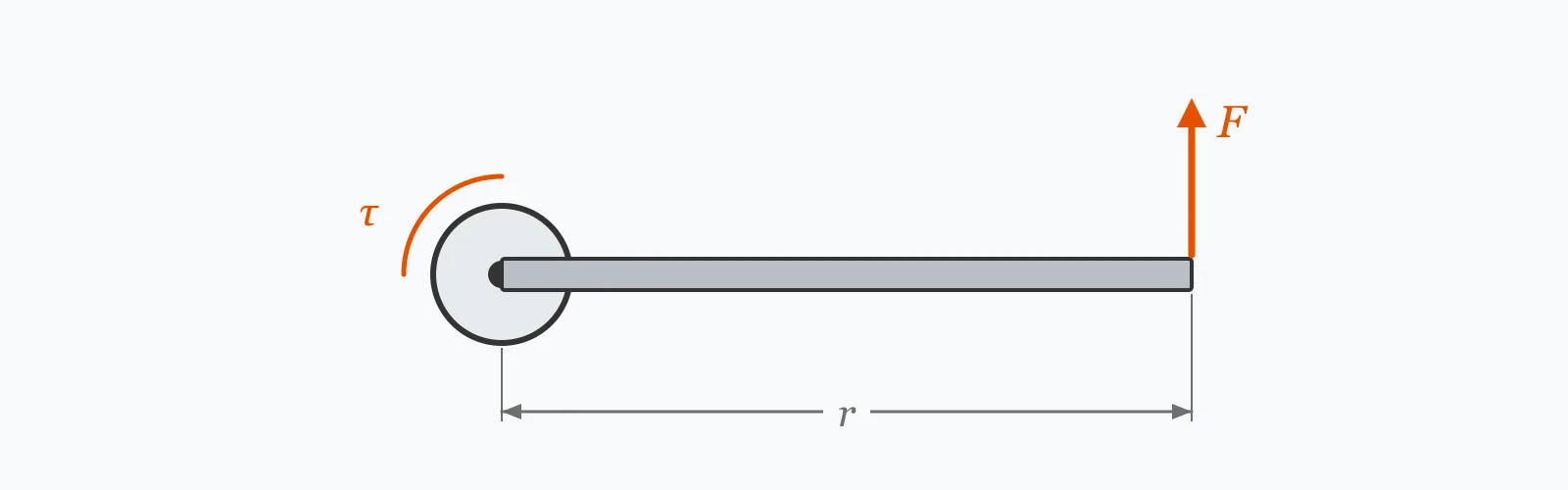
Torque is either a force acting at a distance, τ = F × r, or power divided by angular velocity, τ = P/ω. Enter a force and radius, or a power and speed, and this calculator returns the torque along with the power and angular velocity that accompany it. Enter a non-zero power and speed and it uses the power route; otherwise it uses force and radius.
Calculator
Units:
N
Applied force, perpendicular to the moment arm
m
Distance from the axis to the force line of action
kW
Leave at 0 to use the force and radius route
RPM
Shaft rotational speed
Calculation Result
Press Calculate for torque, power and angular velocity. If you entered a non-zero power and speed, the power route is used and the force and radius are ignored; otherwise torque comes from force times radius.
Step-by-Step Solution
Preliminary design aid. Results follow the published formulas cited
below and are intended for estimating, study and early design. Final design must be
verified by a licensed Professional Engineer against the code in force for your project.
Key Benefits
✓Handles both the statics route and the power transmission route
✓Returns angular velocity in rad/s, the form the power relationship needs
✓Cross-checks by returning the power that corresponds to a force-derived torque
✓Includes the conversion factors between the common torque and power units
✓Sensitivity chart shows the inverse relationship between speed and torque
✓Shareable links and CSV export for drivetrain records
What Is Torque?
Torque measures a force's tendency to rotate something about an axis. It equals the force multiplied by the perpendicular distance from the axis to the line of action — the moment arm. A 500 N force at 0.25 m produces 125 N·m regardless of whether anything actually turns, which is why the same expression covers a static bolt and a rotating shaft.
The power relationship
For a rotating shaft, power is torque times angular velocity: P = τω, with ω in radians per second. Rearranged, τ = P/ω, which is how torque is found for any machine whose power and speed are known. The conversion from RPM matters: ω = 2πn/60, so 1,800 RPM is 188.5 rad/s. Getting that factor wrong is the single most common error in this calculation.
Why torque falls as speed rises
At constant power, torque is inversely proportional to speed. A 15 kW motor produces 98.8 N·m at 1,450 RPM but only 49.4 N·m at 2,900 RPM. This is the whole reason gearboxes exist: motors deliver their rated power efficiently at high speed, and machinery generally needs the opposite, so speed is traded down for the torque the load actually requires.
Formula
τ = F × r
Torque from a force acting at a perpendicular distance from the axis
Related Formulas
τ = P / ω
ω = 2πn / 60
P = τω
τ = 9550 P / n
Variable Definitions
Symbol
Variable
Unit
Description
τ
Torque
N·m
The rotational effect of a force about an axis.
F
Force
N
Applied force, taken perpendicular to the moment arm.
r
Radius
m
Perpendicular distance from the axis of rotation to the line of action of the force.
P
Power
kW
Rate of doing work. For a rotating shaft, the product of torque and angular velocity.
n
Rotational Speed
RPM
Revolutions per minute of the shaft.
ω
Angular Velocity
rad/s
Rotational speed in radians per second, equal to 2πn/60.
How to Use This Calculator
Decide which route your problem usesIf you know a force and a lever arm, use force and radius and leave power at zero. If you know a machine's power and speed, enter those. Entering a non-zero power and speed makes the calculator use the power route and ignore the force and radius entirely.
Use the perpendicular distance for the radiusThe moment arm is the perpendicular distance from the axis to the force's line of action, not the distance along the member. For a force applied at an angle, only the perpendicular component contributes.
Keep the units consistentForce in newtons and radius in metres give torque in newton-metres. Power in kilowatts is converted internally, and speed in RPM is converted to rad/s by multiplying by 2π/60.
Read the angular velocity as a cross-checkAt 1,800 RPM, ω should be 188.5 rad/s. If your hand calculation of torque from power disagrees with the result, the RPM-to-rad/s conversion is the usual culprit.
Apply a service factor for real drivesThe torque returned here is the steady-state value. Starting torque, shock loads and intermittent duty all raise the peak, and drive components are sized against that peak rather than the nominal figure.
Worked Examples
Example 1
A force of 500 N acts at a radius of 0.25 m on a shaft turning at 1,800 RPM. Find the torque and the power being transmitted.
Step-by-Step Solution
Power is zero, so the calculator uses the force route
Cross-check with the combined form: τ = 9550 × 23.562 / 1,800 = 125.0 N·m — consistent
So a modest 500 N at a quarter-metre arm transmits over 23 kW at this speed. Power depends as much on speed as on torque.
Example 2
A 15 kW motor at 1,450 RPM, and the same motor at 2,900 RPM. This is the relationship gearbox selection turns on.
Step-by-Step Solution
Power and speed are both non-zero, so the calculator uses the power route
At 1,450 RPM: ω = 2π × 1,450 / 60 = 151.84 rad/s
Torque: τ = P/ω = 15,000 / 151.84 = 98.79 N·m
At 2,900 RPM: ω = 2π × 2,900 / 60 = 303.69 rad/s
Torque: τ = 15,000 / 303.69 = 49.39 N·m
Doubling the speed exactly halves the torque, since power is unchanged.
The design consequence: a machine needing 200 N·m cannot be driven directly by either motor. A 2:1 reduction from the 1,450 RPM motor gives 198 N·m at 725 RPM, which is why the reducer exists.
Note also what this means for shaft sizing — the low-speed shaft carries the larger torque, and is always the heavier of the two.
Speed Sensitivity
In force mode the torque is fixed by force and radius, so speed changes only the power the shaft transmits — the power curve rises linearly while torque stays flat. Switch between the curves to see it. The marker shows your current speed.
Angular Velocity (ω) vs Speed (n)
Recomputed live from your inputs. The marker shows your current value.
Line chart of Angular Velocity (ω) against Speed (n). The same
values are listed in the data table below.
Values plotted above, sampled across the speed (n) range.
How to Interpret Your Results
Torque values span an enormous range across engineering, so the bands below indicate the scale of application each corresponds to rather than any pass-or-fail limit.
Torque (τ): < 10Small-scale torque
A torque of your result N·m is in the range of small motors, instruments, fasteners and hand tools. At this level, bearing friction and seal drag can be a significant fraction of the total, so measured values often fall below theory.
Torque (τ): 10 – 500Typical machinery range
A torque of your result N·m is the normal range for industrial motors, pumps, fans and light drivetrains. Size the shaft and its keys against this value, applying a service factor for starting and shock loads.
Torque (τ): 500 – 10000Heavy drive torque
A torque of your result N·m indicates a substantial drive — a large reducer output, a mill, a winch. Shaft diameter, key stresses and coupling capacity all need explicit checking, and the torsional stress calculation becomes a separate design step.
Torque (τ): ≥ 10000Very high torque
A torque of your result N·m is in heavy industrial territory — crushers, marine drives, large winches. Verify the inputs, since an error in the RPM-to-rad/s conversion is the usual cause of an unexpectedly large result. Torsional vibration also becomes a design consideration at this scale.
Angular Velocity (ω): ≥ 400High rotational speed
An angular velocity of your result rad/s corresponds to roughly 3,800 RPM or more. At these speeds, balancing, critical speed and bearing selection become governing considerations independently of the torque being transmitted.
Common Mistakes to Avoid
Using RPM directly in the power relationship
Why it matters:P = τω requires ω in radians per second. Substituting RPM understates the angular velocity by a factor of 9.55, and therefore overstates the torque by the same factor.
✓How to avoid it:Convert with ω = 2πn/60 first, or use the combined form τ = 9550P/n with power in kW and speed in RPM.
Using the distance along the member instead of the perpendicular arm
Why it matters:Only the component of force perpendicular to the arm creates torque. A force at 45 degrees to a lever contributes just 71% of its magnitude.
✓How to avoid it:Use the perpendicular distance from the axis to the line of action, or resolve the force and use only the perpendicular component.
Confusing torque with power when comparing machines
Why it matters:They are different quantities and a machine can be strong in one and weak in the other. A high-torque low-speed motor and a low-torque high-speed one can deliver identical power.
✓How to avoid it:Compare torque when the question is about turning force, and power when it is about rate of work. Convert between them with the speed.
Sizing a shaft from the input torque of a reduction drive
Why it matters:A reduction multiplies torque, so the output shaft carries far more than the input. Sizing it from the motor torque understates the requirement by the full gear ratio.
✓How to avoid it:Size each shaft from the torque it actually carries. The low-speed shaft is always the heavier one in a reduction drive.
Ignoring starting and shock torque
Why it matters:Motors produce starting torque well above rated, and driven machines with high inertia or shock loading impose transient peaks. Components sized on steady-state torque fail on those peaks.
✓How to avoid it:Apply a service factor from the relevant standard — commonly 1.25 to 2.0 depending on the driven machine and duty cycle.
Mixing torque units without converting
Why it matters:N·m, kgf·m, lb·ft and lb·in are all in common use, and the numerical values differ by more than an order of magnitude. A lb·ft figure entered as N·m understates torque by 26%.
▸Determining shaft torque for torsional stress checks
▸Calculating bolt tightening torque requirements
▸Assessing winch, hoist and capstan capacity
▸Converting between motor power ratings and available torque
▸Checking coupling and key capacity in drivetrains
Industry Use Cases
Industrial drive selection
Selection starts from the torque the driven machine needs at its working speed. That fixes the required output torque of the reducer, and the motor is then chosen for the power that torque implies at the input speed.
Fastener engineering
Bolt tightening specifications are given as torque because it is what a wrench can measure, even though the quantity being controlled is preload. The relationship between them depends heavily on friction, which is why torque-controlled tightening scatters by 20 to 30%.
Automotive and engine testing
Dynamometers measure torque directly and compute power from it and the speed. This is why engine curves always show both: torque describes the pulling effort at a given speed, and power describes the rate of work available.
Expert Tips
💡At constant power, torque and speed are inversely proportional — halve the speed and you double the torque.
💡Use τ = 9550P/n for a quick answer with power in kW and speed in RPM.
💡1,800 RPM is 188.5 rad/s. Memorising one conversion catches most errors in this calculation.
💡The low-speed shaft in any drive carries the highest torque and is always the one to size carefully.
💡Torque is a static quantity; power requires motion. A stalled motor produces torque and no power at all.
💡Apply a service factor of 1.25 to 2.0 for real drives — steady-state torque is not the design peak.
Advantages & Limitations
Advantages
✓Covers both the statics and power transmission routes to torque
✓Returns angular velocity explicitly, where most conversion errors occur
✓Cross-checks a force-derived torque by returning the corresponding power
✓Applies to any rotating machine regardless of type
✓Simple enough to verify by hand in seconds
Limitations
!Gives steady-state torque only, not starting or shock peaks
!The power route takes precedence, so force and radius are ignored when power and speed are both entered
!Assumes the force acts perpendicular to the moment arm
!Takes no account of drivetrain efficiency between source and load
!Does not check shaft, key or coupling capacity against the result
!Ignores torsional vibration and critical speed
!Assumes constant speed; angular acceleration adds an inertial torque this does not include
Torque from a 15 kW Motor at Different Speeds
The same power at different speeds. This inverse relationship is the reason a drivetrain exists at all — the motor is efficient where torque is low, and the load usually needs the opposite.
A 15 kW motor at various speeds. Torque is inversely proportional to speed at constant power.
Convert speed to rad/s with ω = 2πn/60, then divide power by it: τ = P/ω. Or use the combined form τ = 9550P/n with power in kW and speed in RPM. A 15 kW motor at 1,450 RPM gives 98.79 N·m.
What is the formula for torque?
Two forms depending on what you know. From a force at a lever arm, τ = F × r. From a rotating machine, τ = P/ω. Both give the same quantity in newton-metres.
How do I convert RPM to rad/s?
Multiply by 2π/60, or approximately 0.1047. So 1,800 RPM is 188.5 rad/s and 1,450 RPM is 151.8 rad/s. Missing this conversion overstates torque by a factor of 9.55.
Does torque increase when speed decreases?
At constant power, yes, and exactly in proportion. Halving the speed doubles the torque. This is precisely what a reduction gearbox does, and why the output shaft of a reducer is always heavier than its input.
What is the difference between torque and power?
Torque is turning effort and exists even when nothing moves; power is the rate of doing work and requires motion. A stalled motor produces torque and zero power. Power is the product of torque and angular velocity.
How do I convert lb·ft to N·m?
Multiply by 1.356. So 100 lb·ft is 135.6 N·m. Other common conversions: 1 kgf·m = 9.807 N·m and 1 lb·in = 0.113 N·m. Mixing them unconverted is a frequent source of error.
Why is bolt tightening specified as torque?
Because torque is what a wrench can measure, even though the quantity actually being controlled is bolt preload. The relationship between the two depends on thread and face friction, which is why torque-controlled tightening scatters by 20 to 30%.
What torque does a 10 kW motor produce?
It depends entirely on speed. At 1,450 RPM it gives 65.9 N·m; at 2,900 RPM only 32.9 N·m. A motor's power rating alone does not tell you its torque — you need the speed as well.
Should I use starting torque or rated torque for design?
Size components against the peak they will actually see, which is normally the starting or shock condition rather than the steady state. Standards give service factors, commonly 1.25 to 2.0, to bridge between the two.
Does a longer wrench give more torque?
Yes, in direct proportion. Doubling the length doubles the torque for the same hand force, since τ = F × r. It is why breaker bars are long, and why torque wrench readings depend on where along the handle the force is applied.
Glossary
Torque
The rotational effect of a force about an axis, equal to force times perpendicular distance.
Moment arm
The perpendicular distance from the axis of rotation to the line of action of a force.
Angular velocity (ω)
Rotational speed in radians per second, equal to 2πn/60 for a speed n in RPM.
Power
The rate of doing work; for a rotating shaft, the product of torque and angular velocity.
Newton-metre
The SI unit of torque, equal to one newton acting at one metre from the axis.
Starting torque
The torque a motor produces at zero speed, typically well above its rated value.
Service factor
A multiplier applied to nominal torque to allow for shock, duty cycle and starting conditions.
Preload
The tension induced in a bolt by tightening, the quantity that torque control is attempting to achieve.
Critical speed
A rotational speed at which a shaft's natural frequency is excited, causing large vibration amplitudes.
Hibbeler, R. C., Engineering Mechanics: Statics, 15th Edition — Chapter 4: Force System Resultants — Pearson
AGMA 6013 — Standard for Industrial Enclosed Gear Drives, service factor tables — American Gear Manufacturers Association
VDI 2230 — Systematic calculation of highly stressed bolted joints — Verein Deutscher Ingenieure
ISO 80000-4 — Quantities and units: Mechanics — International Organization for Standardization
Conclusion
Torque arrives by two routes — force times lever arm in statics, power divided by angular velocity in power transmission — and both give the same quantity. The conversion between them is where errors concentrate: ω = 2πn/60, so 1,800 RPM is 188.5 rad/s, and substituting RPM directly overstates torque by a factor of 9.55. The relationship that matters most in design is the inverse one between torque and speed at constant power. It is why gearboxes exist, why the low-speed shaft of any drive is the heavier one, and why a motor's power rating tells you nothing about its torque until you also know the speed.
Try your own numbers above, then sweep the speed in the chart to see torque and power move against each other.