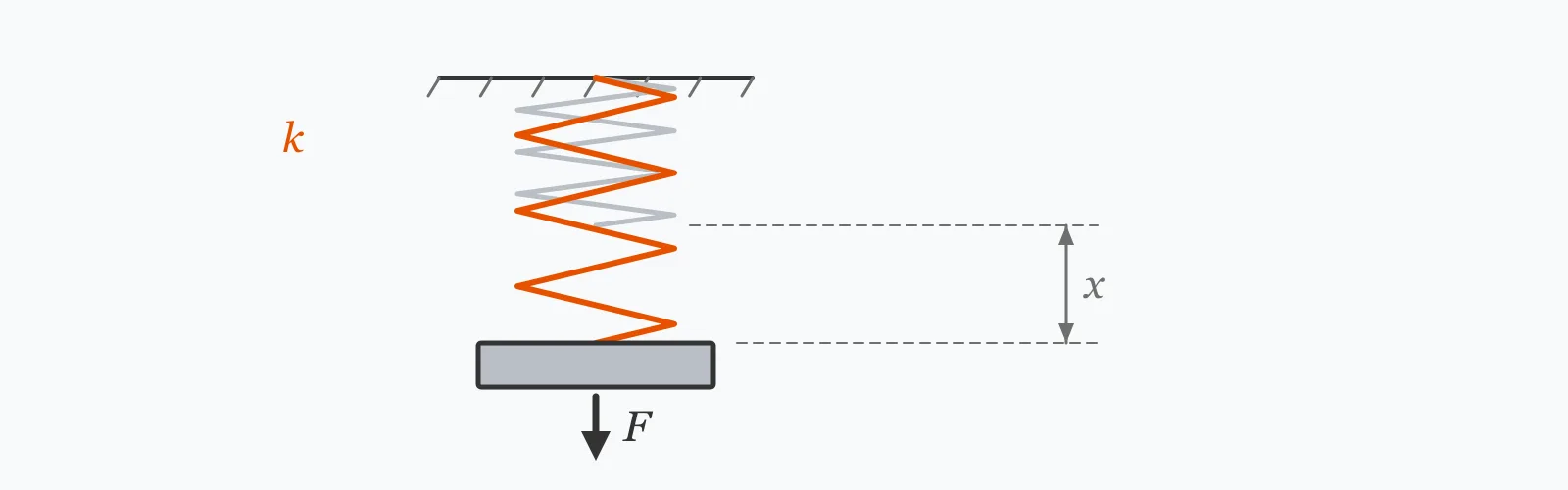
Hooke's law relates force, stiffness and displacement as F = kx. Enter any two of the three and this calculator returns the missing one, plus the potential energy stored, PE = ½kx². Note the priority order: if you supply both a spring constant and a displacement, those are used and any force you entered is recalculated.
Calculator
Units:
N
Leave at 0 to solve for force from k and x
N/m
Leave at 0 to solve for stiffness from F and x
m
In metres — 25 mm is 0.025. Leave at 0 to solve for displacement
Calculation Result
Press Calculate and the missing quantity is solved from the two you supplied, along with the stored energy. Leave the value you want calculated at zero — supplying all three means the spring constant and displacement take priority.
Step-by-Step Solution
Preliminary design aid. Results follow the published formulas cited
below and are intended for estimating, study and early design. Final design must be
verified by a licensed Professional Engineer against the code in force for your project.
Key Benefits
✓Solves for whichever of the three quantities you leave blank
✓Returns the stored elastic energy alongside the force and displacement
✓States its input priority explicitly, so no value is silently overwritten unnoticed
✓Includes series and parallel combination rules for multiple springs
✓Sensitivity chart shows the quadratic growth of stored energy
✓Shareable links and CSV export for design records
What Is Spring Constant?
Hooke's law states that the force needed to extend or compress an elastic element is proportional to the distance moved: F = kx. The constant k is the spring rate or stiffness, measured in newtons per metre, and it is a property of the specific element rather than of its material — a stiff spring and a soft one can be made of identical wire, differing only in coil diameter, wire diameter and number of turns.
Why energy matters more than force
The work done compressing a spring is the area under its force-displacement line, giving PE = ½kx². Because displacement is squared, doubling the compression quadruples the energy stored even though the force only doubles. A spring holding 100 N at 200 mm stores 10 J; the same spring at 400 mm holds 200 N but stores 40 J. That energy is released instantly if the spring escapes its retention, which is why compressed springs are treated as stored-energy hazards.
Where the linear assumption ends
Hooke's law holds only while the material stays elastic and the geometry stays roughly constant. A coil spring compressed until its turns touch — solid height — becomes effectively rigid, and beyond the elastic limit the wire takes a permanent set and the rate itself changes. Conical, variable-pitch and progressive springs are deliberately non-linear, and a single constant does not describe them.
Formula
F = k · x
Hooke's law relating force, spring constant and displacement
Related Formulas
PE = ½ k x²
1/k_total = 1/k₁ + 1/k₂
k_total = k₁ + k₂
k = Gd⁴ / (8D³n)
Variable Definitions
Symbol
Variable
Unit
Description
F
Force
N
Force applied to or exerted by the spring at the given displacement.
k
Spring Constant
N/m
Stiffness or spring rate — the force required per metre of deflection.
x
Displacement
m
Extension or compression from the free length. Note this is in metres, not millimetres.
PE
Potential Energy
J
Elastic energy stored in the spring, equal to the work done deflecting it.
G
Shear Modulus
GPa
Used in the geometric rate expression; about 79 GPa for spring steel.
How to Use This Calculator
Leave the unknown at zeroThe calculator solves for whichever quantity you leave blank. Enter a spring constant and a displacement to find the force, or a force and a constant to find the displacement.
Know the priority orderIf you supply all three, the spring constant and displacement are used and the force you entered is recalculated and overwritten. If your force output does not match what you typed, this is why.
Enter displacement in metresThe spring constant is in newtons per metre, so displacement must be in metres for consistency. A 25 mm deflection is 0.025 — entering 25 overstates the force a thousandfold.
Check the result against the spring's working rangeHooke's law is linear, but a real spring has a solid height it cannot pass and an elastic limit beyond which it takes a permanent set. Confirm the displacement is within both.
Combine multiple springs before enteringSprings in parallel add their rates directly; springs in series combine as reciprocals and are always softer than the softest individual spring. Compute the combined rate first, then use it here.
Worked Examples
Example 1
A spring with a rate of 500 N/m is compressed by 0.2 m. Find the force it exerts and the energy it stores.
Step-by-Step Solution
Both the spring constant and the displacement are supplied, so the calculator solves for force
Force: F = k × x = 500 × 0.2 = 100.00 N
Potential energy: PE = ½kx² = 0.5 × 500 × 0.2²
= 0.5 × 500 × 0.04 = 10.0000 J
Cross-check: energy is also the average force times the distance, (0 + 100)/2 × 0.2 = 10 J — consistent
Assessment: 100 N is a modest force, easily held by hand. The 10 J of stored energy is a different matter — comparable to a 1 kg mass dropped from a metre, and released instantly if the retention fails.
Example 2
The same spring compressed twice as far, to 0.4 m. This is the relationship that makes springs hazardous.
Step-by-Step Solution
Force: F = 500 × 0.4 = 200.00 N — exactly double, as Hooke's law requires
Comparison: the force doubled but the energy quadrupled, from 10 J to 40 J
The reason is the square: work is the area under the force-displacement line, and doubling the base also doubles the height.
The practical consequence: assessing a compressed spring by the force needed to hold it badly understates the hazard. Doubling the compression makes it twice as hard to hold and four times as dangerous to release.
This is why spring compressors for vehicle suspension are rated by energy rather than force, and why a released valve spring can cause serious injury despite a force a person could hold with one hand.
Displacement Sensitivity
Force rises linearly with displacement while stored energy rises with its square, so the two curves diverge sharply. That gap is why a compressed spring is a stored-energy hazard well before its force looks alarming. The marker shows your current displacement.
Potential Energy (PE) vs Displacement (x)
Recomputed live from your inputs. The marker shows your current value.
Line chart of Potential Energy (PE) against Displacement (x). The same
values are listed in the data table below.
Values plotted above, sampled across the displacement (x) range.
How to Interpret Your Results
Spring rate spans an enormous range, from instrument springs at a few newtons per metre to suspension springs at hundreds of thousands. The bands below relate the computed values to the applications they correspond to, and flag the energy hazard.
Spring Constant (k): < 100Soft spring
A rate of your result N/m is soft — the range of instrument springs, light return springs and delicate mechanisms. At this stiffness, friction in the mechanism can be a significant fraction of the spring force.
Spring Constant (k): 100 – 10000General machinery range
A rate of your result N/m covers most machine springs — valve springs, return springs, clamping devices. Confirm the working displacement stays within the spring's elastic range and clear of solid height.
Spring Constant (k): ≥ 10000Stiff spring
A rate of your result N/m is stiff, in the range of vehicle suspension springs, heavy machinery mounts and die springs. Stored energy becomes substantial at any appreciable deflection — treat compression and release as a controlled operation.
Potential Energy (PE): 50 – 500Substantial stored energy
A stored energy of your result J is a real hazard on release — comparable to a 5 kg mass falling a metre at the lower end of this band. Use proper compression tooling and retain the spring throughout any assembly or disassembly.
Potential Energy (PE): ≥ 500Dangerous stored energy
A stored energy of your result J is capable of causing serious injury or death if released uncontrolled. Springs at this level require purpose-designed compression equipment, captive retention, and a procedure that keeps people out of the release path.
Common Mistakes to Avoid
Entering displacement in millimetres
Why it matters:The spring constant is in newtons per metre, so displacement must be in metres. Entering 25 instead of 0.025 overstates the force by a factor of a thousand and the energy by a million.
✓How to avoid it:Divide millimetres by 1000 before entering. A result in the tens of kilonewtons for a small spring is the signature of this error.
Supplying all three values and expecting the force to be honoured
Why it matters:The calculator resolves conflicts by priority: spring constant and displacement win, and the entered force is overwritten with k × x. A deliberate force input is silently replaced.
✓How to avoid it:Leave the quantity you want calculated at zero. If the returned force differs from what you typed, the other two inputs were inconsistent with it.
Assessing spring hazard by force alone
Why it matters:Energy grows with the square of displacement while force grows linearly. A spring that a person can hold by hand may store enough energy to cause serious injury when released.
✓How to avoid it:Compute the stored energy as well as the force. Anything above about 50 J warrants compression tooling and a controlled release procedure.
Extrapolating beyond the elastic range
Why it matters:Hooke's law is linear only while the material remains elastic. Past that point the spring takes a permanent set, its free length changes and the rate itself may shift.
✓How to avoid it:Check the manufacturer's maximum deflection or the solid height. For a compression spring, the working deflection should stay comfortably below the point where coils touch.
Adding rates for springs in series
Why it matters:Series springs get softer, not stiffer — each carries the full load and each deflects, so the deflections add. Two 500 N/m springs in series give 250 N/m, not 1,000.
✓How to avoid it:Use reciprocals for series: 1/k = 1/k₁ + 1/k₂. Rates add directly only for springs in parallel, where they share the load.
Ignoring preload in an installed spring
Why it matters:Most springs are installed with some initial compression, so the working deflection is measured from the installed length rather than the free length. Using free length overstates the force at the working position.
✓How to avoid it:Measure displacement from the installed position for working force, and from free length for total stored energy and for checking against solid height.
Practical Applications
▸Selecting compression and extension springs for machinery
▸Determining suspension spring rates and ride height
▸Sizing return springs in valves and linkages
▸Assessing stored energy hazards during assembly and maintenance
▸Calculating preload in clamping and tensioning devices
▸Analysing vibration isolation mounts
Industry Use Cases
Automotive suspension
Spring rate sets ride height, handling balance and comfort together. Because energy scales with the square of deflection, a compressed coil spring on a strut assembly stores enough energy to be a recognised workshop hazard, and purpose-made compressors are mandatory.
Valve and actuator design
Fail-safe actuators use a spring to drive the valve to a safe position on loss of power. The spring must be stiff enough to overcome friction and process forces at the end of its stroke, which usually makes the return force rather than the ride the governing criterion.
Vibration isolation
Isolator rates are chosen so the mounted natural frequency falls well below the disturbing frequency — a factor of about three is the usual target. That makes the required static deflection, not the load, the governing parameter.
Expert Tips
💡Energy goes as the square of displacement: double the compression and you quadruple the stored energy.
💡Displacement must be in metres to match a rate in N/m — 25 mm is 0.025.
💡Springs in parallel add rates; springs in series add deflections and get softer.
💡Check stored energy, not just force, when assessing whether a spring is safe to handle.
💡For a helical spring, rate goes as the fourth power of wire diameter — a small wire change is a large rate change.
💡Measure working deflection from the installed length, and total energy from the free length.
Advantages & Limitations
Advantages
✓Solves for any of the three quantities from the other two
✓Returns stored energy alongside force, which force alone does not convey
✓Applies to any linear elastic element, not only coil springs
✓Extends to spring combinations through the series and parallel rules
✓Simple enough to verify by hand instantly
Limitations
!Assumes linear elastic behaviour throughout the range entered
!Overwrites an entered force when both spring constant and displacement are supplied
!Does not check against solid height, elastic limit or buckling
!Takes no account of spring geometry, material or fatigue life
!Not applicable to conical, variable-pitch or progressive springs, which are deliberately non-linear
!Ignores damping, which matters in any dynamic application
!Does not address surge, the resonance of the spring's own coils at high cycling rates
Force and Energy Against Displacement
A 500 N/m spring at increasing compression. The force column is linear and the energy column quadratic — the divergence between them is the whole safety argument for treating springs as stored-energy devices.
A 500 N/m linear spring. Force is proportional to displacement; energy to its square. Both assume the spring stays within its elastic range.
It states that the force required to deflect an elastic element is proportional to the deflection: F = kx, where k is the spring constant. It holds while the material stays within its elastic range and the geometry does not change appreciably.
How do I calculate the spring constant?
Divide the force by the displacement it produces: k = F/x. A spring deflecting 0.25 m under 100 N has a rate of 400 N/m. For a helical spring it can also be derived from geometry as Gd⁴/(8D³n).
What are the units of spring constant?
Newtons per metre in SI, though N/mm and lbf/in are both common in industry. 1 N/mm equals 1,000 N/m, and 1 lbf/in equals about 175 N/m. Mixing them unconverted is a frequent source of error.
How much energy does a compressed spring store?
PE = ½kx². A 500 N/m spring compressed 0.2 m stores 10 J. Because displacement is squared, compressing it to 0.4 m stores 40 J — four times as much for twice the force.
How do springs combine in series and parallel?
In parallel, rates add: two 500 N/m springs give 1,000 N/m. In series, deflections add and rates combine as reciprocals: the same two springs give 250 N/m, softer than either alone.
Why are compressed springs dangerous?
Because stored energy grows with the square of deflection while force grows linearly. A spring a person can hold by hand may store tens of joules, released instantly if the retention fails — which is why suspension spring compressors exist.
Does Hooke's law apply to all springs?
Only to linear ones within their elastic range. Conical, variable-pitch and progressive springs are deliberately non-linear so their rate changes with deflection, and no single constant describes them.
What is solid height?
The length of a compression spring when all its coils touch. It cannot compress further, so it behaves as a rigid column beyond that point. Working deflection must stay clear of it, typically with 10 to 20% margin.
What affects a helical spring's rate?
Rate is Gd⁴/(8D³n), so wire diameter dominates through its fourth power — a 10% increase in wire diameter raises the rate by 46%. Coil diameter and number of active turns both reduce it.
Should I measure deflection from free length or installed length?
From the installed length for the working force, since that is the operating condition. From free length for total stored energy and for checking against solid height, since that is the full compression the spring has undergone.
Glossary
Hooke's law
The relationship F = kx, stating that elastic deflection is proportional to applied force.
Spring constant (k)
The force required per unit deflection, also called the spring rate or stiffness.
Elastic potential energy
The work stored in a deflected spring, equal to ½kx².
Free length
The length of a spring under no load.
Solid height
The length of a compression spring with all coils in contact, beyond which it cannot compress.
Preload
Initial deflection applied at installation, so the spring exerts force at its working position.
Springs in series
Springs connected end to end, each carrying the full load; the combination is softer than either.
Springs in parallel
Springs sharing a load side by side; their rates add directly.
Surge
Resonance of a spring's own coils at high cycling rates, which can destroy it independently of the applied load.
EN 13906-1 — Cylindrical helical springs made from round wire and bar: Compression springs — CEN
SMI Handbook of Spring Design — Spring Manufacturers Institute
ASTM A125 — Standard Specification for Steel Springs, Helical, Heat-Treated — ASTM International
Hibbeler, R. C., Engineering Mechanics: Dynamics, 15th Edition — Chapter 14: Kinetics of a Particle, Work and Energy — Pearson
Conclusion
Hooke's law relates force, stiffness and deflection as F = kx, and the calculator solves for whichever you leave blank — with the spring constant and displacement taking priority if all three are supplied. The result worth internalising is the energy one: PE = ½kx² grows with the square of deflection while force grows linearly, so doubling the compression makes a spring twice as hard to hold and four times as dangerous to release. Assessing a spring by the force needed to restrain it consistently understates the hazard, which is why compression tooling is rated by energy. Two practical cautions: displacement must be in metres to match a rate in N/m, and springs in series get softer rather than stiffer.
Try your own spring above, then sweep the displacement in the chart to watch force and energy diverge.