Ratios in a compound drive multiply, they do not add: 3:1 followed by 2.5:1 gives 7.5:1 overall. Enter the input speed and the four pulley diameters to get the intermediate shaft speed, the output speed, the overall ratio and the belt surface speed on the first stage.
Calculator
Units:
rpm
Motor or driving shaft speed
mm
On the input shaft
mm
On the intermediate shaft
mm
Also on the intermediate shaft
mm
On the output shaft
Calculation Result
Press Calculate for the intermediate shaft speed, the final output speed, the overall ratio and the belt speed on the first stage. Torque rises by the same factor the speed falls, less drive losses.
Step-by-Step Solution
Preliminary design aid. Results follow the published formulas cited
below and are intended for estimating, study and early design. Final design must be
verified by a licensed Professional Engineer against the code in force for your project.
Key Benefits
✓Handles the two-stage case, which is how large belt reductions are actually built
✓Reports the intermediate shaft speed, needed to size the second stage
✓Gives belt surface speed, which bounds what the drive can transmit
✓Warns when a single stage exceeds the practical 6:1 limit
✓Sensitivity chart shows the ratio compounding
✓Shareable links and CSV export for design records
What Is Compound Pulley Drive?
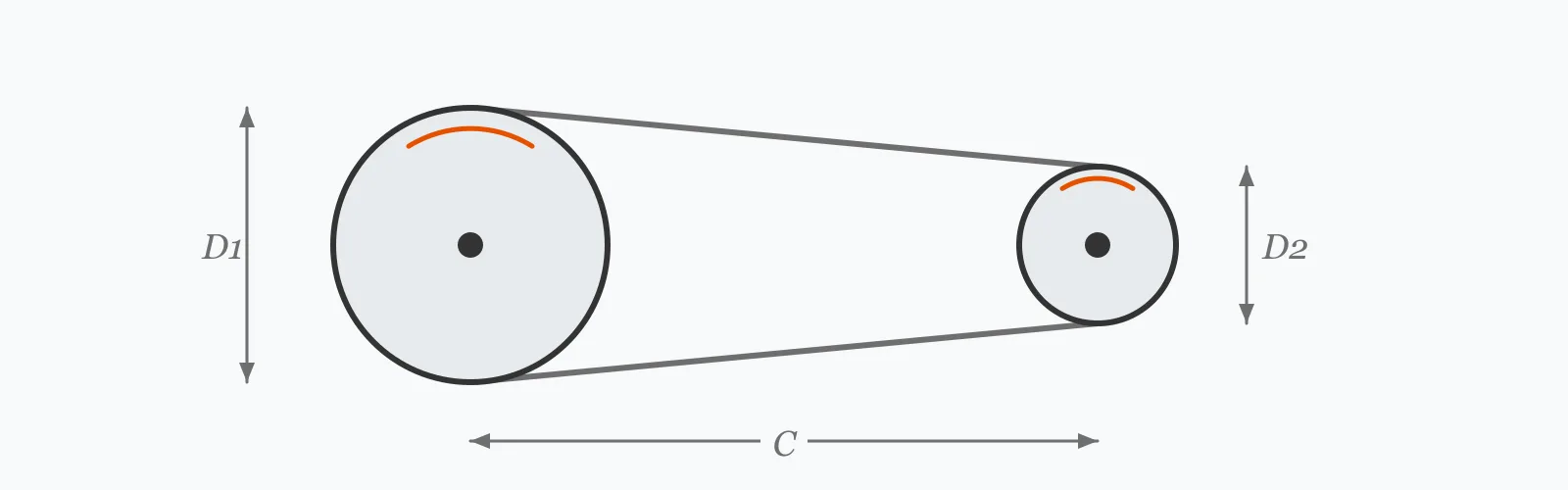
A belt drive changes speed in proportion to the pulley diameters: a small pulley driving a large one reduces speed and multiplies torque. In a compound drive, two such stages are connected by an intermediate shaft — often called a jackshaft or countershaft — carrying the driven pulley of the first stage and the driving pulley of the second. The overall ratio is the product of the two stage ratios.
Why ratios multiply
The intermediate shaft turns at the input speed divided by the first stage ratio. The second stage then divides that again. So a 3:1 followed by a 2.5:1 gives 1440 rpm reduced to 480 and then to 192 — an overall 7.5:1. Adding the ratios would give 5.5:1 and a quite different answer, which is a common slip. The same multiplication applies to torque in the opposite direction, less the losses in each stage.
Why a single stage runs out
As the ratio rises, the belt wraps less of the small pulley. Below about 120° of contact the friction available falls off sharply and the belt slips before it transmits the torque. That practical ceiling of roughly 6:1 per stage is what forces compound drives, and it is also why increasing centre distance helps — a longer span restores some of the wrap angle lost to the diameter difference.
Formula
i_total = (D₂/D₁) · (D₄/D₃)
Overall ratio of a two-stage compound drive — the product of the stage ratios
Related Formulas
n_intermediate = n_input / (D₂/D₁)
n_output = n_input / i_total
v = π · D₁ · n / 60
Variable Definitions
Symbol
Variable
Unit
Description
n_in
Input Speed
rpm
Speed of the driving shaft, usually the motor.
D₁, D₂
Stage 1 Pulleys
mm
Driving and driven diameters of the first stage.
D₃, D₄
Stage 2 Pulleys
mm
Driving and driven diameters of the second stage.
i
Overall Ratio
—
Product of the two stage ratios. Speed divides by it; torque multiplies.
n_int
Intermediate Speed
rpm
Speed of the shaft between the stages.
v
Belt Speed
m/s
Surface speed of the first-stage belt. Standard V-belts are limited to about 30 m/s.
How to Use This Calculator
Use pitch diameters where they matterV-belts run on the pitch diameter, not the outside diameter, and the two differ by a few millimetres depending on the belt section. For small pulleys that difference is a meaningful fraction of the ratio.
Keep each stage below about 6:1Beyond that the small pulley's arc of contact falls too far for reliable grip. Two moderate stages are more robust and more efficient than one extreme one, which is the whole reason compound drives exist.
Check the intermediate speedThat shaft and its bearings run at a speed neither the motor nor the output sees. It also carries two belt tensions simultaneously, which combine as vectors depending on the drive layout — often the most heavily loaded shaft in the machine.
Watch the belt speedStandard V-belts are limited to about 30 m/s, above which centrifugal force lifts the belt out of its groove. Below about 5 m/s the belt must carry very high tension for a given power, since power is force times speed.
Respect the minimum pulley diameterEvery belt section has one, below which the bending stress on each revolution shortens the belt's life sharply. Small pulleys are tempting for large ratios and are frequently the reason a drive fails early.
Worked Examples
Example 1
A 1,440 rpm motor drives a 100 mm pulley to a 300 mm pulley on an intermediate shaft, which carries a 100 mm pulley driving a 250 mm pulley on the output.
Overall ratio: 3.000 × 2.500 = 7.500:1 — note that adding them would give 5.5, which is wrong
Belt speed on stage 1: π × 0.100 × 1,440/60 = 7.54 m/s
Interpretation: 7.5:1 from two stages that are each comfortably within the 6:1 single-stage limit. Torque at the output is 7.5 times the input, less the losses in two belt drives — typically 2 to 3% each.
Example 2
Increasing only the first stage's driven pulley, to see how the overall ratio responds.
Step-by-Step Solution
With a 150 mm driven pulley: stage 1 is 1.5:1, intermediate 960 rpm, output 384 rpm, overall 3.75:1
With 200 mm: stage 1 is 2:1, intermediate 720 rpm, output 288 rpm, overall 5:1
With 300 mm: stage 1 is 3:1, intermediate 480 rpm, output 192 rpm, overall 7.5:1
With 400 mm: stage 1 is 4:1, intermediate 360 rpm, output 144 rpm, overall 10:1
With 600 mm: stage 1 is 6:1, intermediate 240 rpm, output 96 rpm, overall 15:1
The overall ratio rises exactly in proportion to that one pulley, because the second stage is unchanged and the two simply multiply.
The belt speed stays at 7.54 m/s throughout, because it depends only on the driving pulley diameter and the input speed — the driven pulley does not affect it at all.
The 600 mm case reaches 15:1 overall with a first stage at exactly the 6:1 practical limit. Pushing further would need a third stage, or a gearbox — and by that point a gearbox is usually cheaper than three shafts, six bearings and three belts.
First Stage Sensitivity
Changing the first stage's driven pulley moves the intermediate speed and the output in proportion, while the overall ratio rises linearly with it. The belt speed does not move at all, since it depends only on the driving pulley and the input speed. The marker shows your current setting.
Output Speed vs Stage 1 Driven Pulley
Recomputed live from your inputs. The marker shows your current value.
Line chart of Output Speed against Stage 1 Driven Pulley. The same
values are listed in the data table below.
Values plotted above, sampled across the stage 1 driven pulley range.
How to Interpret Your Results
The overall ratio is the design target; the intermediate speed and the belt speed are the checks that determine whether the arrangement is practical.
Overall Ratio: < 6Achievable in one stage
An overall ratio of your result:1 is within what a single belt stage can manage. A compound drive adds a shaft, two bearings and a belt for no benefit here — unless the intermediate shaft is needed to drive something else, or the centre distance cannot accommodate the pulleys a single stage would require.
Overall Ratio: 6 – 20Well suited to two stages
An overall ratio of your result:1 is the natural range for a compound belt drive. Split it so neither stage exceeds about 6:1, and prefer a roughly even split — that keeps both arcs of contact generous.
Overall Ratio: 20 – 40Demanding for two stages
An overall ratio of your result:1 requires both stages near their practical limits. Check each stage's arc of contact, and compare against a gearbox — at this ratio the belt drive's cost advantage has usually disappeared.
Overall Ratio: ≥ 40Beyond two belt stages
An overall ratio of your result:1 cannot be achieved in two belt stages within the 6:1 per-stage limit, which caps a compound drive at 36:1. A gearbox or a third stage is required.
Stage 1 Belt Speed: ≥ 30Belt speed too high
A belt speed of your result m/s exceeds the roughly 30 m/s limit for standard V-belts. Centrifugal force begins to lift the belt out of its groove, reducing the wedging effect the drive depends on. A smaller driving pulley or a different belt type is needed.
Stage 1 Belt Speed: < 5Low belt speed
At your result m/s the belt must carry a high tension to transmit any given power, because power is force times speed. That loads the shafts and bearings heavily — a larger driving pulley is usually a better answer than more belts.
Common Mistakes to Avoid
Adding the stage ratios instead of multiplying them
Why it matters:Ratios compound. A 3:1 followed by a 2.5:1 gives 7.5:1, not 5.5:1 — a 36% error, and in the direction of underestimating the reduction.
✓How to avoid it:Multiply. Each stage divides the speed it receives, so the divisions accumulate as a product.
Using outside diameter instead of pitch diameter
Why it matters:A V-belt sits down in its groove and runs on the pitch diameter, which is a few millimetres below the outside diameter. On a 100 mm pulley that is a percent or two of the ratio, and it compounds across two stages.
✓How to avoid it:Use pitch diameters from the pulley data. The correction is small but it is systematic, so it does not average out.
Pushing one stage far beyond 6:1
Why it matters:The arc of contact on the small pulley falls as the diameter difference grows, and below about 120° the available friction drops sharply. The belt slips, wears and generates heat rather than transmitting torque.
✓How to avoid it:Split the reduction more evenly between the stages, or increase the centre distance, which recovers some of the lost wrap angle.
Ignoring the intermediate shaft loads
Why it matters:That shaft carries two belt tensions at once, and depending on the layout they may add rather than oppose. It is frequently the most heavily loaded shaft in the drive despite being the least considered.
✓How to avoid it:Resolve both belt pulls as vectors for the actual geometry and size the shaft and bearings on the resultant, not on either belt alone.
Choosing pulleys below the belt's minimum diameter
Why it matters:A small pulley bends the belt tightly, and that bending stress is applied on every revolution. Belt life falls sharply below the manufacturer's stated minimum, which is easy to breach when chasing a large ratio.
✓How to avoid it:Check the minimum pulley diameter for the belt section and stay above it. If the ratio demands a smaller pulley, use a smaller belt section or add a stage.
Forgetting the losses compound too
Why it matters:Each belt stage is typically 97 to 98% efficient, so two stages give about 95%. On a continuously running drive that 5% is a real and permanent cost, and it becomes heat in the belts and bearings.
✓How to avoid it:Count the losses per stage when comparing against a gearbox, which for a single reduction is often more efficient than two belt stages.
Practical Applications
▸Designing large-reduction belt drives
▸Calculating output speed for a two-stage arrangement
▸Sizing the intermediate shaft and its bearings
▸Checking belt speed against material limits
▸Comparing a compound belt drive against a gearbox
▸Retrofitting a different output speed to existing machinery
Industry Use Cases
Machine tools
Countershaft drives were the classical way to give a lathe or a mill a range of spindle speeds from one motor. The intermediate shaft carried stepped pulleys, and moving the belt between steps changed one stage's ratio while leaving the other alone.
Agricultural and processing machinery
Belt drives are preferred where shock loading is common, because a belt slips rather than breaking a shaft. Compound arrangements reach the low output speeds that augers, mixers and conveyors need while keeping each stage within its grip limit.
Retrofit and repurposing
Changing a machine's speed is often easiest by changing pulleys, and a compound drive gives two ratios to adjust rather than one. That flexibility is why belt drives survive on machinery that a gearbox would otherwise suit better.
Expert Tips
💡Ratios multiply: 3:1 then 2.5:1 gives 7.5:1, not 5.5:1.
💡Keep each stage below about 6:1 — that caps a two-stage drive at 36:1.
💡Belt speed depends only on the driving pulley and input speed.
💡Standard V-belts run between about 5 and 30 m/s.
💡The intermediate shaft carries two belt tensions and is often the most loaded.
💡Two belt stages give about 95% efficiency; the losses compound.
Advantages & Limitations
Advantages
✓Handles the compound case that single-stage calculators cannot
✓Reports the intermediate speed, which the second stage design needs
✓Gives belt speed, bounding what the drive can transmit
✓Warns when a stage exceeds the practical grip limit
✓Fast enough to test pulley combinations against a target speed
Limitations
!Assumes no belt slip, which is reasonable for a correctly tensioned drive
!Uses the diameters entered, which should be pitch rather than outside diameters
!Does not compute belt length, which needs the centre distances
!Reports the first stage's belt speed only
!Takes no account of drive efficiency, roughly 2 to 3% loss per stage
!Does not resolve the intermediate shaft loads, which depend on the layout geometry
!Assumes two stages; three or more must be chained manually
How the First Stage Sets the Overall Ratio
A 1,440 rpm input with the second stage fixed at 250/100 — a 2.5:1 reduction. Only the first stage's driven pulley changes.
1,440 rpm input, 100 mm driving pulley on both stages, 250 mm final driven pulley. The overall ratio tracks the first stage exactly, because the two multiply. The belt speed never changes, since it depends only on the driving pulley and the input speed — the driven pulley plays no part in it.
Multiply the two stage ratios. A 300/100 first stage and a 250/100 second stage give 3 × 2.5 = 7.5:1 overall, so 1,440 rpm becomes 192 rpm.
Do pulley ratios add or multiply?
They multiply. Each stage divides the speed it receives, so the divisions accumulate as a product. Adding 3 and 2.5 would give 5.5:1 instead of the correct 7.5:1.
What is the maximum ratio for one belt stage?
About 6:1 in practice. Beyond that the small pulley's arc of contact falls too far for the belt to grip reliably, which caps a two-stage compound drive at roughly 36:1.
What is a jackshaft?
The intermediate shaft between the two stages, carrying the first stage's driven pulley and the second stage's driving pulley. It runs at a speed neither the input nor the output sees.
How do I calculate belt speed?
v = π·D·n/60 with D in metres and n in rpm. A 100 mm pulley at 1,440 rpm gives 7.54 m/s. It depends only on the driving pulley and the speed, not on the driven one.
What belt speed range should I aim for?
Roughly 5 to 30 m/s for standard V-belts. Above 30 centrifugal force lifts the belt from its groove; below 5 the tension needed for a given power becomes high enough to load the bearings heavily.
Should I use pitch or outside diameter?
Pitch diameter, since that is where a V-belt actually runs. The difference is a few millimetres, which matters most on small pulleys and compounds across two stages.
How efficient is a two-stage belt drive?
About 95%, since each stage is typically 97 to 98%. The losses compound, which is one reason a single-reduction gearbox often beats a compound belt drive on efficiency.
When should I use a gearbox instead?
Above roughly 15 to 20:1, where the belt drive needs both stages near their limits and the cost of three shafts, six bearings and two belts approaches a gearbox. Also wherever a fixed ratio and compact size matter more than shock tolerance.
How does torque change through the drive?
It multiplies by the same factor the speed divides by, less the losses. A 7.5:1 reduction gives about 7.1 times the input torque at the output after two stages at 97% each.
Glossary
Compound drive
A drive with two or more stages in series, whose ratios multiply.
Jackshaft
The intermediate shaft between two stages, also called a countershaft.
Speed ratio
Driven diameter divided by driving diameter for one stage.
Pitch diameter
The effective diameter at which a V-belt runs, below the outside diameter.
Arc of contact
The angle over which the belt wraps a pulley, governing available friction.
Belt speed
Surface speed of the belt, bounded by centrifugal effects above and tension below.
Minimum pulley diameter
The smallest pulley a given belt section may run on without excessive bending stress.
Centre distance
The distance between shaft centres, which affects the arc of contact.
Stepped pulley
A pulley with several diameters, allowing the ratio to be changed by moving the belt.
Drive efficiency
The fraction of input power reaching the output, roughly 97 to 98% per belt stage.
Scientific & Standards References
ISO 4183 — Belt drives: Classical and narrow V-belts, grooved pulleys — International Organization for Standardization
ISO 5292 — Belt drives: V-belts and V-ribbed belts, calculation of power ratings — International Organization for Standardization
Shigley, J. E. and Mischke, C. R., Mechanical Engineering Design — Chapter on Flexible Mechanical Elements — McGraw-Hill
Machinery's Handbook — Belt Drives and Pulleys — Industrial Press
Conclusion
The single fact that matters in a compound drive is that ratios multiply rather than add. Three to one followed by two and a half to one gives seven and a half, not five and a half, and getting that wrong understates the reduction by 36%. Compound drives exist because a single V-belt stage runs out at about 6:1 — beyond that the small pulley's arc of contact leaves too little friction and the belt slips — so two moderate stages reach where one extreme one cannot, capping the arrangement at roughly 36:1 in total. Two checks are worth making that the ratio calculation does not surface. The intermediate shaft carries both belt tensions at once and is frequently the most heavily loaded in the machine despite being the least considered. And the belt speed, which the table above shows is unaffected by any driven pulley, must stay between about 5 and 30 m/s — high enough that tensions stay reasonable, low enough that centrifugal force does not lift the belt from its groove.
Enter your input speed and four pulley diameters above to get the output and the ratio.