Rolling bearing life follows a power law: L10 = (C/P)^p, where p is 3 for ball bearings and 10/3 for rollers. Enter the dynamic capacity, the equivalent load, the speed and the running hours to get the rating life in millions of revolutions, in hours and in years — plus the load ratio that drives it all.
Calculator
Units:
kN
Catalogue value for the bearing
kN
Combined radial and axial load, reduced to an equivalent radial load
rpm
Rotational speed of the bearing
Ball bearings use exponent 3, rollers 10/3
h/day
For converting the life in hours into years
Calculation Result
Press Calculate for the basic rating life in millions of revolutions, in operating hours and in years at the duty you entered, together with the C/P load ratio that determines it.
Step-by-Step Solution
Preliminary design aid. Results follow the published formulas cited
below and are intended for estimating, study and early design. Final design must be
verified by a licensed Professional Engineer against the code in force for your project.
Key Benefits
✓Applies the ISO 281 basic rating life with the correct exponent for the bearing type
✓Converts to hours and years, which is how a duty is actually specified
✓Reports the C/P ratio, the single figure that governs the answer
✓Warns where the load is high enough that fatigue is not the governing failure mode
✓Sensitivity chart shows the steepness of the cube law
✓Shareable links and CSV export for design records
What Is Bearing Life?
Basic rating life L10 is the number of revolutions that 90% of an identical bearing population will complete before the first sign of fatigue appears. It is a statistical figure, not a guarantee: one bearing in ten is expected to fail earlier, and the median life is roughly five times L10. The formula L10 = (C/P)^p relates it to the ratio between the bearing's dynamic load rating and the load it actually carries.
Where the exponent comes from
Rolling contact fatigue originates below the surface, where the shear stress peaks. For a ball bearing the contact is a point, spreading into a small ellipse under load, and the resulting stress-life relationship gives an exponent of 3. A roller bearing has line contact, which spreads the same load over a longer path and lowers the peak stress, giving the shallower exponent of 10/3. At the same C/P ratio of 10, that difference alone makes a roller bearing last 2.15 times as long.
Why C/P dominates everything
Because the exponent is at least 3, small changes in load produce large changes in life. Going from C/P = 5 to C/P = 10 — halving the load — takes the life from 125 to 1,000 million revolutions, a factor of eight. Conversely a 25% overload cuts life to about half. This is why bearing selection is so sensitive to getting the equivalent load right, and why an unexpected side load or misalignment can be so destructive.
Formula
L10 = (C / P)^p
Basic rating life in millions of revolutions; p = 3 for ball bearings, 10/3 for rollers
Related Formulas
L10h = (10⁶ / (60·n)) · (C/P)^p
P = X·Fr + Y·Fa
L_nm = a1 · a_ISO · L10
Variable Definitions
Symbol
Variable
Unit
Description
C
Dynamic Load Rating
kN
Catalogue value: the load giving one million revolutions of rating life.
P
Equivalent Dynamic Load
kN
The single radial load equivalent to the actual combination of radial and axial loads.
n
Speed
rpm
Rotational speed. Life in hours is inversely proportional to it.
p
Life Exponent
—
3 for ball bearings, 10/3 for roller bearings.
L10
Basic Rating Life
10⁶ rev
Life that 90% of an identical population will reach.
C/P
Load Ratio
—
The ratio that governs the result, raised to the power p.
How to Use This Calculator
Take the dynamic rating from the catalogueC is a defined property of the specific bearing, being the load that would give exactly one million revolutions of rating life. Do not confuse it with C0, the static rating, which governs a different failure mode entirely.
Compute the equivalent load properlyP is the single radial load that would do the same damage as the actual combination of radial and axial forces, found from P = X·Fr + Y·Fa with factors specific to the bearing type and the load ratio. Using the radial force alone understates it whenever significant thrust is present.
Use the operating speed, not the maximumLife in hours is inversely proportional to speed, so a bearing running at half speed lasts twice as long in hours for the same load. Where the speed varies, a duty-weighted average is more meaningful than the peak.
Select the right exponentBall bearings use 3 and roller bearings 10/3, and the difference is not trivial — at the same C/P ratio of 10, a roller bearing lasts 2.15 times as long. The exponent reflects the difference between point and line contact.
Treat L10 as a comparison, not a predictionIt is a statistical fatigue life under clean, well-lubricated conditions. Real bearings usually fail from contamination, poor lubrication or misalignment long before fatigue, so L10 is best used to compare options rather than to forecast a replacement date.
Worked Examples
Example 1
A ball bearing with a dynamic rating of 25.5 kN carries an equivalent load of 2.55 kN at 1,500 rpm, running 16 hours a day.
At 16 hours a day: 11,111 / (16 × 365) = 1.90 years
Interpretation: about two years of continuous two-shift running before 10% of an identical population would show fatigue. For machinery expected to last a decade between overhauls, this bearing is undersized for the duty.
Example 2
The same bearing with the load halved to 1.275 kN, and then the same duty with a roller bearing instead of a ball bearing.
Step-by-Step Solution
Halving the load doubles the ratio: C/P = 25.5 / 1.275 = 20
L10 = 20³ = 8,000 million revolutions — eight times the previous figure
In hours: 88,889 hours, or 15.2 years at 16 hours a day
Halving the load has multiplied the life by exactly 8, because the exponent is 3. This is the single most useful relationship in bearing selection.
Now take the original 2.55 kN load but with a roller bearing of the same 25.5 kN rating. The exponent becomes 10/3.
L10 = 10^3.333 = 2,154 million revolutions, or 23,938 hours — 2.15 times the ball bearing's life at identical load and rating.
That factor comes purely from the contact geometry. Line contact in a roller spreads the same load over a longer path, lowering the subsurface stress that drives fatigue.
Both routes to longer life are worth weighing against their cost. Halving the load usually means a larger bearing and a heavier shaft; changing to rollers usually means a bearing that is less tolerant of misalignment and more expensive.
Load Sensitivity
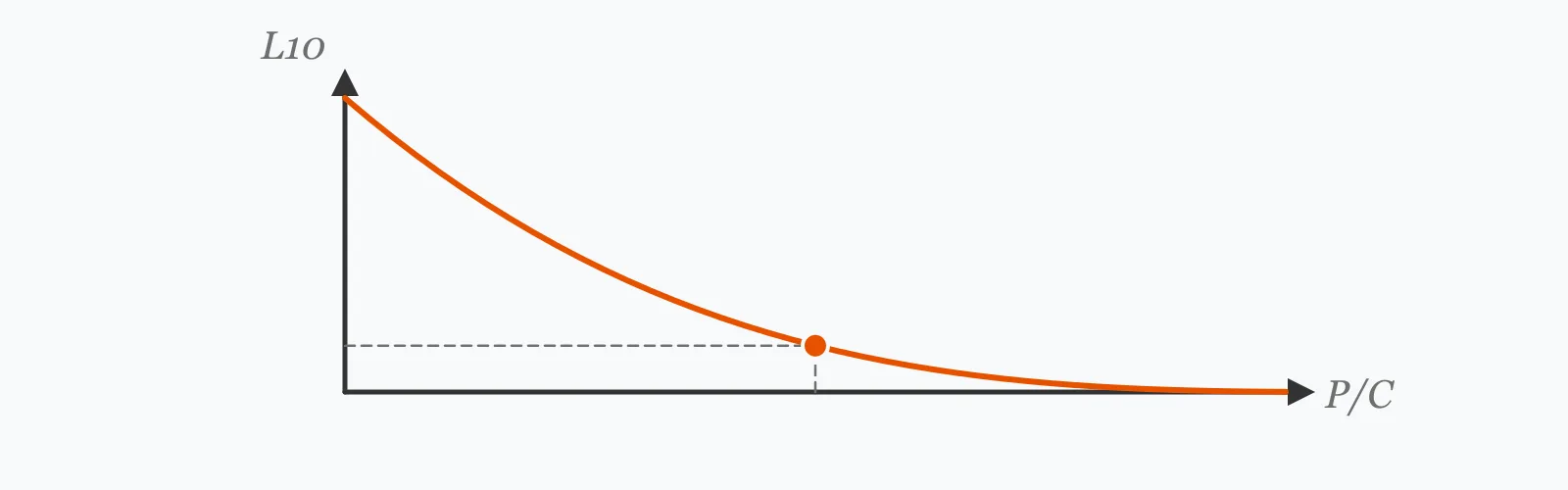
Life falls with the cube of load, so the curve is extremely steep at low loads and flattens as the load rises. That steepness is the whole reason bearing selection is so sensitive to getting the load right. The marker shows your current load.
Rating Life vs Equivalent Dynamic Load (P)
Recomputed live from your inputs. The marker shows your current value.
Line chart of Rating Life against Equivalent Dynamic Load (P). The same
values are listed in the data table below.
Values plotted above, sampled across the equivalent dynamic load (p) range.
How to Interpret Your Results
The life in hours is the practical result, but the C/P ratio tells you how much margin there is. Because the relationship is cubic, a modest change in that ratio transforms the answer.
Rating Life: < 5000Very short rating life
A rating life of your result hours is short for anything but intermittent duty. At this level the bearing will need replacing repeatedly within a normal machine life. Increasing the bearing size is far more effective than it appears, because life goes with the cube of the capacity ratio.
Rating Life: 5000 – 20000Moderate rating life
A rating life of your result hours suits intermittent or lightly used machinery. Continuously running industrial plant is normally designed for 20,000 to 50,000 hours, so check this against the expected overhaul interval.
Rating Life: 20000 – 100000Typical industrial design life
A rating life of your result hours falls in the range most industrial machinery is designed for. Remember this assumes clean, well-lubricated operation — contamination routinely reduces achieved life by an order of magnitude.
Rating Life: ≥ 100000Long rating life — check for oversizing
A rating life of your result hours far exceeds most machine design lives. A lightly loaded bearing can suffer its own problems: below a minimum load the rolling elements skid rather than roll, which damages the raceway surface. Check the manufacturer's minimum load requirement.
Load Ratio C/P: < 4Heavily loaded
A C/P ratio of your result is low. Below about 4 the contact stress approaches the point where the fatigue model itself becomes unreliable, and permanent deformation of the raceway begins to compete with fatigue as the failure mode. Check the static capacity C0 as well.
Common Mistakes to Avoid
Using the radial force as the equivalent load
Why it matters:P is an equivalent load combining radial and axial components with bearing-specific factors. Where meaningful thrust is present, using the radial force alone understates P — and because life goes with its cube, a 20% understatement inflates the predicted life by 95%.
✓How to avoid it:Compute P = X·Fr + Y·Fa using the factors for the specific bearing type and load ratio. The factors are in every bearing catalogue.
Confusing the dynamic rating C with the static rating C0
Why it matters:C governs fatigue life under rotation; C0 governs permanent deformation of the raceway under load, whether rotating or not. A bearing that is stationary or turning very slowly under heavy load can brinell its raceways before fatigue is ever relevant.
✓How to avoid it:Check both. Slow-moving, heavily loaded or shock-loaded applications are usually governed by C0 rather than by rating life.
Treating L10 as the life you will get
Why it matters:It is the life 90% of a population reaches under ideal conditions. One in ten fails sooner by definition, and in service contamination, poor lubrication and misalignment remove most bearings long before fatigue does.
✓How to avoid it:Use L10 to compare options, and apply the modified life L_nm with contamination and lubrication factors where a realistic prediction is needed. Sealing and lubrication usually deliver more life than a larger bearing does.
Using the ball bearing exponent for a roller bearing
Why it matters:Rollers use 10/3, not 3. Applying the cube law to a roller bearing understates its life by a factor of 2.15 at a C/P ratio of 10, and the discrepancy grows with the ratio.
✓How to avoid it:Select the exponent by bearing type. The difference reflects line contact against point contact, and it is a real physical distinction rather than a convention.
Ignoring the minimum load requirement
Why it matters:A very lightly loaded bearing does not simply last forever. Below a minimum load the rolling elements skid instead of rolling, and the resulting sliding damages the raceway surface — a failure mode the fatigue formula knows nothing about.
✓How to avoid it:Check the manufacturer's minimum load figure, particularly on lightly loaded high-speed shafts. Preloading is the usual solution.
Overlooking temperature and speed limits
Why it matters:Rating life assumes the bearing operates within its thermal and speed limits. Above them, lubricant film thickness collapses and the failure mode changes entirely from subsurface fatigue to surface distress.
✓How to avoid it:Check the limiting speed and operating temperature separately. A bearing with excellent calculated life can still fail quickly if its lubricant cannot maintain a film at the operating conditions.
Practical Applications
▸Selecting bearings for a required design life
▸Comparing ball and roller options for the same duty
▸Assessing the effect of a load increase on an existing machine
▸Estimating replacement intervals for maintenance planning
▸Checking whether a bearing is undersized for a revised duty
▸Evaluating the benefit of reducing shaft loads
Industry Use Cases
Rotating machinery design
Bearings are selected to a target rating life for the machine — commonly 20,000 to 50,000 hours for continuous industrial plant. Because life goes with the cube of the load ratio, moving one bearing size up often multiplies the life several times for a modest increase in shaft diameter.
Maintenance and reliability
Recorded bearing failures rarely match calculated lives, because contamination and lubrication dominate in practice. Reliability programmes therefore focus on sealing, lubricant condition and alignment rather than on recalculating fatigue life.
Gearboxes and transmissions
Gear tooth forces produce both radial and axial components, so the equivalent load calculation matters as much as the bearing choice. Helical gears in particular generate substantial thrust that a purely radial calculation would miss entirely.
Expert Tips
💡Life goes with the cube of C/P for ball bearings — halving the load gives eight times the life.
💡A 25% overload roughly halves the rating life.
💡Roller bearings use 10/3, giving 2.15 times the life of a ball at C/P = 10.
💡L10 means 10% are expected to fail sooner; it is not a guarantee.
💡Contamination and lubrication remove more bearings in service than fatigue does.
💡A very lightly loaded bearing can skid rather than roll — check the minimum load.
Advantages & Limitations
Advantages
✓Applies ISO 281 directly with the correct exponent for the bearing type
✓Converts to hours and years, matching how design life is specified
✓Reports the C/P ratio, which is the figure worth reasoning about
✓Warns where the failure mode may not be fatigue at all
✓Fast enough to compare bearing sizes and types during selection
Limitations
!Gives basic rating life only, without the reliability, lubrication and contamination factors
!Requires the equivalent load P to be computed separately from radial and axial components
!Assumes constant load and speed; variable duty needs a weighted cubic mean
!Takes no account of temperature, lubricant film thickness or limiting speed
!Does not check the static rating, which governs slow or shock-loaded applications
!Ignores misalignment, which many bearing types tolerate very poorly
!Says nothing about minimum load, below which skidding replaces rolling
How Load Governs Bearing Life
A ball bearing with a 25.5 kN dynamic rating at 1,500 rpm, running 16 hours a day. Follow the life column: each halving of load multiplies it by eight.
Ball bearing, C = 25.5 kN, 1,500 rpm, 16 h/day. Compare the first and last rows: the load rises by a factor of 3.4 and the life falls by a factor of 39.3 — which is 3.4³. A roller bearing at the C/P = 10 row would reach 2,154 million revolutions instead of 1,000.
The number of revolutions that 90% of an identical bearing population will complete before fatigue appears. One in ten is expected to fail sooner, and the median life is roughly five times L10.
How do I calculate bearing life in hours?
L10h = (10⁶/(60n)) × (C/P)^p. A bearing with C/P = 10 at 1,500 rpm gives 1,000 million revolutions, which is 11,111 hours.
Why is the exponent 3 for ball bearings?
It comes from the relationship between subsurface shear stress and fatigue life for point contact. Roller bearings have line contact, which spreads the load over a longer path and gives the shallower exponent of 10/3.
How much does halving the load extend bearing life?
By a factor of eight for a ball bearing, because the exponent is 3. This is the single most useful relationship in bearing selection and it makes going one size up far more effective than it looks.
What is the difference between C and C0?
C is the dynamic rating governing fatigue life under rotation; C0 is the static rating governing permanent raceway deformation under load. Slow or shock-loaded bearings are usually governed by C0.
What rating life should I design for?
20,000 to 50,000 hours for continuously running industrial machinery, less for intermittent duty. Check it against the intended overhaul interval rather than against a general rule.
Why do bearings fail before their calculated life?
Because fatigue is rarely the actual failure mode. Contamination, inadequate or wrong lubricant, misalignment and moisture ingress remove most bearings in service long before subsurface fatigue develops.
Can a bearing be too lightly loaded?
Yes. Below a minimum load the rolling elements skid rather than roll, and the sliding damages the raceway. Manufacturers publish a minimum load, and preloading is the usual remedy on lightly loaded high-speed shafts.
How is the equivalent load P calculated?
P = X·Fr + Y·Fa, combining radial and axial forces with factors specific to the bearing type and the ratio between them. Using the radial force alone understates P whenever meaningful thrust is present.
What is modified rating life?
L_nm = a1 · a_ISO · L10, adjusting the basic life for a chosen reliability level and for the actual lubrication and contamination conditions. It is the figure to use when a realistic prediction rather than a comparison is needed.
Glossary
L10
Basic rating life: the life 90% of an identical bearing population reaches.
Dynamic load rating (C)
The load giving exactly one million revolutions of rating life.
Static load rating (C0)
The load causing a defined permanent deformation of the raceway.
Equivalent dynamic load (P)
The single radial load doing the same damage as the actual load combination.
Life exponent
3 for ball bearings and 10/3 for rollers, reflecting point against line contact.
Modified rating life
L10 adjusted for reliability, lubrication and contamination.
Brinelling
Permanent indentation of a raceway by static or shock loading.
Skidding
Sliding of rolling elements under insufficient load, damaging the raceway surface.
Limiting speed
The maximum speed at which a bearing can operate with adequate lubrication.
Preload
A deliberate internal load applied to eliminate clearance and prevent skidding.
Scientific & Standards References
ISO 281 — Rolling bearings: Dynamic load ratings and rating life — International Organization for Standardization
ISO 76 — Rolling bearings: Static load ratings — International Organization for Standardization
Harris, T. A. and Kotzalas, M. N., Rolling Bearing Analysis, 5th Edition — CRC Press
SKF General Catalogue — Selecting bearing size using the life equations — SKF
Lundberg, G. and Palmgren, A., Dynamic Capacity of Rolling Bearings, Acta Polytechnica (1947) — Royal Swedish Academy of Engineering Sciences
Conclusion
Rolling bearing life follows a power law with an exponent of at least three, and that steepness is the whole story. The table above shows a load increase of 3.4 times cutting the life by 39.3 times — exactly 3.4 cubed. It works in the favourable direction too: halving the load multiplies the life by eight, which is why moving one bearing size up is so much more effective than it appears. The bearing type matters as well, since line contact in a roller gives the shallower 10/3 exponent and 2.15 times the life of a ball at the same C/P ratio. What the calculation cannot do is predict when a real bearing will fail. L10 assumes clean conditions and good lubrication, and in service contamination, wrong lubricant and misalignment remove most bearings long before fatigue develops — which is why sealing and lubrication usually buy more life than a larger bearing does.
Enter your bearing rating, load and speed above to compare options.