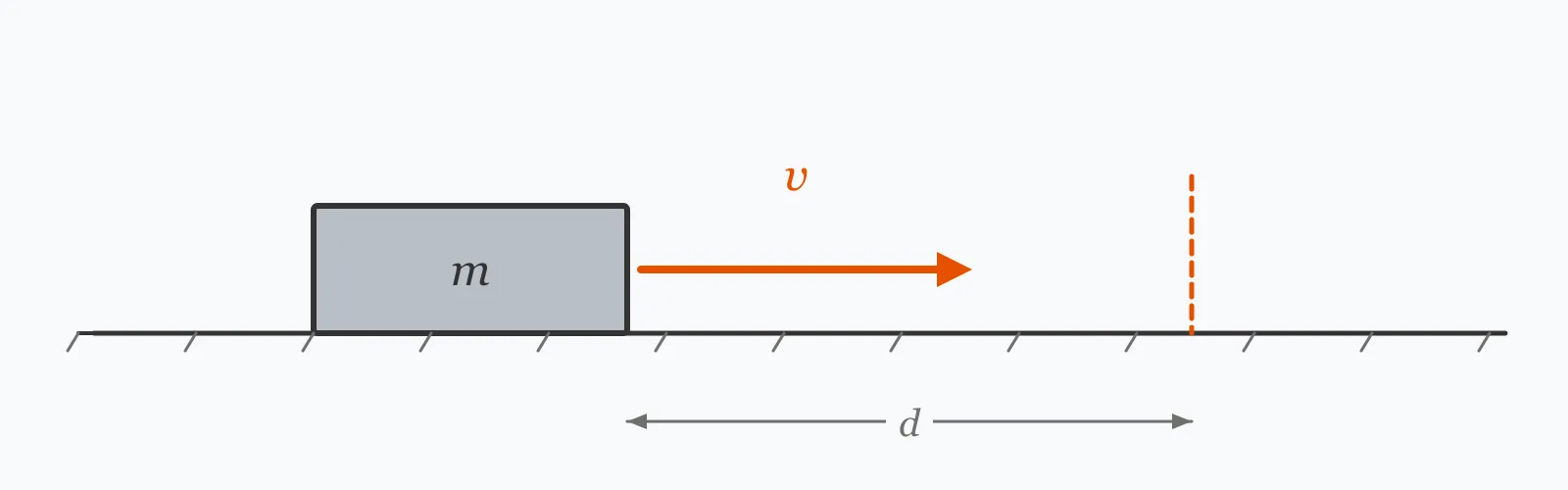
Kinetic energy is ½mv², so it rises with the square of speed while momentum rises only linearly. Enter the mass, velocity and available stopping distance to get the energy, the momentum, the average force needed to arrest it, and the height a free fall would need to reach the same speed.
Calculator
Units:
kg
Mass of the moving object
m/s
Speed. 14 m/s is about 50 km/h
m
Distance over which the energy is absorbed
Calculation Result
Press Calculate for the kinetic energy, the momentum, the average force required to stop over the distance entered, and the free-fall height that would produce the same speed.
Step-by-Step Solution
Preliminary design aid. Results follow the published formulas cited
below and are intended for estimating, study and early design. Final design must be
verified by a licensed Professional Engineer against the code in force for your project.
Key Benefits
✓Gives energy and momentum together, which behave quite differently
✓Converts energy into a stopping force over a stated distance
✓Reports the equivalent drop height, which makes an abstract figure concrete
✓Expresses the deceleration in g, the form injury criteria use
✓Sensitivity chart shows the squared dependence on speed
✓Shareable links and CSV export
What Is Kinetic Energy?
Kinetic energy is the work required to bring a mass from rest to its velocity, and equally the work required to bring it back to rest: E = ½mv². Momentum, p = mv, is a different quantity governing collisions and conservation. Both matter, but they scale differently — doubling the speed doubles the momentum and quadruples the energy, which is why energy is the quantity that determines damage.
The work-energy theorem in practice
Force times distance equals energy, so the average force needed to stop something is its kinetic energy divided by the distance available. That single relationship is the basis of every protective system: a crumple zone, an arrest bed, a fall arrest lanyard and a stunt airbag all work by extending the distance over which the same energy is dissipated. Doubling the stopping distance halves the force, with no change to the energy involved.
Why the equivalent drop height is useful
A figure in kilojoules means little on its own. Converting it to the height a free fall would need to reach the same speed makes it immediate: 14 m/s is the speed acquired by falling 10 metres, roughly a three-storey building. A vehicle at 50 km/h carries the energy of a drop from that height, which is a more useful way to convey severity than any number of joules.
Formula
E = ½ · m · v²
Kinetic energy of a mass moving at velocity v
Related Formulas
p = m · v
F = E / d
h = v² / 2g
Variable Definitions
Symbol
Variable
Unit
Description
m
Mass
kg
Mass of the moving object.
v
Velocity
m/s
Speed. Energy depends on its square, so this dominates.
E
Kinetic Energy
J
Work needed to reach that speed, or to remove it.
p
Momentum
kg·m/s
Mass times velocity, conserved in collisions.
d
Stopping Distance
m
Distance over which the energy is absorbed.
F
Stopping Force
N
Average force required, equal to energy divided by distance.
How to Use This Calculator
Use metres per secondDivide km/h by 3.6, or multiply mph by 0.447. Because energy goes with the square of velocity, a unit error here is squared into the result — mistaking km/h for m/s inflates the energy by a factor of 13.
Enter the realistic stopping distanceFor a vehicle impact this is the crush distance, typically 0.5 to 1 m for a modern car front structure — not the braking distance, which is a different and much larger quantity.
Read the force as an averageThe work-energy theorem gives the mean force over the distance. Real deceleration is far from constant, so the peak can be two or three times the average, which is what determines whether a structure or a person survives it.
Compare the deceleration in gDividing the stopping force by the object's weight gives the deceleration as a multiple of gravity, which is the form injury and equipment criteria use. Sustained levels above about 20g are injurious to a person.
Use the drop height to sanity-check the resultThe equivalent free-fall height converts an abstract energy figure into something physical. If the height seems implausible for the situation, the velocity or the units are probably wrong.
Worked Examples
Example 1
A 1,500 kg vehicle travelling at 14 m/s — about 50 km/h — brought to rest over a 0.6 m crush distance.
Average stopping force: F = E/d = 147,000 / 0.6 = 245,000 N = 245 kN
As a multiple of the vehicle's weight: 245,000 / (1,500 × 9.81) = 16.6g
Equivalent free-fall height: v²/2g = 196/19.62 = 9.99 m
Interpretation: the impact is equivalent to dropping the vehicle from about ten metres — roughly a three-storey building. The 0.6 m of crush is what turns an unsurvivable event into a survivable one, by spreading that energy over a distance.
Example 2
The same vehicle at 20 m/s instead of 14 — about 72 km/h against 50 — and then the effect of doubling the crush distance.
Step-by-Step Solution
At 20 m/s: E = ½ × 1,500 × 400 = 300,000 J, against 147,000 J at 14 m/s
The speed rose by 43%, and the energy by 104% — slightly more than doubling
Momentum rose only from 21,000 to 30,000 kg·m/s, exactly 43%: it is linear where energy is squared
Stopping force over the same 0.6 m: 500,000 N, or 34.0g — twice the previous figure
Equivalent drop height: 20.4 m, against 9.99 m. The higher speed corresponds to a fall from roughly a six-storey building rather than a three-storey one.
Now hold the speed at 14 m/s and double the crush distance from 0.6 to 1.2 m. The energy is unchanged at 147 kJ, but the force halves to 122,500 N, or 8.3g.
That is the entire principle of energy absorption. Nothing reduces the energy — it has to go somewhere — but spreading its dissipation over twice the distance halves the force that does the damage.
It also explains why the speed reduction matters more than any structural improvement. Going from 20 to 14 m/s removed 51% of the energy outright, which no amount of crush distance could achieve at the higher speed.
Velocity Sensitivity
Energy and stopping force curve upward with the square of speed while momentum rises as a straight line. Switching between the two series shows the divergence directly — and it is why speed rather than mass usually dominates severity. The marker shows your current velocity.
Kinetic Energy vs Velocity
Recomputed live from your inputs. The marker shows your current value.
Line chart of Kinetic Energy against Velocity. The same
values are listed in the data table below.
Values plotted above, sampled across the velocity range.
How to Interpret Your Results
The energy tells you what must be absorbed; the stopping force tells you what absorbing it in the available distance actually demands. The ratio between them is the distance, and it is the only variable a designer usually controls.
Kinetic Energy: < 1000Low energy
At your result J the energy is modest — comparable to a hand tool or a small object at walking pace. Even a short stopping distance keeps the forces manageable.
Kinetic Energy: 1000 – 50000Significant energy
At your result J this is enough energy to cause serious damage on impact. Check the stopping force against what the structure or the person involved can absorb, and remember the peak force is well above the average shown.
Kinetic Energy: 50000 – 500000Vehicle-scale energy
At your result J the energy is comparable to a road vehicle at speed. Absorbing it safely requires substantial distance — this is the regime crumple zones, barriers and arrest beds are designed for.
Kinetic Energy: ≥ 500000Very high energy
At your result J the energy is beyond what conventional protective structures absorb. Prevention of the event, rather than mitigation of its consequences, is the appropriate control at this level.
Average Stopping Force: ≥ 100000Very high stopping force
An average force of your result N over the stated distance is severe, and the peak will exceed it substantially. Extending the stopping distance is the only lever that reduces it — halving the force requires doubling the distance.
Common Mistakes to Avoid
Using km/h or mph directly
Why it matters:The formula needs metres per second, and the error is squared. Entering 50 as though it were m/s when the speed is 50 km/h inflates the energy by a factor of 13 — 3.6 squared.
✓How to avoid it:Divide km/h by 3.6 or multiply mph by 0.447 before entering. The equivalent drop height output is a useful check: an implausible height usually means a unit error.
Confusing energy with momentum
Why it matters:They answer different questions. Momentum is conserved in a collision and determines the velocities afterwards; energy determines the damage. Energy goes with v² and momentum with v, so they diverge as speed rises.
✓How to avoid it:Use momentum for collision outcomes and energy for damage and absorption. In the example above, a 43% speed increase raised momentum by 43% and energy by 104%.
Treating the average force as the peak
Why it matters:The work-energy theorem gives the mean force over the distance. Real decelerations are far from uniform, and the peak can be two or three times the average — which is what governs injury and structural failure.
✓How to avoid it:Treat the calculated force as a lower bound on severity. Where the peak matters, a crash pulse or a dynamic analysis is needed rather than an energy balance.
Assuming a heavier object is always more dangerous
Why it matters:Energy is linear in mass but squared in velocity, so speed usually dominates. A 100 kg mass at 20 m/s carries 20 kJ; a 400 kg mass at 5 m/s carries only 5 kJ despite being four times heavier.
✓How to avoid it:Compare energies rather than masses. Speed limits reduce severity far more effectively than weight limits do, for exactly this reason.
Forgetting rotational energy
Why it matters:A rolling or spinning object also stores energy in its rotation, which for a solid cylinder adds 50% to the translational figure and for a hoop doubles it. A flywheel or a rolling wheel carries substantially more energy than ½mv² alone suggests.
✓How to avoid it:Add ½Iω² where rotation is significant. This calculator gives translational energy only.
Ignoring where the energy actually goes
Why it matters:The energy does not disappear — it deforms structures, generates heat and sound, and accelerates whatever is struck. Assuming it is absorbed harmlessly by a rigid object simply relocates the problem.
✓How to avoid it:Identify the absorbing mechanism explicitly. If nothing deforms, the stopping distance is very small and the force correspondingly enormous.
Practical Applications
▸Estimating impact energy for guard and barrier design
▸Sizing energy absorbers and crash structures
▸Assessing fall arrest and drop test requirements
▸Comparing the severity of events at different speeds
▸Calculating flywheel and rotating mass energy storage
▸Checking deceleration against injury criteria
Industry Use Cases
Vehicle safety
Crumple zones exist to extend the stopping distance, since the energy is fixed once the impact begins. Doubling the crush distance halves the average deceleration, which is the mechanism behind almost every advance in occupant protection.
Machine guarding
Guards and containment structures are specified against the kinetic energy of whatever might be ejected, not against its mass. A small fragment at high speed frequently carries more energy than a large one moving slowly.
Fall protection
Fall arrest systems limit the force on the body by extending the deceleration distance with an energy-absorbing lanyard. The free fall distance sets the energy; the absorber sets the distance over which it is dissipated, and therefore the force.
Expert Tips
💡Energy goes with v², momentum with v — a 43% speed rise gave 104% more energy.
💡Divide km/h by 3.6 for m/s; the error would otherwise be squared.
💡Doubling the stopping distance halves the force, with no change to the energy.
💡The equivalent drop height makes an abstract joule figure immediate.
💡Peak force is typically two to three times the calculated average.
💡Rotating objects store extra energy that ½mv² does not include.
Advantages & Limitations
Advantages
✓Gives energy and momentum together, showing how differently they scale
✓Converts energy into a stopping force, which is the actionable quantity
✓Reports the equivalent drop height as an intuitive cross-check
✓Expresses deceleration in g, matching how injury criteria are written
✓Simple enough to use as a quick severity check in a risk assessment
Limitations
!Translational energy only — rotating objects store more
!Gives the average stopping force, not the peak that governs failure
!Assumes all the energy is absorbed over the stated distance
!Takes no account of how the energy divides between colliding bodies
!Assumes constant mass and speeds well below relativistic
!Does not model material behaviour, deformation modes or rebound
!The equivalent drop height ignores air resistance
How Speed Dominates Severity
A 1,500 kg mass stopped over 0.6 m. Energy and force rise with the square of speed; momentum rises linearly, and the gap between the two columns widens all the way down.
1,500 kg, 0.6 m stopping distance. From 5 to 30 m/s the speed rises six times, the momentum six times, and the energy thirty-six times. That divergence is why speed reduction is the most effective single safety measure available.
E = ½mv² with mass in kilograms and velocity in metres per second. A 1,500 kg vehicle at 14 m/s carries 147,000 J, or 147 kJ.
Why does energy go with the square of speed?
Because the work done accelerating a mass is force times distance, and both the force needed and the distance covered scale with speed. Integrating gives the squared relationship.
What is the difference between energy and momentum?
Momentum is mv and is conserved in collisions, determining the velocities afterwards. Energy is ½mv² and determines the damage. Energy scales with the square of speed, momentum only linearly.
How do I calculate stopping force?
Divide the kinetic energy by the stopping distance. 147 kJ over 0.6 m gives 245,000 N — an average force, with the peak substantially higher.
How much does doubling the stopping distance help?
It halves the average force. The energy is unchanged, but spreading its dissipation over twice the distance halves the force required — which is the principle behind every energy-absorbing device.
Why is speed more dangerous than mass?
Because energy is linear in mass but squared in velocity. Doubling the mass doubles the energy; doubling the speed quadruples it. A light object moving fast is often more dangerous than a heavy one moving slowly.
What is the equivalent drop height?
The height a free fall would need to reach the same speed, v²/2g. At 14 m/s it is 9.99 m — so a 50 km/h impact carries the energy of a fall from about three storeys.
How many g is a given deceleration?
Divide the stopping force by the object's weight. 245,000 N on a 1,500 kg vehicle is 16.6g. Sustained levels above about 20g are injurious to a person.
Does this include rotational energy?
No. A rolling or spinning object stores ½Iω² in addition, which adds 50% for a solid cylinder and doubles the total for a hoop. Flywheels and rolling wheels carry substantially more than ½mv².
How do I convert km/h to m/s?
Divide by 3.6. Getting this wrong squares into the energy — treating 50 km/h as 50 m/s overstates the energy by a factor of 13.
Glossary
Kinetic energy
The work needed to bring a mass from rest to its velocity, ½mv².
Momentum
Mass times velocity, conserved in collisions.
Work-energy theorem
The principle that work done equals the change in kinetic energy.
Stopping distance
The distance over which kinetic energy is dissipated.
Deceleration in g
Deceleration expressed as a multiple of gravitational acceleration.
Crumple zone
A structure designed to deform progressively, extending the stopping distance.
Rotational kinetic energy
Energy stored in rotation, ½Iω², additional to translational energy.
Peak force
The maximum instantaneous force during deceleration, above the calculated average.
Energy absorber
A device dissipating energy over a controlled distance to limit force.
Elastic collision
A collision conserving kinetic energy as well as momentum.
Scientific & Standards References
Halliday, D., Resnick, R. and Walker, J., Fundamentals of Physics — Chapter on Kinetic Energy and Work — Wiley
Euro NCAP — Assessment Protocol: Adult Occupant Protection — European New Car Assessment Programme
EN 795 — Personal fall protection equipment: Anchor devices — CEN
ISO 14120 — Safety of machinery: Guards, general requirements for design and construction — International Organization for Standardization
SAE J211 — Instrumentation for Impact Test — SAE International
Conclusion
Kinetic energy rises with the square of speed while momentum rises linearly, and the table above shows how far that divergence goes: from 5 to 30 m/s the momentum rises six times and the energy thirty-six. That is why speed reduction is the most effective safety measure available, and why it beats any amount of structural improvement — dropping from 20 to 14 m/s removed 51% of the energy outright, which no crumple zone could match at the higher speed. Once an impact begins the energy is fixed, and the only remaining variable is the distance over which it is dissipated. Force is energy divided by distance, so doubling the crush length halves the average force. Every protective device works this way. Two cautions: the figure calculated is an average, and real peaks run two to three times higher, and a rotating object stores energy that ½mv² does not count at all.
Enter a mass, speed and stopping distance above to see the energy and the force it demands.