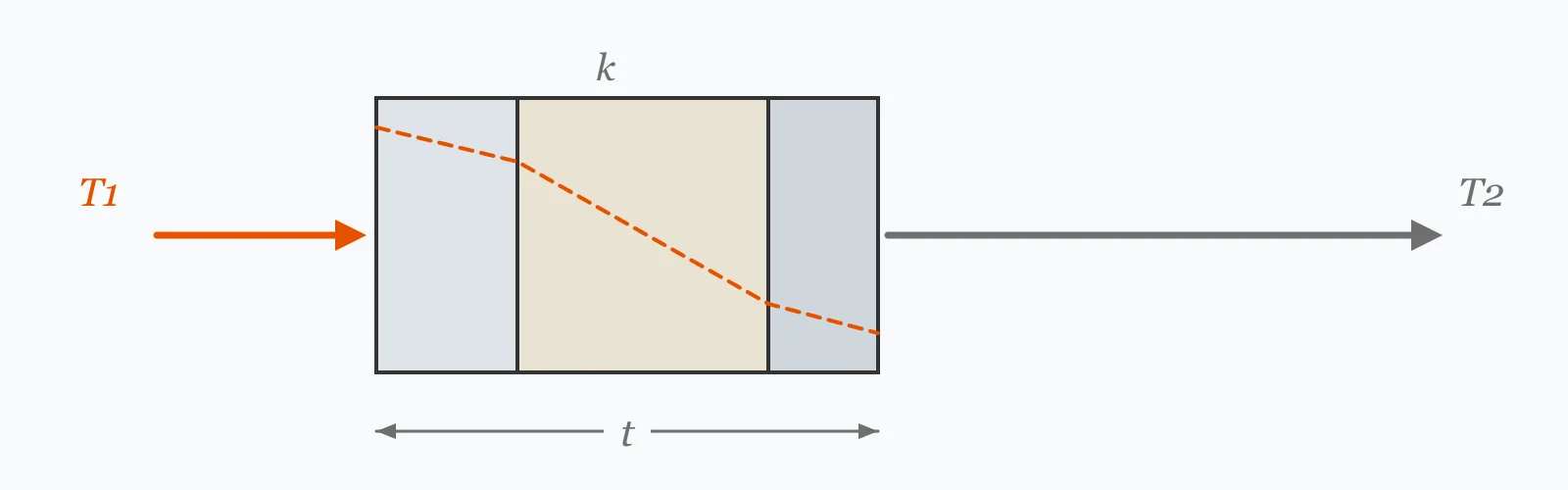
Heat flow through a wall is resisted by the material and by the still air films either side of it. Enter the thermal conductivity, thickness, area, temperature difference and surface resistance to get the total thermal resistance, the U-value, the heat flux per square metre and the total heat flow.
Calculator
Units:
W/m·K
Mineral wool 0.035, PIR 0.022, timber 0.13, brick 0.77, concrete 1.3
mm
Depth of material in the direction of heat flow
m²
Surface area through which heat flows
K
Between inside and outside environments
m²K/W
Both films combined. Wall 0.17, roof 0.14, floor 0.21
Calculation Result
Press Calculate for the total thermal resistance, the U-value, the heat flux per square metre and the total heat flow through the area entered. Lower U-values mean better insulation.
Step-by-Step Solution
Preliminary design aid. Results follow the published formulas cited
below and are intended for estimating, study and early design. Final design must be
verified by a licensed Professional Engineer against the code in force for your project.
Key Benefits
✓Includes surface film resistances, which are often omitted and sometimes dominant
✓Reports both U-value and R-value, since standards use each
✓Gives heat flux and total flow, so the result scales to any area
✓Warns when the surface films provide most of the resistance
✓Sensitivity chart shows the diminishing return of added thickness
✓Shareable links and CSV export for design records
What Is Heat Transfer?
Conduction through a slab of material follows Fourier's law: the heat flow is proportional to area and temperature difference, and inversely proportional to thickness divided by conductivity. That quotient — thickness over conductivity — is the thermal resistance R, in m²K/W. Resistances in series simply add, so a multi-layer construction is the sum of its layers plus the surface films at each face.
U-value and R-value are reciprocals
R measures resistance, so higher is better; U measures transmittance, so lower is better. U = 1/R_total, and building standards are written in U-values because they multiply directly by area and temperature difference to give heat loss. A wall with 3.03 m²K/W of total resistance has a U-value of 0.33 W/m²K, which is roughly what a modern insulated wall achieves.
Why surface films matter so much on thin elements
Still air clinging to each face resists heat flow, contributing about 0.13 m²K/W inside and 0.04 outside for a wall. On a well-insulated element that is a rounding error — 5.6% of the total for 100 mm of mineral wool. On a bare 100 mm concrete wall it is 68.9%, more than the concrete itself. This is why single glazing insulates at all, and why wind stripping the outer film changes the answer noticeably.
Formula
R = t / k
Thermal resistance of a layer, from thickness in metres and conductivity in W/m·K
Related Formulas
R_total = R_si + ΣR_layers + R_so
U = 1 / R_total
Q = U · A · ΔT
Variable Definitions
Symbol
Variable
Unit
Description
k
Thermal Conductivity
W/m·K
Material property. Mineral wool 0.035, timber 0.13, concrete 1.3, steel 50.
t
Thickness
mm
Depth of material in the direction of heat flow.
R
Thermal Resistance
m²K/W
Resistance to heat flow. Higher is better, and resistances add in series.
U
U-Value
W/m²K
Thermal transmittance, the reciprocal of total resistance. Lower is better.
ΔT
Temperature Difference
K
Between the inside and outside environments, not the surfaces.
R_s
Surface Resistance
m²K/W
Still air films at each face, about 0.17 total for a wall.
How to Use This Calculator
Use the declared conductivity for the actual productGeneric figures vary widely within a material class — mineral wool ranges from about 0.032 to 0.044 W/m·K, and PIR reaches 0.022. Manufacturers publish a declared lambda value, and for anything being assessed against a standard that is the figure to use.
Include the surface resistances0.17 m²K/W total is the standard figure for a wall, 0.14 for a roof and 0.21 for a floor, reflecting how convection differs with orientation. Omitting them overstates the U-value, and on a poorly insulated element the error is large.
Use the environmental temperature differenceThe ΔT is between the inside and outside air, not between the two surfaces. The surface resistances already account for the temperature drop across the air films, so using surface temperatures would double-count them.
Add layers by adding resistancesThis calculator handles a single material layer. For a multi-layer construction, compute each layer's t/k separately and add them together with the surface resistances before taking the reciprocal.
Remember what a plane-element calculation missesReal constructions have thermal bridges at studs, junctions, lintels and fixings, and these commonly add 10 to 30% to the heat loss the plane element alone predicts. A whole-element assessment needs them counted separately.
Worked Examples
Example 1
A 100 mm mineral wool layer with a conductivity of 0.035 W/m·K, over 10 m², with 20 K between inside and outside and standard wall surface resistances of 0.17 m²K/W.
Step-by-Step Solution
Material resistance: R = t/k = 0.100/0.035 = 2.857 m²K/W
Total resistance: 2.857 + 0.17 = 3.027 m²K/W
U-value: 1/3.027 = 0.330 W/m²K
Heat flux: U × ΔT = 0.330 × 20 = 6.61 W/m²
Total heat flow: 6.61 × 10 m² = 66.1 W
The surface films provide 0.17/3.027 = 5.6% of the resistance — negligible here
Interpretation: 0.33 W/m²K is roughly what a modern insulated wall achieves. Over 10 m² and 20 K the loss is only 66 W, about the same as a person sitting in the room.
Example 2
The same wall in bare concrete instead — conductivity 1.3 W/m·K, nearly forty times higher — and then what doubling each material's thickness achieves.
Step-by-Step Solution
Concrete at 100 mm: R = 0.100/1.3 = 0.0769 m²K/W, total 0.247 m²K/W
U-value: 4.05 W/m²K, heat flux 81.0 W/m², total flow 810.0 W
That is 12.3 times the heat loss of the insulated wall, from the same 100 mm of thickness.
Now double each. Mineral wool at 200 mm: total resistance 5.884, U-value 0.170 — a 48.6% reduction.
Concrete at 200 mm: total resistance 0.324, U-value 3.088 — only a 23.7% reduction.
The concrete gains half as much proportionally for the same doubling, because the surface films are already 68.9% of its total resistance and doubling the concrete does nothing to them.
This is the practical asymmetry that matters. On a conductive element, the still air films are most of the insulation, so the material thickness has little leverage. On an insulated element the material dominates, and thickness works.
It also explains why 100 mm of insulation added to the concrete wall would take the U-value from 4.05 to 0.32, while another 100 mm of concrete takes it only to 3.09.
Thickness Sensitivity
Resistance rises linearly with thickness but the U-value falls as its reciprocal, so the benefit of each additional layer diminishes sharply. The first 50 mm of insulation does far more than the fifth. The marker shows your current thickness.
U-Value vs Thickness
Recomputed live from your inputs. The marker shows your current value.
Line chart of U-Value against Thickness. The same
values are listed in the data table below.
Values plotted above, sampled across the thickness range.
How to Interpret Your Results
The U-value is what standards are written against and what compares constructions directly. The share of resistance held by the surface films tells you whether adding material will help.
U-Value: < 0.2Very well insulated
A U-value of your result W/m²K meets or exceeds current standards for roofs and approaches passive house levels for walls. At this performance thermal bridges at junctions and fixings usually contribute more heat loss than the plane element does.
U-Value: 0.2 – 0.4Meets modern wall standards
A U-value of your result W/m²K is around what current building regulations require for walls in temperate climates. Check the requirement for the specific element type — roofs and floors are usually held to tighter figures.
U-Value: 0.4 – 1.5Moderate — below modern standards
A U-value of your result W/m²K is typical of a partially insulated or older construction. Adding insulation is highly effective at this level, because the material rather than the surface films dominates the resistance.
U-Value: ≥ 1.5Effectively uninsulated
A U-value of your result W/m²K loses heat at several times the rate a compliant construction would. Note that on an element this conductive, the surface films may hold most of the resistance — so adding thickness of the same material achieves far less than adding a thin layer of insulation.
Total Heat Flow: ≥ 1000Substantial heat loss
A heat flow of your result W through this element alone is significant. Scale it across the whole building envelope and it becomes a major share of the heating load — worth comparing against the cost of improving it.
Common Mistakes to Avoid
Omitting the surface resistances
Why it matters:They contribute about 0.17 m²K/W for a wall, which is trivial against well-insulated construction but dominant against a conductive one. Leaving them out of the concrete example above would give a U-value of 13.0 instead of 4.05 — more than three times too high.
✓How to avoid it:Always include them, using the standard figure for the element orientation: 0.17 for walls, 0.14 for roofs, 0.21 for floors.
Adding U-values instead of resistances
Why it matters:U-values are reciprocals and do not add. Two layers of U = 0.5 do not give U = 1.0; they give R = 2 + 2 = 4, so U = 0.25. Adding transmittances gets the direction of the answer wrong as well as the magnitude.
✓How to avoid it:Convert to resistances, add them in series, then take the reciprocal of the total. Only resistances are additive.
Expecting proportional benefit from added thickness
Why it matters:Resistance grows linearly with thickness but the U-value falls as its reciprocal, so each additional layer helps less than the last. Going from 100 to 200 mm of mineral wool cuts the U-value by 48.6%, but from 200 to 300 mm would cut it far less.
✓How to avoid it:Compare the cost of each increment against the diminishing saving. There is a practical optimum beyond which further insulation costs more than it saves.
Ignoring thermal bridges
Why it matters:Timber studs, steel fixings, lintels and junctions all bypass the insulation, and they commonly add 10 to 30% to the loss the plane element predicts. On a highly insulated construction the bridges can exceed the plane element entirely.
✓How to avoid it:Assess bridges separately using linear and point transmittance values. The better the plane element, the more the bridges matter in relative terms.
Using a generic conductivity value
Why it matters:Materials within a class vary considerably — mineral wool spans roughly 0.032 to 0.044 W/m·K, a 38% range that translates directly into the resistance. Insulation performance also degrades with moisture and, for some foams, with age.
✓How to avoid it:Use the manufacturer's declared value, and the aged value where the product's conductivity changes over time.
Assuming steady state applies
Why it matters:This calculation gives the steady-state heat flow. A real building has thermal mass that stores and releases heat, so the instantaneous flow varies through the day and the peak load differs from the steady-state figure.
✓How to avoid it:Steady state is appropriate for annual energy estimates and for comparing constructions. Peak load and overheating analysis need a dynamic method that accounts for thermal capacity.
Practical Applications
▸Calculating wall, roof and floor U-values
▸Estimating fabric heat loss for a heating load
▸Comparing insulation thicknesses and materials
▸Checking a construction against a regulatory U-value
▸Assessing the benefit of retrofitting insulation
▸Sizing heating systems from envelope losses
Industry Use Cases
Building design
U-values are the currency of building regulations, and each element type carries its own limit. Because resistances add, designers trade insulation thickness against buildability — a thinner high-performance board often costs less overall than a thicker conventional one once wall depth is counted.
Retrofit
The first increment of insulation on an uninsulated element delivers most of the available saving, because the U-value falls as a reciprocal. Taking a solid wall from 2.0 to 0.5 W/m²K saves three times as much as taking it from 0.5 to 0.3.
Industrial process
Pipe and vessel insulation follows the same principle with a cylindrical correction, and surface films are often the dominant resistance on bare hot pipework. That is why even a thin insulation layer on a bare pipe delivers a large proportional saving.
Expert Tips
💡Resistances add in series; U-values do not.
💡R = t/k, so a material forty times more conductive gives forty times less resistance.
💡Surface films are 5.6% of an insulated wall's resistance and 68.9% of a bare concrete one.
💡U-value falls as a reciprocal, so each added layer helps less than the last.
!Does not cover cylindrical geometry, needed for pipe insulation
!Ignores radiation exchange except as absorbed into the standard surface resistances
!Air cavities need their own resistance value rather than a t/k calculation
Material and Thickness Compared
10 m² with 20 K across it and standard wall surface resistances. Compare the two doubling steps: the insulation gains twice as much proportionally as the concrete.
10 m², ΔT = 20 K, surface resistance 0.17 m²K/W. Doubling the mineral wool cuts the U-value by 48.6%; doubling the concrete cuts it by only 23.7%, because the surface films it cannot influence already hold 68.9% of its resistance.
Add the thermal resistances of every layer plus the surface films, then take the reciprocal. 100 mm of mineral wool gives 2.857 plus 0.17 surface, so U = 1/3.027 = 0.330 W/m²K.
What is the difference between U-value and R-value?
They are reciprocals. R measures resistance to heat flow so higher is better; U measures transmittance so lower is better. Only R values add across layers.
What are surface resistances?
The still air films clinging to each face of an element. Standard totals are 0.17 m²K/W for walls, 0.14 for roofs and 0.21 for floors, reflecting how convection differs with orientation.
Why does doubling insulation not halve the heat loss?
Because the surface films and any other layers do not change. Doubling 100 mm of mineral wool cuts the U-value by 48.6% — close to half because the material dominates. Doubling concrete cuts it by only 23.7%.
What U-value do building regulations require?
It varies by country and element, but around 0.18 to 0.30 W/m²K for walls and 0.11 to 0.16 for roofs is typical of current temperate-climate standards. Check the applicable requirement for the specific element.
Can I add U-values for a multi-layer wall?
No. Convert each layer to a resistance with R = t/k, add all the resistances including the surface films, then take the reciprocal of the total. Adding U-values gives a wrong answer in the wrong direction.
What is a thermal bridge?
A path that bypasses the insulation — a timber stud, a steel fixing, a lintel or a junction. Bridges commonly add 10 to 30% to the plane element's heat loss, and proportionally more the better insulated the element is.
What is the thermal conductivity of common materials?
Roughly: PIR 0.022, mineral wool 0.035, timber 0.13, brick 0.77, concrete 1.3 and steel 50 W/m·K. The range from insulation to steel is more than a factor of a thousand.
Does moisture affect insulation performance?
Considerably. Water conducts around twenty times better than still air, so wet insulation loses much of its value. This is why vapour control and drainage detailing matter as much as the insulation specification itself.
Is a steady-state calculation good enough?
For annual energy estimates and for comparing constructions, yes. For peak heating loads and summer overheating, thermal mass matters and a dynamic calculation is needed instead.
Glossary
Thermal conductivity
A material's ability to conduct heat, in W/m·K. Often written as lambda.
Thermal resistance
Thickness divided by conductivity, in m²K/W. Resistances add in series.
U-value
Thermal transmittance, the reciprocal of total resistance, in W/m²K.
Surface resistance
The resistance of the still air film at a surface.
Heat flux
Heat flow per unit area, in W/m².
Thermal bridge
A path of higher conductivity bypassing the insulation layer.
Declared lambda
The manufacturer's stated conductivity for a specific product.
Thermal mass
A material's capacity to store heat, which steady-state calculations ignore.
Fourier's law
The relation stating that heat flow is proportional to area and temperature gradient.
Cavity resistance
The resistance of an air gap, which depends on width, orientation and surface emissivity rather than on t/k.
Scientific & Standards References
ISO 6946 — Building components: Thermal resistance and thermal transmittance calculation methods — International Organization for Standardization
ISO 10456 — Building materials and products: Declared and design thermal values — International Organization for Standardization
CIBSE Guide A — Environmental Design, Chapter 3: Thermal properties of building structures — Chartered Institution of Building Services Engineers
ISO 10211 — Thermal bridges in building construction: Heat flows and surface temperatures — International Organization for Standardization
ASHRAE Handbook of Fundamentals — Chapter 25: Heat, Air and Moisture Control — American Society of Heating, Refrigerating and Air-Conditioning Engineers
Conclusion
Thermal resistances add in series, and that single rule explains most of what is surprising about insulation. Resistance is thickness divided by conductivity, so mineral wool at 0.035 W/m·K buys nearly forty times more resistance per millimetre than concrete at 1.3 — which is why the table above shows the same 100 mm giving a U-value of 0.33 in one case and 4.05 in the other. The surface films matter in inverse proportion to how good the element already is: 5.6% of an insulated wall's resistance and 68.9% of a bare concrete one. That is why doubling the insulation cuts the U-value by 48.6% while doubling the concrete manages only 23.7% — the concrete cannot influence the films that hold most of its resistance. Two things this calculation cannot see: thermal bridges, which add 10 to 30% and matter more the better the element gets, and thermal mass, which decides peak loads even though it does not affect the steady state.
Enter your material, thickness and area above to get the U-value and heat loss.