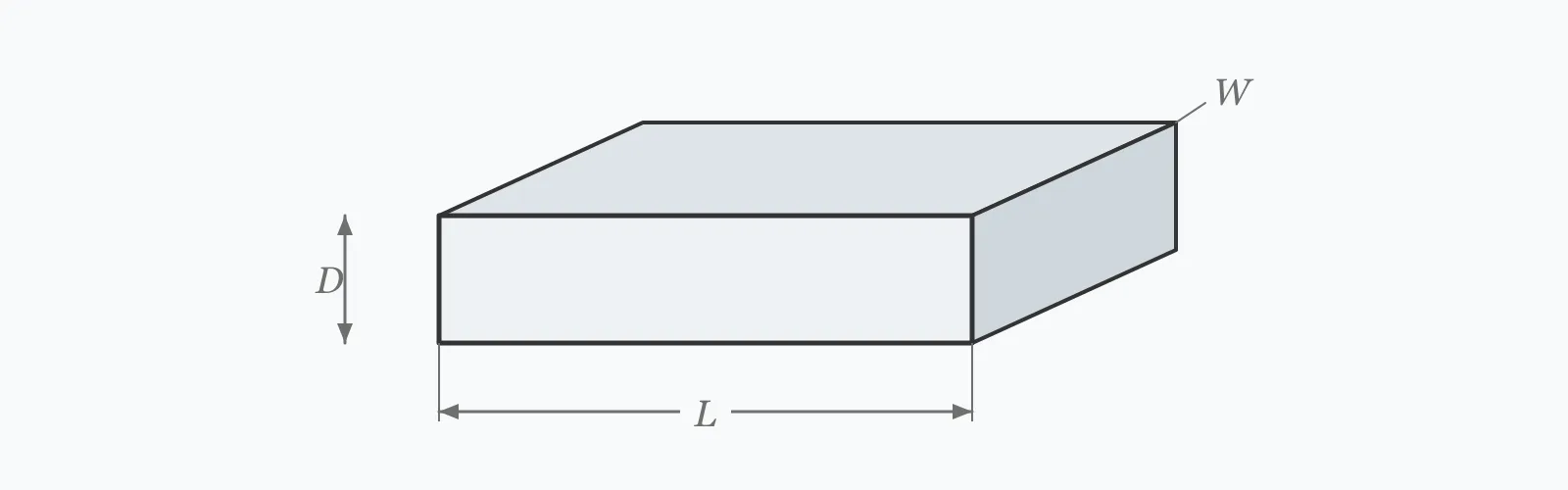
Concrete volume is length × width × depth, plus an allowance for waste. Enter your dimensions and a waste factor to get the net and total volume in cubic metres and yards, the number of 40 kg bags, and how many ready-mix truck loads it represents. The waste factor is not optional — running short mid-pour is far more costly than over-ordering.
Calculator
Units:
m
Plan length of the slab or footing
m
Plan width of the slab or footing
m
In metres — a 150 mm slab is 0.15
%
5–10% for slabs, 10–15% for footings in soft ground
Calculation Result
Press Calculate for the net volume, the total including waste, the equivalent number of 40 kg bags, and the ready-mix truck loads. Order against the total volume, not the net.
Step-by-Step Solution
Preliminary design aid. Results follow the published formulas cited
below and are intended for estimating, study and early design. Final design must be
verified by a licensed Professional Engineer against the code in force for your project.
Key Benefits
✓Returns net and waste-inclusive volume so the ordering figure is unambiguous
✓Converts to 40 kg bags and to ready-mix loads in the same pass
✓Includes a cubic yard conversion for suppliers who quote in imperial
✓Warns on unusually thin or thick sections and on large single pours
✓Sensitivity chart shows how volume responds to slab thickness
✓Shareable links and CSV export for a purchase record
What Is Concrete Volume?
For any prismatic element — a slab, a strip footing, a rectangular pad — the concrete volume is simply the product of its three dimensions. The arithmetic is trivial; what causes problems is everything around it. Dimensions must be in consistent units, thickness is usually quoted in millimetres while plan dimensions are in metres, and the volume that leaves the batching plant is never quite the volume that ends up in the formwork.
Why the waste factor exists
Concrete is lost to spillage, to over-excavation that the concrete then fills, to formwork deflecting outward under the wet pressure, to material left in the truck and the pump line, and to test cylinders. On a well-controlled slab pour the loss runs around 5%; on a footing dug into soft ground it can exceed 15%, because the trench takes whatever it takes. A 10% allowance is the usual default for a slab on a prepared subbase.
Bags or ready-mix
The crossover sits at roughly half a cubic metre. Below that, bagged concrete is convenient and avoids a minimum-load charge. Above it the bag count becomes unmanageable — the 8.25 m³ in the worked example below would take nearly 500 bags, several days of mixing and a very uneven result. Ready-mix suppliers typically carry 6 to 9 m³ per truck and charge a part-load fee below their minimum, which is often around 3 m³.
Formula
V = L × W × D
Net concrete volume of a rectangular element
Related Formulas
V_total = V × (1 + waste/100)
V_yd³ = V_m³ × 1.30795
N_bags = V_total / 0.017
V_circular = π D² h / 4
Variable Definitions
Symbol
Variable
Unit
Description
V
Net Volume
m³
Geometric volume of the element, before any allowance for waste.
V_total
Total Volume
m³
Volume to order, including the waste allowance. This is the ordering figure.
L
Length
m
Longer plan dimension of the element.
W
Width
m
Shorter plan dimension of the element.
D
Depth
m
Thickness of the slab or depth of the footing. Enter in metres — 150 mm is 0.15.
waste
Waste Factor
%
Allowance for spillage, over-excavation and material left in the truck. 5–10% for slabs, 10–15% for footings.
How to Use This Calculator
Enter every dimension in metresThickness is the one people get wrong: a 150 mm slab is 0.15 m, not 150. Entering millimetres here would overstate the volume by a factor of a thousand, which is at least an obvious error rather than a subtle one.
Use the excavated depth for footings, not the design depthA trench in soft ground is rarely the size it was drawn. Concrete fills whatever was dug, so measure the actual excavation or raise the waste factor accordingly.
Choose a waste factor that matches the job5% for a slab on a compacted subbase with tight formwork, 10% as a general default, 15% or more for footings in soft or irregular ground. Pumped concrete adds a further allowance for the material left in the line.
Break complex shapes into rectanglesAn L-shaped slab is two rectangles; a thickened edge is a strip added to the field slab. Compute each part separately and add, taking care not to double-count the overlap at corners.
Order against the total, then round to the supplier's incrementReady-mix is normally sold in 0.5 m³ steps. Round up rather than down — the cost of a partial extra load is trivial against the cost of a cold joint.
Worked Examples
Example 1
A ground floor slab measures 10.0 m by 5.0 m and is 150 mm thick. Allow 10% for waste and work out what to order.
As 40 kg bags: 8.25 / 0.017 = 486 bags — clearly impractical at this scale
As ready-mix: 8.25 / 8.0 = 1.03 truck loads, so order two deliveries or one truck plus a part load
Practical order: 8.5 m³, rounded up to the supplier's half-metre increment.
Example 2
A strip footing 24 m long, 600 mm wide and 450 mm deep, dug into soft clay. This is the case where the waste factor stops being a formality.
Step-by-Step Solution
Convert: L = 24.0 m, W = 0.60 m, D = 0.45 m
Net volume: V = 24.0 × 0.60 × 0.45 = 6.48 m³
At a 10% allowance: V_total = 6.48 × 1.10 = 7.13 m³
But the trench sides in soft clay will not hold the drawn profile. At a 20% allowance more appropriate to the ground: V_total = 6.48 × 1.20 = 7.78 m³
The difference between the two allowances is 0.65 m³ — around 8% of the order, and roughly the volume of one extra part-load
Ready-mix: 7.78 / 8.0 = 0.97 truck loads, so a single delivery covers it if the supplier's minimum charge is acceptable
The judgement to make: over-ordering costs the price of the surplus. Under-ordering on a footing means a construction joint at an arbitrary point, which then has to be justified to the engineer.
Thickness Sensitivity
Volume is directly proportional to thickness, so the curve is a straight line — but the practical consequences are not linear. Watch where the truck count crosses each whole number, since that is where an extra delivery charge appears. The marker shows your current thickness.
Total Volume (with waste) vs Depth / Thickness (D)
Recomputed live from your inputs. The marker shows your current value.
Line chart of Total Volume (with waste) against Depth / Thickness (D). The same
values are listed in the data table below.
Values plotted above, sampled across the depth / thickness (d) range.
How to Interpret Your Results
Volume itself is not a pass-or-fail quantity, so the bands below indicate what the result implies for how you buy and place the concrete. The thresholds are commercial rather than structural.
Total Volume (with waste): < 0.5Bag territory
A total volume of your result m³ is small enough for bagged concrete, avoiding any minimum-load charge. Hand or drum mixing is practical at this scale, though consistency between batches is worth watching if the finish matters.
Total Volume (with waste): 0.5 – 3Awkward middle ground
A total volume of your result m³ is large for bags and below most ready-mix minimum loads, which typically sit around 3 m³. Expect a part-load charge, or check whether a volumetric mixer that batches on site is available in your area.
Total Volume (with waste): 3 – 50Standard ready-mix order
A total volume of your result m³ is a normal ready-mix order. Round up to the supplier's increment, confirm access and discharge times, and have a plan for any surplus before the truck arrives.
Total Volume (with waste): ≥ 50Large pour — plan the logistics
A total volume of your result m³ needs several trucks in sequence. Schedule deliveries against the placing rate rather than ordering them all at once, agree construction joint locations in advance, and confirm that concrete can be placed and finished before the initial set.
Ready-Mix Trucks (8 m³): 1 – 1.3Just over a full load
At your result truck loads you are barely into a second delivery. Check whether trimming the waste allowance, or a small dimensional change, brings the order under one load — the saving is a whole delivery charge.
Common Mistakes to Avoid
Entering thickness in millimetres
Why it matters:Plan dimensions are naturally in metres while thickness is quoted in millimetres, so mixing them is easy. Entering 150 instead of 0.15 overstates the volume a thousandfold.
✓How to avoid it:Convert thickness to metres before entering: divide millimetres by 1000. A result in the thousands of cubic metres for a domestic slab is the signature of this error.
Ordering the net volume
Why it matters:The geometric volume takes no account of spillage, over-excavation, formwork movement or the concrete left in the truck and pump line. Ordering it guarantees running short.
✓How to avoid it:Always order against the waste-inclusive total. Even a well-controlled slab pour loses around 5%, and a footing in soft ground can lose three times that.
Using the drawn trench profile for footings
Why it matters:Excavation in anything other than firm ground over-breaks, and the concrete fills the hole that exists rather than the one that was drawn. Volumes routinely exceed the calculated figure by 15 to 25%.
✓How to avoid it:Measure the actual excavation where possible, or raise the waste factor to suit the ground. In very soft conditions, consider trench sheeting to control the profile.
Forgetting the thickened edges and downstands
Why it matters:A slab with a thickened perimeter or an integral beam carries substantially more concrete than its nominal thickness suggests. On a small slab the extra can be 20% of the total.
✓How to avoid it:Compute the field slab and each thickening separately, then add. Watch the overlap at corners so a strip is not counted twice.
Ignoring the supplier's minimum load
Why it matters:Most ready-mix suppliers charge a part-load fee below a minimum of around 3 m³. An order of 2 m³ can cost nearly as much as 3 m³, which changes the economics of the pour.
✓How to avoid it:Check the minimum before ordering. Where a job sits just below it, consider whether an adjacent element can be poured at the same time.
Not planning for surplus concrete
Why it matters:Surplus has to go somewhere, and returning it to the plant may attract a disposal charge. Discharging it in an unplanned location creates a problem that outlives the pour.
✓How to avoid it:Identify a use in advance — a spare pad, a haunch, a fence post base — or agree the return arrangement with the supplier when ordering.
Practical Applications
▸Estimating concrete for ground slabs and floor slabs
▸Ordering material for strip and pad foundations
▸Quantifying driveways, paths and hardstandings
▸Sizing pours for retaining wall stems and bases
▸Estimating column and pier concrete on small projects
▸Checking a supplier's quantity against your own take-off
Industry Use Cases
Residential construction
Small builders order in half-metre increments and treat the waste factor as insurance. Because a domestic slab pour is a single continuous operation with a small crew, running short is disproportionately damaging — the finishing team is already on site and the joint cannot be hidden.
Quantity surveying
Take-off quantities feed both the tender price and the material order, but they serve different purposes. Surveyors typically price the net volume and order the gross, keeping the waste allowance visible as a separate line so it can be reconciled after the pour.
Ready-mix supply
Suppliers schedule truck rotations against a customer's placing rate rather than the total order. A 40 m³ pour delivered in five trucks needs those trucks spaced to the crew's capacity, or the last arrivals exceed their discharge window and the load is rejected.
Expert Tips
💡Volume is linear in every dimension, so a 10% error in thickness is a 10% error in the order.
💡Round up to the supplier's increment. The cost of surplus is trivial against the cost of a cold joint.
💡Bagged concrete stops being sensible above about half a cubic metre — 0.5 m³ is already 30 bags.
💡For footings in soft ground, measure the excavation rather than trusting the drawing.
💡Break irregular plans into rectangles and add; it is faster and less error-prone than an area formula.
💡Agree in advance where surplus concrete will go, before it is sitting in a truck on your site.
Advantages & Limitations
Advantages
✓Direct arithmetic with no assumptions to challenge
✓Separates net from ordering volume, which serve different purposes
✓Converts straight into the units suppliers actually quote in
✓Extends to any prismatic shape by summing rectangles
✓Fast enough to check a supplier's quantity while on the phone
Limitations
!Covers rectangular prisms only; circular and tapered elements need their own formulas
!Assumes uniform thickness, so thickened edges must be added separately
!Bag yield of 0.017 m³ is nominal and varies between products
!Truck capacity of 8 m³ is typical but suppliers carry 6 to 9
!Does not account for reinforcement displacement, which is negligible below about 2% by volume
!Takes no account of pump line losses, typically a further 0.2 to 0.5 m³
!Gives no guidance on mix design, strength class or placing method
Waste Allowance by Element and Ground Condition
The waste factor is where estimating judgement lives. These are the allowances commonly applied, and the reason each differs — the numbers reflect how much control you have over the shape the concrete actually fills.
Indicative allowances. Site conditions, crew experience and placing method all shift these, and a job's own history is the best guide.
Multiply length by width by depth, all in metres, then add a waste allowance. A 10 m by 5 m slab at 150 mm thick gives 7.5 m³ net, and 8.25 m³ after a 10% allowance — which is the figure to order.
How much waste should I allow for concrete?
5 to 10% for a slab on a prepared subbase, 10 to 15% for pad foundations, and 15 to 25% for strip footings in soft ground where the trench over-breaks. Pumping adds a further 2 to 5% for material left in the line.
How many 40 kg bags make a cubic metre?
About 59, since each bag yields roughly 0.017 m³. That makes bagged concrete impractical above about half a cubic metre — the 8.25 m³ in the example above would need 486 bags.
How much concrete does a ready-mix truck carry?
Typically 6 to 9 m³, with 8 m³ a common working figure. Most suppliers also set a minimum load of around 3 m³ and charge a part-load fee below it, which matters for small pours.
How do I convert cubic metres to cubic yards?
Multiply by 1.308. So 8.25 m³ is 10.79 yd³. Going the other way, multiply cubic yards by 0.7646. Suppliers in North America quote in cubic yards, so the conversion is worth having to hand.
Should I order the net or the total volume?
The total, including waste. The net figure is the geometric volume of the finished element and takes no account of spillage, over-excavation or material left behind. Ordering it reliably leaves you short.
How do I calculate concrete for an L-shaped slab?
Split it into two rectangles, compute each and add. Take care at the corner where they meet so the overlapping strip is not counted twice — that is the usual error with compound shapes.
Does reinforcement reduce the concrete volume?
Negligibly. Steel typically occupies under 2% of a section's volume, which is well inside the waste allowance. It is not worth deducting, and doing so risks under-ordering.
What happens if I run out of concrete mid-pour?
You get a cold joint where the fresh concrete meets partially set concrete, which is a plane of weakness and a potential water path. It usually has to be reported to the engineer, and remediation costs far more than the surplus you were trying to avoid.
How do I work out concrete for a circular column?
Use πD²h/4, where D is the diameter and h the height. A 400 mm column 3 m tall gives π × 0.4² × 3 / 4 = 0.377 m³, before any waste allowance.
Glossary
Net volume
The geometric volume of the finished element, before any allowance for waste.
Waste factor
A percentage allowance covering spillage, over-excavation, formwork movement and material left in the truck or pump line.
Ready-mix concrete
Concrete batched at a plant and delivered by truck mixer, typically 6 to 9 m³ per load.
Part-load charge
A fee applied by suppliers when an order falls below their minimum load, commonly around 3 m³.
Cold joint
A plane of weakness formed where fresh concrete is placed against concrete that has already begun to set.
Over-break
Excavation beyond the designed profile, which concrete then fills, increasing the volume required.
Volumetric mixer
A truck that batches and mixes on site, allowing exact quantities and avoiding minimum-load charges.
Thickened edge
A local increase in slab depth at the perimeter or under a load, adding volume beyond the nominal thickness.
Discharge window
The time within which concrete must be placed after batching, typically 90 to 120 minutes.
Scientific & Standards References
ACI 301 — Specifications for Structural Concrete — American Concrete Institute
ACI 304R — Guide for Measuring, Mixing, Transporting, and Placing Concrete — American Concrete Institute
ASTM C94/C94M — Standard Specification for Ready-Mixed Concrete — ASTM International
EN 206 — Concrete: Specification, performance, production and conformity — CEN
BS 8500-1 — Concrete: Complementary British Standard to BS EN 206 — British Standards Institution
Conclusion
Concrete volume is length times width times depth, and the arithmetic is the easy part. What decides whether a pour goes well is the waste allowance and the units: thickness entered in millimetres instead of metres is the classic error, and ordering the net volume instead of the gross is the classic omission. Choose the allowance to match the job — 5% for a slab on a prepared subbase, up to 25% for footings in soft clay where the trench takes whatever it takes — and round up to the supplier's increment. Surplus concrete costs the price of the surplus; running short costs a cold joint and a conversation with the engineer.
Work out your own pour above, then sweep the thickness in the chart to see where the truck count crosses a whole number.