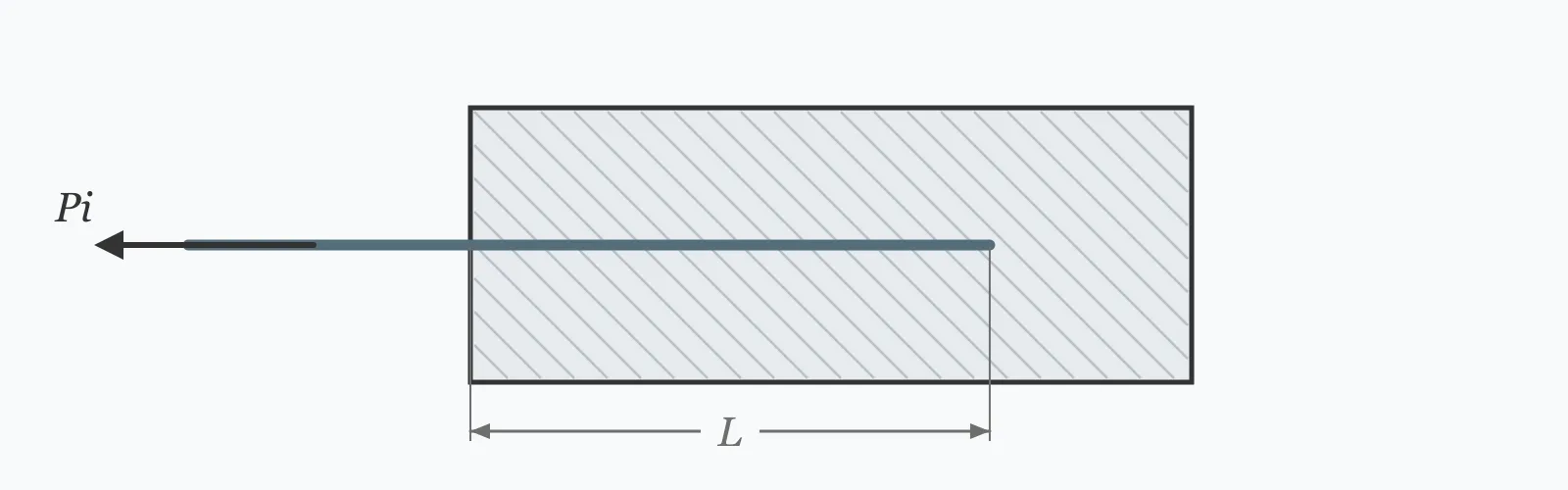
A prestressed tendon does not keep the force it was stressed to. Enter the initial stress, the concrete stress at the tendon, the two moduli, the creep coefficient, the shrinkage strain and the relaxation percentage to get each loss separately, the total, and the effective stress remaining.
Calculator
Units:
MPa
Stress immediately after stressing, typically 0.7 to 0.75 of ultimate
MPa
Sustained compressive stress in the concrete at tendon level
GPa
195 GPa for prestressing strand
GPa
Around 32 GPa for the higher grades used in prestressing
2 to 3 typical; early transfer pushes it higher
microstrain
200 to 400 microstrain typical for long-term shrinkage
%
2 to 3% for low-relaxation strand; 8% or more for normal relaxation
Calculation Result
Press Calculate for the total long-term loss in MPa and as a percentage, the effective stress remaining in the tendon, and the elastic shortening component separately.
Step-by-Step Solution
Preliminary design aid. Results follow the published formulas cited
below and are intended for estimating, study and early design. Final design must be
verified by a licensed Professional Engineer against the code in force for your project.
Key Benefits
✓Separates the four losses instead of applying a lump percentage
✓Shows how much comes from the concrete rather than the steel
✓Reports the effective stress, which is what the design actually relies on
✓Warns when the total falls outside the range real members achieve
✓Sensitivity chart shows concrete stress driving two losses at once
✓Shareable links and CSV export for design records
What Is Prestress Loss?
Prestress is applied by stressing a tendon and locking it off, but the force does not stay where it was put. Four mechanisms reduce it over time. The concrete shortens elastically when the force is transferred, then goes on shortening through creep, and shrinks independently as it dries — the tendon follows all three. Separately, the steel itself relaxes, losing stress at constant strain.
Why the concrete stress matters twice
Elastic shortening is the modular ratio times the concrete stress at the tendon. Creep is that same product multiplied again by the creep coefficient. So the concrete stress feeds two of the four losses, and with a creep coefficient of 2 those two together are three times the elastic loss alone. Raising the concrete stress at the tendon from 6 to 15 MPa takes the total loss from 15.4% to 28.1% — nearly doubling it.
Pre-tensioned and post-tensioned differ
In a pre-tensioned member the whole force transfers at once, so the elastic shortening loss applies in full. In a post-tensioned member with sequential stressing, each tendon shortens the concrete for those stressed before it, but the last tendon stressed suffers no elastic loss at all — the average is roughly half. Post-tensioning also adds friction along the duct and draw-in at the anchorage, neither of which is a time-dependent loss.
Formula
Δf_elastic = n · f_c
Elastic shortening, with n the modular ratio Es/Ec and fc the concrete stress at the tendon
Related Formulas
Δf_creep = n · f_c · φ
Δf_shrinkage = ε_sh · E_s
Δf_relaxation = R · f_pi
Variable Definitions
Symbol
Variable
Unit
Description
f_pi
Initial Stress
MPa
Tendon stress immediately after stressing, typically 0.7 to 0.75 of the ultimate.
f_c
Concrete Stress at Tendon
MPa
Compressive stress in the concrete at the tendon level, under sustained load.
n
Modular Ratio
—
Es divided by Ec, around 6 for normal concrete and prestressing steel.
φ
Creep Coefficient
—
Ratio of creep to elastic strain. 2 to 3 is typical.
ε_sh
Shrinkage Strain
microstrain
Long-term shrinkage, typically 200 to 400 microstrain.
R
Relaxation
%
Steel stress loss at constant strain. 2 to 3% for low-relaxation strand.
How to Use This Calculator
Use the concrete stress at tendon levelNot the extreme fibre stress or the average across the section. The tendon experiences the concrete strain where it sits, and in a member with an eccentric tendon that differs substantially from either.
Take the creep coefficient from the actual conditionsLoading age, humidity and member size all move it, and the range from 1.5 to 3 changes the total loss from 18.7% to 25.8% in the worked case. Early transfer pushes it up, which is part of what programme acceleration costs structurally.
Halve the elastic loss for sequential post-tensioningIn a pre-tensioned member the full force transfers at once and the whole elastic loss applies. Where tendons are stressed sequentially, the last suffers none and the average is roughly half — a distinction worth making explicitly.
Use low-relaxation values only if that is what is specifiedLow-relaxation strand loses 2 to 3%; normal-relaxation wire loses 8% or more. The difference is several percent of the total loss, and low-relaxation is the modern default but not universal.
Add friction and draw-in for post-tensioned membersBoth occur at stressing rather than over time, and friction increases along the tendon so the effective prestress is not uniform. This calculation covers only the four time-dependent losses.
Worked Examples
Example 1
A tendon stressed to 1,300 MPa in a member with 10 MPa of concrete stress at tendon level, steel modulus 195 GPa, concrete 32 GPa, creep coefficient 2.0, shrinkage 300 microstrain and 2.5% relaxation.
Step-by-Step Solution
Modular ratio: 195/32 = 6.09
Elastic shortening: 6.09 × 10 = 60.9 MPa
Creep: 6.09 × 10 × 2.0 = 121.9 MPa
Shrinkage: 300×10⁻⁶ × 195,000 = 58.5 MPa
Relaxation: 2.5% × 1,300 = 32.5 MPa
Total: 60.9 + 121.9 + 58.5 + 32.5 = 273.8 MPa
As a percentage: 273.8/1,300 = 21.06%
Effective stress: 1,300 − 273.8 = 1,026.2 MPa
Interpretation: creep alone is 44.5% of the total loss, and creep plus shrinkage together are 65.9%. Two thirds of what the tendon loses is the concrete moving, not the steel.
Example 2
The same tendon at different concrete stresses, and then at different creep coefficients — the two inputs that dominate.
Step-by-Step Solution
At 6 MPa concrete stress: total loss 200.7 MPa, or 15.4%
At 10 MPa: 273.8 MPa, 21.1%
At 15 MPa: 365.2 MPa, 28.1%
Raising the concrete stress by a factor of 2.5 has raised the total loss by 82%, because it drives both the elastic and creep components simultaneously.
Now hold the concrete stress at 10 MPa and vary the creep coefficient. At 1.0 the total is 16.4%; at 2.0 it is 21.1%; at 3.0 it is 25.8%.
Each unit of creep coefficient adds 60.9 MPa — exactly the elastic loss — because the creep loss is that same product multiplied by φ.
So the two most influential inputs are linked: the concrete stress sets the size of the elastic loss, and the creep coefficient then multiplies it. A member stressed high and transferred early suffers both.
The shrinkage and relaxation components, by contrast, do not respond to either. They stay at 58.5 and 32.5 MPa throughout, which is why they become a smaller share of the total as the concrete stress rises.
Concrete Stress Sensitivity
Total loss rises steeply with the concrete stress at the tendon, because that single input drives both the elastic and the creep components. The effective stress falls in mirror image. The marker shows your current concrete stress.
Total Loss vs Concrete Stress at Tendon
Recomputed live from your inputs. The marker shows your current value.
Line chart of Total Loss against Concrete Stress at Tendon. The same
values are listed in the data table below.
Values plotted above, sampled across the concrete stress at tendon range.
How to Interpret Your Results
The percentage loss is the headline figure, but the effective stress is what the design relies on. Where the loss comes from determines what could be done about it.
Total Loss: < 12Optimistically low
A total loss of your result% is below what real members achieve. Post-tensioned members typically lose 15 to 25%, and pre-tensioned somewhat more because elastic shortening applies in full. Check the creep coefficient and the concrete stress at tendon level.
Total Loss: 12 – 25Typical range
A total loss of your result% is in the normal range for a prestressed member. Confirm that friction and anchorage draw-in have been added separately if this is post-tensioned — neither is a time-dependent loss and neither appears here.
Total Loss: 25 – 35High loss
A total loss of your result% is high. Both the elastic and creep components scale with the concrete stress at the tendon, so reducing it — through a larger section or a different tendon profile — attacks two of the four losses at once.
Total Loss: ≥ 35Very high loss
A total loss of your result% leaves little effective prestress. Check the inputs: a high concrete stress combined with a high creep coefficient, which usually means early transfer, is the combination that produces this. Both are addressable at design stage.
Effective Stress: ≥ 0This is the stress the design relies on
The effective stress after all losses is your result MPa. Serviceability checks — decompression, crack width and deflection — all use this figure rather than the stress at transfer, which the member only ever sees briefly.
Common Mistakes to Avoid
Applying a lump 15% and moving on
Why it matters:The four losses respond to different things, and their total ranges from about 15% to nearly 30% across ordinary conditions. A member with high concrete stress at the tendon and early transfer can lose twice what a lightly stressed mature one does.
✓How to avoid it:Compute the components. It also shows which one to attack — reducing the concrete stress addresses two of the four at once.
Using the full elastic loss for sequential post-tensioning
Why it matters:Each tendon shortens the concrete for those stressed before it, but the last tendon stressed suffers no elastic loss at all. Applying the full value to every tendon overstates the loss by roughly half that component.
✓How to avoid it:Use the full elastic loss for pre-tensioned members and about half for sequentially stressed post-tensioned ones.
Forgetting friction and anchorage draw-in
Why it matters:In a post-tensioned member these occur at stressing, not over time, and friction accumulates along the duct so the prestress varies along the member. Neither appears in a time-dependent loss calculation.
✓How to avoid it:Compute friction from the duct profile and the wobble and curvature coefficients, and draw-in from the anchorage system. Both are separate from the four losses here.
Using an optimistic creep coefficient
Why it matters:Creep is the largest single loss, and the coefficient depends on loading age, humidity and member size. Going from 1.5 to 3.0 raises the total loss from 18.7% to 25.8% in the worked case.
✓How to avoid it:Compute the creep coefficient for the actual transfer age and environment rather than assuming a mid-range value. Early transfer is the common cause of a high figure.
Using normal-relaxation values for low-relaxation strand or vice versa
Why it matters:Low-relaxation strand loses 2 to 3%; normal-relaxation wire loses 8% or more. That is several percent of the total, and the two are not interchangeable in the calculation.
✓How to avoid it:Use the value for the product actually specified. Low-relaxation is the modern default but older structures and some markets use normal-relaxation.
Designing to the stress at transfer
Why it matters:The member holds the transfer stress only briefly. Serviceability behaviour over its life depends on the effective stress after all losses, which in the worked example is 21% lower.
✓How to avoid it:Check transfer conditions against the initial stress and everything else against the effective stress. Both checks are needed and they use different numbers.
Practical Applications
▸Estimating long-term prestress losses in design
▸Checking effective prestress for serviceability
▸Comparing transfer ages for their loss penalty
▸Assessing the effect of concrete stress on total loss
▸Reviewing an existing prestressed member
▸Comparing low-relaxation and normal-relaxation strand
Industry Use Cases
Precast prestressed concrete
Pre-tensioned beams transfer the whole force at once at an early age, so both the elastic loss and the creep coefficient are at their worst. Accelerated curing raises the strength quickly enough to permit transfer, but it does not eliminate the creep penalty of loading young concrete.
Post-tensioned slabs and bridges
Sequential stressing roughly halves the elastic loss, and friction along the duct becomes a separate concern that varies along the member. Stressing from both ends is common precisely to limit the friction loss at midspan.
Assessment of existing structures
Estimating the prestress remaining in an existing member requires the loss history, and where records are incomplete the concrete stress and transfer age are the parameters worth establishing first — they drive two thirds of the total.
Expert Tips
💡Long-term losses typically run 15 to 25% of the initial stress.
💡Creep and shrinkage together are about two thirds of the total.
💡Concrete stress at the tendon drives both the elastic and the creep loss.
💡Each unit of creep coefficient adds exactly one elastic loss to the total.
💡Sequential post-tensioning halves the elastic component.
💡Friction and draw-in are separate and occur at stressing, not over time.
Advantages & Limitations
Advantages
✓Separates the four losses instead of applying a lump percentage
✓Shows how much of the loss comes from the concrete rather than the steel
✓Makes the double role of concrete stress explicit
✓Reports the effective stress, which serviceability checks depend on
✓Fast enough to compare transfer ages and section sizes
Limitations
!Covers the four time-dependent losses only
!Excludes friction and anchorage draw-in, which post-tensioned members also suffer
!Applies the full elastic loss — halve it for sequential post-tensioning
!Assumes constant concrete stress at the tendon over time
!Uses a supplied creep coefficient rather than computing it
!Does not account for differential shrinkage in composite construction
!Gives stress loss, not the resulting change in member behaviour
What Drives the Loss
A tendon at 1,300 MPa with 195/32 GPa moduli, 300 microstrain shrinkage and 2.5% relaxation. The upper block varies the concrete stress at the tendon; the lower varies the creep coefficient at 10 MPa.
All values in MPa. Shrinkage and relaxation never move — they respond to neither variable. Concrete stress raises the elastic and creep columns together, and each unit of creep coefficient adds exactly one elastic loss to the creep column.
Typically 15 to 25% of the initial stress for post-tensioned members, and somewhat more for pre-tensioned ones because elastic shortening applies in full.
What are the four prestress losses?
Elastic shortening at transfer, creep of the concrete under sustained stress, drying shrinkage of the concrete, and relaxation of the steel at constant strain.
Which loss is the largest?
Creep, usually. In the worked example it is 44.5% of the total, and creep plus shrinkage together are 65.9% — two thirds of the loss is the concrete moving rather than the steel.
Why does concrete stress at the tendon matter so much?
Because it drives two losses at once. Elastic shortening is the modular ratio times that stress, and creep is the same product multiplied by the creep coefficient. Raising it from 6 to 15 MPa raised the total loss by 82%.
Do pre-tensioned and post-tensioned members lose the same?
No. Pre-tensioned members transfer the whole force at once so the elastic loss applies in full; sequential post-tensioning halves it, because the last tendon stressed suffers none.
What is steel relaxation?
Loss of stress in the tendon at constant strain — the steel gradually accommodates the stress it is held at. Low-relaxation strand loses 2 to 3%; normal-relaxation wire loses 8% or more.
Are friction losses included here?
No. Friction along the duct and anchorage draw-in occur at stressing rather than over time, and friction accumulates along the tendon so the prestress varies along the member. Both need separate calculation.
Does early transfer increase losses?
Yes, through creep. Young concrete creeps considerably more, and the creep loss is the largest single component — so accelerating the programme by transferring early has a structural cost in effective prestress.
Which stress should serviceability checks use?
The effective stress after all losses, which in the worked example is 1,026 MPa against 1,300 at transfer. The transfer stress is checked separately for the transfer condition itself.
How can total losses be reduced?
Reduce the concrete stress at the tendon, which attacks the elastic and creep components together. Transfer later to lower the creep coefficient, and specify low-relaxation strand. Shrinkage is the hardest to influence.
Glossary
Elastic shortening
Immediate loss as the concrete compresses when prestress is transferred.
Creep loss
Loss as the concrete continues shortening under sustained stress.
Shrinkage loss
Loss as the concrete contracts on drying, independent of stress.
Relaxation
Loss of stress in the steel held at constant strain.
Modular ratio
Es divided by Ec, the ratio of steel to concrete stiffness.
Effective prestress
The stress remaining in the tendon after all losses.
Transfer
The moment prestress force is applied to the concrete.
Friction loss
Loss along a post-tensioned duct from curvature and wobble.
Anchorage draw-in
Loss as the tendon slips slightly when locked off at the anchorage.
Low-relaxation strand
Prestressing steel treated to reduce relaxation to 2 to 3%.
Scientific & Standards References
EN 1992-1-1 (Eurocode 2) §5.10 — Prestressed members and structures — CEN
ACI 318 — Building Code Requirements for Structural Concrete, Chapter 20: Prestressing — American Concrete Institute
PCI Design Handbook — Precast and Prestressed Concrete — Precast/Prestressed Concrete Institute
Hurst, M. K., Prestressed Concrete Design, 2nd Edition — CRC Press
BS EN 10138 — Prestressing steels — British Standards Institution
Conclusion
A prestressed tendon keeps roughly four fifths of the force it was stressed to, and where the missing fifth goes is worth knowing. Two thirds of it is the concrete moving rather than the steel: creep alone is 44.5% of the total in the worked case and creep plus shrinkage 65.9%. That points at the input to attend to, because the concrete stress at tendon level drives both the elastic and the creep components — the table above shows raising it from 6 to 15 MPa increasing the total loss by 82%, while shrinkage and relaxation do not move at all. The creep coefficient then multiplies the elastic loss directly, so each unit of it adds exactly one elastic loss to the total. A member stressed high and transferred early suffers both effects at once, which is the structural cost of an accelerated programme. Post-tensioned members need friction and draw-in added separately, and their elastic loss is roughly half this figure where tendons are stressed in sequence.
Enter your tendon and concrete parameters above to separate the four losses.