Concrete under sustained load goes on deforming for years, and it shrinks whether loaded or not. Enter the applied stress, elastic modulus, relative humidity, member size, loading age and the time of interest to get the creep coefficient, the creep and shrinkage strains, and the total.
Calculator
Units:
MPa
Permanent compressive stress. Transient load does not cause creep
GPa
Around 30 GPa for normal strength concrete
%
Ambient humidity. Heated interiors are drier than outdoors
mm
Twice the cross-sectional area divided by the drying perimeter
days
When sustained load is first applied. Early loading creeps more
days
Age at which the strain is assessed. 3650 days is 10 years
Calculation Result
Press Calculate for the creep coefficient at the time of interest, the creep and shrinkage strains in microstrain, and the total strain including the immediate elastic component.
Step-by-Step Solution
Preliminary design aid. Results follow the published formulas cited
below and are intended for estimating, study and early design. Final design must be
verified by a licensed Professional Engineer against the code in force for your project.
Key Benefits
✓Applies humidity, member size and loading age factors rather than a single assumed value
✓Separates creep from shrinkage, which have different causes and remedies
✓Reports strains in microstrain, matching how movement is specified
✓Shows the time development, not just the ultimate value
✓Sensitivity chart shows how much loading age costs
✓Shareable links and CSV export for design records
What Is Concrete Creep and Shrinkage?
Creep is the continuing deformation of concrete under sustained stress, caused by water migrating within the cement paste and by microcracking. It is expressed as a coefficient — the ratio of creep strain to the initial elastic strain — so a coefficient of 2 means the member eventually deforms three times its immediate amount. Shrinkage is separate: the concrete contracts as it dries, whether or not it carries load at all.
Why loading age matters so much
Young concrete creeps far more than mature concrete under the same stress, because the hydration products are still forming and the structure of the paste is less developed. Loading at 3 days rather than 28 raises the creep coefficient from 1.95 to 2.54, a 30% increase — which is what early striking and early prestressing cost in long-term deflection.
Dry environments move more
Both creep and shrinkage increase as humidity falls, because moisture leaves the concrete more readily. That makes a heated internal environment worse than an exposed external one, which is counter-intuitive but well established: at 40% relative humidity the total strain is 39% higher than at 80%. Member size works the same way — a thin section dries faster and moves more than a thick one.
Creep coefficient, with correction factors and the time development function
Related Formulas
ε_creep = ε_elastic · φ
ε_sh = 780×10⁻⁶ · γ_RH · [t / (35 + t)]
ε_total = ε_elastic + ε_creep + ε_sh
Variable Definitions
Symbol
Variable
Unit
Description
φ
Creep Coefficient
—
Ratio of creep strain to elastic strain. Typically 1.5 to 3.
σ
Applied Stress
MPa
Sustained compressive stress. Only the permanent part causes creep.
Ec
Elastic Modulus
GPa
Concrete modulus, around 30 GPa for normal strength.
RH
Relative Humidity
%
Ambient humidity. Lower means more creep and more shrinkage.
h
Notional Size
mm
Twice the area over the drying perimeter. Thicker sections move less.
t₀
Loading Age
days
Age at first loading. Early loading creeps substantially more.
How to Use This Calculator
Use the sustained stress onlyCreep is driven by permanent load. Transient live load that comes and goes contributes very little, so the stress to enter is that from self weight, superimposed dead load and the quasi-permanent share of the imposed load.
Compute the notional size properlyIt is twice the cross-sectional area divided by the perimeter exposed to drying. A slab drying from one face only has twice the notional size of one drying from both, and thicker sections move considerably less.
Use the real loading ageNot the design age of 28 days unless that is when load is applied. Early striking, early propping removal and early prestressing all load young concrete, and the creep penalty is substantial — 30% more at 3 days than at 28.
Take humidity from the service environmentA heated internal space can sit at 40% relative humidity, drier than most external conditions. That produces more movement, not less, which regularly surprises people expecting exposure to be the harsher case.
Treat the result as an estimate with real scatterCreep and shrinkage predictions within 20% are considered good and 30% scatter is normal, even with a well-calibrated model. Use the figures for design decisions, not as a forecast of what a particular member will do.
Worked Examples
Example 1
Concrete carrying a sustained stress of 10 MPa, with a modulus of 30 GPa, at 60% relative humidity, a notional size of 150 mm, loaded at 28 days and assessed at 10 years.
Time development over 3,622 days under load: 0.932 of ultimate
Creep coefficient at 10 years: 1.950
Elastic strain: 10/30,000 = 333.3 microstrain
Creep strain: 333.3 × 1.950 = 649.9 microstrain
Shrinkage strain: 608.8 microstrain
Total: 1,592.1 microstrain — 4.78 times the immediate elastic value, with 79% of it time-dependent
Example 2
The same concrete loaded at different ages, and then in different humidities, which are the two most influential variables.
Step-by-Step Solution
Loaded at 3 days: creep coefficient 2.538, total strain 1,788 microstrain
Loaded at 7 days: 2.297, total 1,708
Loaded at 28 days: 1.950, total 1,592
Loaded at 90 days: 1.698, total 1,508
Loading at 3 days rather than 90 raises the creep coefficient by 50% and the total strain by 19%. Young concrete simply creeps more, because its paste structure is still forming.
Now hold the loading age at 28 days and vary the humidity. At 40% RH the total is 1,848 microstrain; at 80% it is 1,334 — the dry environment moves 39% more.
Both creep and shrinkage respond to humidity in the same direction, which is why the effect is so large: at 40% the creep is 749 and the shrinkage 766, against 550 and 451 at 80%.
The practical consequence is that a heated interior is a more demanding environment for long-term movement than a sheltered exterior. Designers expecting exposure to be the worst case usually have it backwards.
Time Development
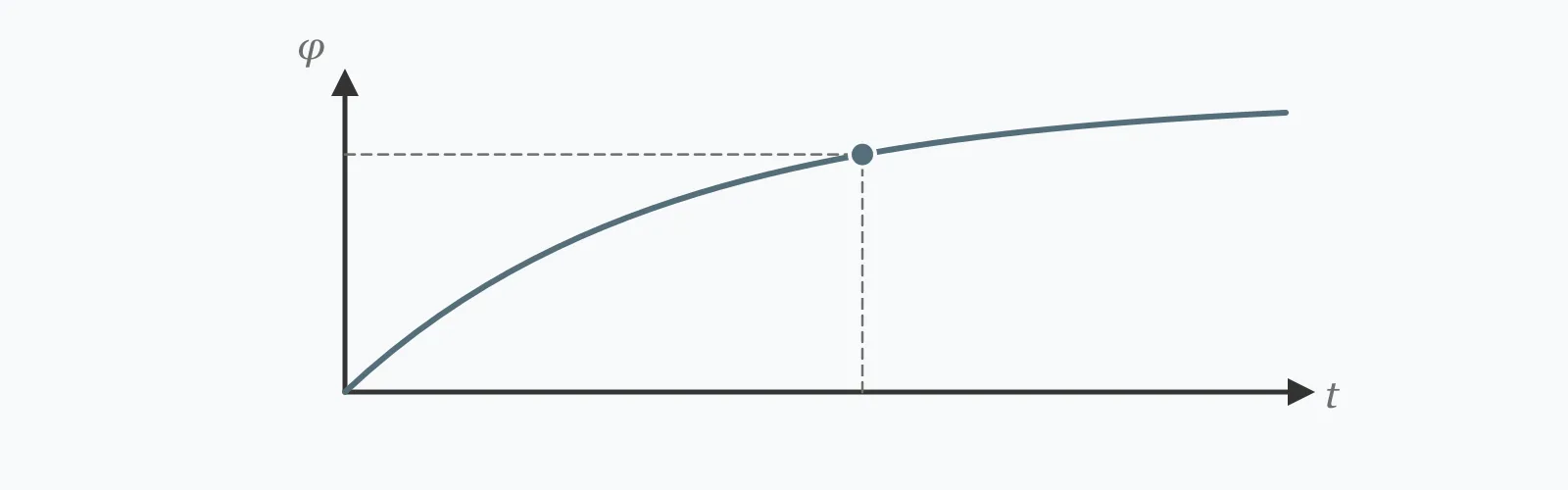
Both creep and shrinkage develop quickly at first and then approach their ultimate values asymptotically. Roughly half the movement occurs within the first few months, and the rest accumulates over years. The marker shows your current assessment age.
Creep Coefficient vs Time of Interest
Recomputed live from your inputs. The marker shows your current value.
Line chart of Creep Coefficient against Time of Interest. The same
values are listed in the data table below.
Values plotted above, sampled across the time of interest range.
How to Interpret Your Results
The creep coefficient tells you how much the member will deform beyond its immediate response. The total strain matters for deflection, and the shrinkage component matters for cracking whether the member is loaded or not.
Creep Coefficient: < 1.2Low creep
A creep coefficient of your result is low, indicating mature concrete, a thick section, a humid environment or a short assessment period. Long-term deflection will be only modestly above the immediate value.
Creep Coefficient: 1.2 – 2.5Typical range
A creep coefficient of your result is normal for concrete loaded at a conventional age. Long-term deflection will be roughly two to three times the immediate value once shrinkage is added, which is why deflection checks are made on long-term values.
Creep Coefficient: ≥ 2.5High creep
A creep coefficient of your result is high. Check the loading age and the humidity — early loading and a dry environment both drive it up, and together they can add half again to the movement compared with mature concrete in humid conditions.
Total Strain: ≥ 1000Substantial total movement
A total strain of your result microstrain is significant. Over a 10 m member that is your result × 10 microns, or several millimetres of shortening — enough to matter for movement joints, cladding fixings and any element restrained against it.
Shrinkage Strain: ≥ 500High shrinkage
A shrinkage strain of your result microstrain occurs whether the member is loaded or not. Where it is restrained — by adjoining construction, by heavy reinforcement, or by its own supports — that strain becomes tensile stress and cracking follows.
Common Mistakes to Avoid
Using a single assumed creep coefficient
Why it matters:The commonly quoted 2.0 is a mid-range value that ignores humidity, member size and loading age. Across the ranges in this calculation the coefficient runs from about 1.6 to 2.6 — a spread of 60% around that assumption.
✓How to avoid it:Compute it for the actual conditions. Loading age and humidity are the two variables that move it most, and both are usually known.
Including transient live load in the creep stress
Why it matters:Creep responds to sustained stress. Live load that comes and goes contributes very little, so including it in full overstates the long-term deflection substantially on a heavily loaded floor.
✓How to avoid it:Use self weight, superimposed dead load and the quasi-permanent fraction of the imposed load, which codes define for each occupancy.
Assuming an exposed member moves more than an internal one
Why it matters:Both creep and shrinkage increase as humidity falls, and a heated interior at 40% RH is drier than most external conditions. The internal member moves 39% more in the worked comparison.
✓How to avoid it:Use the actual service humidity. Exposure is harsher for durability but gentler for movement, and the two considerations point in opposite directions.
Checking deflection at striking only
Why it matters:The immediate elastic deflection is roughly a fifth of the eventual total. A member that looks acceptable when the formwork comes off can be visibly sagging years later, and the difference is entirely predictable.
✓How to avoid it:Check the long-term deflection against the serviceability limit. The immediate value is useful only for confirming the member has not been grossly misjudged.
Treating shrinkage as a deflection problem only
Why it matters:Shrinkage occurs whether the member is loaded or not, and where it is restrained the strain becomes tensile stress. Restrained shrinkage cracking in slabs and walls is one of the most common concrete defects, and it has nothing to do with applied load.
✓How to avoid it:Consider restraint explicitly. Movement joints, crack-control reinforcement and pour sequencing all address restrained shrinkage rather than deflection.
Expecting the prediction to be precise
Why it matters:Creep and shrinkage are among the most variable properties of concrete. Predictions within 20% are considered good, and 30% scatter between nominally identical members is normal.
✓How to avoid it:Use the figures comparatively — to judge whether early loading is worth its cost, or whether a thicker section helps — rather than as a forecast of a specific member's movement.
Practical Applications
▸Estimating long-term deflection of concrete members
▸Assessing the cost of early striking or early loading
▸Calculating prestress losses from creep and shrinkage
▸Sizing movement joints for shrinkage
▸Comparing member sizes for long-term movement
▸Checking serviceability against long-term rather than immediate values
Industry Use Cases
Structural concrete design
Deflection limits are checked against long-term values, which are typically four to five times the immediate elastic figure. A member designed to the elastic deflection alone would fail its serviceability check by a wide margin.
Prestressed concrete
Creep and shrinkage are the two largest contributors to long-term prestress loss, together typically two thirds of the total. Early transfer worsens both, which is why the programme benefit of early stressing has a structural cost.
Composite and restrained construction
Where concrete is restrained — by steel framing, by adjacent pours, or by its own supports — shrinkage produces tensile stress rather than free movement. That is the origin of most early-age cracking, and it is addressed by joints and reinforcement rather than by strength.
Expert Tips
💡Long-term strain is typically four to five times the immediate elastic value.
💡Loading at 3 days rather than 90 raises the creep coefficient by 50%.
💡Dry environments move more — 40% RH gives 39% more total strain than 80%.
💡Only sustained load causes creep; transient live load contributes little.
💡Shrinkage occurs whether loaded or not, and restraint turns it into stress.
💡Predictions within 20% are good; 30% scatter is normal.
Advantages & Limitations
Advantages
✓Applies humidity, size and loading-age factors rather than one assumed value
✓Separates creep from shrinkage, which have different causes and remedies
✓Shows the time development, not just the ultimate figure
✓Reports the split between immediate and time-dependent strain
✓Fast enough to test loading ages and section sizes during design
Limitations
!An ACI 209 style estimate with inherent scatter of 20 to 30%
!Assumes linear creep, valid below about 40% of the concrete strength
!Takes no account of cement type, aggregate stiffness or admixtures
!Assumes constant stress; a varying load history needs superposition
!Assumes constant humidity, where real environments cycle
!Does not compute deflection, only strain — section properties are needed for that
!Does not address restraint, which converts shrinkage strain into stress
The Two Variables That Matter Most
Concrete at 10 MPa sustained stress, 30 GPa modulus, 150 mm notional size, assessed at 10 years. The upper block varies loading age at 60% RH; the lower varies humidity at 28 days.
Elastic strain is 333.3 microstrain in every row. Loading at 3 days rather than 90 raises the creep coefficient 50% and the total 19%. Dropping from 80% to 40% humidity raises the total 39%, because it drives creep and shrinkage in the same direction at once.
The ratio of creep strain to the initial elastic strain. A coefficient of 2 means the member eventually deforms three times its immediate amount under sustained load.
How much does concrete creep?
Typically one and a half to three times the elastic strain, depending on humidity, member size and the age at loading. Adding shrinkage, the total long-term movement is usually four to five times the immediate value.
What is the difference between creep and shrinkage?
Creep is deformation under sustained stress; shrinkage is contraction as the concrete dries, whether loaded or not. They have different causes but similar magnitudes and both increase in dry conditions.
Why does loading age matter?
Young concrete creeps more because its paste structure is still forming. Loading at 3 days rather than 90 raises the creep coefficient by 50%, which is what early striking and early prestressing cost in long-term deflection.
Does humidity affect concrete movement?
Considerably, and in the direction people often expect backwards. Dry conditions increase both creep and shrinkage, so a heated interior at 40% RH moves 39% more than a humid environment at 80%.
What is notional size?
Twice the cross-sectional area divided by the perimeter exposed to drying. It measures how readily moisture can leave, so thick sections and those drying from one face only move less.
Should live load be included in the creep stress?
Only the quasi-permanent fraction. Creep responds to sustained stress, so transient load that comes and goes contributes very little and including it in full overstates the deflection.
How long does creep continue?
Indefinitely in principle, but asymptotically. Roughly half occurs in the first few months and most within a few years, with the remainder accumulating slowly thereafter.
Why does restrained shrinkage cause cracking?
Because if the concrete cannot contract freely, the strain becomes tensile stress instead. Concrete's tensile strength is around a tenth of its compressive strength, so restrained shrinkage cracks readily — which is what movement joints and crack-control reinforcement address.
How accurate are creep and shrinkage predictions?
Within 20% is considered good and 30% scatter between nominally identical members is normal. They are among the most variable properties of concrete, so the figures suit comparison rather than forecast.
Glossary
Creep
Continuing deformation of concrete under sustained stress.
Creep coefficient
Ratio of creep strain to the initial elastic strain.
Shrinkage
Contraction of concrete as it dries, independent of applied load.
Microstrain
Strain expressed in parts per million — 1,000 microstrain is 1 mm per metre.
Notional size
Twice the area over the drying perimeter, measuring how readily moisture escapes.
Quasi-permanent load
The fraction of imposed load treated as sustained for long-term effects.
Restrained shrinkage
Shrinkage prevented from occurring freely, producing tensile stress instead.
Autogenous shrinkage
Shrinkage from internal hydration rather than drying, significant in high-strength concrete.
Linear creep
The proportional regime below about 40% of concrete strength, above which creep accelerates.
Time development function
The expression describing how creep or shrinkage approaches its ultimate value.
Scientific & Standards References
ACI 209R — Prediction of Creep, Shrinkage and Temperature Effects in Concrete Structures — American Concrete Institute
EN 1992-1-1 (Eurocode 2) Annex B — Creep and shrinkage strain — CEN
fib Model Code for Concrete Structures 2010 — Time-dependent behaviour — International Federation for Structural Concrete
Neville, A. M., Properties of Concrete, 5th Edition — Chapter 9: Elasticity, Shrinkage and Creep — Pearson
Bažant, Z. P. and Baweja, S., Creep and Shrinkage Prediction Model B3 — RILEM
Conclusion
Concrete goes on moving long after it is built, and by a margin that changes design decisions. The worked case reaches 1,592 microstrain at ten years against an immediate elastic strain of 333 — 4.78 times, with 79% of it time-dependent. That is why deflection is checked against long-term values and why a member that looks fine when the formwork comes off can sag visibly later. Two variables dominate. Loading age, because young concrete creeps more: loading at 3 days rather than 90 raises the coefficient by 50%, which is what early striking costs. And humidity, which drives creep and shrinkage in the same direction at once — the table above shows 40% relative humidity producing 39% more total strain than 80%, so a heated interior is a harsher environment for movement than a sheltered exterior. Shrinkage also deserves separate attention: it happens whether the member is loaded or not, and wherever it is restrained the strain becomes tensile stress and cracking follows.
Enter your stress, humidity and loading age above to estimate the long-term movement.