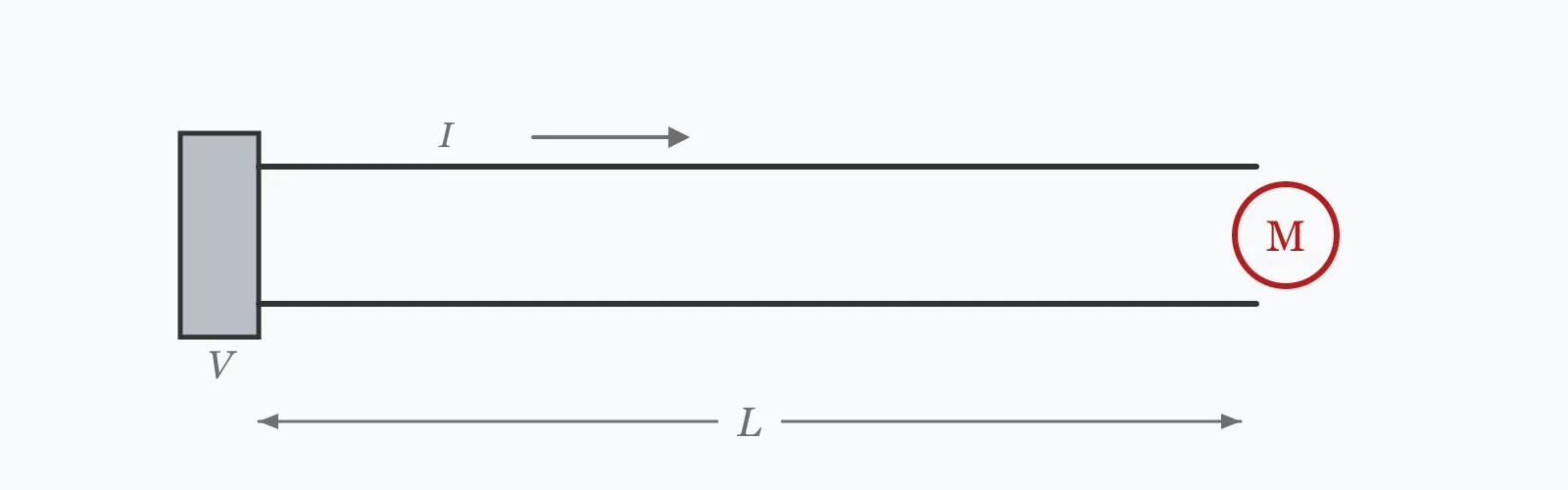
A motor nameplate gives shaft power, but the supply has to provide that plus the losses, and it has to provide it at the motor's power factor. Enter the shaft power, voltage, efficiency, power factor and number of phases to get the full load current, the direct-on-line starting current, the apparent power in kVA and the next standard protective device size.
Calculator
Units:
kW
Mechanical output from the nameplate, not the electrical input
V
Line-to-line for three phase; line-to-neutral for single phase
%
IE3 motors in the 5 to 20 kW range reach about 89 to 92%
At full load. Falls sharply at part load
Three phase uses the √3 factor; single phase does not
Calculation Result
Press Calculate for the full load current, the direct-on-line starting current at six times that value, the apparent power in kVA, and the next standard protective device size at 125% of full load.
Step-by-Step Solution
Preliminary design aid. Results follow the published formulas cited
below and are intended for estimating, study and early design. Final design must be
verified by a licensed Professional Engineer against the code in force for your project.
Key Benefits
✓Works from shaft power, matching how motors are actually rated
✓Applies both the efficiency and the power factor correction
✓Gives direct-on-line starting current, which usually governs the supply
✓Selects the next standard IEC protective device rating
✓Sensitivity chart shows how strongly power factor drives the current
✓Shareable links and CSV export for design records
What Is Motor Full Load Amps?
Full load amps is the current a motor draws at its rated shaft output. The nameplate states mechanical power delivered at the shaft, so the electrical input is that divided by efficiency — a 7.5 kW motor at 89% efficiency draws 8.43 kW from the supply. Dividing by the power factor converts real power to apparent power, and only then does the voltage and phase arithmetic give the current.
Why power factor matters as much as efficiency
An induction motor draws a magnetising current that establishes the rotating field. It does no work and returns to the supply each cycle, but it flows in the conductors and heats them just the same. Power factor is the ratio of real to apparent power, and dividing by it is what accounts for that current. A motor at 0.7 power factor draws 21% more current than the same motor at 0.85, for identical mechanical output.
Starting current is the real constraint
Started direct on line, an induction motor behaves briefly like a short-circuited transformer and draws six to eight times its full load current. A 45 kW motor at 86 A running draws over 500 A starting. The duration is short, but the voltage dip it causes on the supply affects everything else connected, which is why network operators impose limits and why star-delta, soft starters and variable speed drives exist.
Formula
I = P / (√3 · V · η · cos φ)
Full load current for a three-phase motor, with P the shaft power in watts
Related Formulas
I = P / (V · η · cos φ)
S = P / (η · cos φ)
I_start ≈ 6 · I_FLA
I_device ≥ 1.25 · I_FLA
Variable Definitions
Symbol
Variable
Unit
Description
P
Shaft Power
kW
Mechanical output at the shaft, as stated on the nameplate.
V
Supply Voltage
V
Line-to-line voltage for three phase, line-to-neutral for single phase.
η
Efficiency
%
Shaft power divided by electrical input. IE3 motors reach 89 to 94%.
cos φ
Power Factor
—
Ratio of real to apparent power. 0.8 to 0.87 at full load for typical induction motors.
I_FLA
Full Load Current
A
Running current at rated output.
I_start
Starting Current
A
Direct-on-line inrush, six to eight times full load.
How to Use This Calculator
Enter shaft power, not electrical inputMotor nameplates state mechanical output. The supply must provide that plus the losses, which is exactly what dividing by efficiency accounts for. Entering the electrical input instead would understate the current by the efficiency factor.
Use full load efficiency and power factorBoth figures appear on the nameplate or datasheet and both are quoted at rated load. At part load, efficiency falls a little and power factor falls a lot, so a lightly loaded motor draws more current per unit of useful work than this calculation suggests.
Match the voltage to the phase configurationThree-phase calculations use the line-to-line voltage — 400 V in a 230/400 V system — with the √3 factor. Single-phase uses the line-to-neutral voltage, 230 V, with no √3. Mixing the two is a common and large error.
Read the starting current against your supplySix times full load is the figure that determines whether the motor can be started direct on line. Large motors on weak supplies cause voltage dips that affect other equipment, and network operators frequently set a limit above which DOL is not permitted.
Treat the protective device size as a starting point125% of full load covers the running condition. A motor circuit must also let the starting current through without tripping, so a type C or D characteristic, or a dedicated motor protection circuit breaker with separate overload and magnetic settings, is normally required.
Worked Examples
Example 1
A 7.5 kW three-phase induction motor on a 400 V supply, 89% efficient with a power factor of 0.85 at full load.
Step-by-Step Solution
Electrical input: 7.5 / 0.89 = 8.427 kW — the 0.927 kW difference is the losses
Apparent power: 8.427 / 0.85 = 9.914 kVA
Three-phase current: I = 9,914 / (√3 × 400) = 9,914 / 692.8 = 14.31 A
Compare the naive figure: 7,500 / (√3 × 400) = 10.83 A — 32% lower than the truth
Direct-on-line starting current: 6 × 14.31 = 86 A
Protective device: 1.25 × 14.31 = 17.9 A, so the next standard size is 20 A
Interpretation: the efficiency and power factor corrections together add 32% to the current. Neither is optional.
Example 2
The same 7.5 kW motor supplied single phase at 230 V instead of three phase at 400 V — the comparison that explains why three phase exists.
Step-by-Step Solution
The apparent power is unchanged at 9.914 kVA: the motor still needs the same input for the same output
Single-phase current: I = 9,914 / 230 = 43.10 A, with no √3 factor
Against 14.31 A for the three-phase case, that is 3.01 times the current
The ratio decomposes cleanly: √3 = 1.732 from the phase arithmetic, and 400/230 = 1.739 from the voltage — their product is 3.012.
The starting current rises in proportion too, to 259 A, and the protective device jumps from 20 A to 63 A.
Every conductor, contactor, terminal and breaker in the circuit has to be sized for three times the current, which is why single-phase motors are uncommon above a few kilowatts.
The same argument runs the other way for voltage: the identical motor at 690 V would draw 8.30 A, and the cable cost across a large installation is where three-phase distribution earns its complexity.
Power Factor Sensitivity
Current is inversely proportional to power factor, so the curve rises steeply as the factor falls — the same mechanical output, drawn through progressively more current. This is why a motor running at part load, where power factor collapses, can draw surprisingly high current. The marker shows your current value.
Full Load Current vs Power Factor
Recomputed live from your inputs. The marker shows your current value.
Line chart of Full Load Current against Power Factor. The same
values are listed in the data table below.
Values plotted above, sampled across the power factor range.
How to Interpret Your Results
The full load current sizes the cable and the protection. The starting current decides whether the supply can accept the motor at all, and it is usually the more restrictive of the two.
Full Load Current: < 16Small motor — standard circuit
A full load current of your result A sits within ordinary final circuit territory. Direct-on-line starting is normally acceptable at this size, though the inrush still needs a protective device characteristic that tolerates it.
Full Load Current: 16 – 63Mid-range motor
A full load current of your result A needs a dedicated circuit. Check the starting current against the supply capacity — this is the size range where direct-on-line starting begins to cause noticeable voltage dips on weaker supplies.
Full Load Current: 63 – 200Large motor — check starting method
At your result A running, direct-on-line starting draws six times as much. Star-delta, a soft starter or a variable speed drive is usually required at this size, and many network operators will not permit DOL above it.
Full Load Current: ≥ 200Very large motor
A full load current of your result A demands a supply study rather than a rule of thumb. Starting method, voltage dip at the point of common coupling and the effect on other consumers all need assessment before the motor is specified.
DOL Starting Current: ≥ 200High inrush
A starting current of your result A will cause a visible voltage dip on most supplies. Reduced-voltage starting cuts it substantially — star-delta to about a third, a soft starter to whatever the ramp allows, and a drive to little more than full load current.
Common Mistakes to Avoid
Dividing nameplate kW by voltage directly
Why it matters:It omits both corrections. For the example motor the naive calculation gives 10.83 A against a true 14.31 A — 32% low, enough to undersize the cable and the protection together.
✓How to avoid it:Divide by efficiency and by power factor before the voltage arithmetic. Both make the current larger, never smaller.
Using line-to-neutral voltage in the three-phase formula
Why it matters:The three-phase formula uses line-to-line voltage. Substituting 230 V for 400 V in a 230/400 V system overstates the current by a factor of 1.74.
✓How to avoid it:Use 400 V with √3 for three-phase, or 230 V with no √3 for single-phase. Check which the nameplate voltage refers to.
Sizing the protective device on running current alone
Why it matters:A device rated at 125% of full load will trip on the six-fold starting inrush if its magnetic characteristic is too sensitive. A type B breaker trips between three and five times rated current, which a motor start exceeds.
✓How to avoid it:Use a type C or D characteristic, or a motor protection circuit breaker with independently set overload and magnetic thresholds. The overload protects the motor; the magnetic element protects against short circuit.
Assuming power factor stays constant
Why it matters:Power factor is quoted at full load and falls sharply below it. A motor at a quarter load may run at 0.4 to 0.5, so its current does not fall anything like in proportion to the reduced output.
✓How to avoid it:Where a motor is habitually lightly loaded, the fix is a smaller motor rather than correction capacitors — an oversized motor has poor power factor by nature, and correcting it treats the symptom.
Ignoring the service factor
Why it matters:Motors with a service factor above 1.0 are permitted to run continuously above nameplate rating, and the current rises accordingly. Sizing the circuit on the nameplate figure alone leaves no margin for that.
✓How to avoid it:Check the nameplate for a service factor and size the circuit for the maximum permitted continuous load, not the rated one.
Treating six times as a universal starting multiple
Why it matters:The ratio depends on motor design and can reach eight times, and high-efficiency motors tend towards the upper end because their lower resistance means less to limit the locked-rotor current.
✓How to avoid it:Use the nameplate locked rotor code or the datasheet ratio where the starting current matters. The six-fold figure here is a reasonable estimate, not a specification.
Practical Applications
▸Sizing motor circuit cables and protective devices
▸Checking whether a supply can accept a direct-on-line start
▸Comparing single-phase and three-phase supply options
▸Estimating the electrical demand of a motor installation
▸Assessing the effect of a power factor or efficiency change
▸Verifying nameplate data against expected current
Industry Use Cases
Industrial installation
Motor circuits are designed around two currents at once: the running current sets the cable and overload setting, while the starting current sets the protective device characteristic and the supply impedance requirement. The second frequently governs.
Pump and fan systems
Variable speed drives are specified as much for their soft-start behaviour as for their energy saving. A drive limits starting current to little above full load, which removes the voltage dip problem entirely and often makes an installation feasible on a supply that could not accept a DOL start.
Energy management
Oversized motors running at part load are a common finding in energy audits. Power factor collapses at low loading, so current stays disproportionately high while useful output falls — a pattern visible in metered data long before anyone inspects the plant.
Expert Tips
💡Divide by efficiency and power factor — both make the current larger.
💡The two corrections together added 32% in the example above.
💡Single-phase at 230 V draws 3.01 times the current of three-phase at 400 V.
💡Starting current is six to eight times running current, and usually governs.
💡Power factor collapses at part load; an oversized motor is the root cause.
💡Motor circuits need a type C or D characteristic to survive the inrush.
Advantages & Limitations
Advantages
✓Works from shaft power, matching how motors are actually rated
✓Applies both corrections explicitly rather than folding them into a factor
✓Reports starting current, which is often the binding constraint
✓Selects the next standard IEC device rating rather than a raw number
✓Handles single-phase and three-phase with the correct arithmetic for each
Limitations
!Uses six times full load for starting current; real values range from six to eight
!Assumes efficiency and power factor at full load, not at the actual operating point
!Does not account for service factor or intermittent duty ratings
!The protective device size covers running load, not the starting characteristic
!Takes no account of harmonics, which drives and soft starters introduce
!Assumes a balanced three-phase supply at nominal voltage
!Does not cover synchronous or DC machines, whose behaviour differs
Standard Motor Sizes on a 400 V Three-Phase Supply
At 89% efficiency and 0.85 power factor throughout. The starting current column is the one that constrains most installations — note how quickly it reaches levels that a supply notices.
400 V three-phase, 89% efficiency, 0.85 power factor, starting current at six times full load. The 45 kW motor runs at 86 A but starts at over 500 A — which is why reduced-voltage starting is effectively mandatory at that size, regardless of what the running current alone would suggest.
I = P / (√3 × V × η × cos φ) for three phase, with P the shaft power in watts. A 7.5 kW motor at 400 V, 89% efficient with 0.85 power factor draws 14.31 A.
Why is the current higher than kW divided by voltage?
Because the supply must provide the losses as well as the shaft output, and because the current includes a magnetising component that does no work. Together the two corrections added 32% in the example above.
What is motor starting current?
Six to eight times full load current when started direct on line, because the motor briefly behaves like a short-circuited transformer. A 45 kW motor running at 86 A starts at over 500 A.
How do I size a breaker for a motor?
At least 125% of full load current for the running condition, but with a characteristic that tolerates the starting inrush — type C or D, or a dedicated motor protection circuit breaker with separate overload and magnetic settings.
What is a typical motor power factor?
0.8 to 0.87 at full load for a standard induction motor. It falls sharply at part load, which is why a lightly loaded motor draws disproportionately high current for its useful output.
Why does a single-phase motor draw so much more current?
Two reasons multiply: no √3 factor, and usually a lower voltage. At 230 V single phase against 400 V three phase, the same 7.5 kW motor draws 43.1 A instead of 14.31 A — 3.01 times as much.
How can I reduce motor starting current?
Star-delta starting cuts it to about a third, a soft starter ramps the voltage so the inrush follows the ramp, and a variable speed drive limits it to little above full load current. All three trade cost and complexity for a smaller supply demand.
What efficiency should I expect from a motor?
IE3 motors in the 5 to 20 kW range reach about 89 to 92%, and IE4 a little higher. Smaller motors are less efficient — a 0.75 kW motor may be nearer 80%, because fixed losses are a larger share of a small output.
Does power factor correction reduce motor current?
It reduces the current in the supply upstream of the capacitors, not in the motor itself. The motor still draws its magnetising current; the capacitors simply supply it locally rather than drawing it from the network.
What is the service factor on a motor nameplate?
A multiplier above 1.0 indicating the motor may run continuously above its rated output. A 1.15 service factor means 15% overload is permitted continuously, and the circuit should be sized for that rather than for the nameplate rating.
Glossary
Full load amps
The current a motor draws at its rated shaft output.
Shaft power
The mechanical output of a motor, which is what the nameplate rating states.
Power factor
The ratio of real to apparent power, reflecting the magnetising current an induction motor draws.
Apparent power
Voltage times current, in kVA — what the supply must deliver regardless of how much does work.
Direct on line
Starting a motor by connecting it straight to full supply voltage, giving maximum inrush.
Star-delta starting
Starting in star and switching to delta, reducing starting current to about a third.
Soft starter
A device that ramps the applied voltage to limit starting current and mechanical shock.
Locked rotor current
The current drawn with the rotor stationary, which is what starting current approaches.
Service factor
A nameplate multiplier above 1.0 giving permitted continuous overload.
IE3 / IE4
International efficiency classes for motors, IE4 being higher than IE3.
Scientific & Standards References
IEC 60034-1 — Rotating electrical machines: Rating and performance — International Electrotechnical Commission
IEC 60034-30-1 — Efficiency classes of line operated AC motors (IE code) — International Electrotechnical Commission
IEC 60947-4-1 — Low-voltage switchgear: Contactors and motor-starters — International Electrotechnical Commission
NFPA 70 (National Electrical Code), Article 430 — Motors, Motor Circuits and Controllers — National Fire Protection Association
BS 7671 — Requirements for Electrical Installations (IET Wiring Regulations) — Institution of Engineering and Technology
Conclusion
Motor current is nameplate power with two corrections applied, and both push it up. Efficiency accounts for the losses the supply must provide alongside the useful output; power factor accounts for the magnetising current that heats the conductors without doing work. Together they added 32% for the worked example, taking 10.83 A to 14.31 A — the difference between a correctly sized circuit and an undersized one. The figure that usually decides the installation, though, is the one the nameplate does not state. Direct-on-line starting draws six to eight times the running current, so the 45 kW motor in the table above runs at 86 A and starts at over 500 A. That is why reduced-voltage starting is standard at that size, and why the protective device needs a characteristic chosen for the inrush rather than for the running load.
Enter your motor's nameplate data above to get the current, inrush and device size.