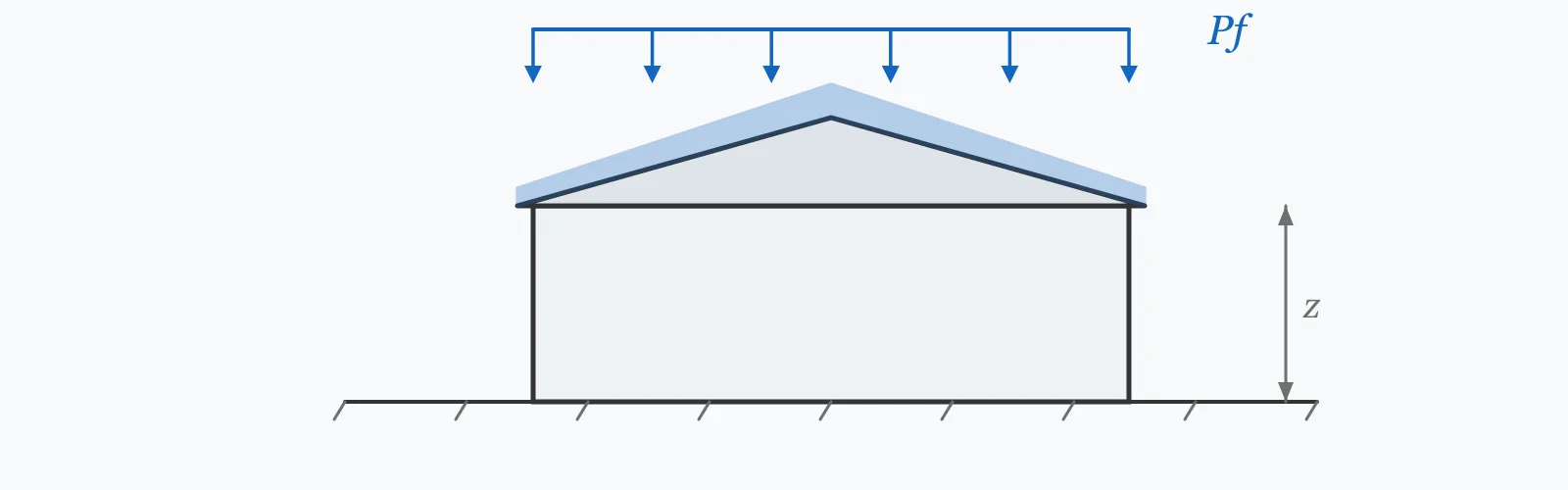
Roof snow load is derived from ground snow load: Pf = 0.7·Ce·Ct·I·Pg for a flat roof, then Ps = Cs·Pf for a pitched one. Enter the ground snow load and roof pitch to get both. This calculator uses the baseline case with exposure, thermal and importance factors all equal to 1.0 — adjust for your building as described below.
Calculator
Units:
kN/m²
Mapped site value — check your local snow load map
°
Roof angle from horizontal. No reduction applies below 30°
Calculation Result
Press Calculate for the flat roof snow load and the sloped roof snow load. Both assume Ce = Ct = I = 1.0; multiply the result by your own factors where they differ, and check drift and sliding separately.
Step-by-Step Solution
Preliminary design aid. Results follow the published formulas cited
below and are intended for estimating, study and early design. Final design must be
verified by a licensed Professional Engineer against the code in force for your project.
Key Benefits
✓Applies the ASCE 7 §7.3 and §7.4 expressions directly
✓Returns both the flat roof and the slope-adjusted load
✓States its factor assumptions plainly instead of hiding them
✓Includes the exposure, thermal and importance factor tables for adjustment
✓Sensitivity chart shows exactly where the slope factor starts to help
✓Shareable links and CSV export for design records
What Is Snow Load?
Design snow load starts from the ground snow load Pg, a mapped value representing the weight of accumulated snow on the ground with a 50-year mean recurrence interval. Roofs carry less than the ground because wind removes some snow and roofs shed and melt it, so ASCE 7 applies a base factor of 0.7. The flat roof snow load is then Pf = 0.7·Ce·Ct·I·Pg, where the three coefficients adjust for wind exposure, heat loss through the roof, and the consequences of failure.
The slope factor
Snow slides off steep roofs, so a pitch reduction applies. For a warm roof with a non-slippery surface, the slope factor Cs stays at 1.0 up to 30 degrees, then falls linearly to zero at 70 degrees — the relationship this calculator uses. Slippery surfaces such as metal or membrane begin shedding much earlier, from about 5 degrees, and cold roofs retain snow longer. Below 30 degrees the reduction is therefore usually zero, which surprises people expecting a modest pitch to help.
Why the balanced case is rarely the whole story
A uniform blanket of snow is the starting point, not the governing case. Wind redistributes snow into drifts against parapets, walls and rooftop plant, where the load can be several times the balanced value over a limited width. Snow sliding from an upper roof onto a lower one produces a similar concentration. Roof collapses under snow are far more often caused by these local accumulations than by the balanced load, which is why ASCE 7 devotes several sections to them.
Formula
P_f = 0.7 · C_e · C_t · I · P_g
Flat roof snow load, ASCE 7 §7.3
Related Formulas
P_s = C_s · P_f
C_s = 1 − (θ − 30) / 40
h_d = 0.43 ∛l_u · ⁴√(P_g + 10) − 1.5
γ = 0.426 P_g + 2.2 ≤ 4.7 kN/m³
Variable Definitions
Symbol
Variable
Unit
Description
P_f
Flat Roof Snow Load
kN/m²
Balanced snow load on a flat or low-slope roof, before any pitch reduction.
P_s
Sloped Roof Snow Load
kN/m²
Balanced load on a pitched roof after applying the slope factor.
P_g
Ground Snow Load
kN/m²
Mapped site value with a 50-year recurrence interval. There is no substitute for the local figure.
C_e
Exposure Factor
—
0.7 to 1.2 depending on wind exposure and terrain. Sheltered roofs keep more snow.
C_t
Thermal Factor
—
1.0 for a heated building, 1.1 for an unheated one, 1.2 for a freezer building.
I
Importance Factor
—
0.8 to 1.2 by risk category. Essential facilities carry the higher value.
C_s
Slope Factor
—
Pitch reduction. 1.0 up to 30° for a warm non-slippery roof, falling to zero at 70°.
How to Use This Calculator
Get the ground snow load from the map, not from memoryPg varies enormously over short distances, especially in mountainous regions where the map gives a case study zone rather than a value. Use the mapped figure for your exact site, or the local jurisdiction's published value where one exists.
Enter the roof pitch in degreesConvert from a rise-over-run ratio first: a 4:12 pitch is 18.4 degrees, 6:12 is 26.6, and 12:12 is 45. Below 30 degrees the slope factor is 1.0 for a warm non-slippery roof, so pitch makes no difference to the balanced load.
Adjust for your exposure, thermal and importance factorsThis calculator assumes all three equal 1.0. Multiply the result by your actual values — a sheltered unheated warehouse in a high risk category can carry over 30% more than the baseline this returns.
Check the minimum roof snow loadFor low-slope roofs, ASCE 7 §7.3.4 sets a minimum that can exceed the calculated balanced load where Pg is small. The minimum is Pg itself where Pg is 0.96 kN/m² or less, and 0.96 kN/m² where it is greater.
Then check drift, sliding and unbalanced casesCompute drift loads at parapets, walls and rooftop equipment per §7.7 and §7.8, sliding snow from upper roofs per §7.9, and unbalanced loads on gable roofs per §7.6. These local cases frequently govern and are the usual cause of snow-related failures.
Worked Examples
Example 1
A heated warehouse in a region with a mapped ground snow load of 2.0 kN/m² has a flat roof in a partially exposed setting. Find the design snow load for the balanced case.
Step-by-Step Solution
Baseline factors: Ce = 1.0 (partially exposed), Ct = 1.0 (heated building), I = 1.0 (Risk Category II)
Check the minimum: Pg = 2.0 kN/m² exceeds 0.96, so the minimum roof load is 0.96 kN/m² — the calculated 1.40 kN/m² governs
Design balanced load: 1.40 kN/m². Drift against the parapet must now be checked separately, and on a wide flat roof it will very likely exceed this.
Example 2
The same site, but a 45-degree pitched roof on an unheated storage building in an exposed location. Three factors change at once, and they pull in opposite directions.
Step-by-Step Solution
Factors: Ce = 0.9 (fully exposed, wind removes snow), Ct = 1.1 (unheated, no melting from below), I = 1.0
Note the near cancellation: the exposure reduction and the thermal increase almost offset, leaving Pf essentially unchanged at 1.39 against the baseline 1.40
The pitch delivers a 38% reduction — far more than the exposure and thermal factors combined.
Note on reproducing this above: the calculator holds Ce = Ct = I = 1.0, so entering Pg = 2.0 and 45° returns Ps = 0.875 kN/m². The 0.866 figure here includes the exposure and thermal factors applied by hand, as step one sets out.
Caution: snow shed from this roof lands somewhere. If a lower roof sits below, the sliding snow load of §7.9 must be applied there, and it will be considerably heavier than the load removed from above.
Roof Pitch Sensitivity
The sloped roof load stays flat up to 30 degrees, then falls linearly — a deliberately blunt curve that shows how little a moderate pitch buys on a warm non-slippery roof. Switch to Pf to see the flat roof load, which pitch does not affect at all. The marker shows your current pitch.
Sloped Roof Load (Ps) vs Roof Pitch (Angle)
Recomputed live from your inputs. The marker shows your current value.
Line chart of Sloped Roof Load (Ps) against Roof Pitch (Angle). The same
values are listed in the data table below.
Values plotted above, sampled across the roof pitch (angle) range.
How to Interpret Your Results
Snow load bands correspond to broad climate zones. Whichever band you land in, remember that the balanced load computed here is the starting case — drift and sliding loads are local, several times heavier, and are what most snow-related roof failures are traced to.
Sloped Roof Load (Ps): < 0.75Light snow region
A sloped roof snow load of your result kN/m² is light, typical of mild or coastal climates. Check the ASCE 7 minimum roof load, which may govern over this calculated value, and confirm that roof live load is not the larger case.
A sloped roof snow load of your result kN/m² is the normal range for temperate regions with regular winter snowfall. This is usually the governing gravity load on the roof structure. Drift loads at parapets and walls should now be checked and will exceed this locally.
Sloped Roof Load (Ps): 2.5 – 5Heavy snow region
A sloped roof snow load of your result kN/m² is substantial and will dominate the roof design. Pay close attention to drift accumulation, rain-on-snow surcharge, and the ponding check where roof drainage relies on deflected members.
Sloped Roof Load (Ps): ≥ 5Severe snow region
A sloped roof snow load of your result kN/m² corresponds to an alpine or subarctic climate. Loads of this magnitude often make snow the dominant design action for the whole building. Verify the ground snow value against local authority data, since mapped values in mountainous terrain are frequently case-study zones rather than published figures.
Common Mistakes to Avoid
Using ground snow load directly as roof load
Why it matters:Ground and roof snow are different quantities. Applying Pg to a roof overstates the balanced load by more than 40%, since the code applies a 0.7 factor for the snow that wind removes and the roof sheds.
✓How to avoid it:Always run the conversion Pf = 0.7·Ce·Ct·I·Pg. The one exception is the minimum roof load provision for low-slope roofs, where a floor based on Pg may apply.
Assuming a pitched roof always gets a reduction
Why it matters:For a warm non-slippery roof, Cs stays at 1.0 up to 30 degrees. A 4:12 or 6:12 pitch — 18.4 and 26.6 degrees — earns no reduction at all, which often surprises designers expecting a benefit.
✓How to avoid it:Check the pitch against the applicable Cs curve for the roof's surface and thermal condition. Slippery surfaces begin shedding at much lower angles.
Checking only the balanced load
Why it matters:Drift at a parapet or against a taller adjacent wall can be several times the balanced load over a limited width. Most snow-related roof collapses trace to drift or sliding rather than uniform accumulation.
✓How to avoid it:Run the drift check of §7.7 and §7.8 at every parapet, wall step and large rooftop unit, and the sliding check of §7.9 wherever an upper roof discharges onto a lower one.
Using Ct = 1.0 for an unheated building
Why it matters:Heat escaping through a roof melts the underside of the snowpack and reduces accumulation. An unheated structure gets no such help, so ASCE 7 raises the thermal factor to 1.1, and to 1.2 for a deliberately refrigerated building.
✓How to avoid it:Take Ct from Table 7.3-2 according to the building's thermal condition. Unheated storage buildings and open canopies are the cases most often missed.
Ignoring rain-on-snow surcharge
Why it matters:On low-slope roofs in regions where Pg is modest, rain falling onto an existing snowpack adds weight that the snow load alone does not capture. ASCE 7 requires a surcharge for slopes below a threshold set by the eave-to-ridge distance.
✓How to avoid it:Apply the rain-on-snow surcharge of §7.10 where the slope is less than the limit. It matters most in exactly the maritime climates where snow otherwise seems undemanding.
Overlooking ponding on a flexible low-slope roof
Why it matters:As a roof deflects under snow or meltwater, the resulting depression collects more water, causing further deflection. The cycle can become unstable and is a recognised progressive collapse mechanism.
✓How to avoid it:Run the ponding stability check of AISC Appendix 2 for low-slope roofs, and ensure secondary drainage is provided and sized independently of the primary system.
Practical Applications
▸Determining the governing gravity load on roof structures in snow regions
▸Sizing roof purlins, joists and trusses
▸Checking existing roofs against revised snow maps
▸Assessing snow drift loads at parapets and roof steps
▸Evaluating rooftop plant supports for accumulated snow
▸Verifying canopy and awning structures against local accumulation
Industry Use Cases
Industrial and warehouse construction
Large flat roofs concentrate snow at parapets, so drift loads over a two to five metre width frequently exceed the balanced load several times. Designers reinforce the perimeter zone rather than uprating the whole roof, which is usually much cheaper.
Residential and light commercial
Pitched roofs in temperate climates commonly sit between 18 and 27 degrees, where the slope factor gives no reduction at all. Designers expecting a benefit from pitch discover that only a steep roof above 30 degrees delivers one.
Building assessment after heavy winters
Following a record snowfall, engineers recompute loads against measured depths converted using the snow density relationship. Where drift has accumulated at a step in the roof, the local load can exceed the original design value even though the balanced load did not.
Expert Tips
💡There is no substitute for the mapped ground snow value; in mountainous terrain, expect a case-study zone and a local authority figure.
💡Below 30 degrees, pitch buys nothing on a warm non-slippery roof — do not assume a modest slope helps.
💡Drift is usually the governing case on a large flat roof. Check it before sizing the perimeter framing.
💡Snow density rises with ground snow load: γ = 0.426·Pg + 2.2 kN/m³, capped at 4.7. Use it to convert measured depths.
💡Snow that slides off an upper roof lands on the lower one — the load is not lost, only moved and concentrated.
💡Where roof drainage depends on deflected members, run the ponding check; it is a progressive mechanism, not a serviceability issue.
Advantages & Limitations
Advantages
✓Implements the ASCE 7 §7.3 and §7.4 expressions directly
✓Returns both flat and sloped roof loads for immediate comparison
✓Makes its baseline factor assumptions explicit rather than hiding them
✓Fast enough to compare roof geometries during scheme design
✓Provides the balanced load that every subsequent drift check builds on
Limitations
!Assumes Ce = Ct = I = 1.0; adjust the result for your building's actual factors
!Uses the warm non-slippery roof slope curve — slippery and cold roofs shed at lower angles
!Covers the balanced load only; drift, sliding and unbalanced cases are separate and often govern
!Does not apply the minimum roof snow load provision of §7.3.4
!Omits the rain-on-snow surcharge required on low-slope roofs
!Takes no account of ponding stability on flexible low-slope roofs
!Not applicable to curved, sawtooth or multiple-folded-plate roofs, which have their own provisions
Roof Pitch and the Slope Factor
The slope factor for a warm non-slippery roof stays at 1.0 until 30 degrees, then falls linearly to zero at 70. The common residential pitches all sit inside the flat region, which is why moderate pitch delivers no reduction at all.
Slope factors for a warm roof with a non-slippery surface (Ct ≤ 1.0), with Ce = Ct = I = 1.0. Slippery surfaces begin shedding from about 5°.
Convert the ground snow load with Pf = 0.7·Ce·Ct·I·Pg for a flat roof, then apply the slope factor with Ps = Cs·Pf for a pitched one. A 2.0 kN/m² ground snow load with all factors at 1.0 gives a 1.40 kN/m² flat roof load.
Why is roof snow load less than ground snow load?
Wind removes snow from roofs, and heat escaping through the roof melts the underside of the snowpack. ASCE 7 captures both effects with a base factor of 0.7, giving a 30% reduction before any of the other coefficients are applied.
At what roof pitch does snow load reduce?
For a warm roof with a non-slippery surface, only above 30 degrees, after which the slope factor falls linearly to zero at 70 degrees. Slippery surfaces such as metal or membrane start shedding from about 5 degrees, and cold roofs retain snow longer than warm ones.
What is the exposure factor Ce?
An adjustment for how much wind reaches the roof, ranging from 0.7 for a fully exposed roof in windswept terrain to 1.2 for one sheltered by trees or taller buildings. Sheltered roofs keep more snow because wind cannot scour it away.
What is the thermal factor Ct?
1.0 for a normally heated building, 1.1 for an unheated structure, and 1.2 for a deliberately refrigerated one such as a freezer building. It reflects how much heat loss through the roof melts snow from beneath.
What is a snow drift load?
A local accumulation where wind deposits snow against a parapet, a taller adjacent wall or rooftop equipment. Drift loads can be several times the balanced load over a limited width and are the most common cause of snow-related roof failures.
How do I convert snow depth to load?
Multiply depth by density. ASCE 7 gives density as γ = 0.426·Pg + 2.2 kN/m³, capped at 4.7. Fresh snow is much lighter, around 1.0 to 2.0 kN/m³, while old settled or wet snow approaches the cap.
Does snow load combine with other loads?
Yes. It appears in the strength combinations alongside dead load, and in some combinations with wind — where wind uplift can partially relieve snow, making the combination without snow the governing case for uplift. Follow the combinations in ASCE 7 Chapter 2.
What is rain-on-snow surcharge?
An additional load applied to low-slope roofs where rain falls onto an existing snowpack and is absorbed rather than draining away. It applies where the roof slope is below a threshold related to the eave-to-ridge distance, and matters most in maritime climates.
What happens to snow that slides off a roof?
It lands on whatever is below. Where an upper roof discharges onto a lower one, ASCE 7 §7.9 requires a sliding snow load on the lower roof, concentrated near the eave of the upper. The load is not lost, only relocated and concentrated.
Glossary
Ground snow load (Pg)
The mapped weight of accumulated snow on the ground at a site, based on a 50-year mean recurrence interval.
Flat roof snow load (Pf)
The balanced snow load on a flat or low-slope roof, obtained by applying the code factors to the ground snow load.
Sloped roof snow load (Ps)
The balanced load on a pitched roof after the slope factor has been applied.
Exposure factor (Ce)
An adjustment for wind exposure and terrain, from 0.7 for fully exposed to 1.2 for sheltered roofs.
Thermal factor (Ct)
An adjustment for heat loss through the roof: 1.0 heated, 1.1 unheated, 1.2 refrigerated.
Slope factor (Cs)
The reduction applied for roof pitch, reflecting snow sliding off steeper surfaces.
Balanced snow load
A uniform snow load across the roof, the starting case before drift and unbalanced conditions are considered.
Snow drift
A local accumulation formed by wind depositing snow against a parapet, wall or obstruction.
Sliding snow load
Snow shed from an upper roof onto a lower one, concentrated near the upper roof's eave.
Ponding
A progressive mechanism in which a deflecting low-slope roof collects water, deflecting further and collecting more.
Scientific & Standards References
ASCE/SEI 7-22 §7.3 — Flat Roof Snow Loads — American Society of Civil Engineers
ASCE/SEI 7-22 §7.4 and Figure 7.4-1 — Sloped Roof Snow Loads — American Society of Civil Engineers
ASCE/SEI 7-22 §7.7 and §7.8 — Drifts on Lower Roofs and Adjacent to Projections — American Society of Civil Engineers
ASCE/SEI 7-22 §7.9 and §7.10 — Sliding Snow and Rain-on-Snow Surcharge — American Society of Civil Engineers
EN 1991-1-3 — Eurocode 1: Actions on structures, Part 1-3: Snow loads — CEN
AISC 360-22 Appendix 2 — Design for Ponding — American Institute of Steel Construction
Conclusion
Design snow load starts from the mapped ground value and is reduced by 0.7 to reach the flat roof load, then adjusted for exposure, thermal condition, importance and pitch. Two things are worth carrying away. First, moderate pitch buys nothing: on a warm non-slippery roof the slope factor stays at 1.0 until 30 degrees, so common residential pitches earn no reduction at all. Second, the balanced load computed here is only the starting case — drift against parapets and walls, and snow sliding from upper roofs, produce local loads several times heavier, and those are what most snow-related roof failures are traced to.
Enter your site's ground snow load above, then sweep the pitch in the chart to see exactly where the slope factor starts to help.