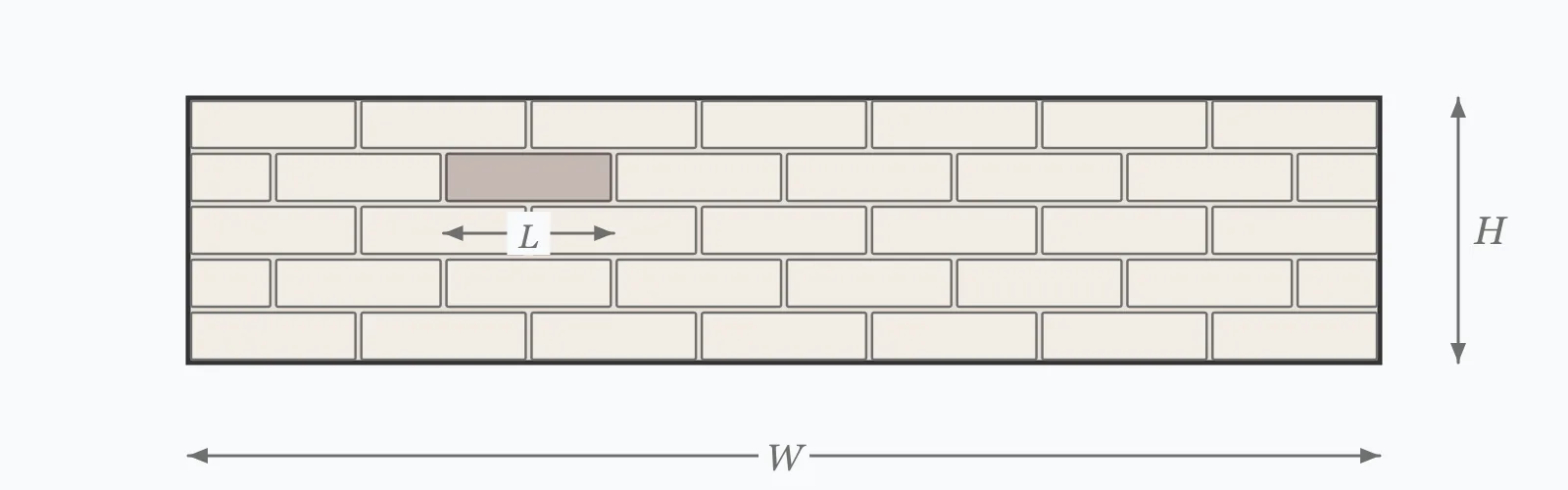
Every brick occupies its own size plus one joint in each direction, so the module — not the brick — is what fills the wall. Enter the wall area, brick dimensions, joint thickness and a wastage allowance to get the bricks per square metre, the total needed and the mortar volume.
Calculator
Units:
m²
Face area of the wall, net of openings
mm
215 mm standard UK; 190 mm modular metric
mm
65 mm standard, giving 75 mm coursing with a 10 mm joint
mm
10 mm standard. Changing it changes the coursing
%
5 to 10% for cutting, breakage and colour matching
Calculation Result
Press Calculate for the bricks per square metre, the total including wastage, the mortar volume for a single skin and the module area each brick occupies.
Step-by-Step Solution
Preliminary design aid. Results follow the published formulas cited
below and are intended for estimating, study and early design. Final design must be
verified by a licensed Professional Engineer against the code in force for your project.
Key Benefits
✓Works from the module, so any brick size and joint thickness are handled
✓Gives mortar volume alongside the brick count
✓Includes a wastage allowance rather than leaving it implicit
✓Shows the module area, which is what actually fills the wall
✓Sensitivity chart shows joint thickness moving both quantities
✓Shareable links and CSV export for ordering records
What Is Brick Wall?
A brick in a wall does not occupy only its own dimensions. Every brick carries one bed joint below it and one perpend joint beside it, so the space it fills is the brick plus one joint in each direction. That rectangle is the module, and dividing one square metre by the module area gives the bricks per square metre directly — no lookup table needed.
Why joint thickness sets the coursing
A standard brick is 65 mm high and a standard joint 10 mm, giving a 75 mm module — so four courses rise exactly 300 mm. That figure is why openings, cills, lintels and dpc levels are dimensioned in multiples of 75 mm. Build to a different joint and the coursing drifts: at 12 mm joints, four courses rise 308 mm, and after twenty courses the wall is 40 mm out against anything set out on the standard module.
The trade between bricks and mortar
Thinner joints pack more bricks into the same area but leave less space between them. Thicker joints do the opposite. Over the practical range from 8 to 12 mm, the brick count falls from 61.43 to 57.21 per square metre — a 7% reduction — while the mortar volume rises from 0.73 to 1.03 m³ for a 50 m² wall, a 42% increase. Neither is free, and the correct answer is the one the coursing requires rather than the one that minimises either.
Formula
n = 1 / ((L + j)(H + j))
Bricks per square metre from brick length, height and joint thickness in metres
Related Formulas
A_module = (L + j) × (H + j)
N = A_wall × n × (1 + waste/100)
V_mortar = A_wall × t × (1 − L·H/A_module)
Variable Definitions
Symbol
Variable
Unit
Description
L
Brick Length
mm
215 mm for a standard UK brick, 190 for a modular metric brick.
H
Brick Height
mm
65 mm standard, giving a 75 mm course with a 10 mm joint.
j
Joint Thickness
mm
10 mm standard. It sets the coursing, so it is not freely variable.
n
Bricks per m²
—
59.26 for a standard brick on a 10 mm joint, single skin.
A_module
Module Area
m²
Brick plus one joint in each direction — the space it truly occupies.
V
Mortar Volume
m³
For a 102.5 mm single skin with fully filled joints.
How to Use This Calculator
Use the wall area net of openingsDeduct windows and doors, but be aware that cutting around them generates waste that a net area does not capture. That is part of what the wastage allowance covers.
Enter the actual brick dimensionsA standard UK brick is 215 × 102.5 × 65 mm; modular metric bricks are 190 × 90 × 65. The length and height set the face module, and the third dimension is the wall thickness used for the mortar volume.
Keep the joint at 10 mm unless there is a reasonThe 75 mm course it produces is why openings, cills and dpc levels are dimensioned in multiples of 75. A different joint drifts against that setting-out, and the error accumulates course by course.
Double the count for a cavity wallThis gives a single skin. A cavity wall has two leaves, so the brick count doubles if both are brick — and if the inner leaf is blockwork, only the outer leaf uses this figure.
Allow 5 to 10% wastageCutting at openings and returns, breakage in handling, and rejects on colour all consume bricks. Running short mid-wall risks a visible batch difference, since bricks vary in colour between firings.
Worked Examples
Example 1
A 50 m² single-skin wall in standard 215 × 65 mm bricks with 10 mm joints and a 5% wastage allowance.
Step-by-Step Solution
Module: each brick occupies 215 + 10 = 225 mm by 65 + 10 = 75 mm
Module area: 225 × 75 = 16,875 mm² = 0.016875 m²
Bricks per m²: 1/0.016875 = 59.26
For 50 m²: 50 × 59.26 = 2,963 bricks
With 5% wastage: 3,112 bricks
Brick face is 215 × 65 = 13,975 mm², which is 82.8% of the module, so mortar fills 17.2%
Mortar volume for a 102.5 mm skin: 50 × 0.1025 × 0.172 = 0.881 m³
Interpretation: 59.26 is the exact figure behind the familiar rule of sixty bricks per square metre. The rounding is deliberately on the generous side.
Example 2
The same wall built with 8 mm and 12 mm joints instead — the two ends of the practical range.
Step-by-Step Solution
At 8 mm: module 223 × 73 = 16,279 mm², giving 61.43 bricks per m² and 3,226 in total
At 10 mm: module 225 × 75 = 16,875 mm², giving 59.26 per m² and 3,112 in total
At 12 mm: module 227 × 77 = 17,479 mm², giving 57.21 per m² and 3,004 in total
The brick count falls 6.9% from the thin joint to the thick one — 222 bricks on this wall.
The mortar goes the other way, from 0.725 m³ at 8 mm to 1.027 m³ at 12 mm. That is a 41.6% increase.
So the two quantities trade against each other, and neither joint is straightforwardly cheaper. Bricks cost more per unit than mortar, but mortar costs labour to mix and place.
What actually decides it is the coursing. At 10 mm the course is 75 mm and four courses rise exactly 300 mm. At 12 mm the course is 77 mm, so twenty courses rise 1,540 mm rather than 1,500 — 40 mm adrift of anything set out on the standard module.
That is why joint thickness is a dimensional decision rather than an economic one, and why bricklayers work to a gauge rod rather than to a measured joint.
Joint Thickness Sensitivity
Brick count falls as the joint thickens while mortar volume rises — the two curves move in opposite directions from the same cause. Switch between them to see the trade. The marker shows your current joint.
Bricks per m² vs Joint Thickness
Recomputed live from your inputs. The marker shows your current value.
Line chart of Bricks per m² against Joint Thickness. The same
values are listed in the data table below.
Values plotted above, sampled across the joint thickness range.
How to Interpret Your Results
The brick count is what gets ordered. The bricks per square metre is the figure worth remembering, and the mortar volume moves against it as the joint changes.
Bricks per m²: < 40Large format unit
At your result per square metre this is a large-format brick or a block rather than a standard brick. Fewer, larger units lay faster but weigh more per piece, and manual handling limits start to apply above about 20 kg.
Bricks per m²: 40 – 75Standard brick range
At your result per square metre this is standard brick coursing. The familiar rule of sixty per square metre comes from exactly this calculation with a 215 × 65 mm brick on a 10 mm joint.
Bricks per m²: ≥ 75Small format — high labour
At your result per square metre the units are small. Laying rate is governed by the number of bricks rather than the area, so a small format costs disproportionately in labour even where the materials are cheaper.
Mortar Volume: ≥ 2Substantial mortar quantity
A mortar volume of your result m³ is a significant material quantity in its own right. Check the mix specification and whether it will be site-mixed or delivered ready-to-use, since the two have quite different logistics.
Common Mistakes to Avoid
Dividing by the brick face area instead of the module
Why it matters:A brick occupies its own size plus one joint in each direction. Using 215 × 65 alone gives 71.6 bricks per square metre against the correct 59.26 — an overestimate of 21%.
✓How to avoid it:Add the joint to both dimensions before dividing. That module is what actually fills the wall.
Changing the joint thickness to suit the brick count
Why it matters:Joint thickness sets the coursing. At 10 mm, four courses rise exactly 300 mm, which is why openings and levels are dimensioned in multiples of 75. A 12 mm joint drifts 2 mm per course and 40 mm over twenty.
✓How to avoid it:Treat 10 mm as fixed and let the brick count follow. Bricklayers work to a gauge rod for exactly this reason.
Forgetting that a cavity wall has two leaves
Why it matters:This calculation gives one skin. A cavity wall with brick both sides needs twice the count, and the mortar with it.
✓How to avoid it:Double the figure for a brick-and-brick cavity wall. Where the inner leaf is blockwork, only the outer leaf uses this brick count.
Ordering without a wastage allowance
Why it matters:Cutting at openings and returns, handling breakage and colour rejects all consume bricks. Running short means a later delivery from a different firing, and the colour difference is usually visible.
✓How to avoid it:Add 5 to 10%, and order the whole quantity from one batch where appearance matters. Surplus bricks are far cheaper than a two-tone wall.
Underestimating mortar for frogged or perforated bricks
Why it matters:A frogged brick laid frog-up fills that recess with mortar, and perforations take some too. The simple face-area calculation assumes solid units and understates the mortar for either.
✓How to avoid it:Add an allowance for frogs and perforations, commonly 15 to 30% above the plain calculation depending on the unit.
Assuming laying rate scales with area
Why it matters:A bricklayer's output is governed by the number of units placed, not by the square metres covered. A small-format brick at 80 per square metre takes substantially longer per square metre than one at 50.
✓How to avoid it:Price labour per thousand bricks rather than per square metre, which is how bricklaying is conventionally measured.
Practical Applications
▸Ordering bricks for a wall or a whole building
▸Estimating mortar quantities and mix requirements
▸Comparing brick formats on quantity and labour
▸Checking a supplier's quantity against a drawing
▸Setting out coursing and opening dimensions
▸Pricing brickwork per thousand units
Industry Use Cases
Housebuilding
The 75 mm course is embedded in the dimensional coordination of the whole building: window heads, cill levels, dpc and floor levels all land on multiples of it. A wall built to a non-standard joint fights that setting-out at every opening.
Estimating
Brickwork is priced per thousand bricks rather than per square metre, because the laying rate depends on the number of units placed. A large-format unit covers more area per brick and therefore costs less in labour for the same wall.
Conservation and matching
Older bricks are frequently a different size from modern ones, so the module and the coursing differ. Matching an existing wall means matching both the brick and the joint, since coursing is what makes a repair read as continuous.
Expert Tips
💡The module is the brick plus one joint in each direction — that is what fills the wall.
💡215 × 65 mm on a 10 mm joint gives 59.26 per m², rounded to 60 in practice.
💡Four courses rise exactly 300 mm at standard coursing.
💡Thinner joints mean more bricks and less mortar; thicker joints the reverse.
💡A cavity wall in brick both sides needs twice this count.
💡Price labour per thousand bricks, not per square metre.
Advantages & Limitations
Advantages
✓Works from the module, so it handles any brick size or joint thickness
✓Gives mortar volume alongside the brick count
✓Shows the module area explicitly, which explains where the count comes from
✓Includes wastage, which is always needed
✓Fast enough to compare brick formats during estimating
Limitations
!Gives a single skin; cavity walls need doubling
!Mortar assumes a 102.5 mm wall thickness with fully filled joints
!Takes no account of frogs or perforations, which consume extra mortar
!Assumes stretcher bond; other bonds with headers change the count
!Does not deduct openings — enter the net area
!Ignores wall ties, insulation and cavity components
!Does not address structural design, only quantity
How Joint Thickness Trades Bricks Against Mortar
A 50 m² single-skin wall in 215 × 65 mm bricks with 5% wastage. The two quantities move in opposite directions from the same variable.
50 m², 215 × 65 mm bricks, 5% wastage, 102.5 mm skin. From 8 to 12 mm the brick count falls 6.9% while the mortar rises 41.6%. What decides the joint is neither of those but the coursing: only 10 mm gives the 75 mm course that four-course-to-300 mm setting-out depends on.
59.26 for a standard 215 × 65 mm brick on a 10 mm joint, single skin. The familiar figure of 60 is that result rounded generously upward.
How do I calculate bricks per square metre?
Add the joint thickness to both brick dimensions to get the module, then divide one square metre by the module area. A 225 × 75 mm module gives 1/0.016875 = 59.26.
Why is the mortar joint 10 mm?
Because it makes a 65 mm brick course at 75 mm, so four courses rise exactly 300 mm. That module underpins the dimensional coordination of openings, cills and levels throughout a building.
How much mortar does brickwork need?
About 0.88 m³ per 50 m² of 102.5 mm single skin at standard joints — roughly 0.018 m³ per square metre. Frogged and perforated bricks need appreciably more.
Does joint thickness change the brick count?
Yes, and the mortar volume too, in opposite directions. Between 8 and 12 mm the count falls 6.9% while the mortar rises 41.6%.
How many bricks does a cavity wall need?
Twice this figure if both leaves are brick. Where the inner leaf is blockwork, only the outer leaf uses the brick count.
What wastage allowance should I use?
5 to 10%. Cutting at openings and returns, handling breakage and colour rejects all consume bricks, and running short risks a visible batch difference in the finished wall.
Why do bricks vary in colour between deliveries?
Clay bricks take their colour from the firing, and batches differ. Ordering the whole quantity from one batch avoids a two-tone wall, which is one reason a generous wastage allowance is worthwhile.
What is a frog?
The indentation in the bed face of some bricks. Laid frog-up it fills with mortar, which improves the bond but consumes 15 to 30% more mortar than a solid brick would.
How is brickwork priced?
Per thousand bricks, because a bricklayer's output depends on the number of units laid rather than the area covered. That is why large-format units are cheaper in labour for the same wall.
Glossary
Module
The space a brick occupies including one joint in each direction.
Coursing
The vertical rhythm of brickwork, 75 mm per course at standard dimensions.
Perpend
The vertical mortar joint between bricks in a course.
Bed joint
The horizontal mortar joint beneath a course of bricks.
Frog
The indentation in a brick's bed face, which fills with mortar when laid frog-up.
Stretcher bond
The common bond with all bricks laid lengthwise, offset half a brick per course.
Single skin
A wall one brick thick, 102.5 mm for a standard brick.
Cavity wall
Two leaves separated by a gap, tied together and usually insulated.
Gauge rod
A marked staff used to keep coursing consistent as a wall rises.
Batch variation
Colour difference between firings, visible where deliveries are mixed in one wall.
Scientific & Standards References
BS EN 771-1 — Specification for masonry units: Clay masonry units — British Standards Institution
BS 5628 / EN 1996 (Eurocode 6) — Design of masonry structures — CEN
Brick Development Association — Design Note: Brickwork Dimensions and Coordination — Brick Development Association
BS EN 998-2 — Specification for mortar for masonry: Masonry mortar — British Standards Institution
NHBC Standards — Chapter 6.1: External masonry walls — National House Building Council
Conclusion
The number of bricks in a wall follows from the module, not the brick: each unit occupies its own size plus one joint in each direction, which for a standard 215 by 65 mm brick on a 10 mm joint is a 225 by 75 mm rectangle and 59.26 bricks to the square metre. Using the brick face alone gives 71.6 and overestimates by 21%. Joint thickness is the one variable, and it moves the two quantities in opposite directions — the table above shows the brick count falling 6.9% between an 8 and a 12 mm joint while the mortar rises 41.6%. Neither of those is what decides it, though. The 10 mm joint exists because it makes the course 75 mm, so four courses rise exactly 300 mm and every opening, cill and level in the building can be set out on that module. Build to a different joint and the wall drifts 2 mm per course against everything dimensioned around it.
Enter your wall area and brick size above to get the quantity and the mortar.