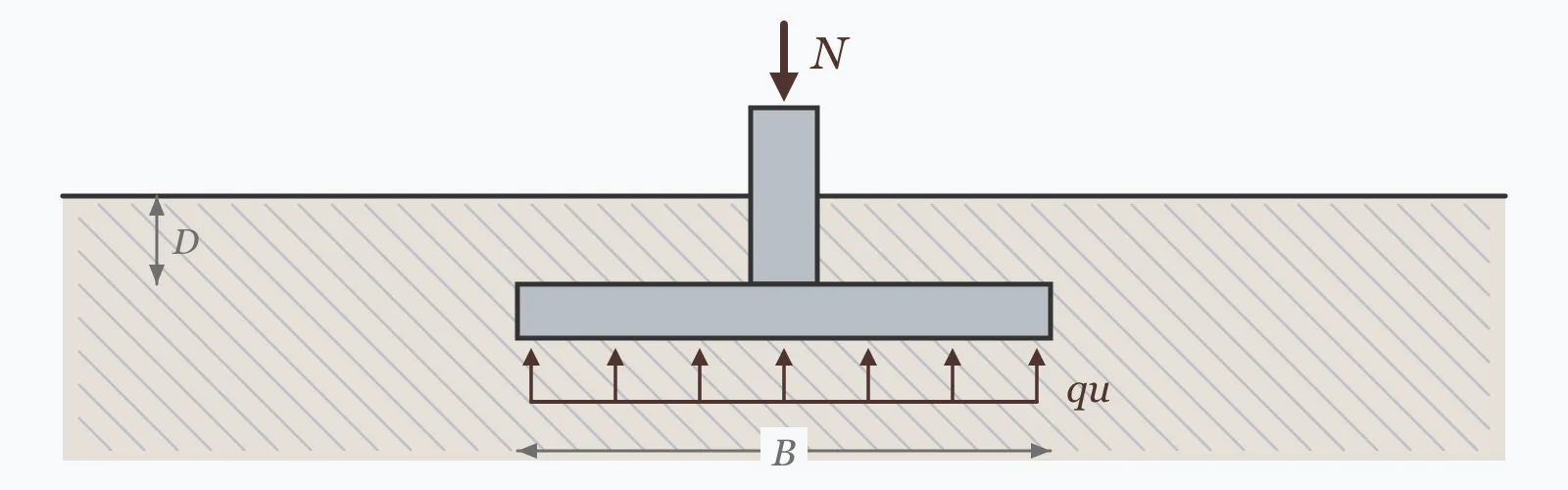
Bearing capacity comes from three sources — cohesion, the surcharge above founding level and the footing's own width — each multiplied by a factor that depends on the friction angle. Enter the soil parameters, the footing dimensions and a factor of safety to get the ultimate capacity, the net allowable pressure and the bearing capacity factor Nc.
Calculator
Units:
kPa
Effective cohesion. Use undrained shear strength with φ' = 0 for clay
Press Calculate for the ultimate bearing capacity, the net allowable pressure after applying the factor of safety, the gross allowable pressure and the bearing capacity factor Nc. Net allowable is the figure to compare against the net pressure a footing imposes.
Step-by-Step Solution
Preliminary design aid. Results follow the published formulas cited
below and are intended for estimating, study and early design. Final design must be
verified by a licensed Professional Engineer against the code in force for your project.
Key Benefits
✓Uses Terzaghi's three-term equation with Vesic bearing capacity factors
✓Distinguishes net from gross allowable pressure, which are routinely confused
✓Shows the three contributions separately, so the governing term is visible
✓Warns when capacity depends on footing width rather than on the soil
✓Sensitivity chart shows how strongly the friction angle drives the result
✓Shareable links and CSV export for design records
What Is Soil Bearing Capacity?
Bearing capacity is the pressure at which the soil beneath a footing fails by shearing, pushing the ground sideways and upward. Terzaghi expressed it as three additive terms: c'·Nc from the soil's cohesion, q·Nq from the weight of soil above founding level surcharging the failure surface, and 0.5·γ·B·Nγ from the weight of the soil within the failure wedge itself. Each factor N depends only on the friction angle, and all three grow steeply with it.
Net against gross allowable
The soil at founding level already carries the weight of the ground that was excavated. That pressure is not new, so it is deducted before the factor of safety is applied and added back afterwards. The net allowable pressure — what a footing may add beyond what was already there — is the figure to compare against a footing's net bearing pressure. Confusing the two overstates the available capacity by the full surcharge, which is 27 kPa at 1.5 m depth in ordinary soil.
Why clay and sand behave oppositely
In saturated clay assessed undrained, φ' is zero, so Nq is 1 and Nγ is zero — the width term vanishes entirely and capacity does not depend on footing size at all. In sand, c' is zero and the whole capacity comes from the two footing-dependent terms, so a wider or deeper footing gains capacity directly. That is why a single quoted allowable pressure means something for clay and rather less for sand.
Formula
q_ult = c'·Nc + q·Nq + 0.5·γ·B·Nγ
Terzaghi's bearing capacity equation for a strip footing, with Vesic factors
Related Formulas
Nq = e^(π·tanφ') · tan²(45° + φ'/2)
Nc = (Nq − 1) / tanφ', Nγ = 2(Nq + 1)·tanφ'
q_net,allow = (q_ult − q) / FS
Variable Definitions
Symbol
Variable
Unit
Description
c'
Cohesion
kPa
Effective cohesion, or undrained shear strength for the φ' = 0 case.
φ'
Friction Angle
°
Effective friction angle. The bearing factors grow steeply with it.
γ
Soil Unit Weight
kN/m³
Bulk unit weight, typically 17 to 20 kN/m³.
B
Footing Width
m
The lesser plan dimension. Enters the width term directly.
D
Founding Depth
m
Depth to the underside of the footing, providing the surcharge.
FS
Factor of Safety
—
Conventionally 3.0 on bearing capacity.
How to Use This Calculator
Use drained or undrained parameters consistentlyFor long-term conditions in any soil, use effective parameters c' and φ'. For short-term loading of saturated clay, use the undrained shear strength as c with φ' = 0. Mixing the two — an undrained strength with a drained friction angle — overstates the capacity substantially.
Enter the lesser plan dimension as BThe width term uses the smaller footing dimension, since that governs the size of the failure wedge. This calculation is for a strip footing; square and circular footings carry shape factors that increase the cohesion and width terms.
Measure founding depth to the undersideThe surcharge is the weight of soil above the founding level, so D is measured to the base of the footing rather than to the top. Deeper founding raises capacity through the Nq term, which is often a cheaper route than a wider footing.
Compare net against netThe net allowable pressure is what a footing may add beyond the overburden that was already there. Compare it against the net bearing pressure — total load divided by area, less the removed overburden — not against the gross pressure.
Check settlement separatelyThis is capacity, not settlement. Footings on clay are almost always governed by settlement rather than by shear failure, so satisfying this calculation is necessary but frequently not sufficient.
Worked Examples
Example 1
A 2 m wide strip footing founded 1.5 m deep in a cohesionless sand with φ' = 32° and a unit weight of 18 kN/m³, at a factor of safety of 3.
Net ultimate, deducting the 27.0 kPa already there: 1,142.6 kPa
Net allowable at FS 3: 380.9 kPa; gross allowable 407.9 kPa
Interpretation: the width term contributes 46% of the capacity, so this figure belongs to a 2 m footing. A narrower footing on identical sand would give a lower allowable pressure.
Example 2
The same sand with different footing widths, and then the contrasting case of undrained clay where width plays no part at all.
Step-by-Step Solution
On sand at φ' = 32°, varying only the width: 1 m gives 290.2 kPa net allowable, 2 m gives 380.9, 4 m gives 562.2
Quadrupling the width has nearly doubled the allowable pressure, because the width term grows in direct proportion to B
Now take undrained clay with c = 50 kPa and φ' = 0. Then Nc = 5.14, Nq = 1 and Nγ = 0.
Doubling the clay's strength to 100 kPa gives 541.0 kPa — an increase of exactly 257 kPa, or 50 × 5.14. The relationship is perfectly linear in c.
The two soils behave in opposite ways. In sand the allowable pressure is a property of the footing as much as the ground, so a wider footing is rewarded twice: more area and a higher permissible pressure on it.
In clay the allowable pressure is genuinely a soil property, and a wider footing gains only through its area. But clay footings are almost always governed by settlement rather than capacity, so the bearing calculation is rarely the one that sizes them.
Friction Angle Sensitivity
Capacity rises exponentially with friction angle, because the bearing factors contain e^(π·tanφ'). A few degrees near the upper end of the range are worth more than the same few degrees at the bottom. The marker shows your current friction angle.
Net Allowable Pressure vs Friction Angle (φ')
Recomputed live from your inputs. The marker shows your current value.
Line chart of Net Allowable Pressure against Friction Angle (φ'). The same
values are listed in the data table below.
Values plotted above, sampled across the friction angle (φ') range.
How to Interpret Your Results
The net allowable pressure is the design value. How it is composed matters too — a capacity dominated by the width term is one that changes when the footing changes.
Net Allowable Pressure: < 75Low capacity — shallow foundations may not suit
A net allowable pressure of your result kPa is low. Soft clay, loose fill and organic ground fall in this range, and shallow footings on them become large quickly. Ground improvement, a raft or piles are the usual alternatives, and settlement will almost certainly govern before capacity does.
Net Allowable Pressure: 75 – 200Moderate capacity
A net allowable pressure of your result kPa suits ordinary firm ground and is workable for most low-rise construction. Check settlement, which at this stiffness frequently governs the footing size rather than capacity.
Net Allowable Pressure: 200 – 500Good bearing ground
A net allowable pressure of your result kPa is competent ground for shallow foundations. Verify how much of it comes from the width term — if that dominates, the figure applies to this footing width and not to the site generally.
Net Allowable Pressure: ≥ 500Very high capacity
A net allowable pressure of your result kPa is dense granular soil or rock. Check the parameters that produced it: friction angles above about 40° are uncommon and the exponential form of the factors makes the result very sensitive to them.
Bearing Factor Nc: < 5.2Undrained clay case
Nc of your result indicates the φ' = 0 undrained condition, where Nγ is zero and capacity does not depend on footing width. For clay, expect settlement rather than bearing capacity to govern the design.
Common Mistakes to Avoid
Confusing net and gross allowable pressure
Why it matters:The soil at founding level already carries the excavated overburden, so that pressure is not new load. Comparing a gross allowable against a net applied pressure — or the reverse — introduces an error equal to the surcharge, which is 27 kPa at 1.5 m in ordinary soil.
✓How to avoid it:Compare net against net. The net applied pressure is the total load over the area, less the overburden removed by the excavation.
Treating allowable bearing pressure as a soil property
Why it matters:In cohesionless soil two of the three terms depend on the footing. The worked example gives 290 kPa for a 1 m footing and 562 kPa for a 4 m one on identical sand — the ground has not changed, only the footing.
✓How to avoid it:Recompute for the actual footing dimensions. Where a report quotes a single allowable pressure, find out what footing width and depth it assumed.
Mixing drained and undrained parameters
Why it matters:Using an undrained shear strength as c' alongside a drained friction angle counts the same strength twice. It is a large error and always in the unsafe direction.
✓How to avoid it:Choose one framework and stay in it: c' with φ' for long-term drained conditions, or undrained shear strength with φ' = 0 for short-term loading of saturated clay.
Checking capacity but not settlement
Why it matters:Bearing failure and excessive settlement are different limit states. Footings on clay almost always reach unacceptable settlement long before they approach shear failure, so a capacity check alone does not size them.
✓How to avoid it:Compute settlement separately and compare against the tolerance of the structure. A footing may need to be several times larger than capacity requires.
Ignoring the shape of the footing
Why it matters:The equation as written is for a strip footing, infinitely long. Square and circular footings mobilise more resistance and carry shape factors that raise the cohesion and width terms, typically by 20 to 30%.
✓How to avoid it:Apply shape factors for square, rectangular and circular footings. Using the strip result unmodified is conservative, which is why it is often left as it stands.
Overconfidence in the friction angle
Why it matters:The bearing factors contain e^(π·tanφ'), so they rise exponentially. Between 30° and 35° the ultimate capacity in the example nearly doubles, which means a few degrees of optimism in the parameter becomes a large error in the result.
✓How to avoid it:Use a conservative characteristic value rather than a mean, and remember that the factor of safety of 3 exists as much for parameter scatter as for load uncertainty.
Practical Applications
▸Sizing pad and strip footings
▸Checking an assumed allowable bearing pressure
▸Comparing founding depths for capacity
▸Assessing the effect of footing width on allowable pressure
▸Screening ground conditions for shallow foundation feasibility
▸Verifying a site investigation report's quoted figure
Industry Use Cases
Building foundations
Site investigation reports quote an allowable bearing pressure, but that figure already assumes a footing size and depth. For granular ground the assumption matters, since the width term can supply nearly half the capacity — a designer using a different footing gets a different answer.
Geotechnical assessment
The factor of safety of 3.0 on bearing capacity is unusually large by structural standards, and it exists because soil parameters are derived from a handful of samples across a whole site. The scatter, not the loading, drives the margin.
Foundation remediation
Underpinning increases founding depth, which raises capacity through the surcharge term. Because Nq is large for granular soil — 23 at φ' = 32° — every additional metre of depth adds substantially more than the weight of soil it represents.
Expert Tips
💡Bearing factors rise exponentially with φ', through e^(π·tanφ').
💡At φ' = 0, Nc is exactly 5.14 and the width term disappears entirely.
💡In sand, allowable pressure depends on the footing as much as on the soil.
💡Compare net against net — the surcharge is not new load on the soil.
💡Clay footings are almost always governed by settlement, not capacity.
💡The factor of safety of 3 covers parameter scatter more than load uncertainty.
Advantages & Limitations
Advantages
✓Uses Vesic factors, which match published tables to the digit
✓Separates net from gross allowable, which are routinely confused
✓Shows the three terms individually so the governing one is visible
✓Handles both the drained and the undrained φ' = 0 case
✓Warns when the result is a property of the footing rather than the ground
Limitations
!Strip footing only — square and circular footings need shape factors
!Assumes vertical concentric loading; inclination and eccentricity factors are not applied
!Assumes homogeneous soil to a depth of at least 1.5 times the footing width
!Takes no account of groundwater, which reduces effective unit weight substantially
!Gives bearing capacity, not settlement, which usually governs on clay
!Assumes a level ground surface and a horizontal founding plane
!Does not address punching or local shear failure in loose or soft soils
Sand and Clay Compared
A footing 1.5 m deep in soil at 18 kN/m³, factor of safety 3. The sand rows vary the footing width; the clay rows vary the strength. Notice which parameter each responds to.
1.5 m founding depth, γ = 18 kN/m³, FS 3. The sand rows quadruple the width and nearly double the allowable pressure. The clay rows are identical for any width, because Nγ is zero at φ' = 0 — and doubling the cohesion adds exactly 50 × 5.14 = 257 kPa each time.
Use Terzaghi's equation q_ult = c'·Nc + q·Nq + 0.5·γ·B·Nγ, with the bearing factors from the friction angle. Divide the net ultimate by a factor of safety, conventionally 3.
What is the difference between net and gross allowable pressure?
Gross includes the overburden pressure already present at founding level; net is what the footing may add beyond it. Compare net against net, or the error equals the surcharge — 27 kPa at 1.5 m depth in ordinary soil.
Why is Nc equal to 5.14 for clay?
At φ' = 0 the general expression for Nc reduces to π + 2 = 5.14. It is an exact analytical result for undrained conditions, and it is why undrained clay capacity is often quoted as 5.14 times the shear strength.
Does footing width affect bearing capacity?
In sand, considerably — the width term grows in proportion to B, giving 290 kPa for a 1 m footing and 562 for a 4 m one on identical ground. In undrained clay, not at all, because Nγ is zero.
What factor of safety should I use?
3.0 is conventional for bearing capacity. It is large by structural standards because soil parameters carry considerable scatter, derived as they are from a few samples across a whole site.
Does founding deeper increase capacity?
Yes, through the surcharge term. At φ' = 32° the factor Nq is 23.18, so each extra metre of depth adds 18 × 23.18 = 417 kPa to the ultimate capacity — far more than the weight of the soil itself.
Is bearing capacity or settlement the governing check?
On clay, settlement almost always governs. On dense sand, capacity is more often the limit. Both must be checked, and a footing may need to be several times larger than capacity alone requires.
How does groundwater affect bearing capacity?
Substantially. Water reduces the effective unit weight to roughly half its bulk value, which cuts both the surcharge and width terms. Where the water table is within about one footing width of the base, the reduction must be applied.
Do square footings have the same capacity as strip footings?
No, they have more. Square and circular footings mobilise resistance around their whole perimeter and carry shape factors that raise the cohesion and width terms, typically by 20 to 30%. The strip result is conservative for them.
How sensitive is the result to the friction angle?
Very. The factors contain e^(π·tanφ'), so they rise exponentially. Going from 30° to 35° nearly doubles the ultimate capacity, which is why a conservative characteristic value matters more than a precise mean.
Glossary
Ultimate bearing capacity
The pressure at which the soil beneath a footing fails in shear.
Net allowable pressure
The pressure a footing may add beyond the overburden already present.
Bearing capacity factors
Nc, Nq and Nγ, dimensionless multipliers depending only on the friction angle.
Surcharge
The pressure from soil above founding level, which resists the failure mechanism.
Undrained shear strength
The strength of saturated clay under rapid loading, used with φ' = 0.
Effective stress parameters
c' and φ', describing drained long-term soil strength.
Shape factor
A multiplier accounting for square, rectangular or circular footings rather than a strip.
Punching shear failure
A local failure mode in loose or soft soil, distinct from general shear.
Founding depth
The depth to the underside of the footing, providing the surcharge.
Characteristic value
A conservative estimate of a soil parameter, below the mean of the test results.
Scientific & Standards References
Terzaghi, K., Theoretical Soil Mechanics (1943) — Wiley
Vesic, A. S., Analysis of Ultimate Loads of Shallow Foundations, Journal of the Soil Mechanics and Foundations Division (1973) — American Society of Civil Engineers
EN 1997-1 (Eurocode 7) Annex D — Sample analytical method for bearing resistance calculation — CEN
Bowles, J. E., Foundation Analysis and Design, 5th Edition — Chapter 4: Bearing Capacity of Foundations — McGraw-Hill
Bearing capacity is a sum of three terms, and which one dominates changes what the answer means. In undrained clay only the cohesion term survives — Nγ is zero, so the capacity is genuinely a property of the ground and holds for any footing width. In sand the cohesion term vanishes instead, leaving two terms that both depend on the footing: the table above shows 290 kPa net allowable for a 1 m footing and 562 kPa for a 4 m one on identical soil. An allowable pressure quoted without a footing size has already assumed one. Two further cautions. The bearing factors contain e^(π·tanφ'), so they rise exponentially and a few degrees of optimism in the friction angle becomes a large error — which is much of why the conventional factor of safety is 3 rather than the 1.5 structural work uses. And this is capacity, not settlement: footings on clay almost always reach unacceptable movement long before they approach shear failure.
Enter your soil parameters and footing dimensions above to get the allowable pressure.