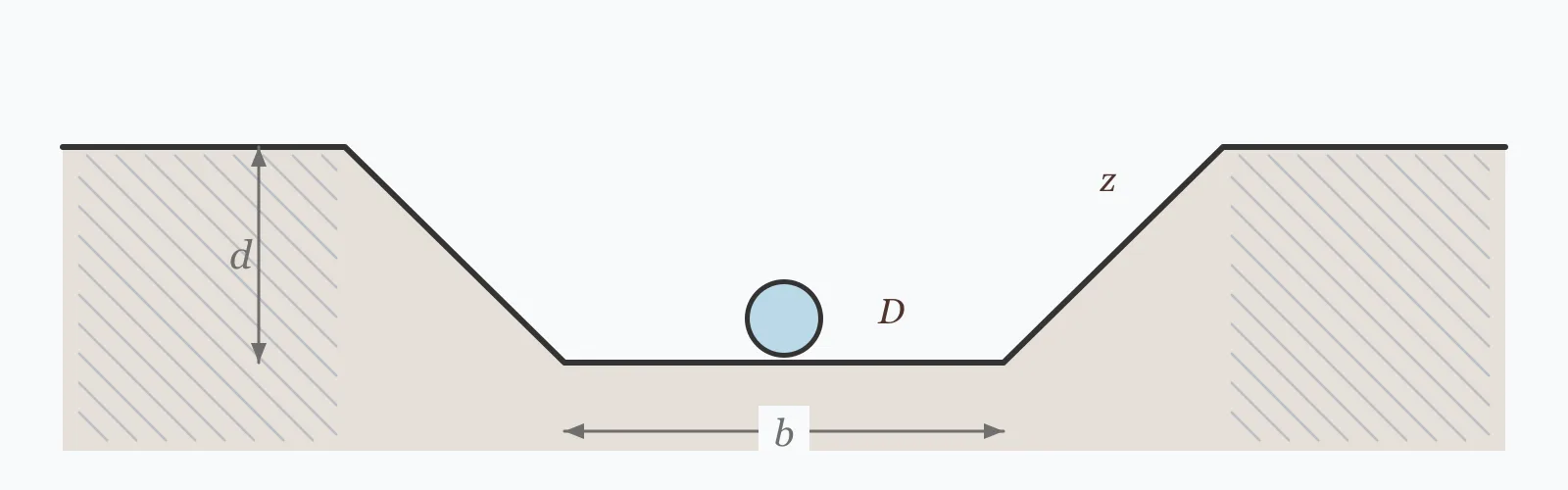
A battered trench is a trapezoid in section, so its volume uses the mean of the top and bottom widths. Enter the bottom width, depth, length, batter slope and pipe diameter to get the excavation volume, the backfill required after the pipe displaces its share, the top width and the surface area affected.
Calculator
Units:
m
Pipe diameter plus at least 150 mm each side for compaction
m
Depth to trench bottom. Support required above about 1.2 m
m
Length of the trench run
H:1V
0 for vertical sides with support; 0.5 to 1 for battered earth
mm
Outside diameter of the pipe, which displaces backfill
Calculation Result
Press Calculate for the excavation volume, the backfill needed after deducting the pipe, the width at ground level and the surface area disturbed. The last of these often governs the method on a constrained site.
Step-by-Step Solution
Preliminary design aid. Results follow the published formulas cited
below and are intended for estimating, study and early design. Final design must be
verified by a licensed Professional Engineer against the code in force for your project.
Key Benefits
✓Handles battered sides properly using the mean width
✓Deducts pipe displacement from the backfill requirement
✓Reports the surface area affected, which drives reinstatement cost
✓Warns at the depth where trench support becomes mandatory
✓Sensitivity chart shows volume growing faster than depth
✓Shareable links and CSV export for quantity records
What Is Trench Volume?
A trench with vertical sides is a simple rectangular prism, but vertical sides in anything but rock require support. The alternative is to batter them back to a stable angle, which turns the section into a trapezoid: the width at the top exceeds the width at the bottom by the batter run on each side. Volume is then the mean of the two widths multiplied by the depth and the length.
Why battering costs so much
The extra width added at the top is proportional to the depth, so the extra volume grows with the square of depth while the useful trench grows only linearly. At 1 m depth with a 1 in 2 batter the excavation is 56% more than a vertical trench; at 3 m it is 167% more. This is why battering suits shallow work in open ground and support systems take over as soon as depth or space becomes constrained.
Backfill is not the same as excavation
Three things separate the two. The pipe displaces some of the volume, so less material returns than came out. The arisings bulk on excavation and then compact when replaced, which works in the opposite direction. And some fraction of what comes out is unsuitable as pipe surround, so it leaves site and imported material takes its place. Only the first is geometric, and it is the smallest of the three.
Formula
V = ((b + b_top)/2) · d · L
Trench volume using the mean of bottom and top widths
Related Formulas
b_top = b + 2·z·d
V_backfill = V − π·D²/4 · L
A_surface = b_top · L
Variable Definitions
Symbol
Variable
Unit
Description
b
Bottom Width
m
Trench width at the invert, set by the pipe plus working space.
d
Depth
m
Depth to the trench bottom. Support becomes mandatory around 1.2 m.
L
Length
m
Length of trench run.
z
Batter Slope
H:1V
Horizontal run per unit depth on each side. 0 for vertical.
D
Pipe Diameter
mm
Outside diameter, which displaces backfill.
b_top
Top Width
m
Width at ground level, which sets the surface disturbed.
How to Use This Calculator
Set the bottom width from the pipe plus working spaceThe trench must be wide enough to compact bedding and surround around the pipe — at least 150 mm each side, and more for large diameters. Poor surround compaction is the usual cause of pipe deformation and of the road settlement that follows it.
Choose the batter from the soil, not from convenienceAround 1 in 2 suits firm cohesive ground, flatter for sand or loose fill, steeper only in rock. If the soil will not stand at the angle chosen, the trench will find its own — usually while someone is in it.
Enter zero batter only where support is providedVertical sides give the least excavation and are only permissible with shoring, a trench box or in ground that will genuinely stand. Around 1.2 m is the depth above which support becomes mandatory in most jurisdictions.
Read the surface area, not just the volumeOn a road or a built-up site the disturbed surface drives the reinstatement cost, the traffic management and the land take — and it frequently exceeds the excavation cost. It is the figure that decides between battering and a trench box.
Treat the backfill figure as geometric onlyIt deducts the pipe but not bulking, compaction or unsuitable material. All three affect what is actually imported and exported, and all three are usually larger effects than the pipe.
Worked Examples
Example 1
A 50 m trench 0.9 m wide at the bottom and 1.5 m deep, battered at 1 in 2, carrying a 300 mm pipe.
Step-by-Step Solution
Top width: b + 2·z·d = 0.9 + 2 × 0.5 × 1.5 = 2.400 m
Mean width: (0.9 + 2.400)/2 = 1.650 m
Excavation: 1.650 × 1.5 × 50 = 123.75 m³
Pipe displacement: π × 0.300²/4 × 50 = 3.53 m³
Backfill required: 123.75 − 3.53 = 120.22 m³
Surface affected: 2.400 × 50 = 120 m²
Interpretation: the same trench with vertical sides would excavate 67.50 m³ and disturb only 45 m². Battering has added 83% to the excavation and 167% to the surface.
Example 2
The same trench at different depths, to show how the battering penalty grows.
Step-by-Step Solution
At 1.0 m: top width 1.900 m, excavation 70.00 m³, surface 95 m²
At 1.5 m: top width 2.400 m, excavation 123.75 m³, surface 120 m²
At 2.0 m: top width 2.900 m, excavation 190.00 m³, surface 145 m²
At 3.0 m: top width 3.900 m, excavation 360.00 m³, surface 195 m²
Tripling the depth from 1 to 3 m has multiplied the excavation by 5.14, not by three. The trench widens as it deepens, so volume grows faster than depth.
The equivalent vertical-sided trenches would be 45.0, 67.5, 90.0 and 135.0 m³ — strictly proportional to depth.
So the battering penalty grows from 56% at 1 m to 167% at 3 m. At shallow depths battering is a cheap way to avoid support; by 3 m it has become the expensive option.
The surface figure tells the same story more sharply on a constrained site. A 3 m battered trench disturbs a 3.9 m wide strip, which on most roads means closing a full lane and reinstating it — costs that a 0.9 m trench box would avoid entirely.
Depth Sensitivity
With battered sides the volume curves upward rather than rising in a straight line, because the trench widens as it deepens. The surface area rises linearly with depth for the same reason. The marker shows your current depth.
Excavation Volume vs Depth
Recomputed live from your inputs. The marker shows your current value.
Line chart of Excavation Volume against Depth. The same
values are listed in the data table below.
Values plotted above, sampled across the depth range.
How to Interpret Your Results
Excavation volume prices the digging and disposal. Surface area prices the reinstatement, and on a constrained site it is usually the larger of the two.
Excavation Volume: < 50Small excavation
An excavation of your result m³ is a modest quantity, within reach of a small machine and a few truck loads. At this scale the mobilisation and reinstatement usually cost more than the digging.
Excavation Volume: 50 – 500Typical utility run
An excavation of your result m³ is a normal utility or drainage run. Check the surface area alongside it — on a road or a paved area, reinstatement frequently exceeds the excavation cost.
Excavation Volume: ≥ 500Substantial excavation
At your result m³ the arisings and their disposal become a significant cost in their own right. Consider whether a narrower trench with support would reduce both the excavation and the reinstatement enough to justify the equipment.
Width at Ground Level: ≥ 3Wide at the surface
A top width of your result m disturbs a broad strip of ground. On a highway that usually means a full lane closure; on a constrained site it may not fit at all. A trench box holds the width to the bottom dimension throughout.
Surface Area Affected: ≥ 300Large surface reinstatement
A disturbed area of your result m² carries substantial reinstatement cost, and on adopted highways the specification for permanent reinstatement is demanding. This figure, rather than the volume, often decides the excavation method.
Common Mistakes to Avoid
Using the bottom width for a battered trench
Why it matters:A battered trench is a trapezoid, not a rectangle. Using the bottom width alone understates the excavation by the whole battering allowance — 45% of the true figure in the 1.5 m example above.
✓How to avoid it:Use the mean of the bottom and top widths, as this calculator does. The top width is the bottom plus twice the batter run.
Leaving trench sides vertical without support
Why it matters:Around 1.2 m is the depth at which support becomes mandatory in most jurisdictions, and trench collapse remains one of the highest-fatality events in construction. A cubic metre of soil weighs close to two tonnes and gives no warning before it moves.
✓How to avoid it:Batter, shore, or use a trench box above the threshold depth. The choice is a cost decision; whether to do one of them is not.
Making the trench too narrow for compaction
Why it matters:Bedding and surround have to be compacted around the pipe, and that is impractical with less than about 150 mm each side. Poorly compacted surround lets the pipe deform and lets the surface above it settle, which is the usual cause of the depressions that appear along reinstated trenches.
✓How to avoid it:Size the bottom width as the pipe outside diameter plus at least 300 mm total, and more for larger pipes where a person must work in the trench.
Treating backfill as equal to excavation
Why it matters:The pipe displaces some volume, the arisings bulk when dug and compact when replaced, and part of what comes out is unsuitable as surround. Only the pipe deduction is geometric, and it is the smallest of the three effects.
✓How to avoid it:Apply bulking and shrinkage factors, and identify the fraction that must be exported and replaced with imported granular material.
Ignoring the surface area
Why it matters:On adopted highways the reinstatement specification is demanding and the area is what it is priced on. A battered trench disturbs a much wider strip than the trench itself, and that cost is frequently larger than the excavation.
✓How to avoid it:Price the reinstatement alongside the excavation before choosing between battering and support. The comparison often reverses the intuitive answer.
Overlooking groundwater
Why it matters:A trench below the water table fills, and the inflow both destabilises the sides and prevents proper compaction of the bedding. Neither the volume nor the batter calculation gives any warning of it.
✓How to avoid it:Check the groundwater level against the trench depth and plan dewatering where needed. Water changes the safe batter angle as well as the working method.
Practical Applications
▸Estimating excavation for drainage and utility trenches
▸Comparing battered against supported trench methods
▸Quantifying backfill and imported surround material
▸Assessing surface reinstatement area and cost
▸Checking trench width against pipe and compaction needs
▸Planning spoil handling and disposal
Industry Use Cases
Utility installation
Trench boxes dominate in urban work not because they are cheap but because the alternative is wider. Battering a 2 m deep trench needs a 2.9 m strip against 0.9 m with a box, and in a carriageway that difference decides the traffic management as well as the reinstatement.
Drainage construction
Trench width is set by the compaction requirement rather than by the pipe, because the surround is what carries the load onto the pipe. A trench too narrow to compact properly produces the surface depressions that follow reinstated services for years.
Highway reinstatement
The permanent reinstatement specification is priced by surface area and is demanding on adopted roads. That makes the top width, rather than the excavated volume, the number that most influences the total cost of a shallow utility run.
Expert Tips
💡Battered volume uses the mean width, not the bottom width.
💡The battering penalty grows with depth: 56% at 1 m, 167% at 3 m.
💡Support becomes mandatory around 1.2 m depth in most jurisdictions.
💡Allow at least 150 mm each side of the pipe for compaction.
💡Surface area often costs more than excavation on a road.
💡A cubic metre of soil weighs close to two tonnes and collapses without warning.
Advantages & Limitations
Advantages
✓Handles battered sides correctly with the mean width
✓Deducts pipe displacement from the backfill requirement
✓Reports the surface area, which usually governs the method choice
✓Warns at the depth where support becomes mandatory
✓Simple enough to compare methods on site
Limitations
!Assumes a uniform trapezoidal section along the whole length
!Backfill deducts only the pipe, not bulking, shrinkage or unsuitable material
!Takes no account of bedding and surround material as a separate quantity
!Assumes level ground and a constant depth along the run
!Does not check batter stability against the actual soil
!Ignores groundwater, which affects both stability and method
!Does not size the support system where vertical sides are used
Battered Against Vertical, by Depth
A 50 m trench 0.9 m wide at the bottom carrying a 300 mm pipe. The battered columns use 1 in 2 sides; the vertical column would require support.
50 m long, 0.9 m bottom width, 1 in 2 batter. Tripling the depth multiplies the battered volume by 5.14 but the vertical volume by only 3, because the battered trench widens as it deepens. The surface area column is why urban work uses trench boxes.
For vertical sides, width times depth times length. For battered sides, use the mean of the bottom and top widths — a 0.9 m trench 1.5 m deep at 1 in 2 has a 2.4 m top width and a 1.65 m mean.
At what depth does a trench need support?
Around 1.2 m in most jurisdictions, though the exact threshold and the permitted alternatives vary. Below it, unsupported vertical sides may be acceptable in competent ground; above it, battering, shoring or a trench box is required.
How much extra does battering cost in volume?
It grows with depth. At 1 m a 1 in 2 batter adds 56% to the excavation; at 3 m it adds 167%, because the extra width is proportional to the depth.
How wide should a pipe trench be?
The pipe outside diameter plus at least 150 mm each side, so bedding and surround can be compacted. Larger pipes and any trench a person must work in need more.
Why does backfill differ from excavation?
Three reasons: the pipe displaces volume, the arisings bulk when excavated and compact when replaced, and some fraction is unsuitable as surround and must be exported. Only the pipe deduction is purely geometric.
What batter slope should I use?
About 1 in 2 for firm cohesive ground, flatter for sand or loose fill, steeper only in rock. The soil determines it — if it will not stand at the chosen angle it will find its own.
Why does surface area matter so much?
Because reinstatement is priced on it, and on adopted highways the specification is demanding. A 3 m deep battered trench disturbs a 3.9 m strip against 0.9 m with a trench box, which changes the traffic management as well as the cost.
Is a trench box cheaper than battering?
Often, once depth exceeds about 1.5 m or the site is constrained. The box costs equipment and handling but holds the trench to its bottom width, saving excavation, disposal and reinstatement together.
How heavy is trench spoil?
Around 1.8 to 2.0 tonnes per cubic metre in place. That is why an unsupported collapse is so dangerous — a small volume of soil is more than enough to prevent breathing, and it gives no warning.
Does groundwater affect the trench?
Considerably. Water destabilises the sides, reduces the safe batter angle and prevents proper compaction of the bedding. It needs assessing separately from the volume calculation.
Glossary
Batter
The slope of a trench side, expressed as horizontal run per unit of depth.
Trench box
A steel shield placed in a trench to protect workers without supporting the ground itself.
Shoring
A support system holding trench sides in place.
Bedding
Prepared granular material beneath a pipe, distributing the load on it.
Surround
Compacted material around and above a pipe, protecting it and transferring load.
Arisings
Material excavated from a trench, some of which may be unsuitable for reuse.
Reinstatement
Restoration of the surface after backfilling, priced by area on highways.
Top width
The trench width at ground level, which sets the surface disturbed.
Bulking
The volume increase when soil is excavated and loosened.
Invert
The lowest internal level of a pipe or trench.
Scientific & Standards References
BS 6031 — Code of practice for earthworks — British Standards Institution
OSHA 29 CFR 1926 Subpart P — Excavations — Occupational Safety and Health Administration
Specification for the Reinstatement of Openings in Highways — UK Department for Transport
CIRIA C750 — Groundwater control: design and practice — Construction Industry Research and Information Association
BS EN 1610 — Construction and testing of drains and sewers — British Standards Institution
Conclusion
A battered trench is a trapezoid, so its volume uses the mean width — and because the extra width grows with depth, the volume curves upward while a vertical trench rises in a straight line. The table above shows the penalty growing from 56% at 1 m to 167% at 3 m, and the excavation multiplying by 5.14 for a tripling of depth. That is the arithmetic case for support systems, but it is rarely the decisive one. The surface area is: a 3 m battered trench disturbs a 3.9 m strip where a trench box holds it to 0.9 m, and on an adopted highway reinstatement is priced by area and specified demandingly. Two things this calculation cannot see still decide the work. The threshold around 1.2 m where support stops being a choice, since a cubic metre of soil weighs close to two tonnes and moves without warning. And groundwater, which changes the safe batter angle, the working method and whether the bedding can be compacted at all.
Enter your trench dimensions above to compare battered and supported options.