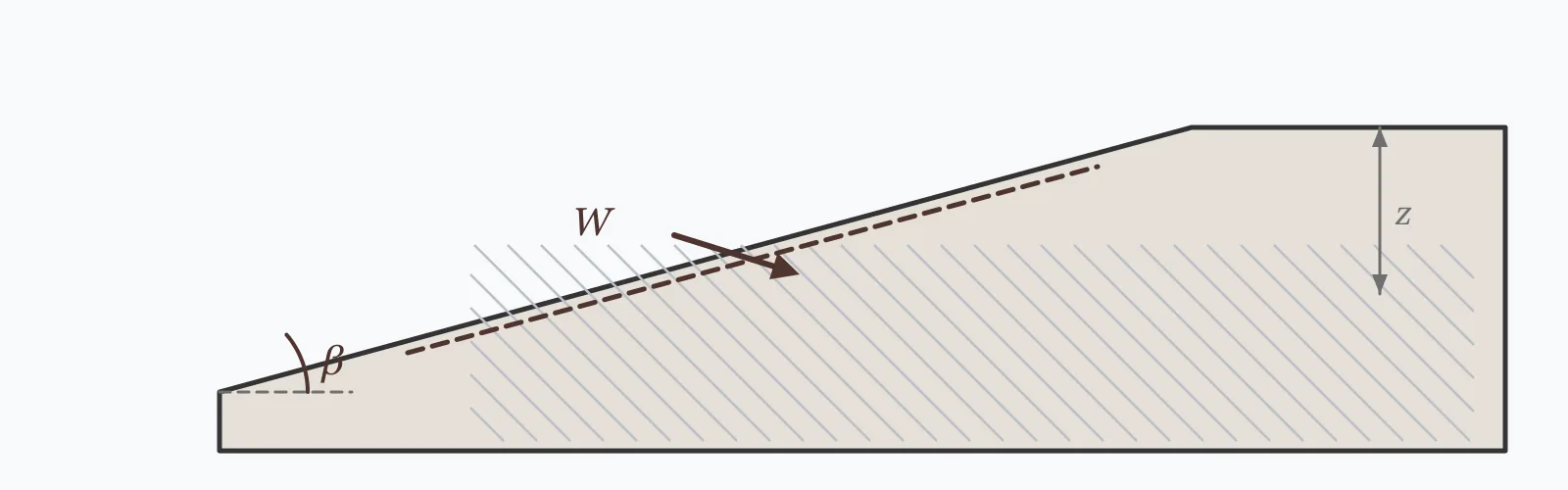
The infinite slope method compares the shear stress driving a shallow failure against the strength resisting it. Enter the cohesion, friction angle, slope angle, unit weight and failure depth to get the driving and resisting stresses, the factor of safety, and the steepest angle at which this soil remains stable.
Calculator
Units:
kPa
Effective cohesion. Use 0 for clean sand and gravel
°
Drained friction angle. Sand 28–40°, clay 20–28°
°
Ground surface inclination. 1 in 2 is 26.6°, 1 in 3 is 18.4°
kN/m³
Bulk unit weight, typically 17–21 kN/m³
m
Vertical depth to the assumed failure plane
Calculation Result
Press Calculate for the driving and resisting shear stresses on the failure plane, their ratio as a factor of safety, and the maximum slope angle at which FS reaches 1.0 for this soil.
Step-by-Step Solution
Preliminary design aid. Results follow the published formulas cited
below and are intended for estimating, study and early design. Final design must be
verified by a licensed Professional Engineer against the code in force for your project.
Key Benefits
✓Applies the infinite slope method in its standard drained form
✓Returns the driving and resisting stresses, not just their ratio
✓Solves the maximum stable angle numerically, consistent with the FS output
✓Warns automatically below FS 1.3 and again below 1.0
✓Sensitivity chart shows how the factor of safety falls with slope angle
✓Shareable links and CSV export for geotechnical records
What Is Slope Stability?
The infinite slope model considers a soil layer of uniform depth on a plane parallel to the ground surface, long enough that end effects can be ignored. The weight of soil above the failure plane resolves into a component driving the slide, γ·z·sinβ·cosβ, and a normal component that mobilises friction. Shear strength on the plane follows the Mohr-Coulomb criterion: c' plus the normal stress times tan φ'. The factor of safety is the ratio of the two.
Why a sand slope stands at its friction angle
Set the cohesion to zero and the expression simplifies dramatically: FS = tan φ'/tan β. That is independent of both the unit weight and the depth — a cohesionless slope is stable at any depth provided the slope angle is below the friction angle, and unstable at every depth above it. It is why dry sand always forms the same cone whatever its size, and why the angle of repose is a material property rather than a scale-dependent one.
What cohesion buys, and its limit
Cohesion adds a constant term to the resisting stress while the driving stress grows with depth. A cohesive soil can therefore stand steeper than its friction angle, but only above a critical depth — and the deeper the potential failure plane, the less the cohesion contributes proportionally. This is exactly why a trench in clay stands vertically when freshly cut and then fails, sometimes days later as suction dissipates and the apparent cohesion with it.
Formula
FS = [c' + γ·z·cos²β·tan φ'] / [γ·z·sin β·cos β]
Infinite slope factor of safety for a dry slope, drained parameters
Ratio of resisting to driving shear stress. Below 1.0 the slope fails.
c'
Effective Cohesion
kPa
Drained cohesion intercept. Zero for clean sands and gravels.
φ'
Effective Friction Angle
°
Drained angle of internal friction. 28–40° for sands, 20–28° for clays.
β
Slope Angle
°
Inclination of the ground surface from horizontal.
γ
Soil Unit Weight
kN/m³
Bulk unit weight of the soil above the failure plane. 17–21 kN/m³ typical.
z
Failure Depth
m
Depth to the assumed failure plane, measured vertically.
How to Use This Calculator
Use drained effective stress parametersEnter c' and φ' from a drained triaxial or shear box test. Undrained parameters describe the short-term condition immediately after excavation and give a quite different, usually more optimistic, answer for a clay.
Choose the failure depth deliberatelyThe depth is an assumption about where the failure plane lies, often a weathered-to-competent interface or a permeability contrast. Trying several depths is worthwhile, since cohesive soils are most critical at a particular depth rather than the deepest one.
Read the maximum safe angle as an FS = 1 resultThe maximum angle returned is where this same model gives FS exactly 1.0 — a failure condition, not a design condition. Design at a slope well below it, to give the factor of safety your application requires.
Account for water separatelyThis calculation assumes a dry slope. Seepage parallel to the surface can halve the factor of safety, because pore pressure reduces the effective normal stress that mobilises friction while the driving weight is unchanged. It is the reason most slope failures occur during or after heavy rain.
Check whether the failure mode is rightThe infinite slope model describes shallow translational sliding. Deep-seated rotational failure in soft clay, wedge failure on a jointed rock face and flow slides all behave differently and need a method suited to them.
Worked Examples
Example 1
A 25° slope in soil with c' = 10 kPa, φ' = 30° and γ = 18 kN/m³ is assessed for a failure plane 2 m deep. Find the factor of safety.
Step-by-Step Solution
Vertical stress from the soil above: γz = 18 × 2 = 36 kPa
Maximum stable angle for this soil and depth: 54.4°, where FS falls to exactly 1.0
Assessment: FS of 1.96 is comfortably above the 1.5 usually required for a permanent slope. Note that the 54.4° figure is a failure condition, not a design target.
Example 2
The same slope with the cohesion removed — a clean sand at φ' = 30°. This is where the model gives its cleanest and most famous result.
Step-by-Step Solution
Driving stress is unchanged: 13.79 kPa
Resisting stress: 0 + 29.57 × tan30° = 17.07 kPa
Factor of safety: FS = 17.07 / 13.79 = 1.238
Equivalently: FS = tan30°/tan25° = 0.5774 / 0.4663 = 1.238 — the same answer with no reference to γ or z
Maximum stable angle: exactly 30.0°, which is φ' itself
That independence from depth and unit weight is the whole point: a cohesionless slope stands at its friction angle regardless of how big it is.
It is why a sand pile of any size forms the same cone, and why a stockpile that has stood for years fails the moment it is steepened past the angle of repose.
Comparison against the cohesive case: 10 kPa of cohesion raised the maximum angle from 30.0° to 54.4°, but only for a 2 m failure depth. At 10 m the same cohesion buys far less, because the driving stress has grown fivefold while the cohesion has not.
Slope Angle Sensitivity
The factor of safety falls steeply as the slope steepens, because driving stress rises while resisting stress falls at the same time. Watch where it crosses 1.5 and 1.0. The marker shows your current slope angle.
Factor of Safety (FS) vs Slope Angle (β)
Recomputed live from your inputs. The marker shows your current value.
Line chart of Factor of Safety (FS) against Slope Angle (β). The same
values are listed in the data table below.
Values plotted above, sampled across the slope angle (β) range.
How to Interpret Your Results
The factor of safety is read against the thresholds set by consequence and duration. Temporary works are held to lower values than permanent slopes, and slopes above occupied buildings to higher ones.
Factor of Safety (FS): < 1Unstable — failure predicted
A factor of safety of your result is below 1.0, meaning the driving stress exceeds the available strength. This slope is predicted to fail. It must be flattened, drained, or supported before anyone works below it.
Factor of Safety (FS): 1 – 1.3Marginal — below temporary works minimum
A factor of safety of your result falls below the 1.3 generally required even for temporary slopes. There is almost no margin for the parameter uncertainty inherent in soil testing, and none at all for a rise in groundwater.
Factor of Safety (FS): 1.3 – 1.5Acceptable for temporary works only
A factor of safety of your result satisfies the usual 1.3 minimum for short-term excavations but falls short of the 1.5 expected for a permanent slope. Confirm the exposure period and that groundwater will not rise during it.
Factor of Safety (FS): 1.5 – 2.5Adequate for a permanent slope
A factor of safety of your result meets the 1.5 normally required for permanent slopes. Where the slope supports a structure or lies above occupied areas, some standards require 2.0 or more.
Factor of Safety (FS): ≥ 2.5Conservative
A factor of safety of your result is generous. Either the slope is flatter than it needs to be, or the strength parameters are conservative. On a large earthworks scheme, a steeper slope at an adequate factor can save considerable volume.
Max Safe Slope Angle: ≥ 85Model does not predict failure at any angle
The maximum angle has capped at your result°, meaning the factor of safety never drops below 1.0 across the range. That happens when cohesion is high relative to the failure depth, and it is a limitation of the infinite slope model rather than a guarantee — a vertical face in cohesive soil fails by a mechanism this model does not represent.
Common Mistakes to Avoid
Ignoring groundwater
Why it matters:This calculation assumes a dry slope. Seepage parallel to the surface reduces the effective normal stress that mobilises friction while leaving the driving weight unchanged, and can roughly halve the factor of safety.
✓How to avoid it:Use the submerged unit weight in the resisting term where seepage is present. Most slope failures occur during or shortly after heavy rainfall, which is exactly this effect.
Using undrained parameters for a long-term assessment
Why it matters:Undrained strength describes a clay immediately after excavation, before pore pressures equilibrate. Over months to years the strength falls to the drained value, which is why cuttings can fail long after they were dug.
✓How to avoid it:Use drained c' and φ' for permanent slopes and undrained parameters only for the short-term construction case. Check both, since either can govern.
Relying on apparent cohesion in a granular soil
Why it matters:Damp sand appears cohesive because of capillary suction between grains, which vanishes entirely on saturation or on drying. Designing a slope on that apparent cohesion is designing on a temporary condition.
✓How to avoid it:Take c' as zero for clean sands and gravels regardless of how the material behaves in a trial pit. Apparent cohesion is not a design parameter.
Treating the maximum safe angle as a design angle
Why it matters:The maximum angle returned is where FS equals exactly 1.0 — the point of failure. Building to it leaves no margin for parameter uncertainty, groundwater or loading.
✓How to avoid it:Design at an angle giving the required factor of safety, typically 1.3 for temporary and 1.5 for permanent slopes. Use the maximum angle only to understand how much margin exists.
Applying the infinite slope model to a deep-seated failure
Why it matters:The model describes shallow translational sliding on a plane parallel to the surface. Deep rotational failures in soft clay follow a curved surface, and the infinite slope result can be badly unconservative for them.
✓How to avoid it:Use a method of slices — Bishop, Janbu or Morgenstern-Price — for anything other than a shallow planar mechanism. Infinite slope is a screening tool, not a general one.
Testing only one failure depth
Why it matters:In a cohesive soil the factor of safety varies with the assumed depth, because cohesion is constant while driving stress grows. The critical depth is not necessarily the deepest one considered.
✓How to avoid it:Run a range of depths and take the lowest factor of safety. Pay particular attention to interfaces — weathered to competent, permeable to impermeable — where failure planes tend to form.
Practical Applications
▸Screening cut and fill slope angles during earthworks design
▸Assessing shallow landslide risk on natural slopes
▸Checking temporary excavation batters
▸Evaluating the stability of stockpiles and spoil heaps
▸Estimating the effect of rainfall on marginal slopes
▸Determining the maximum angle for a given soil
Industry Use Cases
Highway and railway earthworks
Cutting and embankment slopes are set from the factor of safety, and the volume of earthworks scales directly with the angle chosen. On a long scheme, a degree of extra steepness at an acceptable factor can remove hundreds of thousands of cubic metres.
Landslide hazard assessment
Shallow translational slides in weathered soil and colluvium are exactly the mechanism this model describes, which makes it the basis of most regional landslide susceptibility mapping. The mapping is typically run twice: dry and with a saturated seepage condition.
Temporary works
Excavation batters are the commonest place this calculation is applied, and the commonest place it is skipped. Trench collapse remains a leading cause of construction fatalities, and cohesive soil standing vertically at first is precisely what makes it deceptive.
Expert Tips
💡A dry cohesionless slope stands at exactly its friction angle, whatever its size.
💡Cohesion allows something steeper, but only above a critical depth — deeper planes get less benefit.
💡Seepage parallel to the slope can roughly halve the factor of safety.
💡Check both drained and undrained cases for a clay; either can govern depending on timescale.
💡Never design on apparent cohesion in sand — it disappears on wetting or drying.
💡Try several failure depths; the critical one is rarely the deepest.
Advantages & Limitations
Advantages
✓Closed-form and fast enough to screen many slopes
✓Describes a real and common failure mechanism accurately
✓Reduces to a clean result for cohesionless soil, independent of scale
✓Returns the driving and resisting stresses, so the balance is visible
✓Maximum stable angle is solved consistently with the factor of safety
Limitations
!Assumes a dry slope; seepage can halve the factor of safety
!Describes shallow planar failure only, not deep rotational or wedge mechanisms
!Assumes uniform soil properties through the depth considered
!Ignores end effects, so it suits long uniform slopes rather than short ones
!Takes no account of surcharge, seismic loading or vegetation root reinforcement
!Requires a failure depth to be assumed rather than found
!Caps the maximum angle at 89° where the model never predicts failure, which reflects the model rather than reality
Factor of Safety by Slope Angle
The default soil — c' = 10 kPa, φ' = 30°, γ = 18 kN/m³ at 2 m depth. Driving stress peaks at 45° while resisting stress falls throughout, so the factor of safety declines steadily across the useful range.
Dry infinite slope, c' = 10 kPa, φ' = 30°, γ = 18 kN/m³, z = 2 m. The final row is the maximum stable angle the calculator returns.
Generally 1.5 for a permanent slope and 1.3 for temporary works. Where the slope supports a structure or lies above occupied areas, 2.0 or more is often required. Below 1.0 the slope is predicted to fail.
What is the infinite slope method?
An analysis of shallow translational failure on a plane parallel to the ground surface, assuming the slope is long enough for end effects to be ignored. It describes the mechanism by which most shallow slips in weathered soil occur.
Why does a sand slope stand at its friction angle?
With zero cohesion the factor of safety reduces to tan φ'/tan β, which contains neither the unit weight nor the depth. So a cohesionless slope is stable below its friction angle at any scale, and unstable above it at any scale.
How does water affect slope stability?
Substantially. Pore pressure reduces the effective normal stress that mobilises friction, while the driving weight is unchanged or increased. Seepage parallel to the slope can roughly halve the factor of safety, which is why most failures occur during or after heavy rain.
What is the difference between drained and undrained parameters?
Undrained strength applies immediately after excavation, before pore pressures equilibrate; drained parameters apply in the long term. Clay slopes are often stable at first and fail months or years later as the strength falls to its drained value.
Can I rely on cohesion in sand?
No. Damp sand appears cohesive through capillary suction between grains, but that vanishes entirely on saturation or on drying. Take c' as zero for clean sands and gravels regardless of how the material behaves in a trial pit.
What is the angle of repose?
The steepest angle a loose granular material forms unaided, equal to its friction angle for a dry cohesionless soil. Typically 30 to 35° for sand and 35 to 40° for angular gravel.
How deep should I assume the failure plane?
It is an assumption, so test several. Failure planes tend to form at interfaces — weathered to competent rock, permeable to impermeable soil — and in cohesive soils the critical depth is not necessarily the deepest one you consider.
When is the infinite slope method not appropriate?
For deep-seated rotational failure in soft clay, wedge failure on jointed rock, or flow slides. Use a method of slices such as Bishop or Morgenstern-Price for anything other than shallow planar sliding.
Does vegetation improve slope stability?
Yes, in two ways: roots reinforce the soil mechanically, and transpiration lowers pore pressures. The effect is real but hard to quantify and easy to lose — clearing vegetation from a marginal slope has triggered failures more than once.
Glossary
Factor of safety
The ratio of resisting to driving shear stress on the assumed failure surface.
Infinite slope
An idealised long uniform slope with a failure plane parallel to the surface, ignoring end effects.
Effective cohesion (c')
The drained cohesion intercept of the Mohr-Coulomb strength envelope.
Effective friction angle (φ')
The drained angle of internal friction, describing how strength grows with normal stress.
Angle of repose
The steepest stable angle of a loose granular material, equal to its friction angle when dry.
Translational failure
Sliding along an approximately planar surface, as distinct from rotational slip on a curved one.
Pore water pressure
Pressure in the water filling soil voids, which reduces effective stress and therefore frictional strength.
Apparent cohesion
Temporary strength in damp granular soil from capillary suction, lost on saturation or drying.
Method of slices
A family of analyses dividing a curved failure mass into vertical slices, used for rotational failures.
Scientific & Standards References
Skempton, A. W. & DeLory, F. A., Stability of Natural Slopes in London Clay, Proceedings 4th ICSMFE (1957) — International Society for Soil Mechanics and Geotechnical Engineering
Duncan, J. M., Wright, S. G. & Brandon, T. L., Soil Strength and Slope Stability, 2nd Edition — Wiley
EN 1997-1 (Eurocode 7) §11 — Overall stability — CEN
CIRIA C750 — Groundwater control: design and practice — Construction Industry Research and Information Association
Craig, R. F., Craig's Soil Mechanics, 8th Edition — Chapter 12: Stability of Slopes — CRC Press
Conclusion
The infinite slope method compares the shear stress driving a shallow slide against the strength resisting it, and its cleanest result is that a dry cohesionless slope stands at exactly its friction angle — independent of depth and unit weight, which is why a sand pile of any size forms the same cone. Cohesion permits something steeper but only above a critical depth, and that is precisely the mechanism behind trenches in clay that stand vertically and then fail. Two cautions carry most of the weight. This calculation assumes a dry slope, and seepage can roughly halve the factor of safety — which is why failures cluster around heavy rainfall. And the maximum angle returned is an FS = 1.0 condition, a failure state rather than a design target.
Assess your own slope above, then sweep the angle in the chart to see where the factor of safety crosses 1.5 and 1.0.