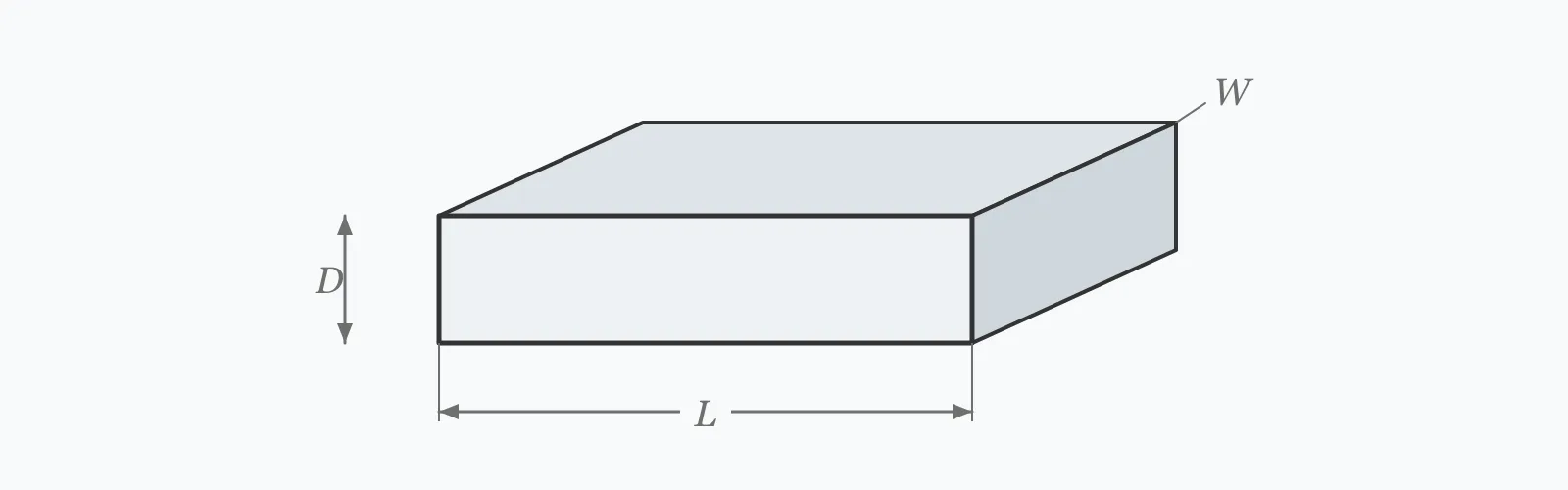
Excavation is measured in place as bank volume, but it is hauled loose and weighed in tonnes — three different numbers for the same soil. Enter the length, width and depth of the dig along with a swell factor to get all three: bank volume, loose volume after bulking, the number of truck loads, and the approximate weight.
Calculator
Units:
m
Length of the excavation
m
Width of the excavation
m
Excavation depth below existing ground
%
Bulking on excavation. Sand 12%, common earth 25%, clay 30%, rock 50%+
Calculation Result
Press Calculate for the bank volume in place, the loose volume after bulking, the number of truck loads, and the approximate weight. Excavation is normally paid on bank volume; haulage is limited by loose volume.
Step-by-Step Solution
Preliminary design aid. Results follow the published formulas cited
below and are intended for estimating, study and early design. Final design must be
verified by a licensed Professional Engineer against the code in force for your project.
Key Benefits
✓Gives bank, loose and weight figures from one set of dimensions
✓Applies the swell factor properly, so the truck count is realistic
✓Makes clear which figure belongs in which part of an estimate
✓Sensitivity chart shows how swell drives haulage but not weight
✓Works for any rectangular dig — pit, trench or basement
✓Shareable links and CSV export for quantity records
What Is Earthwork Volume?
Earthwork volume is the amount of material to be excavated, and for a rectangular dig it is simply length × width × depth. The complication is that this figure — bank volume, the material as it sits undisturbed in the ground — is not the figure that governs haulage or disposal. Excavating breaks up the soil structure and introduces air voids, so the same mass of material occupies more space once it is on a truck.
Bank, loose and compacted
Three states, three volumes. Bank volume is in place before excavation and is what excavation is usually paid on. Loose volume is after digging, larger by the swell factor — 12% for sand, around 25% for common earth, 30% for clay and 50% or more for blasted rock. Compacted volume is after placing and rolling as fill, and is often smaller than the original bank volume. Only the mass stays constant through all three.
Why the weight does not change with swell
Bulking adds air, not material. The approximate weight this calculator reports is derived from the bank volume for exactly that reason, and it stays fixed no matter what swell factor is entered — as the comparison table below shows. This matters because disposal is frequently charged by weight while haulage capacity is limited by volume, so on light material the truck fills up before it reaches its weight limit, and on wet clay or rock the opposite happens.
Formula
V_bank = L × W × D
Bank volume of a rectangular excavation, measured in place
Related Formulas
V_loose = V_bank × (1 + swell/100)
N_trucks = ⌈V_loose / capacity⌉
Weight ≈ V_bank × 1.8 t/m³
Variable Definitions
Symbol
Variable
Unit
Description
L, W, D
Dig Dimensions
m
Length, width and depth of the excavation. Volume scales linearly with each.
V_bank
Bank Volume
m³
Volume in place before excavation. The basis for most excavation payment.
V_loose
Loose Volume
m³
Volume after excavation, increased by the swell factor. What governs haulage.
Swell
Swell Factor
%
Percentage volume increase on excavation. 12% sand, 25% common earth, 30% clay.
N
Truck Loads
—
Number of 12 m³ loads, rounded up, based on loose volume.
ρ
Bulk Density
t/m³
Assumed at 1.8 t/m³ for common earth in the weight estimate.
How to Use This Calculator
Measure the dig, not the structureExcavation dimensions include working space around the structure and any battering of the sides for stability. A foundation 20 m long is dug longer than 20 m, and on a deep or wide excavation the difference is substantial.
Use the depth below existing groundMeasure from the current surface to formation level, not from finished floor level or from a datum. Where topsoil is stripped separately, deduct that thickness so it is not counted twice.
Set the swell factor for the actual materialSand bulks about 12%, common earth 25%, clay 30%, and blasted rock 50% or more. This factor changes the haulage cost directly and does not change the excavation quantity at all.
Use bank volume for payment, loose for haulageExcavation is normally measured and paid in bank volume. Haulage, stockpile capacity and disposal volume all work from loose volume. Using one where the other belongs is a 25% error on common earth.
Treat the weight as indicativeThe weight uses 1.8 t/m³, a reasonable average for common earth. Saturated clay reaches 2.1 and dry sand can be 1.5, so where disposal is charged by weight, use the density of the actual material.
Worked Examples
Example 1
A basement excavation 20 m long, 10 m wide and 3 m deep in common earth with a 25% swell factor. Trucks carry 12 m³.
Truck loads: 750 / 12 = 62.5, rounded up to 63 loads
Approximate weight: 600 × 1.8 = 1,080 tonnes
Note that the truck count comes from the loose volume, not the bank volume. Using 600 m³ would have given 50 loads — an underestimate of 13 loads, or 21% of the haulage.
The weight is derived from the bank volume because bulking adds air rather than material. The same 1,080 tonnes leaves site whatever the swell factor.
Example 2
The same footprint dug 1 m deeper, to 4 m — a common late change when formation level is revised.
Step-by-Step Solution
Bank volume: 20 × 10 × 4 = 800 m³, up from 600 m³
Loose volume: 800 × 1.25 = 1,000 m³
Truck loads: 1,000 / 12 = 83.3, rounded up to 84 loads
Approximate weight: 800 × 1.8 = 1,440 tonnes
One extra metre of depth — a third more — added 200 m³ of excavation, 21 truck loads and 360 tonnes to dispose of.
Volume scales linearly with each dimension, so the proportional effect of a depth change is the same as for length or width. Depth simply tends to be the dimension that gets revised late.
Depth also carries costs the volume does not show: below about 1.2 m the sides need support or battering, and battering itself adds volume that this rectangular calculation does not include.
Swell Factor Sensitivity
Loose volume and truck loads rise with the swell factor while bank volume and weight stay flat — because bulking adds air, not material. Switch series to see it. Truck loads step rather than rise smoothly, since a partial load still occupies a whole truck. The marker shows your current swell factor.
Loose Volume (hauled) vs Swell Factor
Recomputed live from your inputs. The marker shows your current value.
Line chart of Loose Volume (hauled) against Swell Factor. The same
values are listed in the data table below.
Values plotted above, sampled across the swell factor range.
How to Interpret Your Results
Bank volume sets the excavation quantity, loose volume sets the haulage. The gap between them is the swell factor, and it is the number most often left out of a quick estimate.
Bank Volume (in place): < 50Small excavation
A bank volume of your result m³ is a small dig, within reach of a mini excavator and a few truck loads. At this scale the mobilisation cost of plant usually exceeds the cost of the excavation itself.
Bank Volume (in place): 50 – 1000Typical building excavation
A bank volume of your result m³ is a typical foundation or basement dig. Check whether the excavated material can be re-used on site — moving it within the boundary is far cheaper than exporting it and importing fill.
Bank Volume (in place): 1000 – 10000Large excavation — haulage dominates
A bank volume of your result m³ generates enough traffic that haulage and disposal, not digging, dominate the cost. Disposal routes, tipping charges and lorry movements per day are worth confirming before the programme is fixed.
Bank Volume (in place): ≥ 10000Bulk earthworks scale
A bank volume of your result m³ is bulk earthworks. At this scale the calculation should come from a survey and a mass haul analysis rather than from rectangular dimensions, and material re-use on site becomes a major cost driver.
Truck Loads (12 m³): ≥ 200High lorry movements
your result truck loads is a significant number of vehicle movements. Site access, traffic management and permitted daily lorry limits frequently constrain the programme more than the excavation rate does.
Common Mistakes to Avoid
Using bank volume to size the haulage
Why it matters:Trucks carry loose material. Bank volume understates what has to be moved by the full swell factor — 25% for common earth, 50% or more for rock.
✓How to avoid it:Apply the swell factor before dividing by truck capacity. In the example above the difference is 63 loads against 50, a 21% understatement of the haulage.
Measuring the structure instead of the dig
Why it matters:Excavation must include working space to build and to strip formwork, plus battering of the sides where they are not supported. A dig is always larger than the thing it contains, and on a deep excavation substantially so.
✓How to avoid it:Add working space — commonly 0.5 to 1.0 m each side — and account for battered sides. A 3 m deep excavation battered at 1:1 adds 3 m of width at the top on each face.
Assuming excavated material can be re-used as fill
Why it matters:Topsoil, organic material, soft clay and contaminated ground are excavated but cannot be placed as engineered fill. They must be exported and replaced with imported material.
✓How to avoid it:Identify the suitable fraction separately. Unsuitable material carries a double cost — disposal plus imported replacement — that a single volume figure conceals.
Applying swell to the weight
Why it matters:Bulking introduces air voids; it does not create material. The mass leaving site is the same whether the soil is loosely or densely packed on the truck.
✓How to avoid it:Derive weight from bank volume, as this calculator does. The comparison table below shows the tonnage unchanged across every swell factor.
Using a single density for every material
Why it matters:The 1.8 t/m³ used here is an average for common earth. Dry sand runs near 1.5 and saturated clay reaches 2.1, a spread of 40% between the extremes.
✓How to avoid it:Where disposal is charged by weight, use the measured density of the actual material. On a large dig this single figure moves the disposal cost more than most design decisions.
Forgetting that trucks fill by volume or by weight, whichever comes first
Why it matters:A 12 m³ truck with a 20 tonne payload is volume-limited on light material and weight-limited on wet clay or rock. Assuming volume always governs overloads the vehicle on heavy material.
✓How to avoid it:Check both limits. Divide the load weight by the loose volume per truck and compare against the payload rating before fixing the haulage plan.
Practical Applications
▸Estimating foundation and basement excavation quantities
▸Sizing haulage and disposal for a dig
▸Converting between bank, loose and weighed quantities
▸Estimating trench excavation for drainage and services
▸Planning stockpile capacity on a constrained site
▸Checking a contractor's measured excavation quantities
Industry Use Cases
Building construction
Basement and foundation digs are estimated from drawings and priced on bank volume, while the site logistics plan works from loose volume and lorry movements. On urban sites the permitted number of daily movements often constrains the programme more than the excavation rate.
Utilities and drainage
Trench excavation is repetitive and highly sensitive to depth, since the volume scales with it directly and support requirements begin around 1.2 m. Arisings are frequently unsuitable for backfill, so both export and import are needed on the same trench.
Waste and disposal
Tipping is commonly charged by weight while haulage is limited by volume, so both figures are needed for the same load. Contaminated material is charged at a multiple of the clean rate, which makes accurate segregation worth far more than accurate volume measurement.
Expert Tips
💡Excavation is paid on bank volume; haulage runs on loose volume.
💡Common earth bulks about 25%, clay 30%, blasted rock 50% or more.
💡Weight comes from bank volume — bulking adds air, not material.
💡Add working space and battering; the dig is always bigger than the structure.
💡A truck fills by volume or by weight, whichever limit it reaches first.
💡Below about 1.2 m depth, excavation sides need support or battering.
Advantages & Limitations
Advantages
✓Gives all three quantities — bank, loose and weight — from one set of dimensions
✓Applies swell where it belongs and leaves it out where it does not
✓Makes the haulage implication of a dimension change immediately visible
✓Simple enough to check by hand during a quantity review
✓Covers the rectangular case that most foundation and trench digs reduce to
Limitations
!Assumes a rectangular excavation with vertical sides
!Does not include battering or working space, both of which add real volume
!Weight assumes 1.8 t/m³ regardless of the material entered
!Truck loads assume a 12 m³ capacity and no weight limit
!Applies no shrinkage factor for material re-placed as compacted fill
!Does not distinguish suitable from unsuitable excavated material
!Takes no account of groundwater, which changes both weight and method
!For irregular ground, a cross-section or surface model method is more appropriate
Same Dig, Different Materials
A 20 × 10 × 3 m excavation — 600 m³ in place — with the swell factor varied across the range of common materials. Excavation quantity and weight never move; only the haulage does.
20 × 10 × 3 m dig, 12 m³ truck capacity, weight at 1.8 t/m³ of bank volume. Excavation quantity and tonnage are identical across every row — swell changes only what happens after the material leaves the ground, adding 50% to the lorry movements between the extremes.
For a rectangular dig, multiply length by width by depth. A 20 × 10 × 3 m excavation gives 600 m³ of bank volume, measured in place before digging.
What is the difference between bank and loose volume?
Bank volume is soil in place before excavation; loose volume is the same soil after digging, expanded by the swell factor. Excavation is usually paid on bank volume, while haulage and stockpiling work from loose volume.
What is a swell factor?
The percentage by which soil expands when excavated. Sand bulks about 12%, common earth 25%, clay 30%, and blasted rock 50% or more.
Why doesn't the weight change when I change the swell factor?
Because bulking introduces air voids rather than creating material. The mass leaving site is the same whether the soil rides loosely or densely packed, which is why the weight is derived from bank volume.
How many truck loads will my excavation need?
Divide the loose volume by the truck capacity and round up. A 600 m³ dig in common earth gives 750 m³ loose, which is 63 loads at 12 m³ — not the 50 that bank volume alone would suggest.
How much does a cubic metre of soil weigh?
Common earth is around 1.8 tonnes per cubic metre in place. Dry sand runs closer to 1.5 and saturated clay can reach 2.1, so use the actual material density where disposal is charged by weight.
Should I include working space in the excavation volume?
Yes. Excavation must allow room to build and to strip formwork, commonly 0.5 to 1.0 m each side, plus battering where the sides are not supported. This calculator uses the dimensions you enter, so include that allowance in them.
At what depth does an excavation need support?
Around 1.2 m is the usual threshold at which sides must be supported or battered back, though it depends on the ground and on local regulation. Battering adds volume that a rectangular calculation does not capture.
Can excavated material be re-used as backfill?
Only the suitable fraction. Topsoil, organic material, soft clay and contaminated ground must be exported and replaced with imported fill — a double cost that a single volume figure hides.
Is this calculator suitable for irregular excavations?
It assumes a rectangular dig with vertical sides. For irregular ground, sloping formations or a whole site, use a cross-section method such as average end area, or a surface model.
Glossary
Bank volume
Volume of soil in place before excavation. The usual basis for excavation payment.
Loose volume
Volume after excavation, increased by the swell factor. What a truck actually carries.
Compacted volume
Volume after placing and compacting as fill, often less than the original bank volume.
Swell factor
Percentage volume increase when soil is excavated and loosened.
Shrinkage factor
Percentage volume reduction when loose soil is placed and compacted.
Arisings
Material produced by an excavation, whether re-used or exported.
Battering
Sloping the sides of an excavation back for stability, which adds volume.
Working space
Additional excavation around a structure to allow construction access.
Payload
The maximum weight a truck may legally carry, which can bind before its volume capacity.
Formation level
The level to which excavation is taken, on which the structure or pavement is built.
Scientific & Standards References
CESMM4 — Civil Engineering Standard Method of Measurement, Class E: Earthworks — Institution of Civil Engineers
Caterpillar Performance Handbook — Material Weights, Swell and Load Factors — Caterpillar Inc.
BS 6031 — Code of practice for earthworks — British Standards Institution
OSHA 29 CFR 1926 Subpart P — Excavations — Occupational Safety and Health Administration
Manual of Contract Documents for Highway Works, Volume 1, Series 600 — Earthworks — National Highways
Conclusion
The volume of a rectangular dig is length times width times depth, and everything difficult about earthwork estimating happens after that. The same soil carries three volumes — bank in the ground, loose on the truck, compacted in a fill — and only its mass is constant, which is why the weight in the table above never moves while the lorry count rises by half between sand and rock. Bank volume is what excavation is paid on; loose volume is what governs haulage, stockpiles and disposal; and confusing the two costs 25% on common earth. Two things this arithmetic cannot see are worth adding by hand: the working space and battering that make every dig larger than the structure inside it, and the fraction of arisings that is unsuitable as fill and therefore has to be exported and replaced.
Enter your own dimensions above and compare the bank and loose figures before fixing the haulage.