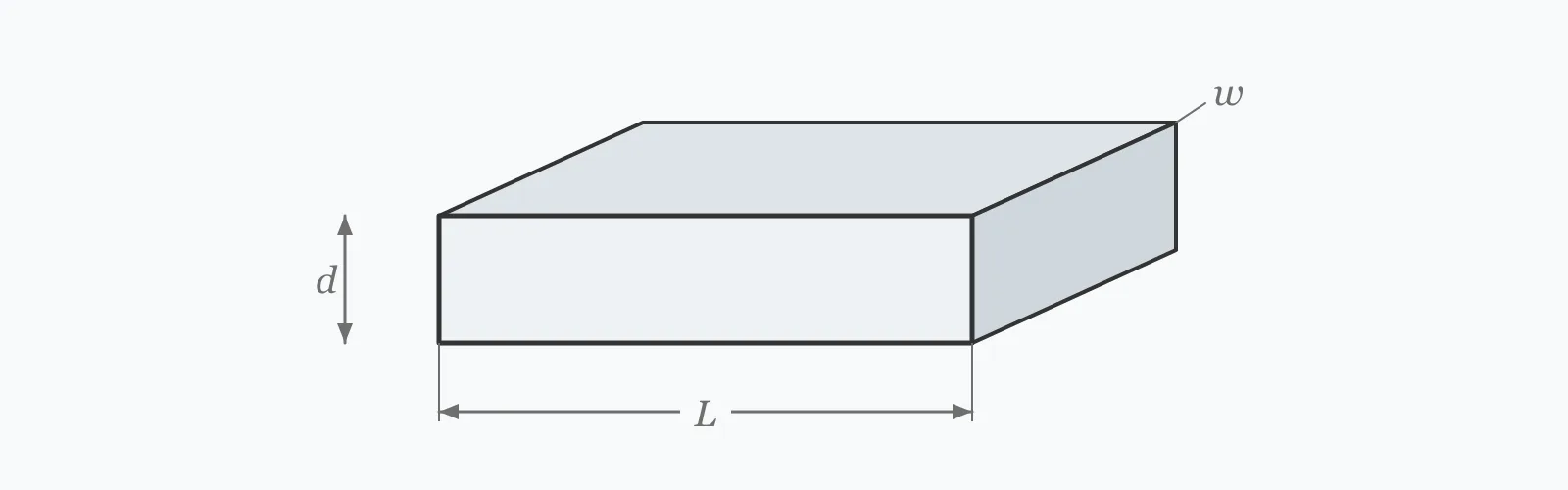
Timber volume is section area times length times quantity, and the arithmetic is trivial — but the dimensions to use are not. Enter the finished width, depth, length and piece count to get the volume in cubic metres and board feet, the total linear length, and an estimated cost at the rate you supply.
Calculator
Units:
mm
Finished width. A nominal 50 mm regularises to 47
mm
Finished depth. A nominal 150 mm regularises to about 145
m
Standard lengths run in 300 mm increments; above 6 m costs more
Pieces of this section and length
per m³
Rate for the grade, species and treatment specified
Calculation Result
Press Calculate for the total volume in cubic metres and board feet, the combined linear length of all pieces, and an estimated cost at the rate entered.
Step-by-Step Solution
Preliminary design aid. Results follow the published formulas cited
below and are intended for estimating, study and early design. Final design must be
verified by a licensed Professional Engineer against the code in force for your project.
Key Benefits
✓Converts between cubic metres and board feet, which markets use differently
✓Reports total linear length, which suits transport and handling
✓Works from finished dimensions rather than nominal ones
✓Warns where a section is slender enough to need lateral restraint
✓Sensitivity chart shows volume scaling with section depth
✓Shareable links and CSV export for ordering records
What Is Lumber Volume?
Timber volume is the cross-sectional area multiplied by the length and the number of pieces. In metric markets it is quoted in cubic metres; in North America the board foot is standard, defined as one foot square by one inch thick. One cubic metre is 423.776 board feet, and the two units coexist in international trade, which is why a conversion is often needed.
Nominal against finished size
Timber is described by the size it was sawn at, not the size it ends up. Regularising — planing to a consistent section — removes a few millimetres from each face, so a nominal 50 by 100 becomes 47 by 97. That is 9% less cross-sectional area, and the difference is entirely systematic. Structural calculations use the finished size, and so should any volume bought by the cubic metre.
Why volume alone does not price the job
A cubic metre of C16 carcassing and a cubic metre of C24 structural timber differ substantially in price, and both differ again from hardwood or treated material. Grade, species, moisture content and treatment all move the rate, so volume gives the quantity and not the cost. What volume does give reliably is the transport and handling requirement, which depends on mass rather than on grade.
Formula
V = (w/1000) × (d/1000) × L × n
Total volume in cubic metres from section dimensions in mm, length in metres and piece count
Related Formulas
BF = V × 423.776
L_total = L × n
V_per_m = (w/1000) × (d/1000)
Variable Definitions
Symbol
Variable
Unit
Description
w
Width
mm
Finished section width, not the nominal size.
d
Depth
mm
Finished section depth. The dimension that carries bending.
L
Length
m
Length of one piece. Above 6 m attracts a premium.
n
Quantity
—
Number of pieces of this section and length.
V
Volume
m³
Total volume, the unit timber is traded in metrically.
BF
Board Feet
bd ft
North American volume unit; one cubic metre is 423.776.
How to Use This Calculator
Use finished dimensions, not nominal onesA nominal 50 × 100 regularises to 47 × 97, which is 9% less material. The difference is systematic, so it does not cancel out across a large order, and structural design uses the finished size in any case.
Check standard lengths before specifyingTimber comes in fixed increments, commonly 300 mm steps. Specifying 4.7 m when the stock length is 4.8 m means cutting every piece and wasting the offcut, which is a real cost on a large quantity.
Watch the 6 metre thresholdLengths above about 6 m attract a premium and may not be stocked at all. A design needing 7 m members can often be rearranged to use two shorter pieces with a splice, at considerably less cost.
Use volume for transport, price for gradeVolume gives the mass and therefore the handling and delivery requirement reliably. It does not give the cost, because grade, species, moisture content and treatment all move the rate substantially.
Check slenderness on deep sectionsA deep narrow joist buckles sideways under bending long before it reaches its strength in the vertical plane. Noggings, strutting or a fixed deck restrain the compression edge, and the calculator flags depth-to-width ratios that need them.
Worked Examples
Example 1
Thirty joists of 47 × 150 mm finished section, each 4.8 m long, at 450 per cubic metre.
Step-by-Step Solution
Section area: 0.047 × 0.150 = 0.00705 m²
One piece: 0.00705 × 4.8 = 0.03384 m³
Thirty pieces: 0.03384 × 30 = 1.0152 m³
In board feet: 1.0152 × 423.776 = 430.2 bd ft
Total linear length: 4.8 × 30 = 144.0 m
Cost at 450 per m³: 1.0152 × 450 = 456.84
Interpretation: just over a cubic metre for a floor's worth of joists. Note that if these had been ordered as nominal 50 × 150, the volume implied by the label would be 1.08 m³ — 6.4% more than what arrives.
Example 2
The same thirty pieces at different section depths, which shows how weakly the material cost grows against the capacity it buys.
Going from 100 to 200 mm deep doubles the volume and the cost, exactly as the linear relationship requires.
But bending strength goes with the square of depth and stiffness with the cube. Doubling the depth quadruples the strength and multiplies the stiffness by eight, for twice the material.
That asymmetry is why deep shallow-width joists are the standard floor solution: depth is the cheapest capacity available. A 47 × 200 costs twice a 47 × 100 and carries four times the bending moment.
It also explains the practical limit. As the section deepens without widening, it becomes prone to buckling sideways under load, so restraint at the compression edge becomes necessary — which is what noggings and strutting between joists are for.
Section Depth Sensitivity
Volume and cost rise in direct proportion to section depth, so every series is a straight line through the origin. Note that bending strength rises with the square of depth and stiffness with the cube — the material cost grows far more slowly than the capacity it buys. The marker shows your current depth.
Total Volume vs Section Depth
Recomputed live from your inputs. The marker shows your current value.
Line chart of Total Volume against Section Depth. The same
values are listed in the data table below.
Values plotted above, sampled across the section depth range.
How to Interpret Your Results
Volume gives the quantity and the transport requirement. The cost estimate is only as good as the rate supplied, which depends on grade and treatment rather than on volume.
Total Volume: < 1Small quantity
At your result m³ this is a small order — roughly a van load. Minimum order quantities and delivery charges often dominate at this scale, and buying from stock lengths matters more than optimising the volume.
Total Volume: 1 – 20Typical construction quantity
At your result m³ this is a normal structural timber order for a house or a small project. Confirm the grade required, since C16 and C24 differ materially in price for identical dimensions.
Total Volume: ≥ 20Large order — check availability
At your result m³ the order is large enough that lead time, stock availability and delivery scheduling all matter. Non-standard lengths and higher grades can carry long lead times at this quantity.
Total Linear Length: ≥ 500Substantial linear quantity
A total of your result m is a significant length to transport and handle. Storage on site needs level bearers and protection from ground moisture — timber stacked directly on the ground takes up water and distorts.
Common Mistakes to Avoid
Using nominal dimensions for volume
Why it matters:Timber is described by its sawn size and supplied at its regularised size. A nominal 50 × 100 arrives at 47 × 97, so the label implies 9% more material than turns up — a systematic error that does not average out.
✓How to avoid it:Use finished dimensions throughout. Structural design uses them too, so there is no case for the nominal figure anywhere in the calculation.
Specifying non-standard lengths
Why it matters:Timber is stocked in fixed increments. Specifying 4.7 m against a 4.8 m stock length means every piece is cut and every offcut wasted, which on a large order is a meaningful quantity of material and labour.
✓How to avoid it:Design to stock lengths where the layout allows. Where it does not, order the next size up and plan the offcuts into shorter members.
Pricing by volume alone
Why it matters:Grade, species, moisture content and treatment all move the rate substantially. C24 costs appreciably more than C16 for identical dimensions, and treated timber more than untreated.
✓How to avoid it:Price by grade and specification, using volume only for the quantity. The rate is the variable, not the volume.
Ignoring moisture content
Why it matters:Timber shrinks as it dries, and green or unseasoned material can lose several percent of its cross-section. It also moves after installation, which causes squeaking floors and cracked finishes.
✓How to avoid it:Specify kiln-dried timber for internal work, at a moisture content appropriate to the environment. The dimensional change is largest across the grain and negligible along it.
Overlooking lateral restraint on deep sections
Why it matters:A deep narrow joist buckles sideways under bending well before it reaches its capacity in the vertical plane. The section is strong on paper and unstable in practice.
✓How to avoid it:Provide noggings, strutting or a fixed deck to restrain the compression edge. The deeper the section relative to its width, the more essential it becomes.
Storing timber on the ground
Why it matters:Timber in contact with the ground takes up moisture, swells, distorts and can begin to decay. Material that arrives straight and dry can be unusable within days of poor storage.
✓How to avoid it:Stack on level bearers clear of the ground, with covers that shed water but allow air movement. Sealed wrapping traps moisture and is worse than none.
Practical Applications
▸Ordering structural and carcassing timber
▸Converting between cubic metres and board feet
▸Estimating timber cost for a project
▸Planning transport and handling from linear length
▸Comparing section sizes on material cost
▸Checking a supplier's quantity against a schedule
Industry Use Cases
Timber frame construction
Whole-house timber quantities are scheduled by section and length, then ordered by volume. Standard lengths drive the layout more than is often appreciated, because designing to stock avoids both waste and the labour of cutting every piece.
International trade
Cubic metres and board feet coexist in the same market, so the conversion is routine. One cubic metre is 423.776 board feet, and prices are quoted in whichever unit the origin market uses.
Structural design
Section depth is the cheapest capacity available, since strength rises with its square and stiffness with its cube while cost rises only linearly. That is why floors use deep narrow joists, and why lateral restraint between them is not optional.
Expert Tips
💡Use finished dimensions — a nominal 50 × 100 is really 47 × 97.
💡One cubic metre is 423.776 board feet.
💡Cost rises linearly with depth; strength with its square and stiffness with its cube.
💡Design to stock lengths, usually in 300 mm increments.
💡Above 6 m attracts a premium and may not be stocked.
💡Deep narrow sections need noggings or strutting to prevent lateral buckling.
Advantages & Limitations
Advantages
✓Converts between the two volume units used in international trade
✓Reports linear length, which governs transport and handling
✓Works from finished dimensions, matching both supply and structural design
✓Flags slender sections that need lateral restraint
✓Simple enough to check a delivery note against an order
Limitations
!Uses the dimensions entered — nominal sizes must be converted first
!Cost depends on grade, species, moisture and treatment, none of which are inputs
!Assumes all pieces are the same section and length
!Takes no account of cutting waste or offcuts
!Does not check structural capacity, only quantity
!Ignores moisture content, which affects both dimensions and mass
!Does not address availability or lead time for non-standard sizes
Section Size Against Volume and Capacity
Thirty pieces 4.8 m long at 450 per cubic metre. Volume and cost rise linearly with the section, while the capacity that section buys rises far faster.
Thirty pieces, 4.8 m each, 450 per m³. Relative bending strength is proportional to width times depth squared, normalised to the first row. The 47 × 200 costs twice the 47 × 100 and carries four times the moment — which is why depth is the cheapest structural capacity available.
Multiply width by depth by length by the number of pieces, working in metres. Thirty 47 × 150 mm joists at 4.8 m give 1.0152 m³.
How many board feet in a cubic metre?
423.776. A board foot is one foot square by one inch thick, and the two units coexist in international timber trade.
What is the difference between nominal and finished timber size?
Nominal is the size it was sawn at; finished is the size after regularising. A nominal 50 × 100 arrives at 47 × 97 — 9% less cross-sectional area.
Why does timber cost vary so much per cubic metre?
Grade, species, moisture content and treatment all move the rate substantially. C24 structural timber costs appreciably more than C16 carcassing for identical dimensions.
What are standard timber lengths?
Usually 300 mm increments, from about 1.8 m upward. Lengths above 6 m attract a premium and may not be stocked, so a design needing them is worth revisiting.
Is a deeper joist better value than a wider one?
Almost always. Cost rises linearly with either dimension, but bending strength rises with the square of depth and stiffness with its cube. A 47 × 200 costs twice a 47 × 100 and carries four times the moment.
Why do deep joists need noggings?
A deep narrow section buckles sideways under bending before it reaches its vertical capacity. Noggings, strutting or a fixed deck restrain the compression edge and let the section develop its strength.
Does moisture content matter?
Yes, for both dimensions and behaviour. Timber shrinks as it dries and moves after installation, causing squeaking floors and cracked finishes. Kiln-dried material for internal work avoids most of it.
How should timber be stored on site?
On level bearers clear of the ground, covered so water sheds but air still moves. Sealed wrapping traps moisture against the timber and does more harm than leaving it uncovered.
Does this calculate structural capacity?
No, only quantity. Span, load, grade and restraint all determine whether a section is adequate, and those are a separate calculation from the volume.
Glossary
Nominal size
The size timber was sawn at, before planing or regularising.
Finished size
The actual delivered section after regularising, a few millimetres smaller.
Regularised
Planed to a consistent section, the normal supply condition for structural timber.
Board foot
A volume of one foot square by one inch thick; 423.776 to the cubic metre.
C16 / C24
Strength classes for structural softwood, C24 being the stronger and dearer.
Carcassing
General structural timber for framing, floors and roofs.
Nogging
A short piece fixed between joists or studs, providing restraint and fixing points.
Strutting
Diagonal or solid bracing between joists, restraining them against lateral buckling.
Kiln dried
Timber dried under controlled conditions to a specified moisture content.
Lateral torsional buckling
Sideways instability of a deep narrow beam under bending.
Scientific & Standards References
BS EN 336 — Structural timber: Sizes, permitted deviations — British Standards Institution
BS EN 338 — Structural timber: Strength classes — British Standards Institution
EN 1995-1-1 (Eurocode 5) — Design of timber structures — CEN
TRADA — Timber Frame Construction, 5th Edition — Timber Research and Development Association
NHBC Standards — Chapter 6.4: Timber and concrete upper floors — National House Building Council
Conclusion
The volume arithmetic is trivial; the dimensions are where the care belongs. Timber is described by the size it was sawn at and supplied at the size it ends up, so a nominal 50 by 100 arrives at 47 by 97 — 9% less material than the label implies, systematically and in every piece. The other point worth carrying is the mismatch between what timber costs and what it buys. Volume and price rise linearly with section depth, but bending strength rises with its square and stiffness with its cube: the table above shows a 47 × 200 costing twice a 47 × 100 and carrying four times the moment. Depth is the cheapest structural capacity available, which is why floors use deep narrow joists — and why noggings and strutting between them are not an optional refinement but the restraint that lets a slender section reach the capacity it was chosen for.
Enter your section, length and quantity above to get the volume and cost.