Inflow to an excavation depends far more on the ground's permeability than on how deep the water is drawn down. Enter the permeability, excavation radius, required drawdown and aquifer thickness to get the steady-state flow in litres per second and cubic metres per day, together with the radius of influence.
Equivalent radius of the excavation treated as a single well
m
Depth the water table must be lowered, usually to below formation level
m
Saturated thickness above the impermeable base
m
Enter a measured value, or 0 to use Sichardt's estimate
Calculation Result
Press Calculate for the steady-state inflow in litres per second and cubic metres per day, the radius of influence over which groundwater is drawn down, and the water level remaining at the excavation.
Step-by-Step Solution
Preliminary design aid. Results follow the published formulas cited
below and are intended for estimating, study and early design. Final design must be
verified by a licensed Professional Engineer against the code in force for your project.
Key Benefits
✓Applies the Dupuit-Forchheimer equation for an unconfined aquifer
✓Computes the radius of influence rather than requiring it as an input
✓Reports flow in both L/s and m³/day, which suit pump and consent respectively
✓Warns where permeability makes pumping impractical at either extreme
✓Sensitivity chart shows how weakly flow responds to drawdown
✓Shareable links and CSV export for design records
What Is Dewatering Flow?
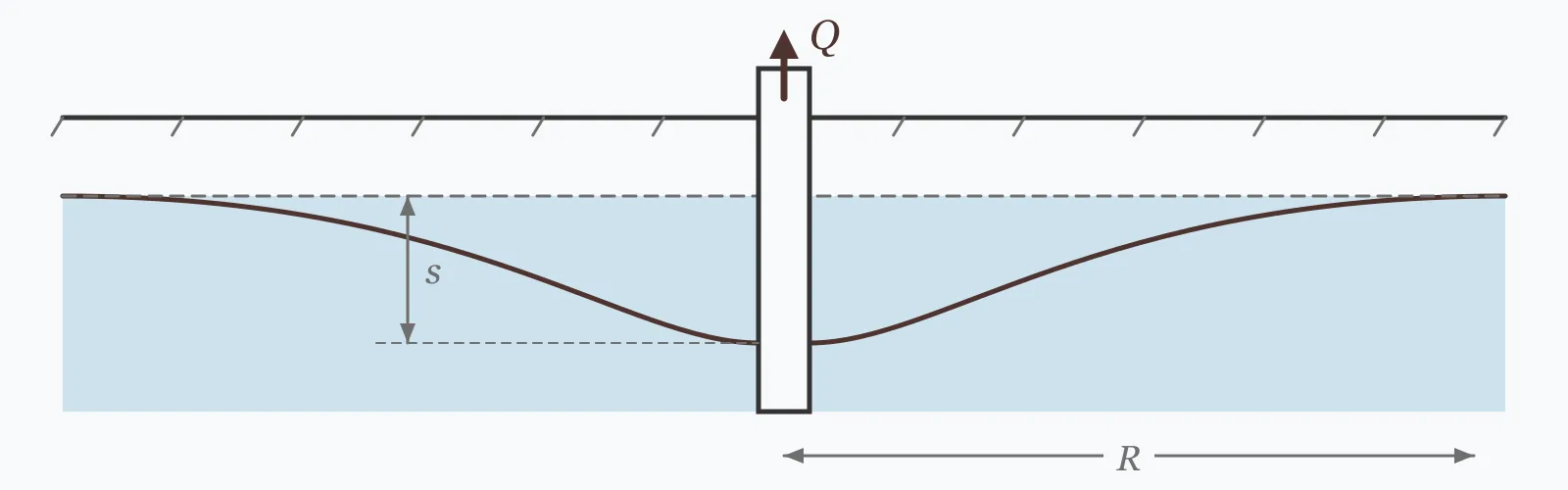
Dewatering lowers the groundwater table so an excavation can be worked dry. Water flows in radially from the surrounding ground, and the Dupuit-Forchheimer equation gives the steady-state rate by treating the excavation as a large well in an unconfined aquifer. The driving quantity is the difference between the squares of the original and drawn-down water levels, divided by the logarithm of how far the influence extends.
The radius of influence
Drawdown does not stop at the excavation edge — it extends outward until the head gradient dies away. That distance is the radius of influence, and it is rarely measured. Sichardt's empirical formula R = 3000·s·√k is the usual stand-in, and it can be wrong by a factor of two. Mercifully it appears inside a logarithm, which compresses the error substantially: doubling R reduces the flow by about 22% at the geometry here.
Why drawdown is such a weak lever
Increasing the drawdown steepens the head gradient, which should increase the flow. But it also widens the radius of influence in direct proportion, and that appears in the denominator. The two effects largely cancel: taking the drawdown from 1 m to 5 m — a fivefold increase — raises the flow from 4.52 to 8.04 L/s, only 78% more. The depth of the excavation is almost irrelevant to the pumping duty compared with the ground it is in.
Formula
Q = π·k·(h₀² − h_w²) / ln(R/r)
Dupuit-Forchheimer steady-state flow to a circular excavation in an unconfined aquifer
Equivalent radius of the excavation treated as a well.
s
Drawdown
m
Depth the water table must be lowered.
h₀
Aquifer Thickness
m
Saturated thickness above the impermeable base.
R
Radius of Influence
m
Distance over which drawdown extends. Empirical and uncertain.
Q
Inflow
L/s
Steady-state flow that must be pumped.
How to Use This Calculator
Get the permeability from testing, not from a tableIt dominates the answer and it varies over ten orders of magnitude across soil types — and by a factor of ten within a single description. A pumping test gives a mass permeability that reflects the ground's fabric; particle size correlations do not.
Use an equivalent radius for a non-circular excavationTake the radius of a circle with the same plan area. The Dupuit equation assumes radial flow to a well, and for a long narrow excavation that assumption is poor — a line-of-wells analysis suits better.
Draw down to below formation, not to itWorking conditions need the water table a little below the excavation base, typically 0.5 to 1 m, so the formation is dry and stable rather than damp. Drawing down exactly to formation leaves a wet, soft surface.
Enter a measured influence radius if you have oneSichardt's formula is a rough approximation. If a pumping test has established the actual radius, use it. Otherwise accept that this input carries considerable uncertainty — though the logarithm limits how much it matters.
Treat the result as an order of magnitudeSteady-state radial flow to an idealised well in a homogeneous aquifer is a considerable simplification of real ground. Use the figure to size a system and to judge feasibility, and expect the actual flow to differ.
Worked Examples
Example 1
A circular excavation 8 m in radius in a sandy aquifer 10 m thick with a permeability of 10⁻⁴ m/s, requiring 3 m of drawdown.
Step-by-Step Solution
Radius of influence by Sichardt: R = 3000 × 3 × √(10⁻⁴) = 3000 × 3 × 0.01 = 90.0 m
Water level at the excavation: 10 − 3 = 7.00 m
Head difference term: h₀² − h_w² = 100 − 49 = 51.0 m²
ln(R/r) = ln(90/8) = ln(11.25) = 2.4204
Q = π × 10⁻⁴ × 51.0 / 2.4204 = 6.62 × 10⁻³ m³/s
Inflow: 6.62 L/s, or 572 m³ per day
Interpretation: 6.6 L/s is a modest wellpoint duty, but the drawdown extends 90 m from the excavation — well beyond the site boundary, which is usually the constraint that matters more than the pump.
Example 2
The same excavation in different ground, and then at different drawdowns — which shows which variable actually governs.
Step-by-Step Solution
At k = 10⁻⁵ m/s (silty sand): R = 28.5 m, inflow 1.26 L/s
At k = 5×10⁻⁵: R = 63.6 m, inflow 3.86 L/s
At k = 10⁻⁴ (sand): R = 90.0 m, inflow 6.62 L/s
At k = 5×10⁻⁴ (coarse sand): R = 201.2 m, inflow 24.84 L/s
Permeability has risen by a factor of 50 and the inflow by a factor of 19.7 — less than proportional, because the influence radius grows with √k and appears in the denominator.
Now hold k at 10⁻⁴ and vary the drawdown: 1 m gives 4.52 L/s, 3 m gives 6.62, and 5 m gives 8.04.
A fivefold increase in drawdown has raised the flow by only 78%. The steeper head gradient is almost entirely offset by the wider radius of influence, which grows in direct proportion to the drawdown.
The practical conclusion is clear. The ground determines the pumping duty; the depth of the excavation barely affects it. A feasibility judgement made on permeability alone will usually be right, and one made on drawdown alone will usually be wrong.
Drawdown Sensitivity
Flow rises with drawdown but far less than proportionally, because the radius of influence widens at the same time and works against it. The influence radius series rises linearly for comparison. The marker shows your current drawdown.
Inflow vs Required Drawdown
Recomputed live from your inputs. The marker shows your current value.
Line chart of Inflow against Required Drawdown. The same
values are listed in the data table below.
Values plotted above, sampled across the required drawdown range.
How to Interpret Your Results
The inflow sizes the pumps. The radius of influence is often the more consequential output, because it says how far the effects of dewatering reach beyond the site.
Inflow: < 2Low inflow
An inflow of your result L/s is modest and manageable with a small sump pump or a few wellpoints. In low-permeability ground the greater difficulty is usually that drawdown takes a long time to develop, not that the volume is large.
Inflow: 2 – 20Typical wellpoint duty
An inflow of your result L/s suits a conventional wellpoint system. Check the discharge arrangements as well as the pumping — consent for the volume and its quality is frequently the longer lead item.
Inflow: 20 – 100Substantial pumping duty
An inflow of your result L/s requires deep wells rather than wellpoints, and continuous running with standby capacity. At this rate a cut-off wall to reduce the inflow is often more economical than pumping against the ground.
Inflow: ≥ 100Very high inflow — reconsider the approach
An inflow of your result L/s is a major undertaking, with the discharge, the settlement risk and the energy all substantial. Exclusion — sheet piling, secant walls or ground freezing — usually becomes preferable to pumping at this level.
Radius of Influence: ≥ 100Drawdown extends a long way
A radius of influence of your result m means groundwater is lowered well beyond the excavation. Settlement of adjacent structures, drying of timber piles and drawing in of contamination are all recognised consequences, and monitoring is normally required.
Common Mistakes to Avoid
Taking permeability from a soil description
Why it matters:It varies over ten orders of magnitude across soil types and by a factor of ten within one description. Since the flow is directly proportional to it, an estimate from a borehole log can be out by an order of magnitude.
✓How to avoid it:Use a pumping test where the project justifies it. A test measures the mass permeability of the ground as it actually is, including the fabric and layering that particle-size correlations miss entirely.
Expecting drawdown to control the flow
Why it matters:It barely does. Increasing the drawdown steepens the gradient but widens the radius of influence in proportion, and the two largely cancel — a fivefold drawdown increase gave only 78% more flow in the example.
✓How to avoid it:Judge feasibility on permeability. Reducing the required drawdown is rarely an effective way to reduce the pumping duty.
Ignoring the effects beyond the site
Why it matters:Drawdown extends to the radius of influence, which was 90 m in the worked example and over 200 m in coarse sand. Lowering groundwater under adjacent buildings can cause settlement, and it can dry out timber piles that have survived centuries submerged.
✓How to avoid it:Assess the ground beneath neighbouring structures, install monitoring, and consider recharge wells or a cut-off wall where the consequences are unacceptable.
Overlooking the discharge
Why it matters:The water has to go somewhere, and both the volume and its quality are usually regulated. Silty discharge blocks drains and damages watercourses, and consent can take longer to obtain than the excavation takes to dig.
✓How to avoid it:Arrange discharge consent and settlement treatment early. Abstraction may need its own consent separate from discharge.
Applying the equation to a long narrow excavation
Why it matters:Dupuit's equation assumes radial flow to a well. A trench or a long basement draws water predominantly from two sides, which a radial model represents poorly.
✓How to avoid it:Use a line-of-wells or plane-flow analysis for elongated excavations. The equivalent-radius approach is only reasonable for something approximately square or circular.
Assuming steady state is reached quickly
Why it matters:In low-permeability ground the drawdown develops slowly, and the steady-state flow this calculation gives may not be approached within the construction programme. Early-time flows are higher and then decline.
✓How to avoid it:For fine-grained soils, consider the transient behaviour. The initial pumping rate can substantially exceed the steady-state figure while storage is being drained.
Practical Applications
▸Estimating groundwater inflow to an excavation
▸Sizing wellpoint and deep well dewatering systems
▸Assessing whether pumping or exclusion is appropriate
▸Judging how far drawdown effects extend
▸Screening feasibility from a permeability estimate
▸Estimating discharge volumes for consent applications
Industry Use Cases
Basement construction
Urban basements in permeable ground frequently use exclusion rather than pumping, because the radius of influence reaches beneath neighbouring buildings. A secant or diaphragm wall contains the excavation and limits the drawdown to within it.
Pipeline and trench work
Wellpoint systems suit shallow trenches in sand, installed along both sides of the run. The elongated geometry means a radial calculation is only indicative, and the design is normally based on well spacing along a line.
Groundwater risk assessment
Lowering the water table can mobilise contamination from a nearby source, drawing it toward the excavation and the discharge. Where contaminated land is within the radius of influence, the discharge quality becomes the governing constraint rather than the volume.
Expert Tips
💡Permeability dominates; drawdown barely matters.
💡A fiftyfold rise in permeability raised the flow twentyfold in the example.
💡A fivefold rise in drawdown raised it by only 78%.
💡Sichardt's radius can be out by a factor of two, but a logarithm limits the damage.
💡Draw down 0.5 to 1 m below formation, not to it.
💡The radius of influence usually reaches beyond the site boundary.
Advantages & Limitations
Advantages
✓Computes the influence radius rather than requiring it
✓Reports flow in both L/s and m³/day, matching pump and consent needs
✓Makes the weak dependence on drawdown explicit
✓Warns at both permeability extremes, where pumping is impractical for opposite reasons
✓Fast enough to screen ground conditions before detailed design
Limitations
!Assumes steady-state radial flow to a single equivalent well
!Assumes a homogeneous, isotropic unconfined aquifer on a horizontal impermeable base
!The Dupuit assumption degrades at large drawdowns relative to aquifer thickness
!Sichardt's influence radius is empirical and can be out by a factor of two
!Poorly suited to long narrow excavations, where flow is not radial
!Gives steady state only; transient flows in fine soils are initially higher
!Says nothing about seepage pressure, base heave or piping, which often govern
What Actually Governs the Inflow
An 8 m radius excavation in a 10 m aquifer. The upper block varies permeability at 3 m drawdown; the lower varies drawdown at k = 10⁻⁴ m/s.
8 m radius, 10 m aquifer thickness. Permeability rises 50 times in the upper block and the inflow 19.7 times. Drawdown rises 5 times in the lower block and the inflow only 1.78 times. The ground decides the duty; the depth barely touches it.
Use the Dupuit-Forchheimer equation Q = π·k·(h₀² − h_w²)/ln(R/r), with the radius of influence from Sichardt's formula if it has not been measured.
What is the radius of influence?
The distance from the excavation over which the water table is measurably lowered. Sichardt's empirical estimate is R = 3000·s·√k, which gave 90 m for the worked example.
Does deeper drawdown mean much more pumping?
No — surprisingly little. Taking the drawdown from 1 m to 5 m raised the flow only 78%, because the steeper gradient is offset by a proportionally wider radius of influence.
What permeability values should I use?
Roughly 10⁻² m/s for gravel, 10⁻⁴ for sand, 10⁻⁶ for silty sand and 10⁻⁹ for clay. But the range within any one description spans an order of magnitude, so a pumping test is far more reliable.
When is pumping impractical?
At both ends of the range. In very permeable gravel the flows are too large to pump economically, so exclusion is used. In clay the drawdown develops too slowly to be useful within a construction programme.
Does dewatering cause settlement?
It can. Lowering the water table increases effective stress in the ground and compresses it, which settles structures within the radius of influence. Compressible soils and timber piles are the particular concerns.
How accurate is Sichardt's formula?
It is a rough empirical approximation and can be out by a factor of two. It appears inside a logarithm, though, which compresses the error — doubling R reduces the flow by about 22% at the geometry here.
What is the difference between wellpoints and deep wells?
Wellpoints suck from the surface and are limited to about 5 to 6 m of drawdown per stage by atmospheric pressure. Deep wells have a submersible pump at the bottom and are not limited that way, so they suit greater depths and higher flows.
Do I need consent to dewater?
Usually for both the abstraction and the discharge, and the discharge often takes longer to obtain. Silty water damages watercourses and blocks drains, so settlement treatment is normally required as well.
Is this calculation suitable for a trench?
Only indicatively. Dupuit's equation assumes radial flow to a well, and a long narrow excavation draws water mainly from two sides. A line-of-wells or plane-flow analysis represents it better.
Glossary
Permeability
Hydraulic conductivity, the ease with which water flows through soil, in m/s.
Drawdown
The depth by which the water table is lowered.
Radius of influence
The distance over which drawdown extends from the excavation.
Unconfined aquifer
A water-bearing layer with a free water table rather than a confining stratum above.
Dupuit assumption
That flow is horizontal and the gradient equals the slope of the water table.
Wellpoint
A shallow suction dewatering point, limited to about 5 to 6 m per stage.
Deep well
A borehole with a submersible pump, for greater depths and flows.
Cut-off wall
A barrier such as sheet piling or a secant wall that excludes water rather than pumping it.
Base heave
Upward movement of an excavation floor from unrelieved water pressure beneath it.
Recharge well
A well returning water to the ground outside an excavation, limiting settlement.
Scientific & Standards References
CIRIA C750 — Groundwater control: design and practice, 2nd Edition — Construction Industry Research and Information Association
Powers, J. P. et al., Construction Dewatering and Groundwater Control, 3rd Edition — Wiley
Sichardt, W., Das Fassungsvermögen von Rohrbrunnen (1928) — Springer, Berlin
EN 1997-2 (Eurocode 7 Part 2) — Ground investigation and testing — CEN
BS 5930 — Code of practice for ground investigations — British Standards Institution
Conclusion
Dewatering inflow is governed by the ground, not by the excavation. The table above shows permeability rising fifty times and the inflow nearly twenty, while a fivefold increase in drawdown raises it by just 78% — because the steeper head gradient is almost entirely cancelled by a proportionally wider radius of influence. That asymmetry is worth carrying into any feasibility judgement: ask what the permeability is, and treat the required depth as almost incidental to the pumping duty. The output that most often decides the approach is not the flow at all but the radius of influence, which was 90 m in the worked example and over 200 m in coarse sand. Drawdown reaching that far beneath neighbouring buildings brings settlement, timber pile decay and contaminant migration into scope, and it is usually why urban basements exclude water with a cut-off wall rather than pumping it out.
Enter your permeability, excavation size and required drawdown above to estimate the inflow.