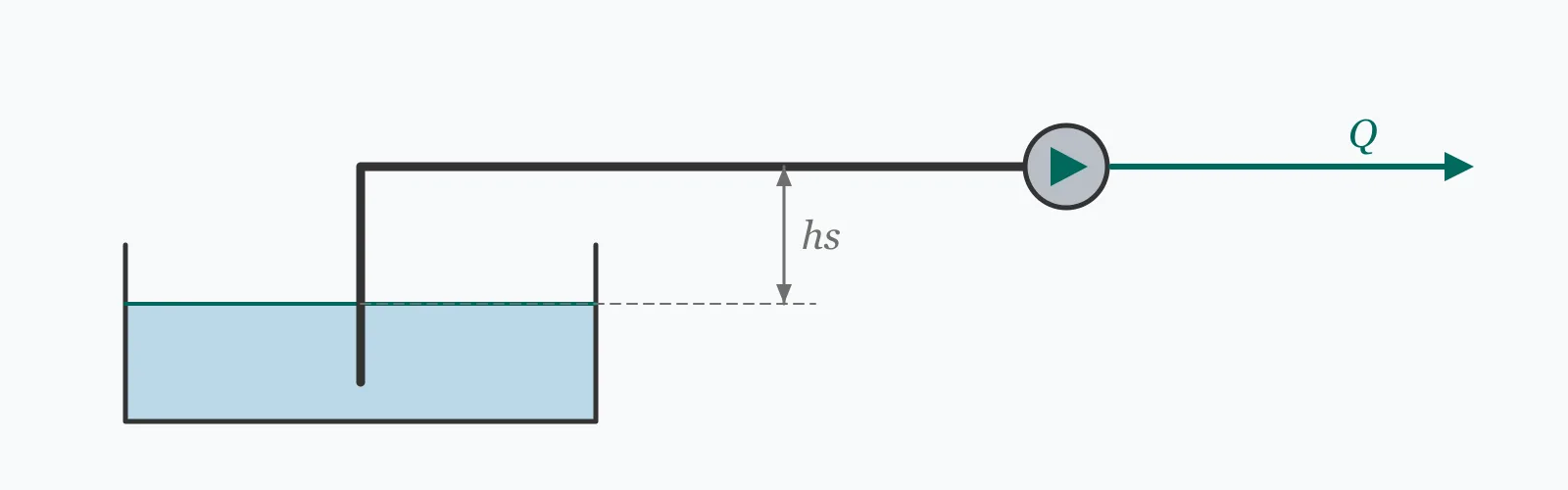
Cavitation happens when the pressure at the impeller eye falls to the liquid's vapour pressure. NPSH available measures how much margin there is above that point. Enter the atmospheric pressure, static suction head, friction loss, vapour pressure, fluid density and the pump's NPSH required to get the NPSH available, the margin, a cavitation verdict, and the greatest lift the suction line can sustain.
Calculator
Units:
kPa
101.3 at sea level. For a closed vessel, use the absolute pressure above the liquid
m
Positive if the source is above the pump; negative for a suction lift
m
Pipe, fittings, foot valve and strainer losses at design flow
kPa
Water: 2.34 at 20 °C, 7.38 at 40 °C, 19.94 at 60 °C, 47.39 at 80 °C
kg/m³
Water: 998 at 20 °C, 983 at 60 °C, 972 at 80 °C
m
From the pump curve at the design flow. It rises steeply as flow increases
Calculation Result
Press Calculate for the NPSH available, the margin over the pump's requirement, the cavitation risk verdict, and the maximum static lift this suction line can sustain. A margin of at least 0.6 m is normally required.
Step-by-Step Solution
Preliminary design aid. Results follow the published formulas cited
below and are intended for estimating, study and early design. Final design must be
verified by a licensed Professional Engineer against the code in force for your project.
Key Benefits
✓Computes NPSH available from the full pressure budget
✓Reports the margin explicitly rather than leaving it to be inferred
✓Gives the maximum suction lift the system can sustain, which sizes the installation
✓Handles any liquid through its vapour pressure and density
✓Sensitivity chart shows the margin crossing zero as the lift increases
✓Shareable links and CSV export for design records
What Is NPSH?
Net positive suction head available is the pressure at the pump suction, expressed as a head of the liquid, measured above the liquid's vapour pressure. It is a budget: atmospheric pressure supplies it, and static lift, friction and vapour pressure spend it. NPSH required is a property of the pump, determined by test, describing how much head above vapour pressure the impeller needs to fill properly. The available figure must exceed the required one, with margin.
What cavitation actually does
If the pressure at the impeller eye falls to the vapour pressure, the liquid boils locally and forms vapour bubbles. Those bubbles are carried into the higher-pressure region of the impeller and collapse there, imploding against the blade surface. Each collapse is a tiny but violent impact, and their accumulation erodes the metal, produces a characteristic gravel-in-the-pump noise, and destroys the head the pump can generate. It is a mechanical failure driven by a hydraulic condition.
Why temperature matters so much
Vapour pressure rises steeply and non-linearly with temperature. Water at 20 °C has a vapour pressure of 2.34 kPa, which consumes almost none of the atmospheric budget. At 60 °C it is 19.94 kPa and at 80 °C it is 47.39 kPa — nearly half of atmospheric pressure gone before anything else is subtracted. An installation that works perfectly on cold water can cavitate on the same duty hot, with no change to the pipework at all.
Formula
NPSHa = (P_atm − P_vap)/(ρ·g) + h_s − h_f
NPSH available: pressure head above vapour pressure, plus static head, less friction loss
Related Formulas
Margin = NPSHa − NPSHr
h_s,max = (P_atm − P_vap)/(ρ·g) − h_f − NPSHr
(P_atm)/(ρ·g) ≈ 10.33 m
Variable Definitions
Symbol
Variable
Unit
Description
NPSHa
NPSH Available
m
Head above vapour pressure available at the pump suction.
NPSHr
NPSH Required
m
Head the pump needs, from the manufacturer's curve. Rises steeply with flow.
P_atm
Atmospheric Pressure
kPa
101.3 at sea level; falls about 1.2 kPa per 100 m of altitude.
P_vap
Vapour Pressure
kPa
Of the liquid at its operating temperature. Water: 2.34 at 20 °C, 47.39 at 80 °C.
h_s
Static Suction Head
m
Positive when the source is above the pump centreline, negative when the pump lifts.
h_f
Suction Friction Loss
m
Pipe and fitting losses in the suction line at the design flow.
How to Use This Calculator
Get the sign of the static head rightPositive when the liquid level is above the pump centreline — a flooded suction — and negative when the pump has to lift. This is the single most common error, and it produces an answer wrong by twice the head.
Use the vapour pressure at the operating temperatureNot at ambient, and not at the design maximum unless that is what the pump will see. Water's vapour pressure rises from 2.34 kPa at 20 °C to 47.39 kPa at 80 °C, which alone consumes 4.5 metres of the available head.
Compute the friction loss at the design flowSuction losses scale roughly with the square of flow, so a pump running out along its curve loses NPSH available at the same time as its NPSH required is rising. Include the foot valve and strainer, which are often the largest single items.
Read NPSHr from the curve at the actual dutyNPSH required is not a single number for a pump. It rises steeply with flow, so a value taken at the best efficiency point understates what the pump needs when running out towards its maximum flow.
Require a real margin, not just a positive numberAt least 0.6 m over NPSHr is the usual minimum, and more for large or critical pumps. Margins are needed because both NPSHa and NPSHr shift with operating conditions, and because the standard NPSHr test corresponds to a 3% head drop — cavitation has already begun at that point.
Worked Examples
Example 1
A pump draws cold water at 20 °C from a sump 4.0 m below its centreline. Suction friction loss is 1.5 m, atmospheric pressure 101.3 kPa, and the pump requires 3.5 m NPSH at the design flow.
Margin: 4.608 − 3.5 = 1.108 m over the pump's requirement
Maximum static lift this suction line could sustain: 10.108 − 1.5 − 3.5 = 5.11 m
Interpretation: the installation works, with 1.11 m of margin against the 0.6 m minimum. But the lift could only be increased by another 1.1 m before the pump reaches its limit.
Example 2
The same installation, unchanged in every physical respect, now handling water at 60 °C instead of 20 °C. Vapour pressure rises to 19.94 kPa and density falls to 983 kg/m³.
Step-by-Step Solution
Net pressure head: (101.3 − 19.94) × 1000 / (983 × 9.81) = 81,360 / 9,643.2 = 8.437 m
The budget has fallen by 1.67 m purely from the higher vapour pressure
Static lift and friction are unchanged: NPSHa = 8.437 − 4.0 − 1.5 = 2.937 m
Margin: 2.937 − 3.5 = −0.563 m — the pump now cavitates
Nothing about the pipework has changed. The same pump on the same lift with the same suction line has gone from a working 1.11 m margin to cavitating, purely on temperature.
The maximum lift this system can now sustain has fallen from 5.11 m to 3.44 m.
At 80 °C it is worse again: vapour pressure reaches 47.39 kPa, the budget collapses to 5.654 m, NPSHa becomes 0.154 m, and the maximum sustainable lift is just 0.65 m — the pump would need a flooded suction.
This is why hot-water and condensate pumps are almost always installed below their source. There is no practical way to lift hot liquid, because atmospheric pressure has already been spent on holding it liquid.
Static Head Sensitivity
NPSH available falls one metre for every metre the pump is raised above the liquid. Switch to the margin series to see it cross zero — the point at which the pump begins to cavitate. The marker shows your current static head.
NPSH Available vs Static Suction Head
Recomputed live from your inputs. The marker shows your current value.
Line chart of NPSH Available against Static Suction Head. The same
values are listed in the data table below.
Values plotted above, sampled across the static suction head range.
How to Interpret Your Results
The margin, not the NPSH available on its own, is the result that matters. A large NPSHa means nothing if the pump requires more, and a small one is fine if it requires less.
Margin Over Requirement: < 0Cavitating
A margin of your result m means NPSH available is below what the pump requires. Vapour bubbles will form at the impeller eye and collapse against the blades, eroding the metal and destroying the head. Lower the pump, shorten or enlarge the suction line, cool the liquid, or reduce the flow.
Margin Over Requirement: 0 – 0.6Below the usual minimum margin
A margin of your result m is positive but below the 0.6 m normally required. NPSHr rises steeply as the pump runs out along its curve, and NPSHa falls at the same time as suction friction increases — so this margin can disappear in normal operation.
Margin Over Requirement: 0.6 – 2Adequate margin
A margin of your result m meets the usual 0.6 m minimum. Check that it holds at the maximum flow the pump will see, and at the highest liquid temperature — both erode this figure from opposite directions.
Margin Over Requirement: ≥ 2Comfortable margin
A margin of your result m gives substantial tolerance for flow variation, temperature change and suction line fouling. There is room here to accept a longer suction run or a higher duty point if the design changes.
NPSH Available: < 0Negative NPSH available
NPSH available of your result m means the pressure at the suction is already below the liquid's vapour pressure. The liquid will boil in the suction line itself and the pump cannot prime, let alone deliver. The suction arrangement needs fundamental change, not adjustment.
Common Mistakes to Avoid
Getting the sign of the static head wrong
Why it matters:A flooded suction adds to NPSH available; a lift subtracts. Reversing the sign produces an error of twice the static head, which on a 4 m lift is 8 m — enough to turn a cavitating installation into an apparently safe one on paper.
✓How to avoid it:Positive when the liquid surface is above the pump centreline, negative when below. Sketch it if there is any doubt.
Using ambient vapour pressure for a hot liquid
Why it matters:Vapour pressure rises steeply with temperature and consumes the atmospheric budget directly. Water at 80 °C spends 4.5 m more of that budget than water at 20 °C — often the entire margin.
✓How to avoid it:Use the vapour pressure at the actual operating temperature, and check the highest temperature the system will see, including upset conditions.
Taking NPSHr at the best efficiency point
Why it matters:NPSH required rises sharply with flow. A pump selected on its BEP value can cavitate when it runs out towards maximum flow — which happens whenever system resistance is lower than assumed.
✓How to avoid it:Read NPSHr at the maximum flow the pump will actually see, not at the design duty. The two can differ by several metres on the same curve.
Treating a positive margin as sufficient
Why it matters:The standard NPSHr test defines the requirement as the point where head has already dropped by 3%, meaning cavitation is under way. A margin of a few centimetres provides no protection against it at all.
✓How to avoid it:Require at least 0.6 m, and considerably more for large, high-energy or critical pumps. Some standards call for a multiple of NPSHr rather than a fixed addition.
Undersizing the suction line
Why it matters:Suction friction subtracts directly from NPSHa and scales with roughly the square of flow. Matching the suction pipe to the discharge pipe is a common shortcut, but the two have quite different jobs.
✓How to avoid it:Size the suction line at least one size larger than the discharge, keep it short and direct, and minimise fittings. A partly blocked strainer or foot valve is a frequent cause of cavitation appearing in a system that previously worked.
Ignoring altitude
Why it matters:Atmospheric pressure falls by roughly 1.2 kPa per 100 m of elevation, which is about 0.12 m of head. At 1,500 m the budget is around 1.8 m smaller than at sea level — often the whole margin on a suction lift installation.
✓How to avoid it:Use the local atmospheric pressure. For a closed vessel, use the absolute pressure above the liquid, which may be far below or above atmospheric.
Practical Applications
▸Checking a pump installation against cavitation before commissioning
▸Determining the maximum lift a suction arrangement can sustain
▸Diagnosing cavitation in an existing pump
▸Assessing the effect of a temperature change on an existing duty
▸Sizing the suction line for a new installation
▸Verifying a pump selection against the system's suction conditions
Industry Use Cases
Water supply and boosting
Booster pumps drawing from a break tank are checked against the lowest tank level, not the normal one, because NPSH available falls as the tank draws down. The low-level cut-out is often set by NPSH rather than by tank capacity.
Heating and condensate systems
Condensate and hot-water pumps are installed below their source almost without exception, because vapour pressure at operating temperature has already consumed most of the atmospheric budget. A hot-well pump on a lift is not a design that can be made to work by better pipework.
Process and chemicals
Volatile liquids have high vapour pressures at ambient temperature, so NPSH governs the layout of the whole suction side. Vessels are elevated and suction lines kept short and generous specifically to preserve the margin.
Expert Tips
💡Atmospheric pressure gives only about 10.1 m of head with cold water at sea level.
💡Static head is positive for flooded suction, negative for lift — get the sign right first.
💡Water at 80 °C spends 4.5 m more of the budget on vapour pressure than at 20 °C.
💡NPSHr rises steeply with flow; read it at maximum flow, not at the design point.
💡Suction friction scales with flow squared, so it bites hardest exactly when NPSHr peaks.
💡Altitude costs about 0.12 m of head per 100 m of elevation.
Advantages & Limitations
Advantages
✓Accounts for the whole pressure budget rather than a simplified subset
✓Reports the margin explicitly, which is the criterion that actually applies
✓Gives the maximum sustainable lift, a directly useful design output
✓Works for any liquid through its vapour pressure and density
✓Simple enough to check by hand when diagnosing a cavitating pump
Limitations
!NPSH required must be supplied from the pump curve at the correct flow
!Suction friction loss must be computed separately and supplied
!Assumes steady flow; transient conditions such as rapid valve action are not covered
!Takes no account of the suction-specific speed or the pump's internal geometry
!Does not model dissolved gas coming out of solution, which occurs above vapour pressure
!The 0.6 m margin is a common convention, not a universal requirement
!For a closed vessel the absolute pressure above the liquid must be used, not atmospheric
The Same Pump at Different Suction Arrangements
Cold water at 20 °C, 1.5 m suction friction, pump requiring 3.5 m NPSH. Only the static head changes — one metre of lift costs exactly one metre of NPSH available.
Water at 20 °C (Pv 2.34 kPa, ρ 998 kg/m³), 101.3 kPa atmospheric, 1.5 m suction friction, NPSHr 3.5 m. The maximum lift satisfying the pump exactly is 5.11 m. Raising the water to 60 °C moves that limit down to 3.44 m, and to 80 °C down to 0.65 m — with no change to the pipework at all.
Net positive suction head — the pressure at a pump's suction expressed as a head of the liquid, measured above its vapour pressure. NPSH available is what the system provides; NPSH required is what the pump needs.
How do I calculate NPSH available?
NPSHa = (P_atm − P_vap)/(ρg) + h_s − h_f. Cold water at sea level on a 4 m lift with 1.5 m of suction friction gives 10.108 − 4.0 − 1.5 = 4.608 m.
What margin should NPSH available have over NPSH required?
At least 0.6 m is the usual minimum, and more for large or critical pumps. The requirement exists because the standard NPSHr test corresponds to a 3% head drop, at which point cavitation has already started.
What causes pump cavitation?
The pressure at the impeller eye falling to the liquid's vapour pressure, so the liquid boils locally. The bubbles then collapse in the higher-pressure part of the impeller, eroding the blades and destroying the head.
What is the maximum suction lift for a pump?
It depends on the liquid, the temperature and the suction line, but with cold water at sea level the absolute ceiling is about 10.1 m before friction and NPSHr are subtracted. In the example here the practical limit is 5.11 m.
Why can't a pump lift hot water?
Because vapour pressure consumes the atmospheric budget. Water at 80 °C has a vapour pressure of 47.39 kPa, nearly half of atmospheric, leaving only 5.65 m of head before any lift or friction. Hot-water pumps are installed below their source for this reason.
How does flow rate affect NPSH?
Badly, in both directions at once. NPSH required rises steeply with flow, while suction friction loss rises with roughly the square of flow and reduces NPSH available. A pump running out along its curve is squeezed from both sides.
How does altitude affect NPSH available?
Atmospheric pressure falls about 1.2 kPa per 100 m, or roughly 0.12 m of head. At 1,500 m elevation the available head is about 1.8 m less than at sea level, which is frequently the whole margin on a suction lift.
What does a cavitating pump sound like?
Like gravel or marbles passing through it, accompanied by vibration and an unstable discharge pressure. The head and flow fall away, and prolonged operation pits the impeller vanes.
How do I fix a cavitating pump?
Increase NPSH available or reduce NPSH required. Lower the pump relative to the liquid, shorten or enlarge the suction line, clean the strainer, cool the liquid, or reduce the flow. Lowering the pump is usually the most effective single measure.
Glossary
NPSH available
Head above vapour pressure that the system provides at the pump suction.
NPSH required
Head above vapour pressure the pump needs to fill its impeller, determined by test.
Cavitation
Formation and violent collapse of vapour bubbles when local pressure reaches vapour pressure.
Vapour pressure
The pressure at which a liquid boils at a given temperature.
Flooded suction
An arrangement with the liquid source above the pump centreline, adding to NPSH available.
Suction lift
An arrangement with the pump above the liquid, subtracting from NPSH available.
Impeller eye
The central inlet of the impeller, where pressure is lowest and cavitation begins.
Foot valve
A non-return valve at the bottom of a suction line, often a major friction loss.
Best efficiency point
The flow at which a pump is most efficient; NPSHr is usually lowest near it.
NPSH margin
The difference between NPSH available and NPSH required.
Scientific & Standards References
ANSI/HI 9.6.1 — Rotodynamic Pumps Guideline for NPSH Margin — Hydraulic Institute
ISO 17769-1 — Liquid pumps and installation: Terms, definitions, quantities and symbols — International Organization for Standardization
Karassik, I. J. et al., Pump Handbook, 4th Edition — Chapter 2: Centrifugal Pump Theory — McGraw-Hill
NIST Chemistry WebBook — Saturation Properties of Water — National Institute of Standards and Technology
Europump and Hydraulic Institute, Variable Speed Pumping: A Guide to Successful Applications — Elsevier
Conclusion
NPSH is a budget with one source and three claims on it. Atmospheric pressure supplies about 10.1 metres of head with cold water at sea level, and static lift, suction friction and the liquid's own vapour pressure spend it. What remains must exceed the pump's requirement by a real margin — 0.6 m at least, because the standard NPSHr test already corresponds to a 3% head drop, meaning cavitation has begun. Of the three claims, temperature is the one that most often turns a working installation into a failing one: the example above shows an identical pump, lift and suction line going from a comfortable 1.11 m margin on cold water to cavitating on the same duty at 60 °C, and to needing a flooded suction at 80 °C. Flow is the other trap, because it raises NPSHr and suction friction simultaneously — so the margin is smallest exactly when the pump is working hardest.
Enter your own suction arrangement above to check the margin before commissioning.