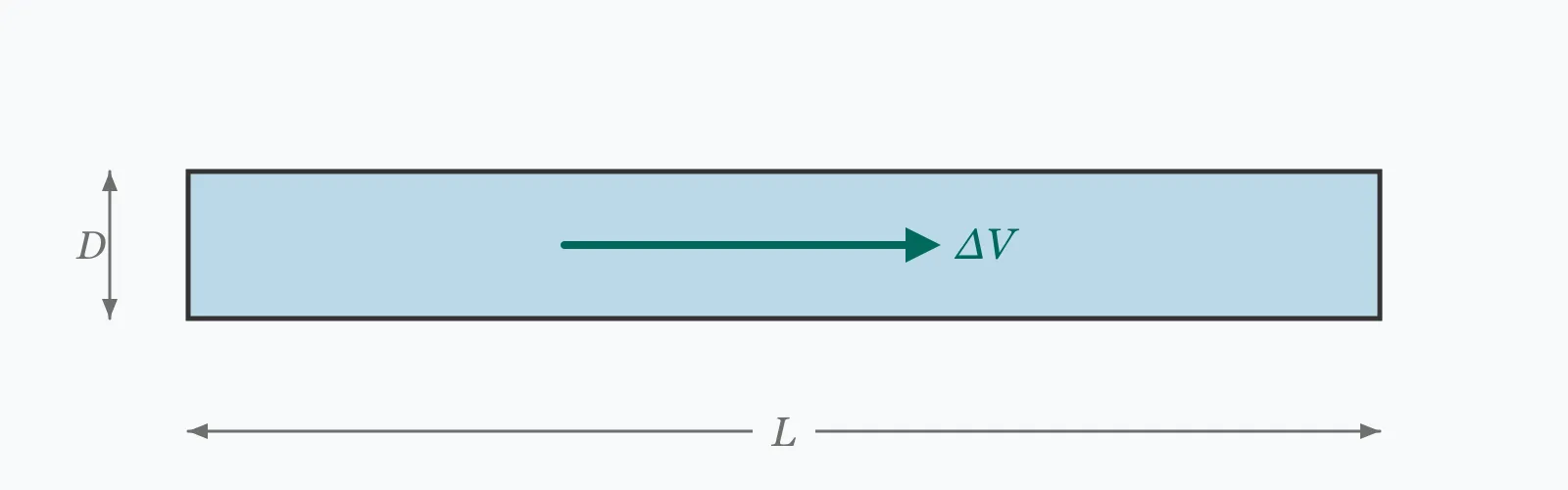
Stopping a moving column of water converts its momentum into pressure: Δp = ρ·a·ΔV. Enter the flow velocity, pipe length, valve closure time, wave speed and fluid density to get the surge pressure, the surge expressed as a head, the critical closure time 2L/a, and whether the closure counts as rapid. Below the critical time, closing more slowly achieves nothing at all.
Calculator
Units:
m/s
The velocity being stopped. Surge is directly proportional to it
m
From the valve to the nearest reservoir, tank or branch that reflects the wave
s
Time for the valve to go from fully open to fully shut
m/s
Steel/ductile iron 1200; concrete 1000; PVC 400; PE 250 to 350
kg/m³
Water at 20 °C is 998 kg/m³
Calculation Result
Press Calculate for the surge pressure, the equivalent head, the critical closure time 2L/a, and whether the closure is rapid or slow. A rapid closure produces the full Joukowsky surge no matter how much faster it happens.
Step-by-Step Solution
Preliminary design aid. Results follow the published formulas cited
below and are intended for estimating, study and early design. Final design must be
verified by a licensed Professional Engineer against the code in force for your project.
Key Benefits
✓Applies the Joukowsky equation with the correct critical-time test
✓Distinguishes rapid from slow closure, which decides whether slowing the valve helps
✓Reports the surge as both a pressure and a head for checking against pipe ratings
✓Makes the direct proportionality with velocity immediately visible
✓Sensitivity chart shows the plateau below the critical closure time
✓Shareable links and CSV export for design records
What Is Water Hammer?
When a valve closes on a flowing pipeline, the water immediately upstream is brought to rest and its momentum is converted into pressure. That pressure rise travels back up the pipe as a wave at the speed of sound in the fluid-pipe system, typically 1,000 to 1,400 m/s in metal pipe. The Joukowsky equation gives the magnitude directly: Δp = ρ·a·ΔV. It depends on the velocity change, not on the pipe length or the working pressure.
Why 2L/a is the threshold that matters
The pressure wave travels to the far end of the pipeline, reflects off the reservoir or tank there, and returns to the valve. That round trip takes 2L/a seconds. If the valve is still closing when the reflection arrives, the returning wave relieves the pressure and the surge is reduced. If the valve has already shut, the full Joukowsky surge develops regardless. Closing in a tenth of the critical time produces exactly the same peak as closing in the critical time itself.
The negative half of the cycle
The surge is oscillatory, not a single pulse. After the pressure wave passes, the same mechanism produces a pressure drop of similar magnitude on the return stroke. On a long pipeline that low-pressure phase can approach the vapour pressure of water, causing column separation — the water column parts, then rejoins violently when the pressure recovers. The rejoining impact is often more damaging than the original surge, and thin-walled pipe can also collapse under the external pressure differential.
Formula
Δp = ρ · a · ΔV
Joukowsky equation for the surge from an instantaneous velocity change
Related Formulas
T_c = 2L / a
Δp_slow = ρ · a · ΔV · (T_c / T)
ΔH = Δp / (ρ · g)
a = √(K/ρ) / √(1 + (K·D)/(E·e))
Variable Definitions
Symbol
Variable
Unit
Description
Δp
Surge Pressure
kPa
Pressure rise above the working pressure, added to it rather than replacing it.
ρ
Fluid Density
kg/m³
998 for water at 20 °C.
a
Wave Speed
m/s
Speed of the pressure wave. Steel and ductile iron 1,000–1,400; PE 200–500.
ΔV
Velocity Change
m/s
The velocity stopped. Surge is directly proportional to it.
L
Pipe Length
m
Distance from the valve to the nearest reflecting boundary.
T_c
Critical Time
s
2L/a. Closing faster than this gains nothing; closing slower relieves proportionally.
How to Use This Calculator
Use the velocity actually being stoppedThe surge depends on the velocity change, so a valve that closes from part flow produces a proportionally smaller surge. For a full closure from the design duty, use the full design velocity.
Measure the length to the nearest reflecting boundaryThe wave reflects at a reservoir, tank, large branch or open end — not necessarily at the far end of the pipe. Using too long a length overstates the critical time and makes a rapid closure look slow.
Use the wave speed for the actual pipe materialWave speed depends on the pipe's elasticity as well as the fluid's. Steel and ductile iron sit around 1,000 to 1,400 m/s, PVC near 400, and polyethylene as low as 250. Because the surge is directly proportional to wave speed, this choice changes the answer by a factor of four.
Read the closure type before anything elseIf the closure is rapid, slowing the valve within the critical time gains nothing. Only once the closure time exceeds 2L/a does slowing it start to relieve the surge, and then in inverse proportion.
Add the surge to the working pressureThe surge is a rise above whatever pressure is already there. Check the sum against the pipe's rated pressure, including any fittings, valves and joints, which are often the weakest elements.
Worked Examples
Example 1
An 800 m steel pipeline carries water at 1.5 m/s. A valve closes in 1.0 second. Wave speed is 1,200 m/s and the water density 998 kg/m³.
As a head: 1,796,400 / (998 × 9.81) = 183.5 m of water
Interpretation: 183 m of surge head is added to the working pressure, which is several times the operating head of a typical distribution main. Closing faster than 1.0 s would change nothing — the surge is already at its maximum.
Example 2
The same pipeline with the valve fitted with an actuator that takes 8 seconds to close instead of 1 second.
Step-by-Step Solution
The critical time is unchanged at 1.333 s, since it depends only on length and wave speed
The valve now closes in 8.0 s, well beyond the critical time, so the returning reflection relieves the pressure
Relief factor: Tc/T = 1.333/8.0 = 0.1667
Surge pressure: 1,796.4 × 0.1667 = 299.4 kPa
Surge head: 30.6 m, against 183.5 m for the rapid closure
An eightfold increase in closure time has reduced the surge sixfold — the ratio being 8/1.333, not 8, because the relief only starts at the critical time.
Note what would not have worked. Slowing the valve from 1.0 s to 1.3 s achieves nothing at all, because both are inside the critical time. The first useful second of extra closure time is the one that takes it past 1.333 s.
Reducing the design velocity would have worked from the start, since the surge is directly proportional to it. Halving the velocity to 0.75 m/s halves the surge whatever the closure time — which is why pipelines liable to rapid valve action are often limited to around 1.5 m/s.
Closure Time Sensitivity
The surge is flat below the critical closure time — closing faster than 2L/a changes nothing — then falls in inverse proportion beyond it. That plateau is the single most important feature of the curve. The marker shows your current closure time.
Surge Pressure vs Valve Closure Time
Recomputed live from your inputs. The marker shows your current value.
Line chart of Surge Pressure against Valve Closure Time. The same
values are listed in the data table below.
Values plotted above, sampled across the valve closure time range.
How to Interpret Your Results
The surge head is the figure to check against the pipe rating, and the closure type tells you whether slowing the valve is a remedy available to you at all.
Surge Head: < 20Modest surge
A surge head of your result m is small enough that most pipe systems will accommodate it within their rating. Confirm the sum of working pressure and surge against the weakest component, which is usually a fitting or joint rather than the pipe itself.
Surge Head: 20 – 60Significant surge
A surge head of your result m is a substantial addition to the working pressure. Check the total against the pipe rating and consider whether a slower actuator or a lower design velocity would reduce it economically.
A surge head of your result m exceeds the working pressure of most distribution systems. Surge protection is required: a surge vessel, an air valve, a pressure relief valve, or a slow-closing actuator taking the closure well past the critical time.
Surge Head: ≥ 150Severe surge
A surge head of your result m will damage the pipeline. Address the cause rather than the symptom: reduce the design velocity, which the surge is directly proportional to, and extend the closure time beyond the critical time. Check for column separation on the negative half-cycle as well.
The valve closes within the critical time of 2L/a, so the full Joukowsky surge develops. Any further reduction in closure time is irrelevant, and small increases are too — the closure time has to exceed the critical time before it starts to help at all.
Common Mistakes to Avoid
Assuming a slower valve always reduces the surge
Why it matters:Below the critical time 2L/a, the surge is at its maximum and does not depend on closure time at all. Slowing a valve from 0.2 s to 1.0 s on an 800 m pipeline achieves precisely nothing, because both are inside the 1.333 s critical time.
✓How to avoid it:Compare the closure time against 2L/a first. Only extension beyond that threshold produces relief, and then in inverse proportion.
Using the wrong pipe length
Why it matters:The wave reflects at the nearest boundary — a reservoir, tank, large branch or open end — not necessarily at the end of the pipeline. Taking too long a length overstates the critical time and makes a rapid closure appear slow.
✓How to avoid it:Measure to the nearest genuine reflecting boundary. Where there are several, the shortest distance governs the critical time.
Using the free-fluid wave speed
Why it matters:The speed of sound in water alone is about 1,480 m/s, but pipe elasticity reduces it. Steel and ductile iron give 1,000 to 1,400, PVC around 400, and polyethylene as low as 250 — a factor of nearly six between the extremes.
✓How to avoid it:Use the wave speed for the actual pipe material, wall thickness and restraint. This is also why plastic pipe is inherently far more tolerant of transients than metal.
Ignoring the negative half-cycle
Why it matters:The surge oscillates. The pressure drop on the return stroke is of similar magnitude, and on a long pipeline it can reach vapour pressure, causing the water column to separate and then rejoin violently. That rejoining impact is often the more damaging event.
✓How to avoid it:Check the minimum pressure as well as the maximum, particularly at high points along the profile. Thin-walled pipe can also collapse under the external pressure differential.
Checking the pipe but not the fittings
Why it matters:Surge is added to the working pressure throughout the system, and joints, valves, flanges and thrust blocks are frequently rated lower than the pipe barrel. A pipeline can survive a transient that destroys the fittings in it.
✓How to avoid it:Check the total against the lowest-rated component in the line, and confirm that thrust restraint accounts for the transient force as well as the steady one.
Overlooking pump trip as a surge source
Why it matters:Valve closure is the obvious cause, but a power failure that stops a pump produces the same velocity change — often faster, and with the low-pressure phase arriving first. Downsurge on pump trip is a common cause of column separation.
✓How to avoid it:Analyse pump trip as well as valve closure. Flywheels, surge vessels and air valves are the usual remedies, and the trip case frequently governs the protection.
Practical Applications
▸Checking a pipeline against transient pressures before commissioning
▸Setting a minimum valve closure time for a given system
▸Sizing surge protection such as vessels and relief valves
▸Verifying pipe and fitting pressure ratings against the transient case
▸Comparing pipe materials by their wave speed and surge behaviour
▸Diagnosing knocking and pipe movement in an existing system
Industry Use Cases
Water distribution
Transmission mains are analysed for both valve closure and pump trip, and the trip case usually governs because it produces the low-pressure phase first. Surge vessels are sized to keep the minimum pressure above vapour pressure at every high point along the profile.
Building services
Quick-closing solenoid and lever taps produce surges in short pipe runs where the critical time is a few hundredths of a second, so every closure is rapid. Arrestors are fitted close to the valve because relief must arrive before the wave has travelled far.
Irrigation and industrial pipelines
Long pipelines with automated valves have critical times of several seconds, so a slow-closing actuator is genuinely effective. It is also the cheapest form of surge protection where the pipeline geometry allows it.
Expert Tips
💡Below 2L/a, closing faster or slower makes no difference at all.
💡Surge is directly proportional to velocity — halving the velocity halves the surge.
💡Polyethylene's low wave speed makes it far more tolerant of transients than steel.
💡The surge adds to the working pressure; check the sum against the weakest fitting.
💡The negative half-cycle can cause column separation, often the more damaging event.
💡Pump trip usually governs over valve closure, and it hits with downsurge first.
Advantages & Limitations
Advantages
✓Applies the Joukowsky equation with the correct rapid-versus-slow test
✓Makes the critical-time plateau explicit, which is the most misunderstood aspect
✓Reports both pressure and head, matching how pipe ratings are quoted
✓Handles any fluid and pipe material through density and wave speed
✓Simple enough to check by hand when assessing an existing installation
Limitations
!Gives the peak surge from a single velocity change, not the full transient time history
!Uses a linear relief for slow closure; real valve characteristics are non-linear
!Wave speed must be supplied rather than computed from pipe properties
!Does not model column separation, which needs a full transient analysis
!Takes no account of friction damping, which reduces successive peaks
!Does not cover pump trip, air valve behaviour or surge vessel response
!Assumes a simple pipeline with a single reflecting boundary
Closure Time and Pipe Material
An 800 m pipeline at 1.5 m/s. The upper block varies the closure time on steel pipe; the lower block varies the pipe material at a fixed 1 second closure. Note the flat region below the critical time in the first block.
800 m pipeline, water at 1.5 m/s, 998 kg/m³. The first two rows are identical because both closures are inside the critical time — a 2.7-fold difference in closure speed with no effect whatsoever. In the lower block every closure is still rapid, yet the surge falls fourfold from ductile iron to polyethylene purely on wave speed.
The pressure surge produced when a moving column of water is stopped or slowed suddenly, converting its momentum into pressure. The rise travels along the pipe as a wave at the speed of sound in the fluid-pipe system.
How do I calculate water hammer pressure?
By the Joukowsky equation, Δp = ρ·a·ΔV. Water at 1.5 m/s in steel pipe with a wave speed of 1,200 m/s gives 1,796 kPa, or 183 m of head.
What is the critical closure time?
Tc = 2L/a, the time for a pressure wave to travel to the nearest reflecting boundary and back. Closing faster than this produces the full surge; closing slower relieves it in proportion.
Does closing a valve more slowly always help?
Only once the closure time exceeds 2L/a. Below that threshold the surge is already at its maximum and does not depend on closure time at all — slowing from 0.5 s to 1.3 s on an 800 m pipeline achieves nothing.
What is the pressure wave speed in a pipe?
About 1,000 to 1,400 m/s in steel and ductile iron, 1,000 in concrete, 400 in PVC and 250 to 350 in polyethylene. Pipe elasticity reduces it below the 1,480 m/s of water alone.
Why does plastic pipe suffer less from water hammer?
Because the surge is directly proportional to wave speed, and plastic's elasticity lowers it substantially. Polyethylene at 350 m/s produces a quarter of the surge that ductile iron at 1,400 m/s does, for the same velocity.
How do I reduce water hammer?
Lower the design velocity, since surge is proportional to it; extend the closure time beyond 2L/a; use a pipe material with a lower wave speed; or fit surge protection such as a vessel, air valve or relief valve.
What is column separation?
The negative half of the surge cycle dropping the pressure to vapour pressure, so the water column parts. When the pressure recovers, the column rejoins violently — an impact often more damaging than the original surge.
Why does pump trip cause water hammer?
Because a power failure stops the pump and therefore the flow, which is the same velocity change a closing valve produces — often faster, and with the low-pressure phase arriving first. Pump trip frequently governs the surge protection design.
What velocity should a pipeline be limited to?
Around 1.5 m/s is a common limit where rapid valve action is possible, precisely because the surge scales directly with velocity. Higher velocities are used where the closure time can be assured well beyond the critical time.
Glossary
Water hammer
The pressure surge from a sudden change in flow velocity in a pipeline.
Joukowsky equation
Δp = ρ·a·ΔV, the surge from an instantaneous velocity change.
Wave speed
Speed at which a pressure wave travels, reduced below the fluid's own by pipe elasticity.
Critical closure time
2L/a, the wave's round trip to the nearest reflecting boundary and back.
Rapid closure
Closure completed within the critical time, producing the full Joukowsky surge.
Column separation
Parting of the water column when the negative surge reaches vapour pressure.
Surge vessel
A pressurised chamber that absorbs and returns flow to limit transient pressures.
Downsurge
The negative pressure phase, typically the first event after a pump trip.
Air valve
A valve admitting air to prevent negative pressures and releasing it afterwards.
Transient analysis
Time-domain modelling of the full pressure history, as distinct from a peak calculation.
Scientific & Standards References
Joukowsky, N., Über den hydraulischen Stoss in Wasserleitungsröhren (1900) — Mémoires de l'Académie Impériale des Sciences de St.-Pétersbourg
Wylie, E. B. and Streeter, V. L., Fluid Transients in Systems — Prentice Hall
Thorley, A. R. D., Fluid Transients in Pipeline Systems, 2nd Edition — Professional Engineering Publishing
AWWA M11 — Steel Water Pipe: A Guide for Design and Installation — American Water Works Association
BS EN 805 — Water supply: Requirements for systems and components outside buildings — British Standards Institution
Conclusion
Water hammer is governed by two relationships, and one of them is a threshold rather than a slope. The magnitude is Joukowsky's Δp = ρ·a·ΔV — directly proportional to velocity and to wave speed, which is why limiting a pipeline to around 1.5 m/s and choosing polyethylene over ductile iron each cut the surge by a factor of several. The closure time behaves quite differently: below the critical time 2L/a it has no effect at all, as the first two rows of the table above show, and only past that threshold does it relieve the surge in inverse proportion. That plateau is what makes slow-closing actuators either the cheapest available remedy or completely useless, depending entirely on the pipeline length. Two things a peak calculation cannot show still need checking: the negative half-cycle, which can part the water column and cause a rejoining impact worse than the original surge, and pump trip, which produces the same velocity change with the low-pressure phase arriving first.
Enter your own velocity, pipe length and closure time above to check the surge.