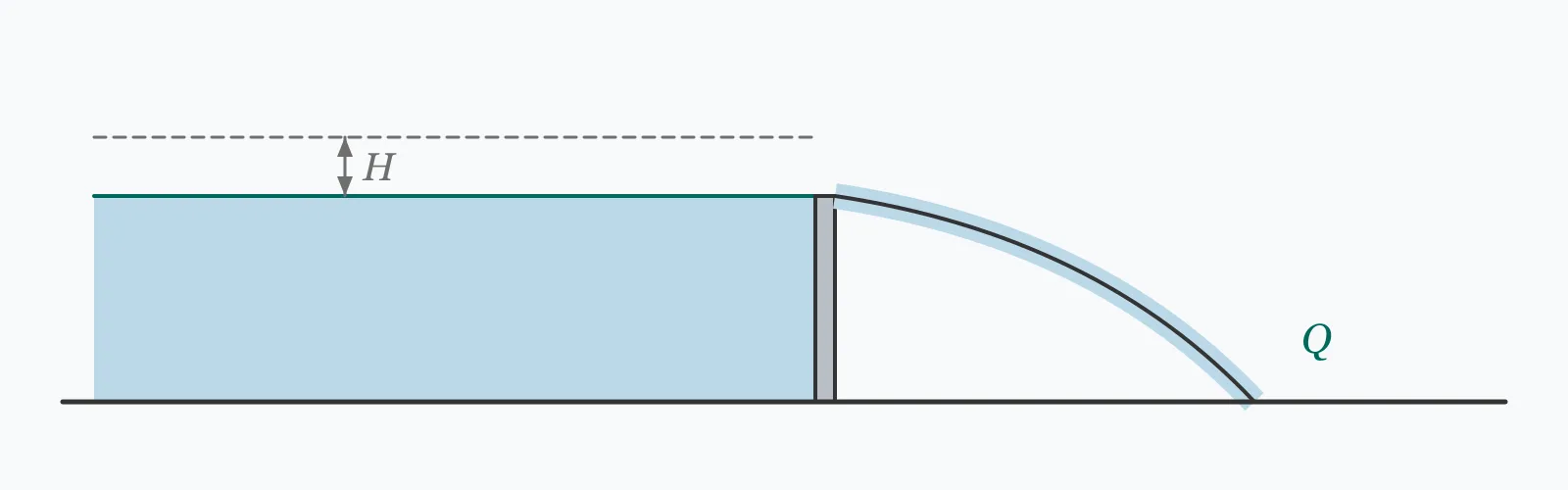
A sharp-crested weir turns a single depth measurement into a flow rate: Q = ⅔·Cd·√(2g)·L·H^1.5. Enter the crest length, the head over the crest, the discharge coefficient and the number of end contractions to get the discharge, the effective crest length after the Francis correction, and the discharge per metre of crest.
Calculator
Units:
m
Width of the notch along the crest
m
Measured at least 4H upstream, where the drawdown has not begun
0.61 to 0.63 for a sharp-crested weir with a ventilated nappe
2 for a contracted notch, 0 for a suppressed weir spanning the channel
Calculation Result
Press Calculate for the discharge, the effective crest length after end contractions are deducted, and the discharge per metre of crest. Discharge rises with head to the power 1.5, so accuracy depends heavily on measuring the head correctly.
Step-by-Step Solution
Preliminary design aid. Results follow the published formulas cited
below and are intended for estimating, study and early design. Final design must be
verified by a licensed Professional Engineer against the code in force for your project.
Key Benefits
✓Applies the standard rectangular sharp-crested weir equation
✓Includes the Francis end-contraction correction, which is often omitted
✓Reports the effective crest length so the correction is visible
✓Warns below the 30 mm head at which surface tension takes over
✓Sensitivity chart shows the three-halves power curve
✓Shareable links and CSV export for gauging records
What Is Weir Flow?
A sharp-crested weir is a thin plate set across a channel with a level notch cut in it, over which the whole flow passes. Because the crest is thin, the water springs clear of it as a free jet — the nappe — and the discharge depends only on the head above the crest and the crest geometry. That single-variable relationship is what makes a weir useful: measuring one depth upstream gives the flow through the channel.
Why the exponent is 1.5
The velocity at any depth below the surface follows √(2gh), and integrating that over the depth of the nappe gives a discharge proportional to H^1.5. The consequence is worth internalising: a 1% error in head produces a 1.5% error in flow, and at low heads the absolute error in reading the level becomes a larger fraction of the head. This is why weirs lose accuracy at the bottom of their range and why the head should be kept comfortably above the practical minimum.
End contractions and the Francis correction
Where the notch is narrower than the channel, flow approaching from the sides has to turn inward and contracts at each end of the crest. Francis found this effectively shortens the crest by one tenth of the head at each contraction, giving Le = L − 0.1·n·H. A weir spanning the full channel width has no side contractions at all and is called suppressed. The correction is small at low heads and grows with the head, which is why it cannot simply be absorbed into the coefficient.
Formula
Q = ⅔ · Cd · √(2g) · Le · H^1.5
Discharge over a rectangular sharp-crested weir, with effective crest length Le
Related Formulas
Le = L − 0.1 · n · H
Q = 1.84 · Le · H^1.5
Q = (8/15) · Cd · √(2g) · tan(θ/2) · H^2.5
Variable Definitions
Symbol
Variable
Unit
Description
Q
Discharge
L/s
Volumetric flow rate passing over the weir.
L
Crest Length
m
Width of the notch, measured along the crest.
Le
Effective Crest Length
m
Crest length after deducting end contractions.
H
Head Over Crest
m
Height of the upstream water surface above the crest, measured well back from the weir.
Cd
Discharge Coefficient
—
Typically 0.61 to 0.63 for a sharp-crested weir.
n
End Contractions
—
2 for a notch narrower than the channel, 0 for a suppressed weir spanning it fully.
How to Use This Calculator
Measure the head well upstream of the crestThe water surface dips as it approaches the weir, so a reading taken close to the crest underestimates the head. Measure at least four times the head upstream, where the drawdown has not begun. This is the single largest source of error in weir gauging.
Set the head datum to the crest levelThe head is measured from the crest, not from the channel bed or from the water level downstream. An error in establishing the crest level shifts every subsequent reading by the same amount, and at low heads it becomes a large proportional error.
Count the end contractions correctlyA notch narrower than the channel has two contractions; a weir spanning the full width has none and is called suppressed. At a head of 0.2 m on a 1.5 m crest the difference is 2.7% of the flow, and it grows with the head.
Keep the nappe ventilatedAir must reach the underside of the falling sheet. If it cannot, the nappe clings to the plate, the pressure beneath it drops and the discharge rises above the formula's prediction — sometimes by more than 20%. Provide vent pipes through the weir wall on a suppressed weir.
Respect the practical head limitsBelow about 30 mm, surface tension dominates and the formula loses reliability. Above roughly half the crest length, approach velocity becomes significant and the standard equation understates the discharge. Both conditions are flagged.
Worked Examples
Example 1
A rectangular sharp-crested weir with a 1.5 m crest and two end contractions carries a head of 0.20 m. The discharge coefficient is 0.62.
Step-by-Step Solution
Effective crest: Le = L − 0.1·n·H = 1.5 − 0.1 × 2 × 0.20 = 1.5 − 0.04 = 1.46 m
Discharge = 239.08 L/s, or 0.1638 m³/s per metre of effective crest
Interpretation: the two end contractions have removed 40 mm of crest — 2.7% of the length, and therefore 2.7% of the flow. Ignoring them would overstate the discharge by 6.55 L/s.
Example 2
The same weir with the head raised by half, from 0.20 m to 0.30 m.
Step-by-Step Solution
Effective crest: Le = 1.5 − 0.1 × 2 × 0.30 = 1.5 − 0.06 = 1.44 m — 20 mm shorter than before
Compared with 239.08 L/s, the discharge has risen by a factor of 1.812
The pure power law would predict 1.5^1.5 = 1.837. The shortfall is because the effective crest shrank from 1.46 m to 1.44 m as the head grew: 1.837 × (1.44/1.46) = 1.812.
This is why the Francis correction cannot simply be folded into the discharge coefficient. It is head-dependent, so it changes the shape of the rating curve, not just its scale.
For comparison, a suppressed weir of the same 1.5 m crest at 0.20 m head would pass 245.63 L/s against 239.08 L/s — 2.7% more, entirely from the absent contractions.
Head Sensitivity
Discharge rises with head to the power 1.5, so the curve steepens as the head grows — the opposite of an orifice. Note the effective crest length series falling slowly: end contractions consume more crest as the head increases. The marker shows your current head.
Discharge vs Head Over Crest (H)
Recomputed live from your inputs. The marker shows your current value.
Line chart of Discharge against Head Over Crest (H). The same
values are listed in the data table below.
Values plotted above, sampled across the head over crest (h) range.
How to Interpret Your Results
The discharge is the result, but the head is where the accuracy lives. Because the exponent is 1.5, every percentage error in measuring the head becomes one and a half percent in the flow.
Discharge: < 10Low flow — near the limit of the method
A discharge of your result L/s implies a very small head on this crest. Rectangular weirs lose accuracy at low heads because the absolute error in reading the level becomes a large fraction of it. A V-notch weir, whose exponent is 2.5, gives far better resolution at low flows.
Discharge: 10 – 500Within the reliable range
A discharge of your result L/s is in the range where a rectangular sharp-crested weir performs well. Confirm the head is measured at least four times H upstream and that the nappe is ventilated — those two conditions matter more than the coefficient.
Discharge: ≥ 500High flow — check submergence
A discharge of your result L/s is substantial. Verify the downstream water level stays clear of the crest: once the tailwater submerges the weir, the head-discharge relationship breaks down entirely and the reading means nothing.
Effective Crest Length: < 0.3End contractions dominate the crest
An effective crest of your result m means the contractions are consuming a large share of the opening. The Francis correction was calibrated for modest contractions relative to the crest, so at this proportion the result is only indicative.
Common Mistakes to Avoid
Measuring the head too close to the weir
Why it matters:The water surface draws down as it approaches the crest, so a reading taken near the plate is lower than the true upstream head. Because discharge goes as H^1.5, an understated head gives an understated flow by half again as much proportionally.
✓How to avoid it:Measure at least 4H upstream, in a stilling well if the surface is disturbed. This is the largest single source of error in weir gauging.
Failing to ventilate the nappe
Why it matters:If air cannot reach the underside of the falling sheet, the pressure there drops and the nappe is drawn onto the plate. The discharge then exceeds the formula's prediction, in some cases by more than 20%, and the weir stops being a meter.
✓How to avoid it:Fit vent pipes through the weir wall below the crest on a suppressed weir. A contracted weir usually ventilates naturally through the gaps at each end.
Ignoring end contractions
Why it matters:A contracted notch behaves as though its crest were shorter by 0.1H at each end. Omitting the correction overstates the flow — by 2.7% at 0.2 m head on a 1.5 m crest, and by more as the head rises.
✓How to avoid it:Apply Le = L − 0.1·n·H, as this calculator does. The correction is head-dependent, so it cannot be absorbed into the discharge coefficient.
Using the weir when the tailwater has risen over the crest
Why it matters:A submerged weir no longer has a free nappe, and the discharge then depends on the downstream level as well as the upstream one. The single head-discharge relationship simply does not apply.
✓How to avoid it:Keep the downstream water level clear of the crest by a good margin. Where submergence is unavoidable, use a submerged weir correction or a different measurement method entirely.
Operating at very low heads
Why it matters:Below about 30 mm, surface tension and the nappe clinging to the plate dominate, and measured flow can differ from the formula by tens of percent. The proportional error in reading the level is also at its worst there.
✓How to avoid it:Size the crest so the working head stays above 30 mm, or use a V-notch weir. The V-notch exponent of 2.5 concentrates resolution at low flows, which is why it is the standard choice for small streams.
Applying a rounded or broad crest coefficient
Why it matters:The equation and the 0.62 coefficient describe a thin-plate weir with a sharp upstream edge, where the nappe springs clear. A broad-crested or rounded weir has quite different behaviour and a different coefficient.
✓How to avoid it:Confirm the crest is genuinely sharp — typically a plate 1 to 2 mm thick at the edge, chamfered on the downstream side. A crest that has corroded or been damaged no longer behaves as designed.
Practical Applications
▸Gauging flow in streams, channels and treatment works
▸Continuous flow monitoring from a recorded water level
▸Verifying discharge consent compliance at an outfall
▸Measuring flow in irrigation and drainage channels
▸Calibrating other flow measurement devices
▸Estimating spillway discharge over a sharp-crested section
Industry Use Cases
Water and wastewater treatment
Weirs measure and distribute flow between parallel treatment streams, and a level recorder upstream gives a continuous flow record from the head-discharge relationship. Crest level accuracy is checked periodically because a settled or corroded crest shifts every reading.
Hydrometry
Gauging stations on small watercourses use sharp-crested weirs to establish a stable rating curve. V-notch profiles are preferred where low flows must be resolved, because their 2.5 exponent gives much better sensitivity at small heads.
Irrigation
Distribution of water between channels is measured and apportioned at weirs, where a single staff gauge reading converts to a flow. The method survives in the field because it needs no power, no moving parts and no calibration beyond the crest level.
Expert Tips
💡Measure the head at least 4H upstream — closer readings sit in the drawdown.
💡Discharge goes as H^1.5, so a 1% head error is a 1.5% flow error.
💡End contractions shorten the crest by 0.1H each, and the effect grows with head.
💡Ventilate the nappe or the discharge can exceed prediction by more than 20%.
💡Keep the working head above 30 mm; below it, surface tension takes over.
💡For low flows, a V-notch weir with its 2.5 exponent resolves far better.
Advantages & Limitations
Advantages
✓Converts a flow measurement into a level measurement, which is far easier to record
✓Needs no power, no moving parts and no in-line obstruction
✓Applies the Francis end-contraction correction explicitly rather than hiding it
✓Reports the effective crest length so the correction can be checked
✓Simple enough to verify by hand and stable enough for a permanent rating
Limitations
!Applies to rectangular sharp-crested weirs with a free, ventilated nappe
!Invalid once the tailwater submerges the crest
!Unreliable below about 30 mm of head, where surface tension dominates
!Understates discharge when the head exceeds about half the crest length, as approach velocity becomes significant
!Assumes a properly maintained sharp crest; corrosion or damage changes the coefficient
!The Francis correction is calibrated for modest contractions relative to the crest
!Does not cover broad-crested, rounded, V-notch or Cipoletti weirs
Discharge Against Head on a 1.5 m Crest
A contracted rectangular weir with two end contractions at Cd = 0.62. Note the effective crest length shrinking as the head grows — the contractions consume more of the opening at higher flows.
1.5 m crest, two end contractions, Cd = 0.62. Six times the head gives 14.2 times the discharge — steeply increasing, the opposite of an orifice. A suppressed weir of the same crest at 0.20 m head would pass 245.63 L/s rather than 239.08 L/s.
Q = ⅔·Cd·√(2g)·Le·H^1.5 for a rectangular sharp-crested weir. A 1.5 m crest with two end contractions under 0.20 m of head passes 239 L/s at Cd = 0.62.
Why is the exponent 1.5?
Because the velocity at each depth below the surface follows √(2gh), and integrating that over the depth of the nappe gives a discharge proportional to H^1.5. A 1% error in head therefore becomes a 1.5% error in flow.
What are end contractions?
Where the notch is narrower than the channel, flow turning in from the sides contracts at each end of the crest. Francis found this effectively shortens the crest by 0.1H at each contraction.
What is a suppressed weir?
One whose crest spans the full channel width, so there are no side contractions. It passes slightly more flow than a contracted weir of the same crest length — 2.7% more at 0.2 m head on a 1.5 m crest.
Where should I measure the head?
At least four times the head upstream of the crest, clear of the surface drawdown. Measuring close to the plate understates the head and therefore the flow.
Why does the nappe need ventilating?
If air cannot reach beneath the falling sheet, the pressure there drops and the nappe clings to the plate, raising the discharge above the formula's prediction by up to 20% or more. Vent pipes through the weir wall solve it.
What is the minimum head for a weir?
About 30 mm. Below that, surface tension and nappe adhesion dominate and the formula becomes unreliable, quite apart from the proportional error in reading such a small level.
When should I use a V-notch weir instead?
When low flows must be measured accurately. The V-notch discharge goes as H^2.5, so the head changes much more for a given change in flow — far better resolution at the bottom of the range.
What happens if the weir becomes submerged?
The head-discharge relationship breaks down, because the flow then depends on the downstream level too. A submerged weir is not a flow meter without an additional submergence correction.
What discharge coefficient should I use?
0.61 to 0.63 for a sharp-crested weir with a properly ventilated nappe. The value drifts with the ratio of head to weir height, so refined formulations such as Rehbock's include that dependence.
Glossary
Sharp-crested weir
A thin-plate weir over which the nappe springs clear of the crest.
Nappe
The sheet of water falling free over a weir crest.
Crest
The level upper edge of a weir, over which the flow passes.
Head
Height of the upstream water surface above the crest, measured clear of the drawdown.
End contraction
The inward contraction of flow at each end of a notch narrower than the channel.
Francis formula
The correction Le = L − 0.1nH for end contractions on a rectangular weir.
Suppressed weir
A weir spanning the full channel width, with no end contractions.
Admission of air beneath the nappe to keep atmospheric pressure under it.
Submergence
The condition where the downstream level rises above the crest, invalidating the rating.
Scientific & Standards References
Francis, J. B., Lowell Hydraulic Experiments (1855) — Little, Brown and Company, Boston
ISO 1438 — Hydrometry: Open channel flow measurement using thin-plate weirs — International Organization for Standardization
Bos, M. G., Discharge Measurement Structures, 3rd Edition — International Institute for Land Reclamation and Improvement
USBR Water Measurement Manual, Chapter 7 — Weirs — US Bureau of Reclamation
BS 3680 / EN ISO 1438 — Measurement of liquid flow in open channels — British Standards Institution
Conclusion
A weir converts flow measurement into level measurement, and the three-halves power law is both why it works and where its accuracy is spent. Discharge rises steeply with head — six times the head gives more than fourteen times the flow on the table above — which means resolution is excellent at high flows and poor at low ones, and it is why V-notch weirs with their 2.5 exponent exist for small streams. The two conditions that most often invalidate a reading have nothing to do with the equation: measuring the head inside the surface drawdown rather than 4H upstream, and a nappe that cannot draw air and so clings to the plate, lifting the real discharge above prediction by 20% or more. The Francis end-contraction correction is a smaller effect, 2.7% at the default conditions, but it is head-dependent — it changes the shape of the rating curve, not merely its scale, so it cannot be folded into the coefficient.
Enter your own crest length and head above to convert a level reading into a discharge.