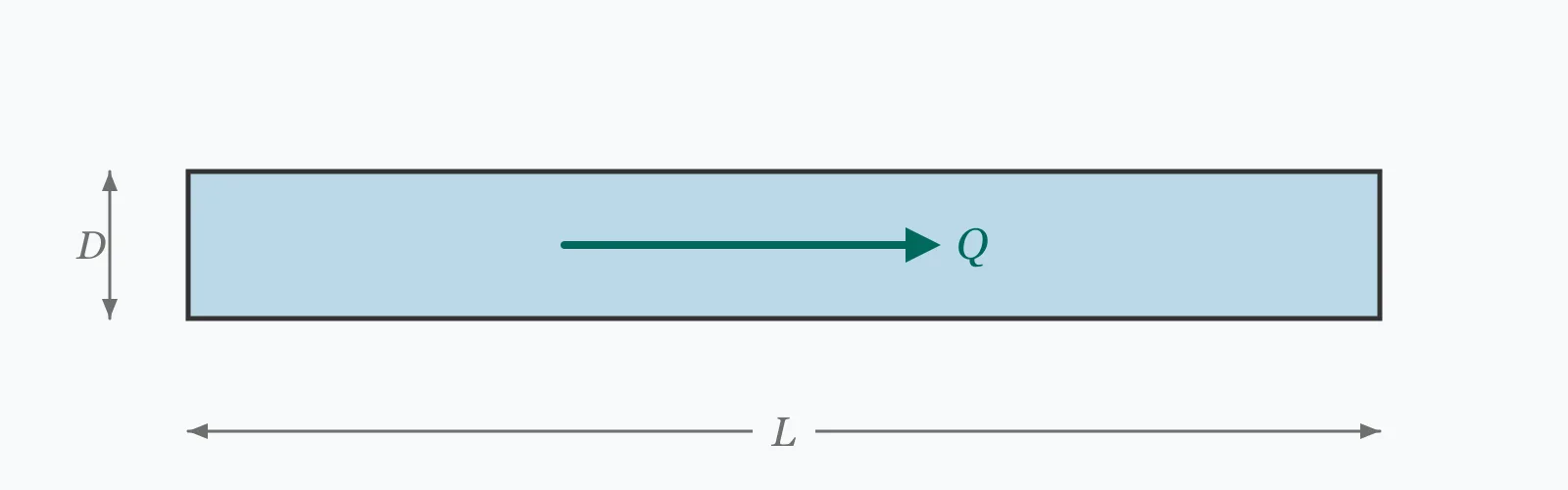
A circular culvert flowing full has a hydraulic radius of exactly D/4, which makes Manning's equation collapse to a single power law: capacity is proportional to D^(8/3). Enter the diameter, gradient, roughness and design flow to get the full-bore capacity, the velocity, the percentage of capacity used, and the diameter actually required.
Press Calculate for the full-bore capacity, the velocity at that capacity, the proportion of capacity your design flow uses, and the diameter needed to carry it. Culverts are normally sized to run no more than about 80% full.
Step-by-Step Solution
Preliminary design aid. Results follow the published formulas cited
below and are intended for estimating, study and early design. Final design must be
verified by a licensed Professional Engineer against the code in force for your project.
Key Benefits
✓Computes full-bore capacity and velocity from diameter, gradient and roughness
✓Solves the required diameter directly rather than by trial and error
✓Reports the proportion of capacity used, which is the practical design check
✓Warns on both self-cleansing and outlet scour velocity limits
✓States explicitly that inlet control must also be checked
✓Shareable links and CSV export for design records
What Is Culvert Design?
A culvert carries a watercourse or drainage flow beneath an embankment, road or railway. Hydraulically it is a short pipe that may run part full as an open channel, full as a pipe, or somewhere between depending on the flow and the headwater. This calculator treats the full-bore condition, in which Manning's equation applies with a hydraulic radius of exactly D/4 — the geometry of a full circular section makes that exact rather than approximate.
Inlet control and outlet control
A culvert's capacity is governed by whichever of two mechanisms is more restrictive. Under outlet control, the barrel itself limits the flow through friction along its length — the case computed here. Under inlet control, the entrance acts like an orifice and the barrel never fills; this governs on steep gradients and with poorly shaped entries. The two must both be checked and the design taken on the lower, because the culvert can only pass what the more restrictive mechanism allows.
Why capacity scales with D^(8/3)
Manning's equation gives V proportional to R^(2/3), and for a full pipe R = D/4, so V goes as D^(2/3). Area goes as D², and their product gives Q proportional to D^(8/3). That exponent has a practical consequence: stepping from 450 mm to 600 mm — one third more diameter — multiplies the capacity by 2.15. Where a culvert is undersized, the next standard size up usually solves it outright.
Formula
Q_full = (1/n) · (D/4)^(2/3) · S^(1/2) · (π·D²/4)
Full-bore capacity of a circular culvert by Manning's equation
Related Formulas
R = D / 4
Q ∝ D^(8/3)
D = (Q / K)^(3/8), K = π·√S / (4 · n · 4^(2/3))
Q ∝ √S
Variable Definitions
Symbol
Variable
Unit
Description
Q_full
Full-Bore Capacity
m³/s
Discharge the barrel carries when running full under outlet control.
D
Internal Diameter
mm
Bore of the culvert. Capacity scales with its eight-thirds power.
S
Gradient
m/m
Longitudinal slope of the barrel. Capacity depends on its square root.
The peak flow the culvert must carry, from the catchment analysis.
How to Use This Calculator
Enter the internal diameterConcrete pipes are specified by nominal internal diameter, but corrugated and lined products are not. Because capacity depends on D^(8/3), a 5% error in bore becomes a 13% error in capacity.
Use the barrel gradient, not the ground slopeThe gradient that matters is the fall of the culvert invert from inlet to outlet, divided by its length. It is often flatter than the watercourse it replaces, which is one reason culverts silt.
Match roughness to the actual productConcrete is 0.013, smooth-bore plastic about 0.010, and corrugated steel around 0.024 — nearly double concrete, and therefore nearly half the capacity for the same bore. Do not use a concrete value for a corrugated product.
Aim for no more than about 80% of capacityA culvert running at its theoretical full capacity has no margin for blockage, sedimentation or a storm above the design event. Blockage, not capacity, is what most often causes a culvert to flood.
Check inlet control as wellThis calculation is outlet control, where the barrel governs. On steep gradients or with a square-edged entry, the inlet governs instead and the barrel never fills. Both must be checked and the design taken on the lower capacity.
Worked Examples
Example 1
A 600 mm concrete culvert at a gradient of 1 in 100 must carry a design flow of 0.5 m³/s. Manning's n is 0.013.
Step-by-Step Solution
Full-bore area: A = π × 0.600²/4 = 0.2827 m²
Hydraulic radius: R = D/4 = 0.600/4 = 0.1500 m — exact for a full circular pipe
The design flow of 0.5 m³/s is 0.5/0.6140 = 81.4% of capacity
Diameter required for exactly 0.5 m³/s: D = (Q/K)^(3/8) = 556 mm
Interpretation: a 600 mm pipe carries the flow, but at 81.4% full it has very little margin. The next standard size, 675 or 750 mm, would bring it comfortably below the usual 80% target.
Example 2
The same 600 mm culvert laid at 1 in 500 instead of 1 in 100 — a common outcome when a culvert must match flat existing ground levels.
Step-by-Step Solution
Area and hydraulic radius are unchanged at 0.2827 m² and 0.1500 m
√S = √0.002 = 0.04472, against 0.1000 before
V = (1/0.013) × 0.2823 × 0.04472 = 0.971 m/s
Capacity: Q = 0.971 × 0.2827 = 0.2746 m³/s — less than half the design flow
The design flow is now 182% of capacity, so the culvert will surcharge and head will build up at the inlet
Capacity has fallen by exactly √5 = 2.236, because the gradient dropped by a factor of five and capacity depends on its square root.
The diameter required at this gradient rises to 751 mm, against 556 mm at 1 in 100 — an increase of only 35% in size to compensate for a fivefold reduction in slope.
That asymmetry is the practical lesson. Gradient is a weak lever, entering as a square root, while diameter is a strong one at the eight-thirds power. Where levels constrain the fall, the answer is nearly always a larger pipe rather than a search for gradient.
The velocity of 0.97 m/s is also above the 0.75 m/s self-cleansing threshold, but not by much — a flatter culvert accumulates sediment, which reduces the bore and compounds the problem.
Diameter Sensitivity
Capacity rises with the eight-thirds power of diameter, so the curve steepens sharply — this is why one standard size up so often resolves an undersized culvert. Velocity climbs much more gently, with the two-thirds power. The marker shows your current diameter.
Full-Bore Capacity vs Internal Diameter
Recomputed live from your inputs. The marker shows your current value.
Line chart of Full-Bore Capacity against Internal Diameter. The same
values are listed in the data table below.
Values plotted above, sampled across the internal diameter range.
How to Interpret Your Results
The proportion of capacity used is the practical result. A culvert at its theoretical limit is not a working design, because the limit assumes a clean barrel and exactly the design storm.
Design Flow as % of Capacity: < 50Generous capacity
The design flow uses your result% of capacity, leaving substantial margin for blockage and for events above the design storm. Consider whether a smaller size would still stay below 80%, since diameter drives the cost of the pipe, the excavation and the headwall alike.
Design Flow as % of Capacity: 50 – 80Well proportioned
At your result% of capacity the culvert has sensible margin without being oversized. This is the range most design guidance targets, precisely because it tolerates partial blockage and moderate sedimentation.
Design Flow as % of Capacity: 80 – 100Little margin
At your result% of capacity there is almost no allowance for debris, sediment or a storm larger than the design event. Because capacity scales with D^(8/3), the next standard size up typically adds 40 to 60% capacity for a modest cost increase.
Design Flow as % of Capacity: ≥ 100Undersized — will surcharge
The design flow is your result% of capacity, so the culvert cannot pass it under outlet control. Head will build at the inlet and the embankment may overtop. Use the required diameter shown, rounded up to the next standard size.
A full-bore velocity of your result m/s is below the 0.75 m/s usually required for self-cleansing. Sediment will accumulate, reducing the effective bore and compounding the capacity problem over time.
Full-Bore Velocity: ≥ 4.5Outlet scour likely
A full-bore velocity of your result m/s will scour the receiving channel at the outlet. Provide riprap, a stilling basin or another energy dissipator; outlet scour is a common cause of culvert and embankment failure.
Common Mistakes to Avoid
Checking outlet control only
Why it matters:On a steep gradient or with a square-edged entry, the inlet governs and the barrel never runs full. An outlet-control calculation then overstates the capacity, sometimes substantially, because it assumes the barrel is the constraint when the entrance is.
✓How to avoid it:Compute both and design on the lower. Improved inlets — bevelled or tapered entries — raise inlet-controlled capacity considerably for very little cost.
Sizing to exactly the design flow
Why it matters:Full-bore capacity assumes a clean barrel, an unobstructed inlet and exactly the design storm. Real culverts collect branches, gravel and litter, and the design storm is a probability, not a ceiling.
✓How to avoid it:Target no more than about 80% of capacity, and provide a debris screen where the catchment is wooded. A screen needs maintenance access, or it becomes the blockage itself.
Using a concrete roughness for corrugated pipe
Why it matters:Corrugated steel has a Manning's n around 0.024 against 0.013 for concrete. Using the concrete value overstates the capacity by about 85%, because capacity is inversely proportional to n.
✓How to avoid it:Use the roughness of the actual product, including any lining. Smooth-lined corrugated pipe sits between the two and should be taken from the manufacturer's data.
Chasing gradient on a flat site
Why it matters:Capacity depends on the square root of slope, so a fivefold increase in gradient buys only 2.24 times the capacity — often at considerable cost in excavation depth and outlet level.
✓How to avoid it:Compare against increasing the diameter, which acts at the eight-thirds power. In the example above, restoring capacity after a fivefold loss of gradient took only a 35% increase in bore.
Ignoring the outlet velocity
Why it matters:A culvert concentrates the flow of a wide channel into a small bore, so the velocity leaving it is much higher than the natural watercourse. Unprotected, that jet scours the receiving channel and undermines the headwall.
✓How to avoid it:Check the outlet velocity against the receiving channel's erosion limit and provide riprap or a stilling basin. Outlet scour undermines more culverts than insufficient capacity does.
Overlooking headwater depth
Why it matters:Capacity alone does not say how deep the water will stand at the inlet. Headwater is normally limited to a ratio of the culvert diameter — often 1.2 or 1.5 — to protect the embankment and upstream land.
✓How to avoid it:Check the headwater-to-diameter ratio against the design standard as well as the discharge. A culvert can pass the flow and still flood the land upstream.
Practical Applications
▸Sizing culverts under roads, tracks and embankments
▸Checking the capacity of an existing culvert against a revised design flow
▸Comparing pipe materials by their roughness and resulting capacity
▸Assessing the hydraulic effect of a flatter gradient
▸Screening for outlet scour and sedimentation risk
▸Estimating the diameter required before detailed design
Industry Use Cases
Highway drainage
Culverts under carriageways are sized for a design return period with a check event above it, and headwater depth is limited to protect the embankment. Blockage allowance is explicit in most highway standards because debris, not capacity, is the usual cause of failure.
Agricultural access
Field-access culverts are frequently laid at whatever gradient existing ditch levels permit, which is often very flat. Capacity then falls with the square root of slope, and the compensating measure is a larger bore rather than a deeper excavation.
Watercourse crossings
Culverts on fish-bearing streams face an additional constraint: velocity must stay low enough for passage, and the invert is often set below bed level so natural substrate forms inside. Both requirements push towards larger, flatter barrels than hydraulics alone would need.
Expert Tips
💡Capacity goes as D^(8/3) — one size up is usually the cheapest fix.
💡Capacity goes only as √S, so gradient is a weak lever.
💡Hydraulic radius of a full circular pipe is exactly D/4.
💡Design to about 80% of capacity, not 100% — blockage is the real risk.
💡Corrugated steel at n = 0.024 carries about 55% of what concrete does.
💡Check outlet velocity: scour undermines more culverts than undersizing does.
Advantages & Limitations
Advantages
✓Solves the required diameter in closed form rather than by trial and error
✓Reports the proportion of capacity used, which is the real design check
✓Warns on both the sedimentation and the scour velocity bound
✓States the inlet control limitation explicitly rather than leaving it implicit
✓Fast enough to compare sizes, gradients and materials during scheme design
Limitations
!Computes outlet control only; inlet control must be checked separately
!Assumes the barrel flows full, which is not the case at part-flow conditions
!Circular sections only — box and arch culverts need their own geometry
!Does not compute headwater depth, which is often the governing criterion
!Takes no account of entry and exit losses, bends or a skewed inlet
!Assumes free outfall; a submerged outlet reduces the effective head
!Does not model blockage, which is the commonest practical cause of failure
Standard Sizes Against a 0.5 m³/s Design Flow
Concrete culvert at 1 in 100, n = 0.013, carrying a design flow of 0.5 m³/s. Each step up in size adds capacity far faster than it adds diameter.
Concrete, 1 in 100 gradient, n = 0.013, design flow 0.5 m³/s. Going from 450 to 600 mm — a third more diameter — multiplies the capacity by 2.15. The exact diameter for 0.5 m³/s at this gradient is 556 mm, so 600 mm is the smallest standard size that passes.
For full-bore outlet control, apply Manning's equation with R = D/4: Q = (1/n)·(D/4)^(2/3)·√S·(πD²/4). A 600 mm concrete culvert at 1 in 100 carries 0.614 m³/s.
What is the difference between inlet and outlet control?
Under outlet control the barrel's friction limits the flow; under inlet control the entrance acts as an orifice and the barrel never fills. Capacity is whichever is lower, so both must be checked.
Why is the hydraulic radius of a pipe D/4?
Because area is πD²/4 and wetted perimeter is πD, so their ratio is exactly D/4. It is an exact geometric result for a full circular section, not an approximation.
How much should a culvert be oversized?
Aim for no more than about 80% of full capacity at the design flow. The margin covers partial blockage, sedimentation and storms above the design event — blockage being the commonest real cause of failure.
How does diameter affect culvert capacity?
Capacity is proportional to D^(8/3). Going from 450 to 600 mm — one third more diameter — multiplies the capacity by 2.15, which is why one standard size up so often solves an undersized culvert.
How does gradient affect capacity?
Only as the square root. Reducing the gradient from 1 in 100 to 1 in 500 — a factor of five — cuts the capacity by √5 = 2.24, and restoring it needs only a 35% larger bore.
What Manning's n should I use for a culvert?
0.013 for concrete, about 0.010 for smooth-bore plastic, and around 0.024 for corrugated steel. Corrugated pipe carries roughly 55% of what concrete of the same bore does.
What is the minimum culvert velocity?
About 0.75 m/s at full bore for self-cleansing. Below that, sediment accumulates, the effective bore shrinks and the capacity problem gets steadily worse.
What causes culvert outlet scour?
The culvert concentrates a wide channel's flow into a small bore, so the emerging jet moves much faster than the receiving channel. Above about 4.5 m/s, riprap or a stilling basin is needed, and outlet scour undermines more culverts than undersizing does.
What is headwater depth?
The depth of water standing at the culvert inlet. It is usually limited to a ratio of the diameter — often 1.2 or 1.5 — to protect the embankment and upstream land, and it can govern the design even when the discharge capacity is adequate.
Glossary
Culvert
A closed conduit carrying a watercourse or drainage flow beneath an embankment.
Outlet control
The condition where barrel friction limits capacity and the culvert flows full.
Inlet control
The condition where the entrance limits capacity and the barrel does not fill.
Full-bore capacity
The discharge a barrel carries when flowing full under outlet control.
Headwater
Depth of water at the culvert inlet, usually limited to a multiple of the diameter.
Hydraulic radius
Flow area divided by wetted perimeter; exactly D/4 for a full circular pipe.
Improved inlet
A bevelled or tapered entry that raises inlet-controlled capacity at low cost.
Outlet scour
Erosion of the receiving channel by the high-velocity jet leaving a culvert.
Self-cleansing velocity
The minimum velocity, about 0.75 m/s, that prevents sediment accumulating.
Surcharge
The condition where flow exceeds capacity and head builds up at the inlet.
Scientific & Standards References
FHWA HDS-5 — Hydraulic Design of Highway Culverts, 3rd Edition — Federal Highway Administration
CIRIA C689 — Culvert, Screen and Outfall Manual — Construction Industry Research and Information Association
Design Manual for Roads and Bridges, CD 526 — Spacing of road gullies and culvert design — National Highways
The SuDS Manual C753, Chapter on Conveyance Design — Construction Industry Research and Information Association
Conclusion
Culvert capacity under outlet control follows one power law, and the exponents are what make the design decisions obvious. Diameter enters at the eight-thirds power, so 450 mm to 600 mm multiplies the capacity by 2.15 — one standard size up nearly always resolves an undersized culvert. Gradient enters only as a square root, so a fivefold loss of fall costs a factor of 2.24 in capacity but needs just a 35% larger bore to recover. Where levels are tight, that asymmetry says to buy diameter rather than chase gradient. Two things this calculation cannot see decide as many culverts as the hydraulics do. Inlet control governs on steep gradients and with square-edged entries, and the design must take the lower of the two capacities. And blockage, not discharge, is what most often floods a culvert — which is why 80% of capacity, not 100%, is the target worth designing to.
Enter your own diameter, gradient and design flow above to size a culvert.