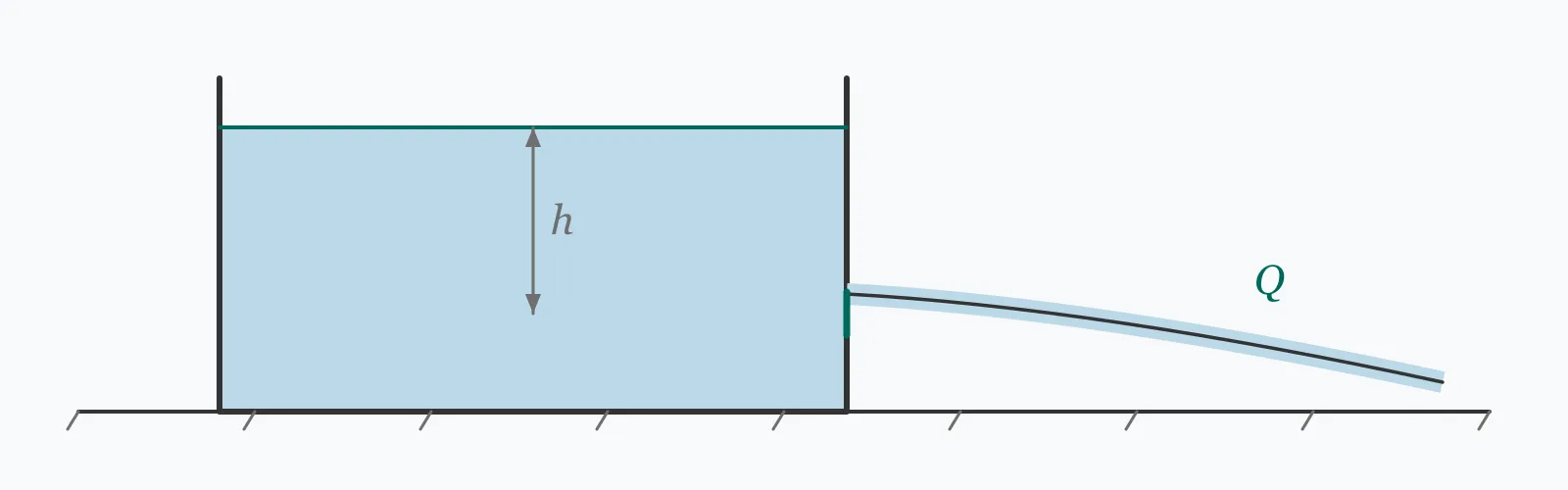
Water leaving an orifice reaches the velocity it would have after falling freely through the head above it: V = √(2gh). Enter the orifice diameter, the head and the discharge coefficient to get the flow rate, that theoretical velocity, and the actual mean velocity through the opening. Because flow depends on the square root of head, doubling the head raises the discharge by only 41%.
Calculator
Units:
mm
Diameter of the opening
m
Height of the free surface above the orifice centreline
Sharp-edged 0.62; short tube 0.80; well-rounded bellmouth 0.97
Calculation Result
Press Calculate for the orifice area, the theoretical Torricelli velocity, the actual discharge, and the mean velocity through the geometric opening. The gap between theoretical and actual velocity is the discharge coefficient at work.
Step-by-Step Solution
Preliminary design aid. Results follow the published formulas cited
below and are intended for estimating, study and early design. Final design must be
verified by a licensed Professional Engineer against the code in force for your project.
Key Benefits
✓Applies Torricelli's theorem with an explicit discharge coefficient
✓Separates theoretical velocity from the actual velocity through the opening
✓Makes the square-root relationship with head immediately visible
✓Warns when the small-orifice assumption no longer holds
✓Sensitivity chart shows the flattening discharge curve
✓Shareable links and CSV export for design records
What Is Orifice Flow?
Torricelli's theorem states that a fluid escaping through an opening reaches the same velocity a body would have after falling freely from the free surface: V = √(2gh). It follows directly from Bernoulli's equation with the pressure and velocity heads at the surface both effectively zero. Multiplying that velocity by the opening area gives the theoretical discharge, which is always more than the real one.
The vena contracta
Fluid approaching a sharp-edged hole arrives from all directions and cannot turn instantly, so the jet continues to converge after it leaves the plate, reaching its narrowest section about half a diameter downstream. That waist is the vena contracta, and its area is roughly 0.61 to 0.64 of the geometric opening. This contraction, not friction, is the main reason the discharge coefficient of a sharp-edged orifice is about 0.62.
Why square-root behaviour matters
Because Q depends on √h, an orifice responds very weakly to changes in head. Doubling the head raises the discharge by only 41%; quadrupling it doubles the discharge. As a control device this is a weakness — an orifice makes a blunt throttle — but as a limiter it is the whole point. A storage tank discharging through an orifice releases at a nearly constant rate as it drains, which is precisely the behaviour a flow attenuation device needs.
Formula
Q = Cd · A · √(2gh)
Discharge through a small orifice under head h, with discharge coefficient Cd
Related Formulas
V = √(2gh)
A = π · D² / 4
Cd = Cc · Cv
h = (Q / (Cd·A))² / 2g
Variable Definitions
Symbol
Variable
Unit
Description
Q
Discharge
L/s
Actual volumetric flow rate through the orifice.
Cd
Discharge Coefficient
—
Ratio of actual to theoretical discharge. About 0.62 for a sharp-edged hole.
A
Orifice Area
mm²
Geometric area of the opening, before any contraction of the jet.
h
Head
m
Height of the free surface above the orifice centreline.
Cc
Contraction Coefficient
—
Vena contracta area divided by geometric area, typically 0.61 to 0.64.
Cv
Velocity Coefficient
—
Actual jet velocity divided by the Torricelli velocity, typically 0.97 to 0.99.
How to Use This Calculator
Measure the head to the orifice centrelineHead is the vertical distance from the free surface to the centre of the opening, not to its top or bottom edge. For a small orifice the difference is negligible; for a large one it is not, and the calculation should then be integrated over the opening depth.
Choose the discharge coefficient from the actual geometryA sharp-edged hole in a thin plate is about 0.62. A short tube fitted to the opening rises to roughly 0.80 because the jet re-expands and fills it. A well-rounded bellmouth entry approaches 0.97. The spread between the extremes is more than 50% of the flow.
Confirm the small-orifice assumptionThe formula assumes the head is effectively uniform across the opening, which requires the head to be several times the diameter. This calculator flags cases where it is less than twice the diameter, at which point the result is only indicative.
Check that the discharge is freeTorricelli's theorem assumes the jet discharges to atmosphere. If the orifice is submerged, use the difference between the two water levels as the head instead of the depth below the upstream surface.
Remember what falling head doesAs a tank drains, the head falls and the discharge falls with its square root. The instantaneous flow this calculator gives applies at that head only — emptying time requires integrating over the drawdown.
Worked Examples
Example 1
A 50 mm sharp-edged orifice in the side of a tank discharges to atmosphere under a head of 2.0 m. The discharge coefficient is 0.62.
Step-by-Step Solution
Orifice area: A = π × 50²/4 = 1,963.5 mm² = 1.9635×10⁻³ m²
Torricelli velocity: V = √(2gh) = √(2 × 9.81 × 2.0) = √39.24 = 6.264 m/s
Actual discharge: Q = Cd × A × √(2gh) = 0.62 × 12.30 = 7.626 L/s
Mean velocity through the geometric opening: 7.626/1.9635 = 3.884 m/s
Interpretation: the jet itself moves at close to 6.2 m/s, but it occupies only about 62% of the opening at the vena contracta. The mean velocity across the full hole is correspondingly lower.
Example 2
The same orifice with the head raised from 2.0 m to 4.0 m — a doubling.
Step-by-Step Solution
Torricelli velocity: V = √(2 × 9.81 × 4.0) = √78.48 = 8.859 m/s
Compared with 7.626 L/s at 2.0 m, that is a rise of only 41.4%
The ratio is exactly √2 = 1.414, because Q is proportional to √h and the head has doubled
To double the discharge instead, the head would have to be quadrupled — from 2.0 m to 8.0 m.
This is why an orifice is a poor throttle: adjusting the flow means moving the head by the square of the change wanted.
It is also why an orifice is an excellent limiter. A stormwater attenuation tank discharging through one releases at a nearly constant rate over most of its drawdown, which is precisely the behaviour a discharge consent requires.
Head Sensitivity
Discharge follows the square root of head, so the curve rises steeply at first and then flattens markedly. This is what makes an orifice a poor throttle and a good flow limiter — a large change in head produces only a modest change in flow. The marker shows your current head.
Discharge vs Head Above Orifice
Recomputed live from your inputs. The marker shows your current value.
Line chart of Discharge against Head Above Orifice. The same
values are listed in the data table below.
Values plotted above, sampled across the head above orifice range.
How to Interpret Your Results
The discharge is the headline result, but the relationship between the two velocities tells you how much the jet is contracting, and the head-to-diameter ratio tells you whether the assumptions hold.
Discharge: < 1Low flow — restrictor scale
A discharge of your result L/s is in the range of a flow restrictor or a small drain. At this scale the orifice can block easily, so a debris screen and access for cleaning matter more than the hydraulic calculation.
Discharge: 1 – 50Typical control orifice
A discharge of your result L/s is typical of an attenuation outlet or a tank drain. Confirm the discharge coefficient matches the actual edge geometry — the difference between a sharp hole and a rounded entry is more than 50% of this figure.
Discharge: ≥ 50High flow — check the assumptions
A discharge of your result L/s implies a large opening or a high head. Verify the head is several times the orifice diameter, otherwise the small-orifice assumption fails and the pressure across the opening is far from uniform.
Torricelli Velocity: ≥ 10High jet velocity
A Torricelli velocity of your result m/s produces a jet with substantial momentum. Downstream surfaces need erosion protection, and the reaction force on the vessel is not negligible — it equals ρQV, which is often overlooked in tank restraint design.
Common Mistakes to Avoid
Omitting the discharge coefficient
Why it matters:Using Torricelli's velocity times the geometric area gives the theoretical discharge, which overstates the real flow by about 60% for a sharp-edged hole. The jet contracts after leaving the plate, so it never occupies the full opening.
✓How to avoid it:Always apply Cd. Use 0.62 for a sharp edge unless the geometry justifies otherwise; the example above would read 12.30 L/s instead of 7.63 L/s without it.
Using the same Cd for every geometry
Why it matters:The coefficient depends heavily on the edge. A sharp-edged plate gives about 0.62, a short tube around 0.80, and a well-rounded bellmouth close to 0.97 — a spread of more than 50% for the same nominal opening.
✓How to avoid it:Select the coefficient from the actual detail. Where the geometry is uncertain, the sharp-edged value is the conservative choice for capacity.
Assuming discharge is proportional to head
Why it matters:It is proportional to the square root of head. Doubling the head raises the flow by 41%, not 100%, and this catches out anyone sizing an orifice by scaling from a known duty.
✓How to avoid it:Work with √h throughout. To double the discharge, quadruple the head — or change the diameter, which acts on the flow as the square.
Applying the formula to a large orifice
Why it matters:The equation assumes uniform head across the opening. When the orifice diameter approaches the head, the top of the opening sees much less head than the bottom, and a single value of h no longer represents it.
✓How to avoid it:Where the head is less than about twice the diameter, integrate over the depth of the opening. This calculator flags that condition.
Using the depth below the surface for a submerged orifice
Why it matters:A submerged orifice discharges against a downstream water level, not against atmosphere. The driving head is the difference between the two levels, which can be a small fraction of the upstream depth.
✓How to avoid it:Use the level difference. A submerged orifice also has a slightly different discharge coefficient, typically a little lower than the free-discharge value.
Treating the discharge as constant while a tank drains
Why it matters:The head falls as the tank empties, and the discharge falls with its square root. The instantaneous flow at full head substantially overstates the average over the drawdown.
✓How to avoid it:For emptying time, integrate the discharge over the falling head. For a prismatic tank draining to empty, the time comes out at twice the volume divided by the initial flow rate.
Practical Applications
▸Sizing flow control orifices for stormwater attenuation
▸Estimating discharge from a tank or reservoir outlet
▸Designing drain-down and emergency release openings
▸Checking the capacity of an existing restrictor plate
▸Estimating leakage through a hole in a vessel or pipe
▸Sizing orifice plates for flow measurement
Industry Use Cases
Stormwater management
Attenuation tanks discharge through a deliberately undersized orifice so that the release rate meets a discharge consent. The square-root behaviour is the reason the approach works: the release rate stays within a narrow band across most of the tank's drawdown.
Process and storage tanks
Drain-down times are set by orifice size, and emptying time must be integrated over falling head rather than taken from the initial flow. For a prismatic tank the exact result is twice the volume divided by the initial discharge — a useful check on any numerical answer.
Flow measurement
Orifice plates in pipelines infer flow from the differential pressure across them, using the same square-root relationship. Their discharge coefficients are standardised and depend on Reynolds number, which is why a meter sized for design flow reads poorly at turndown.
Expert Tips
💡Discharge follows √h — doubling head gives 41% more flow, not 100%.
💡Diameter acts as the square, so it is a far stronger lever than head.
💡Sharp-edged Cd is about 0.62; a rounded bellmouth reaches 0.97.
💡The vena contracta forms about half a diameter downstream of the plate.
💡For a submerged orifice, use the difference in water levels as the head.
💡A prismatic tank empties in twice the volume divided by the initial flow rate.
Advantages & Limitations
Advantages
✓Direct application of Torricelli's theorem with an explicit, adjustable coefficient
✓Separates theoretical from actual velocity, making the contraction visible
✓Flags the head-to-diameter condition where the small-orifice assumption fails
✓Fast enough to iterate an orifice size against a target discharge
✓Simple enough to verify by hand during a design review
Limitations
!Assumes a small orifice with effectively uniform head across the opening
!Assumes free discharge to atmosphere; submerged orifices need the level difference
!Gives the instantaneous discharge at the stated head, not an average over drawdown
!The discharge coefficient must be supplied and is the largest source of uncertainty
!Does not account for the approach velocity in the vessel
!Assumes a circular opening; other shapes have different contraction behaviour
!Does not model partial blockage, which is the commonest real failure of small orifices
A 50 mm Orifice Across a Range of Heads
The same sharp-edged 50 mm opening at Cd = 0.62. Head rises by a factor of eighteen down the table; discharge rises by only a factor of four and a quarter.
50 mm sharp-edged orifice, Cd = 0.62, free discharge. Every doubling of head multiplies the discharge by exactly √2 = 1.414. Eighteen times the head buys only 4.24 times the flow — the defining behaviour of an orifice.
Q = Cd·A·√(2gh), where A is the opening area, h the head above the centreline, and Cd the discharge coefficient. A 50 mm sharp-edged orifice under 2 m of head passes 7.63 L/s.
What is Torricelli's theorem?
That fluid escaping an opening reaches the velocity it would have after falling freely through the head above it, V = √(2gh). It follows directly from Bernoulli's equation.
What is a typical discharge coefficient?
About 0.62 for a sharp-edged hole in a thin plate, around 0.80 for a short tube, and up to 0.97 for a well-rounded bellmouth entry. The edge geometry matters more than anything else.
What is the vena contracta?
The narrowest section of the jet, forming about half a diameter downstream of a sharp-edged opening. Its area is roughly 0.62 of the geometric area, which is the main reason the discharge coefficient takes that value.
Why does doubling the head not double the flow?
Because discharge is proportional to the square root of head. Doubling h multiplies the flow by √2, or 41%. Quadrupling the head is what doubles the discharge.
How does orifice diameter affect the flow?
As the square, since area is proportional to D². Doubling the diameter quadruples the flow, which makes diameter a far stronger design lever than head.
How do I calculate a tank's emptying time?
Integrate the discharge over the falling head, since the flow drops as the level does. For a prismatic tank draining fully, the result simplifies to twice the volume divided by the initial discharge.
What head do I use for a submerged orifice?
The difference between the upstream and downstream water levels, not the depth of the orifice below the upstream surface. The discharge coefficient is also slightly lower than for free discharge.
Why are orifices used for stormwater attenuation?
Because the square-root relationship makes the release rate insensitive to head. A tank discharging through an orifice releases at a nearly constant rate across most of its drawdown, which is exactly what a discharge consent requires.
When does the small orifice assumption fail?
When the head is not several times the diameter. The formula assumes uniform pressure across the opening, and once the opening is a significant fraction of the head, the top and bottom see materially different heads.
Glossary
Orifice
An opening through which fluid discharges, used for flow control or measurement.
Torricelli's theorem
That efflux velocity equals √(2gh), the free-fall velocity through the head above the opening.
Discharge coefficient
Ratio of actual to theoretical discharge, combining contraction and velocity effects.
Vena contracta
The narrowest section of the jet downstream of a sharp-edged orifice.
Contraction coefficient
Vena contracta area divided by geometric opening area, typically 0.61 to 0.64.
Velocity coefficient
Actual jet velocity divided by the theoretical Torricelli velocity, typically 0.97 to 0.99.
Submerged orifice
An orifice discharging below a downstream water level, driven by the level difference.
Bellmouth
A rounded entry that suppresses contraction and raises the discharge coefficient towards 0.97.
Attenuation
Deliberate restriction of stormwater discharge to limit the peak rate leaving a site.
Free discharge
Discharge to atmosphere, with no downstream water level influencing the flow.
Scientific & Standards References
Torricelli, E., Opera Geometrica — De Motu Aquarum (1644) — Florence, 1644
ISO 5167 — Measurement of fluid flow by means of pressure differential devices inserted in circular cross-section conduits — International Organization for Standardization
Massey, B. S., Mechanics of Fluids, 9th Edition — Chapter 3: Flow Measurement — CRC Press
CIRIA C753 — The SuDS Manual, Chapter on Flow Control Devices — Construction Industry Research and Information Association
Idelchik, I. E., Handbook of Hydraulic Resistance, 4th Edition — Begell House
Conclusion
Discharge through an orifice is Torricelli's velocity multiplied by the area and by a coefficient, and the two things worth remembering both concern how weakly it responds. Flow follows the square root of head, so eighteen times the head buys only four and a quarter times the flow — poor as a throttle, ideal as a limiter, which is why stormwater attenuation is built on it. And the discharge coefficient does more work than the geometry suggests: 0.62 for a sharp-edged hole against 0.97 for a rounded entry is a 56% difference on the same nominal opening, so the edge detail deserves more attention than the diameter tolerance. Where diameter does matter it matters twice over, acting on the flow as the square, which makes it the effective lever when an orifice needs resizing.
Enter your own diameter, head and edge geometry above to size an orifice.