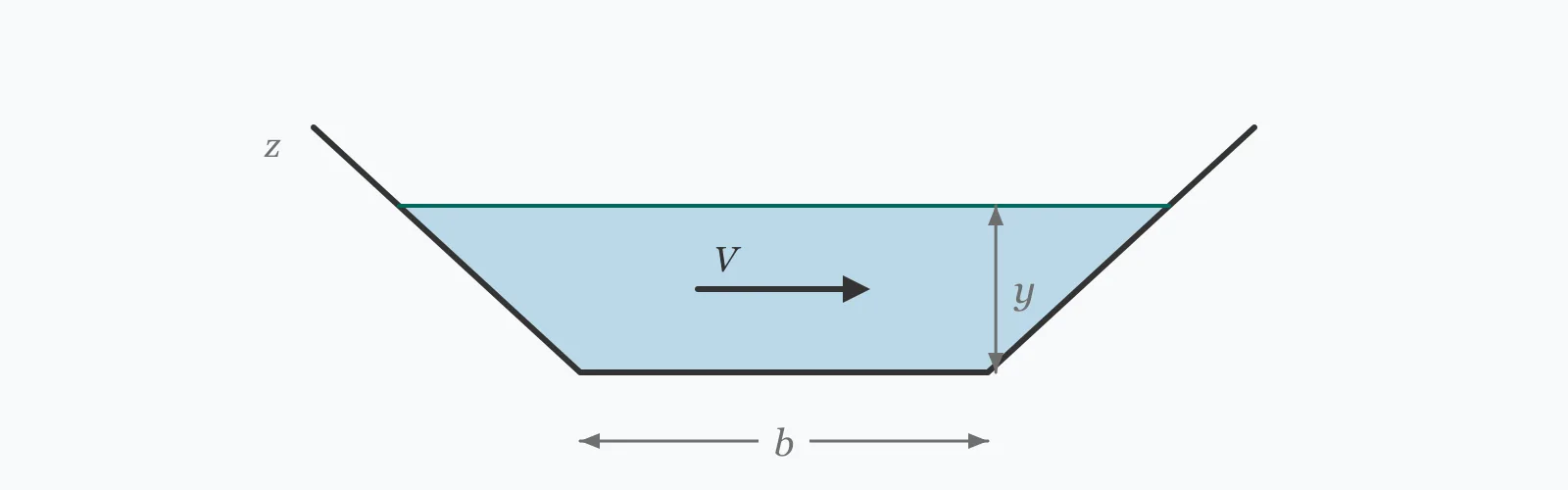
The Froude number compares the speed of the water against the speed at which a surface wave travels on it: Fr = V/√(gy). Enter the mean velocity and flow depth to get the Froude number, the flow regime, the critical depth for the same discharge, and the specific energy. Below 1 the flow is tranquil; above 1 it is rapid and cannot be influenced from downstream.
Calculator
Units:
m/s
Discharge divided by flow area
m
Depth of flow. Use hydraulic depth A/T for non-rectangular sections
Calculation Result
Press Calculate for the Froude number, the flow regime, the critical depth at the same unit discharge, and the specific energy. Fr below 1 is subcritical, above 1 supercritical, and anywhere near 1 the flow is unstable.
Step-by-Step Solution
Preliminary design aid. Results follow the published formulas cited
below and are intended for estimating, study and early design. Final design must be
verified by a licensed Professional Engineer against the code in force for your project.
Key Benefits
✓Classifies the flow regime, which governs how a channel responds to obstructions
✓Returns the critical depth for the same discharge, the reference every design uses
✓Reports specific energy, which is minimised exactly at critical depth
✓Warns where a hydraulic jump is likely and energy dissipation is needed
✓Sensitivity chart shows the specific energy curve and its minimum
✓Shareable links and CSV export for design records
What Is Froude Number?
The Froude number is the ratio of flow velocity to the celerity of a shallow-water wave: Fr = V/√(g·y). A surface disturbance travels at √(g·y) relative to the water. If the water moves more slowly than that, the wave can work its way upstream and the flow is subcritical. If the water moves faster, the wave is swept downstream and the flow is supercritical. It is the open-channel analogue of the Mach number in compressible gas flow, and the two behave in strikingly similar ways.
Why control moves from downstream to upstream
In subcritical flow, a weir, a culvert entrance or a bridge pier raises the water level for a considerable distance upstream, and the flow profile is computed working backwards from a downstream control. In supercritical flow, that influence is impossible: nothing downstream can be felt upstream, and the profile is computed forwards from an upstream control. Getting the direction wrong is not a numerical error but a modelling one — the calculation converges to a plausible but entirely wrong water surface.
Critical depth and minimum specific energy
Specific energy is E = y + V²/2g, the head measured from the channel bed. For a fixed discharge, plotting E against depth gives a curve with a single minimum, and that minimum occurs exactly at the critical depth where Fr = 1. Above it, the flow is deep and slow; below it, shallow and fast. Two quite different depths carry the same discharge at the same energy — the alternate depths — and the jump between them is the hydraulic jump.
Formula
Fr = V / √(g · y)
Froude number from mean velocity and flow depth, for a rectangular or wide channel
Related Formulas
y_c = (q² / g)^(1/3)
E = y + V² / 2g
c = √(g · y)
Fr = V / √(g · A/T)
Variable Definitions
Symbol
Variable
Unit
Description
Fr
Froude Number
—
Ratio of flow velocity to shallow-water wave celerity. Dimensionless.
V
Mean Velocity
m/s
Discharge divided by flow area, not the surface velocity.
y
Flow Depth
m
Depth of flow. For non-rectangular sections use the hydraulic depth A/T.
y_c
Critical Depth
m
The depth at which Fr = 1 for the same discharge, and specific energy is minimised.
q
Unit Discharge
m²/s
Discharge per unit width, equal to V·y.
E
Specific Energy
m
Depth plus velocity head, measured from the channel bed.
How to Use This Calculator
Use the mean velocityFroude number is defined on the cross-sectional mean velocity, discharge divided by flow area. Surface velocity in an open channel is typically 15 to 20% higher than the mean, and using it would push a marginal flow across the critical threshold.
Use hydraulic depth for non-rectangular sectionsFor a trapezoidal, triangular or circular channel, substitute the hydraulic depth A/T — flow area divided by top width — rather than the maximum depth. In a trapezoidal channel the two differ substantially, and using the maximum depth understates the Froude number.
Read the regime before computing a profileThe regime determines the direction of computation. Subcritical profiles are computed upstream from a downstream control; supercritical profiles downstream from an upstream control. Getting this backwards produces a converged but wrong answer.
Compare the depth to the critical depth reportedThe critical depth shown is for the same unit discharge as your input. A flow depth above it confirms subcritical, below it confirms supercritical — and how far away it is tells you how much margin the design has.
Treat a near-critical result as a design problemFlow within a few percent of Fr = 1 is unstable: the surface oscillates, standing waves form, and small changes in depth cause large changes in energy. Adjust the slope or the section so the channel runs clearly on one side.
Worked Examples
Example 1
A drainage channel carries water at a mean velocity of 1.2 m/s at a depth of 0.8 m. Classify the flow and find its critical depth.
Step-by-Step Solution
Wave celerity: c = √(g·y) = √(9.81 × 0.8) = √7.848 = 2.801 m/s
Fr = V/c = 1.2 / 2.801 = 0.428
Fr = 0.428 is below 1, so the flow is subcritical — tranquil, and controlled from downstream
Specific energy: E = y + V²/2g = 0.8 + 1.44/19.62 = 0.8 + 0.073 = 0.873 m
Interpretation: at 0.8 m the flow runs well above the critical depth of 0.455 m, so a weir or culvert downstream will make its influence felt upstream. There is comfortable margin from the unstable region around Fr = 1.
Example 2
The same discharge passing down a steep chute, where it has accelerated to 3.2 m/s and thinned to 0.3 m depth. The unit discharge is unchanged at 0.96 m²/s.
Step-by-Step Solution
Wave celerity: c = √(9.81 × 0.3) = √2.943 = 1.716 m/s
Fr = 3.2 / 1.716 = 1.865 — supercritical
Critical depth is unchanged at 0.455 m, because the unit discharge has not changed
The flow is now at 0.3 m, below the critical depth of 0.455 m, confirming the classification
Specific energy: E = 0.3 + 3.2²/19.62 = 0.3 + 0.522 = 0.822 m
Note that the specific energy has fallen from 0.873 m to 0.822 m — but the depth has fallen from 0.8 m to 0.3 m. The same discharge now carries almost the same energy in a very different form: mostly velocity head instead of mostly depth.
At the critical depth of 0.455 m the specific energy would be 0.682 m, the minimum possible for this discharge. Both the deep and the shallow states carry more energy than that.
Where this supercritical flow meets a subcritical reach it will form a hydraulic jump, dissipating the excess energy in turbulence. A stilling basin or apron is needed at that point, or the channel bed will scour.
Depth Sensitivity
Sweeping depth at fixed velocity. The Froude number falls as depth grows, crossing 1 where the flow turns tranquil. Note that this sweep holds velocity constant rather than discharge, so the critical depth line moves with it — the classic specific energy curve is drawn at fixed discharge instead. The marker shows your current depth.
Froude Number vs Flow Depth
Recomputed live from your inputs. The marker shows your current value.
Line chart of Froude Number against Flow Depth. The same
values are listed in the data table below.
Values plotted above, sampled across the flow depth range.
How to Interpret Your Results
The Froude number classifies the flow and, with it, how the channel behaves. The distance from 1 matters as much as the side — flow close to critical is unstable regardless of which way it leans.
Froude Number: < 0.5Comfortably subcritical
Fr = your result is well below 1, so the flow is tranquil. Disturbances travel upstream, the water surface is stable, and the profile is controlled from downstream. This is the normal condition for rivers, drains and most designed channels.
Fr = your result is still subcritical but with less margin. Local features such as a contraction, a bend or a bed rise can push the flow through critical, so check the section at any obstruction rather than only in the uniform reach.
Froude Number: 0.9 – 1.1Near critical — unstable
Fr = your result is close to critical. Flow here is inherently unstable: the surface oscillates, standing waves form, and small changes in depth produce large changes in energy. Adjust the slope or the section so the channel runs clearly on one side of Fr = 1.
Froude Number: 1.1 – 1.7Weakly supercritical
Fr = your result is supercritical, so nothing downstream can influence this flow and the profile must be computed forwards. A jump back to subcritical here would be an undular one, dissipating little energy but generating persistent surface waves.
Fr = your result carries substantial excess energy. Where this flow meets a subcritical reach it will form a strong hydraulic jump, dissipating energy violently. Provide a stilling basin, baffle blocks or an apron, or the bed will scour at the transition.
Common Mistakes to Avoid
Using maximum depth for a non-rectangular channel
Why it matters:The Froude number is defined on the hydraulic depth A/T, area over top width. In a trapezoidal channel with sloping sides the hydraulic depth is noticeably less than the maximum depth, so using the latter understates Fr and can classify a near-critical flow as comfortably subcritical.
✓How to avoid it:Compute A/T and use that. Only for a wide rectangular channel are the two effectively equal.
Computing a supercritical profile from downstream
Why it matters:In supercritical flow no disturbance can travel upstream, so a downstream boundary condition cannot control the profile. The calculation may still converge, but to a water surface that does not exist.
✓How to avoid it:Check the regime first, then choose the direction: subcritical backwards from downstream, supercritical forwards from upstream. Mixed-regime reaches need both, joined by a jump.
Designing a channel to run at critical depth
Why it matters:It looks efficient — critical depth minimises the specific energy for a given discharge — but flow at Fr = 1 is unstable. The surface oscillates, standing waves form, and the depth becomes very sensitive to small changes in energy.
✓How to avoid it:Design clearly either side, conventionally outside Fr = 0.9 to 1.1. Critical depth is a useful reference for computation, not an operating point.
Overlooking a hydraulic jump at a regime change
Why it matters:Supercritical flow entering a subcritical reach must jump, and the jump dissipates energy through intense turbulence. Unprotected, it scours the bed and undermines the structure that created it.
✓How to avoid it:Locate the jump and design a stilling basin, apron or baffle blocks for it. The energy loss across a strong jump can exceed half the incoming energy — that has to go somewhere.
Using surface velocity from a float measurement
Why it matters:Surface velocity in an open channel exceeds the cross-sectional mean by roughly 15 to 20%, because of the velocity profile. Substituting it inflates the Froude number by the same margin.
✓How to avoid it:Apply the usual 0.85 float coefficient, or measure at 0.6 of the depth where the local velocity approximates the mean.
Confusing the Froude number with the Reynolds number
Why it matters:Both are dimensionless flow ratios, but they answer different questions. Froude compares inertia against gravity and governs free-surface behaviour; Reynolds compares inertia against viscosity and governs whether flow is laminar or turbulent.
✓How to avoid it:Use Froude for open channels and anything with a free surface, and Reynolds for pipe friction and regime. Open channel flow is almost always turbulent, so Reynolds rarely determines anything there.
Practical Applications
▸Classifying open channel flow before computing a water surface profile
▸Locating hydraulic jumps and sizing stilling basins
▸Checking spillway and chute design for stable flow
▸Assessing whether a channel section runs too near critical
▸Determining critical depth as a control section for gauging
▸Scaling physical hydraulic models by Froude similarity
Industry Use Cases
Drainage and flood design
Urban drainage channels are designed subcritical so that downstream controls govern the profile and the surface stays stable. Where a steep reach forces supercritical flow, the transition back is located deliberately and protected, rather than left to happen at a random point.
Dam and spillway engineering
Spillway chutes run strongly supercritical by design, and the stilling basin at the toe exists solely to force and contain the hydraulic jump. Basin length and baffle geometry are selected from the incoming Froude number, which is why it is computed at the toe rather than anywhere else.
Hydraulic modelling
Free-surface physical models are scaled by matching the Froude number rather than the Reynolds number, because gravity dominates the behaviour being reproduced. Velocities in a 1:25 model then scale by the square root of 25, or a factor of five.
Expert Tips
💡Fr < 1 tranquil and controlled from downstream; Fr > 1 rapid and controlled from upstream.
💡Specific energy is minimised exactly at critical depth — no discharge can pass on less.
💡Use hydraulic depth A/T, not maximum depth, for any non-rectangular section.
💡Design outside Fr = 0.9 to 1.1; near-critical flow is unstable regardless of which side.
💡Surface velocity runs 15 to 20% above the mean — do not use it directly.
💡A strong jump can dissipate more than half the incoming energy; plan where it happens.
Advantages & Limitations
Advantages
✓Classifies the flow, which determines the direction of every profile computation
✓Returns critical depth at the same discharge as a direct comparison point
✓Reports specific energy, connecting the classification to the energy curve
✓Warns explicitly about the near-critical band and about likely jumps
✓Applies to any free-surface flow, and underpins Froude scaling of physical models
Limitations
!Assumes a rectangular or wide channel; other sections need hydraulic depth A/T
!Assumes the pressure distribution is hydrostatic, which fails on steeply curved streamlines
!Gives no information about where a hydraulic jump will occur, only that one is likely
!Does not compute the sequent depth or the energy loss across a jump
!Takes no account of air entrainment, which bulks the flow at high Froude numbers
!Assumes steady flow; unsteady waves and surges need a different treatment
!The critical depth returned is for a rectangular section at the same unit discharge
One Discharge, Five Depths
The same unit discharge of 0.96 m²/s carried at different depths. Notice the specific energy column: it falls to a minimum exactly at the critical depth of 0.455 m and rises again on both sides. No channel can pass this discharge on less than 0.682 m of energy.
Unit discharge q = 0.96 m²/s held constant, rectangular channel. The 0.30 m and 0.60 m rows carry almost the same specific energy — 0.822 against 0.730 m — at radically different depths. Pairs like these are the alternate depths, and the hydraulic jump is the transition from the shallow one to the deep one.
The ratio of flow velocity to the speed of a shallow-water surface wave, Fr = V/√(g·y). It determines whether disturbances can travel upstream, and therefore how an open channel behaves.
What does a Froude number less than 1 mean?
Subcritical or tranquil flow. The water moves more slowly than its own surface waves, so a weir or obstruction downstream raises the level upstream, and the profile is controlled from downstream.
What is supercritical flow?
Flow with Fr greater than 1, where the water outruns its surface waves. Nothing downstream can influence it, the surface is typically shallow and fast, and returning to subcritical requires a hydraulic jump.
What is critical depth?
The depth at which Fr = 1 for a given discharge. It is also the depth at which specific energy is minimised — no channel can pass that discharge with less energy than at critical depth.
How do I calculate critical depth?
For a rectangular channel, yc = (q²/g)^⅓ where q is the discharge per unit width. A unit discharge of 0.96 m²/s gives a critical depth of 0.455 m.
What is a hydraulic jump?
The abrupt transition from supercritical to subcritical flow, in which depth increases suddenly and a large amount of energy is dissipated in turbulence. Stilling basins exist to contain it and protect the bed from scour.
What is specific energy?
Depth plus velocity head, E = y + V²/2g, measured from the channel bed rather than a fixed datum. For a fixed discharge it has a minimum at critical depth, and two different depths share every value above the minimum.
Why should channels not be designed at critical depth?
Because flow at Fr = 1 is unstable. The surface oscillates, standing waves form, and depth becomes extremely sensitive to small changes in energy. Design clearly outside about Fr = 0.9 to 1.1.
What is the difference between the Froude and Reynolds numbers?
Froude compares inertia against gravity and governs free-surface behaviour; Reynolds compares inertia against viscosity and governs whether flow is laminar or turbulent. Open channel flow is almost always turbulent, so Froude is the one that decides the design.
Why are hydraulic models scaled by Froude number?
Because gravity dominates free-surface flow, so matching the Froude number reproduces the behaviour of interest. Reynolds similarity cannot be achieved at the same time in a reduced-scale model, and Froude is the one that matters for waves and jumps.
Glossary
Froude number
Ratio of flow velocity to shallow-water wave celerity, V/√(gy).
Subcritical flow
Tranquil flow with Fr < 1, controlled from a downstream section.
Supercritical flow
Rapid flow with Fr > 1, controlled from an upstream section.
Critical depth
The depth at which Fr = 1 and specific energy is minimised for a given discharge.
Specific energy
Depth plus velocity head, measured from the channel bed.
Alternate depths
The two depths, one subcritical and one supercritical, carrying the same discharge at the same specific energy.
Hydraulic jump
The abrupt supercritical-to-subcritical transition, dissipating energy in turbulence.
Sequent depth
The depth downstream of a hydraulic jump, paired with the supercritical depth upstream.
Hydraulic depth
Flow area divided by top width, A/T — the depth used for non-rectangular sections.
Celerity
The speed at which a surface wave propagates relative to the water, √(gy) in shallow water.
Scientific & Standards References
Chow, V. T., Open-Channel Hydraulics — Chapters 1 to 3: Basic Principles and Energy — McGraw-Hill
Henderson, F. M., Open Channel Flow — Chapter 2: The Energy Principle — Macmillan
USBR Engineering Monograph No. 25 — Hydraulic Design of Stilling Basins and Energy Dissipators — US Bureau of Reclamation
Chanson, H., The Hydraulics of Open Channel Flow: An Introduction, 2nd Edition — Butterworth-Heinemann
EN 1991-1-6 and CIRIA C689 — Culvert, Screen and Outfall Manual — Construction Industry Research and Information Association
Conclusion
The Froude number answers one question — can a disturbance travel upstream — and everything else in open channel design follows from the answer. Below 1 the flow is tranquil and controlled from downstream; above 1 it is rapid and controlled from upstream, and computing the profile in the wrong direction gives a converged but fictional water surface. Critical depth, where Fr = 1, is the natural reference point because specific energy is minimised there: the table above shows 0.682 m as the least energy that can carry a unit discharge of 0.96 m²/s, with both the deep and the shallow state costing more. Two practical rules follow. Design clearly away from Fr = 1, because near-critical flow oscillates and is very sensitive to small energy changes. And wherever supercritical flow must return to subcritical, decide where the hydraulic jump happens and protect that spot, because a strong jump can dissipate more than half the incoming energy.
Enter your own velocity and depth above to classify the flow and find its critical depth.