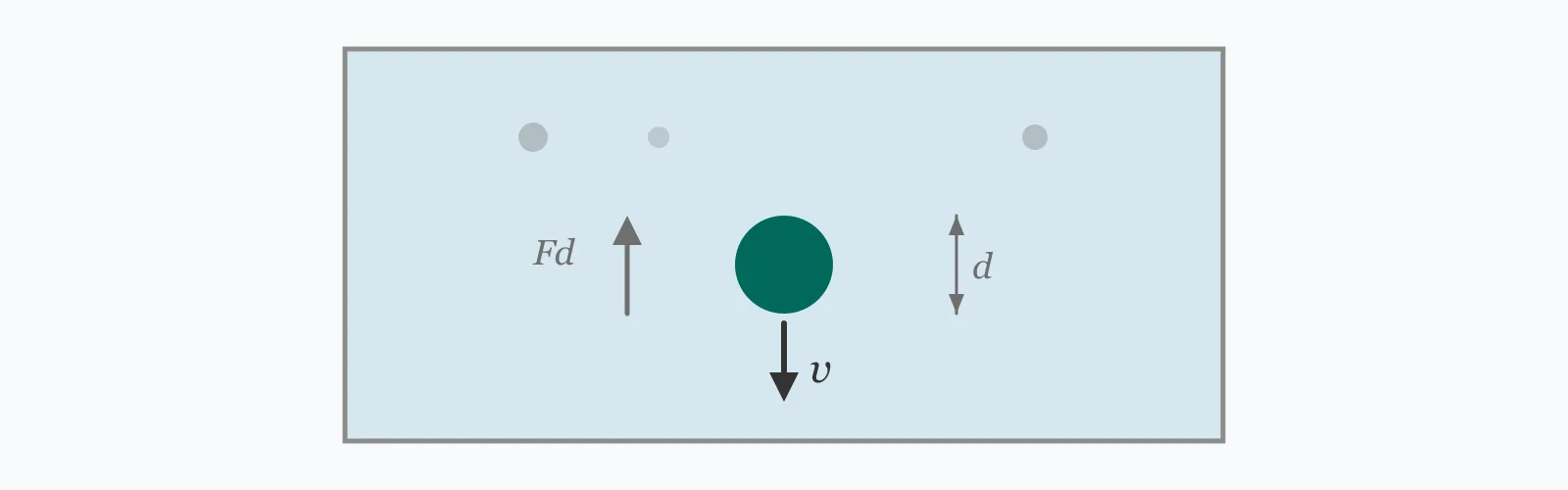
Stokes' law gives the terminal velocity of a small particle as v = g·d²·Δρ/(18μ) — proportional to the square of diameter. Enter the particle size and density, the fluid properties and a tank depth to get the settling velocity, the Stokes value for comparison, the particle Reynolds number, and the time to settle. Beyond Re 1 the drag law changes and the calculator solves it iteratively.
Calculator
Units:
mm
Equivalent spherical diameter. Fine sand 0.1, silt 0.01, clay 0.002
kg/m³
Quartz sand 2650; alum floc 1010 to 1100; grit 2600
kg/m³
Water at 20 °C is 998 kg/m³
Pa·s
Water: 0.001 at 20 °C, 0.00131 at 10 °C, 0.00055 at 50 °C
m
Depth the particle must fall through
Calculation Result
Press Calculate for the settling velocity, the Stokes value for comparison, the particle Reynolds number, and the time to settle through the depth entered. Where the Reynolds number exceeds 1, the drag-corrected velocity is the one to use.
Step-by-Step Solution
Preliminary design aid. Results follow the published formulas cited
below and are intended for estimating, study and early design. Final design must be
verified by a licensed Professional Engineer against the code in force for your project.
Key Benefits
✓Applies Stokes' law and reports where it stops being valid
✓Solves the drag balance iteratively beyond Re 1, so the answer stays correct
✓Shows both values side by side, making the Stokes error visible
✓Converts directly to a settling time for a given tank depth
✓Sensitivity chart shows the squared dependence on particle size
✓Shareable links and CSV export for design records
What Is Settling Velocity?
A particle released in a still fluid accelerates until the drag on it balances its submerged weight, after which it falls at a constant terminal velocity. For a small sphere in slow flow, drag is purely viscous and the balance solves analytically to give Stokes' law: v = g·d²·(ρs − ρf)/(18μ). The squared dependence on diameter is the dominant feature — halving the particle size quarters the settling velocity.
Where Stokes' law stops working
Stokes' law assumes the flow around the particle is entirely viscous, which holds only while the particle Reynolds number stays below about 1. Above that, inertia contributes to the drag, and the real velocity falls behind the Stokes prediction — by 12% at Re 0.8, but by 148% for a 0.5 mm sand grain at Re 45. Using Stokes alone for anything sand-sized gives an answer that is not merely imprecise but wrong by a factor of two or more.
Why fine particles need coagulation
Because velocity goes as the square of size, the range across natural particles is enormous. In the same three-metre tank, a 0.5 mm sand grain settles in 33 seconds, a 0.1 mm grain in 6 minutes, a 10 micron silt particle in over 9 hours, and a 5 micron particle in 37 hours. No sedimentation tank can be built with a residence time of days, so water treatment adds coagulants to bind fine particles into flocs hundreds of times larger — buying settling velocity through size rather than through tank volume.
Formula
v = g · d² · (ρs − ρf) / (18μ)
Stokes' law for terminal settling velocity, valid while the particle Reynolds number is below 1
Related Formulas
Re_p = ρf · v · d / μ
v = √(4·g·d·Δρ / (3·Cd·ρf))
Cd = 24/Re + 3/√Re + 0.34
t = h / v
Variable Definitions
Symbol
Variable
Unit
Description
v
Settling Velocity
mm/s
Terminal velocity at which drag balances submerged weight.
d
Particle Diameter
mm
Equivalent spherical diameter. Velocity scales with its square in the Stokes range.
ρs
Particle Density
kg/m³
2650 for quartz sand; 1050 to 1100 for organic flocs.
ρf
Fluid Density
kg/m³
998 for water at 20 °C.
μ
Dynamic Viscosity
Pa·s
0.001 for water at 20 °C. Roughly halves between 20 and 50 °C.
Re_p
Particle Reynolds Number
—
ρf·v·d/μ. Stokes' law is valid only below about 1.
How to Use This Calculator
Use an equivalent spherical diameterReal particles are not spheres, and irregular or plate-like shapes settle more slowly than a sphere of the same volume. Use a sieve or sedimentation diameter where one is available, and treat the result as an upper bound for angular material.
Use the density difference that actually appliesSettling velocity depends on the difference between particle and fluid density, not on the particle density alone. An alum floc at 1050 kg/m³ in water at 998 has a density difference of only 52 — about 3% of a sand grain's — which is why flocs settle so slowly for their size.
Set viscosity at the operating temperatureVelocity is inversely proportional to viscosity, and water's viscosity rises by 31% between 20 and 10 °C. A settlement tank that performs adequately in summer can fall short in winter for that reason alone.
Check the Reynolds number against 1Below 1, Stokes' law and the drag-corrected result agree. Above it they separate quickly, and the corrected figure is the one to use. The calculator reports both so the size of the discrepancy is visible.
Treat the settling time as an idealThe time given assumes still water and a single particle falling freely. Real tanks have inlet turbulence, short-circuiting currents and hindered settling at high solids concentration, all of which make actual performance worse than the calculation.
Worked Examples
Example 1
A fine sand grain 0.1 mm across, density 2650 kg/m³, settling in still water at 20 °C through a 3 m deep tank.
Interpretation: fine sand settles readily. A tank with six minutes of quiescent residence time will remove this fraction, which is why grit removal is a straightforward unit process.
Example 2
A coarser grain, 0.5 mm across — five times the diameter, and well outside the Stokes range.
Step-by-Step Solution
Stokes' law would give v = 9.81 × (0.0005)² × 1652 / 0.018 = 225.1 mm/s
That is 25 times the 0.1 mm value, exactly as the squared law predicts for five times the diameter
But the particle Reynolds number at that velocity would be far above 1, so the drag law no longer applies
Solving the full force balance iteratively gives 90.7 mm/s at Re = 45.3
Stokes overstates the velocity by 148% — a factor of 2.5, not a rounding error
The real ratio to the 0.1 mm grain is 11.3, not 25. Beyond Stokes the dependence on diameter weakens from the square towards roughly the square root.
Settling time: 3.0 / 0.0907 = 33 s, against 374 s for the 0.1 mm grain.
The practical lesson is that Stokes' law is a fine-particle law. For anything sand-sized it should be used only as a first estimate, and the Reynolds number checked before the number is relied on.
Particle Size Sensitivity
Settling velocity rises steeply with particle size — as the square of diameter while Stokes' law holds. Compare the two velocity series to see where they diverge: they agree below Re 1 and separate rapidly above it. The marker shows your current particle size.
Settling Velocity vs Particle Diameter
Recomputed live from your inputs. The marker shows your current value.
Line chart of Settling Velocity against Particle Diameter. The same
values are listed in the data table below.
Values plotted above, sampled across the particle diameter range.
How to Interpret Your Results
The settling velocity determines whether sedimentation is a practical removal mechanism at all. The particle Reynolds number tells you whether Stokes' law was entitled to produce the answer.
Settling Velocity: < 0.05Effectively non-settling
A settling velocity of your result mm/s means this particle will not be removed by sedimentation in any practical tank. Coagulation to build larger flocs, or filtration, is the appropriate mechanism. Brownian motion and surface charge also become significant at this scale.
Settling Velocity: 0.05 – 1Slow settling — long residence needed
At your result mm/s the residence time required is measured in hours. This is the silt and fine floc range, where lamella plates or tube settlers are used to increase the effective settling area without increasing tank volume.
Settling Velocity: 1 – 20Readily settleable
A settling velocity of your result mm/s removes well in a conventional sedimentation tank. This is the fine sand and grit range, and the corresponding surface overflow rate is a practical design figure.
Settling Velocity: ≥ 20Rapid settling
At your result mm/s the particle drops out almost immediately. Removal is not the difficulty — the concern shifts to abrasion of pumps and pipework, and to keeping the material in suspension where it needs to be transported.
Particle Reynolds Number: ≥ 1Outside the Stokes range
A particle Reynolds number of your result is above 1, so Stokes' law does not apply. The drag-corrected velocity is shown alongside the Stokes value; the difference between them is how wrong the simple formula would have been.
Common Mistakes to Avoid
Applying Stokes' law to sand-sized particles
Why it matters:Stokes' law is valid only below a particle Reynolds number of about 1. For a 0.5 mm grain the Reynolds number is 45 and Stokes overstates the velocity by 148% — a factor of two and a half, not a correction.
✓How to avoid it:Always compute the Reynolds number at the resulting velocity. Where it exceeds 1, solve the full drag balance, as this calculator does.
Using particle density instead of the density difference
Why it matters:Settling is driven by submerged weight, which depends on ρs − ρf. An alum floc at 1050 kg/m³ looks dense until the 998 of water is subtracted, leaving a difference of 52 — about 3% of a sand grain's.
✓How to avoid it:Use the difference. This is why flocs settle so slowly despite being large, and why floc density rather than floc size is often the limiting factor.
Ignoring temperature
Why it matters:Velocity is inversely proportional to viscosity, and water's viscosity rises 31% from 20 °C to 10 °C. A tank sized on summer conditions loses roughly a quarter of its settling velocity in winter.
✓How to avoid it:Design on the coldest expected water temperature. This is a routine cause of settlement tanks underperforming seasonally.
Assuming particles are spheres
Why it matters:Angular, plate-like and fibrous particles settle more slowly than a sphere of the same volume, because they present more drag area and tend to orient broadside to the flow. The error can exceed 50% for platy clays.
✓How to avoid it:Use a sedimentation diameter where available, or treat the spherical result as an upper bound. For flocs, settling column tests are more reliable than any formula.
Reading the settling time as a design residence time
Why it matters:The calculation assumes still water and one particle falling freely. Real tanks have inlet momentum, density currents, wind shear and short-circuiting, and at high solids concentration particles interfere with one another and settle more slowly still.
✓How to avoid it:Apply a performance factor, or design on surface overflow rate rather than residence time. Overflow rate is the more robust criterion because it is independent of tank depth.
Expecting sedimentation to remove fine particles
Why it matters:A 5 micron particle takes 37 hours to fall 3 m. No practical tank offers that residence time, and below about 1 micron Brownian motion and surface charge keep particles suspended indefinitely.
✓How to avoid it:Coagulate to build larger, faster-settling flocs, or filter. Buying settling velocity through particle size is far cheaper than buying it through tank volume.
Practical Applications
▸Sizing sedimentation tanks and clarifiers
▸Designing grit chambers and stormwater settlement basins
▸Assessing whether coagulation is needed for a given particle size
▸Estimating sediment transport and deposition in channels
▸Checking settling performance across seasonal temperature variation
▸Analysing particle size distribution by sedimentation
Industry Use Cases
Water treatment
Raw water particles are mostly too fine to settle in any practical time, so coagulation binds them into flocs hundreds of times larger. Floc density is low, so the gain comes from size — and settling column tests are used because floc behaviour is not reliably predicted by formula.
Wastewater and stormwater
Grit chambers are designed to remove the sand fraction while passing organic solids to the biological stage, which is a settling velocity distinction rather than a size one. The density difference between sand at 2650 and organics near 1050 is what makes the separation possible.
Mineral processing
Hydraulic classification separates particles by settling velocity, which combines size and density. Two particles of different minerals can settle at the same rate, which is why classification and gravity concentration are distinct operations.
Expert Tips
💡Velocity goes as diameter squared while Stokes holds — halving size quarters velocity.
💡Always check the particle Reynolds number; Stokes is valid only below about 1.
💡It is the density difference that drives settling, not the particle density.
💡Water's viscosity rises 31% from 20 °C to 10 °C, slowing settling by about a quarter.
💡A 5 micron particle takes 37 hours to fall 3 m — coagulate rather than build bigger tanks.
💡Design clarifiers on surface overflow rate, which is independent of tank depth.
Advantages & Limitations
Advantages
✓Reports the Stokes value and the corrected value together, showing the error directly
✓Stays accurate beyond Re 1, where the simple formula fails badly
✓Converts to a settling time for a stated depth, which is the practical output
✓Works for any particle and fluid through their densities and viscosity
✓Makes the seasonal temperature effect easy to test
Limitations
!Assumes spherical particles; irregular shapes settle more slowly
!Assumes a single particle in still fluid — hindered settling at high concentration is slower
!Takes no account of inlet turbulence, density currents or short-circuiting in real tanks
!Does not model flocculation, where particles grow while settling
!Brownian motion and surface charge dominate below about 1 micron and are not included
!The drag correlation is for a smooth sphere and is approximate above Re 200,000
!Gives an ideal settling time, not a design residence time
How Far Particle Size Reaches
Quartz particles at 2650 kg/m³ settling in still water at 20 °C through 3 m. A two hundred-fold range in size produces a nearly eight thousand-fold range in settling velocity — and shows where Stokes' law parts company with reality.
Quartz in water at 20 °C, 3 m depth. Stokes and the corrected value agree to within 0.4% in the top two rows and diverge by a factor of 5.1 in the bottom one. The Reynolds number column shows exactly where the assumption breaks: agreement holds while it stays below about 0.1.
The analytical solution for the terminal velocity of a small sphere in viscous flow: v = g·d²·(ρs − ρf)/(18μ). It is exact while the particle Reynolds number stays below about 1.
How do I calculate settling velocity?
Use Stokes' law for fine particles, then check the Reynolds number. If it exceeds 1, solve the full drag balance instead — this calculator does both and shows the difference.
When does Stokes' law stop being valid?
Above a particle Reynolds number of about 1. For quartz in water that corresponds to a diameter around 0.1 mm, above which the error grows quickly — 148% at 0.5 mm and a factor of five at 1 mm.
How fast does sand settle in water?
Fine sand at 0.1 mm settles at about 8 mm/s, taking six minutes to fall 3 m. Medium sand at 0.5 mm settles at about 91 mm/s, clearing the same depth in half a minute.
Why do fine particles take so long to settle?
Because velocity scales with the square of diameter. A 5 micron particle settles about 360 times more slowly than a 0.1 mm one, taking 37 hours to fall 3 m against 6 minutes — which is beyond any practical tank.
Why is coagulation used in water treatment?
To bind fine particles into flocs hundreds of times larger, buying settling velocity through size. It is far cheaper than providing the tank volume that would otherwise be needed for the same removal.
Does temperature affect settling?
Yes, through viscosity. Water is 31% more viscous at 10 °C than at 20 °C, so settling velocity falls by roughly a quarter. Settlement tanks routinely perform worse in winter for this reason.
Why do flocs settle slowly despite being large?
Because settling depends on the density difference, and flocs are mostly water. An alum floc at 1050 kg/m³ has a density difference of only 52 against water's 998 — about 3% of a sand grain's.
What is hindered settling?
At high solids concentration, particles interfere with one another and with the upward displacement of fluid, so the whole suspension settles more slowly than any single particle would. This calculation assumes an isolated particle.
What is surface overflow rate?
Flow divided by tank surface area, in metres per hour, which is dimensionally a velocity. Particles settling faster than it are removed, so it is the more robust design criterion — and unlike residence time it does not depend on tank depth.
Glossary
Settling velocity
The constant terminal velocity at which drag balances a particle's submerged weight.
Stokes' law
The analytical settling velocity for a sphere in purely viscous flow, valid below Re 1.
Particle Reynolds number
ρf·v·d/μ, the check on whether Stokes' law applies to a given particle.
Drag coefficient
Dimensionless resistance of a body to flow around it; 24/Re in the Stokes range.
Terminal velocity
The steady velocity reached once drag equals submerged weight.
Coagulation
Chemical destabilisation of fine particles so they bind into larger, faster-settling flocs.
Floc
An aggregate of fine particles, large but of low density because it is mostly water.
Hindered settling
Slower settling at high solids concentration, where particles interfere with one another.
Surface overflow rate
Flow divided by tank surface area — a velocity, and the primary clarifier design criterion.
Grit chamber
A tank sized to remove dense inorganic particles while passing lighter organic solids.
Scientific & Standards References
Stokes, G. G., On the Effect of the Internal Friction of Fluids on the Motion of Pendulums, Transactions of the Cambridge Philosophical Society (1851) — Cambridge Philosophical Society
Clift, R., Grace, J. R. and Weber, M. E., Bubbles, Drops and Particles — Academic Press
Metcalf & Eddy, Wastewater Engineering: Treatment and Resource Recovery, 5th Edition — Chapter 5: Physical Unit Operations — McGraw-Hill
Cheng, N.-S., Simplified Settling Velocity Formula for Sediment Particle, Journal of Hydraulic Engineering (1997) — American Society of Civil Engineers
AWWA, Water Treatment Plant Design, 5th Edition — Sedimentation — American Water Works Association
Conclusion
Settling velocity scales with the square of particle diameter, and that single fact organises the whole subject. Across the two hundred-fold size range in the table above, velocity spans nearly four orders of magnitude — 33 seconds to clear three metres for medium sand, 37 hours for fine silt. No tank can be built with a residence time of days, which is why water treatment buys settling velocity by growing particles rather than by growing tanks. The second thing worth carrying away is where the familiar formula stops working. Stokes' law is exact below a particle Reynolds number of about 1 and badly wrong above it: at 0.5 mm it overstates the velocity by 148%, and at 1 mm by a factor of five. Check the Reynolds number before relying on the number, and remember that both figures describe an isolated sphere in still water — real tanks, irregular particles and concentrated suspensions all settle more slowly than this.
Enter your own particle size and fluid above to find its settling velocity and time.