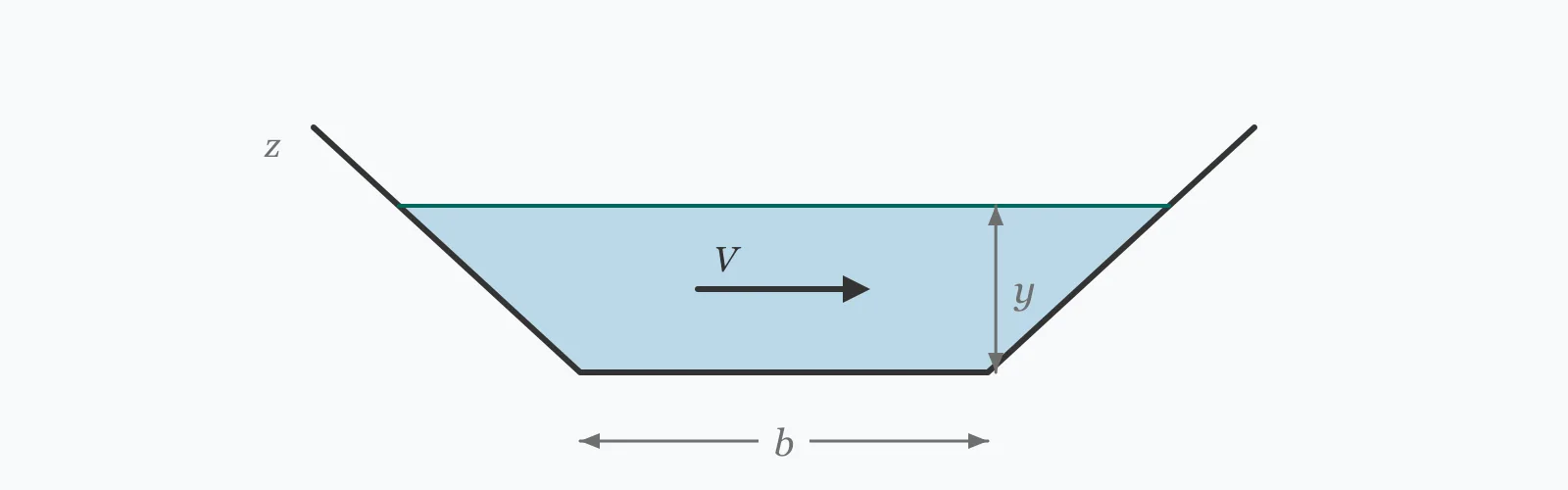
Manning's equation gives open channel velocity as V = (1/n)·R^⅔·S^½, where R is the hydraulic radius and S the channel slope. Enter the roughness coefficient, bottom width, flow depth and slope to get the velocity, discharge, hydraulic radius and flow area. It applies to gravity flow in channels, ditches and part-full pipes.
Press Calculate for the flow velocity, discharge, hydraulic radius and flow area. The hydraulic radius is what makes a channel efficient — it is area divided by wetted perimeter, and maximising it maximises capacity for a given excavation.
Step-by-Step Solution
Preliminary design aid. Results follow the published formulas cited
below and are intended for estimating, study and early design. Final design must be
verified by a licensed Professional Engineer against the code in force for your project.
Key Benefits
✓Applies Manning's equation directly for a rectangular channel
✓Returns the hydraulic radius, the property that governs channel efficiency
✓Includes roughness coefficients for the common channel linings
✓Shows how sensitive capacity is to the roughness selection
✓Sensitivity chart shows the response to flow depth
✓Shareable links and CSV export for drainage design records
What Is Manning's Equation?
Open channel flow is driven by gravity rather than pressure, so the channel slope replaces the pressure gradient of a pipe. Manning's equation states that velocity is proportional to the two-thirds power of the hydraulic radius and the square root of the slope, divided by a roughness coefficient: V = (1/n)·R^⅔·S^½. Discharge follows as Q = V·A.
The hydraulic radius
R = A/P, the flow area divided by the wetted perimeter, is the measure of how efficiently a channel section conveys water. A wide shallow channel has a large wetted perimeter for its area and therefore a small R; a deep narrow one has a larger R and moves water faster. The most efficient rectangular section is one twice as wide as it is deep, which gives the greatest hydraulic radius for a given area.
Where the uncertainty lives
Manning's n is not measured but selected, from tables, photographs and judgement. Smooth concrete is around 0.012, ordinary concrete 0.015, an earth channel 0.025, gravel 0.030, and a vegetated channel 0.050 or more. Because velocity is inversely proportional to n, that range spans a factor of four in capacity — far more uncertainty than any other input. Seasonal vegetation growth alone can halve a channel's capacity between spring and late summer.
Formula
V = (1/n) · R^(2/3) · S^(1/2)
Manning's equation for mean velocity in an open channel (SI units)
Related Formulas
R = A / P
Q = V · A
A = b·y, P = b + 2y
V = (1.486/n) · R^(2/3) · S^(1/2)
Variable Definitions
Symbol
Variable
Unit
Description
V
Flow Velocity
m/s
Mean velocity in the channel section.
n
Manning's Roughness
—
Empirical roughness coefficient. 0.012 smooth concrete to 0.050 for vegetated channels.
R
Hydraulic Radius
m
Flow area divided by wetted perimeter — the measure of sectional efficiency.
S
Channel Slope
m/m
Longitudinal bed slope. Velocity goes with its square root, so it is a weak lever.
b
Bottom Width
m
Width of the rectangular channel base.
y
Flow Depth
m
Depth of water in the channel, not the channel depth.
Q
Discharge
m³/s
Volumetric flow rate carried by the channel.
How to Use This Calculator
Select the roughness coefficient carefullyThis is the input carrying the most uncertainty by a wide margin. Use published tables and reference photographs, and consider the channel's condition through the year rather than at its best — vegetation growth can double n between spring and late summer.
Enter the water depth, not the channel depthManning's equation describes the flow that exists, not the channel's capacity. To find capacity, enter the depth at which the channel would be at design freeboard.
Enter the slope as a decimalA gradient of 1 in 200 is 0.005; 1 in 1,000 is 0.001. Because velocity goes with the square root of slope, quadrupling the gradient only doubles the velocity — slope is a weak lever compared with roughness or section.
Check the velocity against both limitsBelow about 0.6 m/s, sediment deposits. Above roughly 2 m/s in an unlined earth channel, or 4 m/s in concrete, erosion becomes a concern. Both bounds matter in channel design.
Remember it assumes uniform flowManning's equation describes steady uniform flow, where depth and velocity are constant along the channel. Backwater from a downstream control, a drop, or a sudden change of section all break that assumption and need a gradually varied flow analysis.
Worked Examples
Example 1
A rectangular concrete channel 2.0 m wide carries water 0.5 m deep on a slope of 0.005 (1 in 200). Manning's n is 0.013. Find the velocity and discharge.
Step-by-Step Solution
Flow area: A = b × y = 2.0 × 0.5 = 1.000 m²
Wetted perimeter: P = b + 2y = 2.0 + 2(0.5) = 3.000 m
Hydraulic radius: R = A/P = 1.000 / 3.000 = 0.3333 m
R to the two-thirds power: 0.3333^⅔ = 0.4807
Square root of slope: √0.005 = 0.07071
Velocity: V = (1/0.013) × 0.4807 × 0.07071 = 76.92 × 0.4807 × 0.07071 = 2.615 m/s
Discharge: Q = V × A = 2.615 × 1.000 = 2.615 m³/s
Note the coincidence: because the flow area is exactly 1.000 m², the velocity and discharge share the same number here. That will not be true for other dimensions.
Assessment: 2.615 m/s is well above the 0.6 m/s self-cleansing minimum and acceptable for concrete, though it would erode an unlined earth channel.
Example 2
The same channel, but neglected until it becomes vegetated, raising Manning's n from 0.013 to 0.050. This is the maintenance case that catches drainage systems out.
Step-by-Step Solution
Geometry is unchanged: A = 1.000 m², P = 3.000 m, R = 0.3333 m
Velocity: V = (1/0.050) × 0.4807 × 0.07071 = 20.0 × 0.4807 × 0.07071 = 0.680 m/s
Discharge: Q = 0.680 × 1.000 = 0.680 m³/s
Comparison: capacity has fallen from 2.615 to 0.680 m³/s — a 74% reduction, purely from vegetation
The relationship is exactly inverse: n rose by a factor of 3.85 and capacity fell by the same factor.
The design consequence: a channel sized on its as-built roughness has no margin at all once it vegetates. Either design on the maintained-condition n, or commit to a maintenance regime that keeps it there — and the second is a recurring cost the first is not.
Note also that 0.680 m/s is close to the 0.6 m/s self-cleansing threshold, so the vegetated channel starts silting as well, which compounds the problem.
Depth Sensitivity
Discharge rises faster than depth because both the area and the hydraulic radius grow together — area linearly, velocity through R^⅔. Switch between the curves to see the two effects separately. The marker shows your current depth.
Discharge (Q) vs Flow Depth (y)
Recomputed live from your inputs. The marker shows your current value.
Line chart of Discharge (Q) against Flow Depth (y). The same
values are listed in the data table below.
Values plotted above, sampled across the flow depth (y) range.
How to Interpret Your Results
Velocity is the number to read against design limits, and both bounds matter in an open channel: too slow and it silts, too fast and it erodes. The acceptable upper limit depends entirely on the lining.
Flow Velocity: < 0.6Below self-cleansing velocity
A velocity of your result m/s is below the 0.6 m/s needed to keep sediment in suspension. The channel will silt up, which raises the roughness further and reduces capacity in a self-reinforcing cycle. Increase the slope or reduce the section.
Flow Velocity: 0.6 – 2Suitable for most channel linings
A velocity of your result m/s is fast enough to be self-cleansing and slow enough for earth, grass and gravel linings. This is the normal design range for open drainage channels.
Flow Velocity: 2 – 4Requires an erosion-resistant lining
A velocity of your result m/s will erode earth and grass channels. Acceptable in concrete, masonry or riprap, but confirm the lining is specified for it and check for scour at bends and transitions.
Flow Velocity: ≥ 4High velocity — check the flow regime
A velocity of your result m/s is high even for concrete. At this speed the flow may be supercritical, which brings hydraulic jumps at any transition and significant scour potential. Check the Froude number and consider energy dissipation.
A hydraulic radius of your result m is small, meaning the wetted perimeter is large relative to the flow area. Wide shallow sections are hydraulically inefficient; a deeper, narrower section conveys more for the same excavation.
Common Mistakes to Avoid
Choosing an optimistic roughness coefficient
Why it matters:Velocity is inversely proportional to n, so the difference between clean concrete at 0.013 and a vegetated channel at 0.050 is a factor of nearly four in capacity. It is by far the largest source of uncertainty in the calculation.
✓How to avoid it:Select n for the condition the channel will actually be in, including seasonal vegetation, not its as-built state. Where maintenance cannot be guaranteed, design on the worst realistic value.
Using the channel depth instead of the flow depth
Why it matters:Manning's equation describes the flow that exists at a given depth. Entering the full channel depth gives the capacity at brim full, with no freeboard.
✓How to avoid it:Enter the design water depth. For capacity checks, use the depth at the required freeboard below the bank, not the bank level itself.
Applying it to non-uniform flow
Why it matters:The equation assumes steady uniform flow, with depth and velocity constant along the channel. Backwater from a downstream structure, a drop or a contraction all violate that, sometimes over considerable distances.
✓How to avoid it:Use a gradually varied flow analysis where a downstream control governs. Manning's equation gives the normal depth, which is the depth the flow tends towards, not necessarily the depth that exists.
Treating slope as a strong lever
Why it matters:Velocity goes with the square root of slope, so quadrupling the gradient only doubles the velocity. Designers reaching for slope to solve a capacity problem usually find it an expensive way to gain little.
✓How to avoid it:Changing the section or the lining is generally more effective. Doubling the hydraulic radius gains 59% in velocity; doubling the slope gains only 41%.
Ignoring the flow regime
Why it matters:Above a Froude number of 1 the flow is supercritical, and it behaves quite differently: disturbances cannot travel upstream, hydraulic jumps form at transitions, and scour potential is high.
✓How to avoid it:Check the Froude number V/√(gy). Design in subcritical flow where possible, and where supercritical flow is unavoidable, provide for the jump and its energy dissipation.
Using a rectangular section for a trapezoidal channel
Why it matters:Most earth channels are trapezoidal for stability, and their area and wetted perimeter differ from a rectangle of the same base width and depth. Using the rectangular form understates the capacity.
✓How to avoid it:Compute A and P for the actual section: for a trapezoid with side slope z, A = by + zy² and P = b + 2y√(1+z²), then apply Manning's equation to the resulting R.
Practical Applications
▸Sizing open drainage channels and roadside ditches
▸Checking storm sewer capacity in part-full gravity flow
▸Designing irrigation and conveyance channels
▸Assessing river and stream capacity for flood studies
▸Verifying culvert outlet channel capacity
▸Estimating the effect of channel maintenance on capacity
Industry Use Cases
Highway and site drainage
Roadside ditches are sized on Manning's equation with a roughness selected for the vegetated condition, since mowing regimes are unreliable over a road's life. Designing on the as-built clean value would give a channel that fails within a season.
Storm sewer design
Gravity sewers run part full, so they are open channel problems rather than pipe flow ones. Capacity peaks at about 94% full rather than brim full, because the wetted perimeter grows faster than the area in the top of the pipe.
River engineering and flood modelling
Roughness in natural channels varies with stage — a river in flood engages its vegetated floodplain, whose n may be three times that of the main channel. Composite roughness methods are used to combine them across the section.
Expert Tips
💡Roughness carries the most uncertainty of any input: a factor of four across common linings.
💡Velocity goes with the square root of slope, so gradient is a weak and expensive lever.
💡The most efficient rectangular section is twice as wide as it is deep.
💡Design on the maintained-condition roughness, or commit to the maintenance that keeps it there.
💡A part-full pipe carries its maximum flow near 94% full, not when brim full.
💡Check the Froude number where velocities are high — supercritical flow changes the design entirely.
Advantages & Limitations
Advantages
✓Simple, well-established and calibrated against more than a century of field data
✓Returns the hydraulic radius, which shows why a section is or is not efficient
✓Applies to channels, ditches and part-full pipes alike
✓Needs only geometry, slope and a roughness selection
✓Fast enough to compare channel sections during design
Limitations
!Covers rectangular sections only; trapezoidal and natural channels need their own A and P
!Assumes steady uniform flow with constant depth along the channel
!Roughness must be selected by judgement, carrying substantial uncertainty
!Empirical and dimensionally inconsistent, so the coefficient differs between SI and US units
!Less reliable at very shallow depths and very small hydraulic radii
!Does not identify supercritical flow or locate hydraulic jumps
!Takes no account of sediment transport, bends or transitions
Capacity by Channel Roughness
The same 2.0 m wide channel at 0.5 m depth on a 0.005 slope. Capacity is inversely proportional to n, so this single selection spans a factor of four — more than any other input in the calculation.
Rectangular channel, b = 2.0 m, y = 0.5 m, S = 0.005. Relative capacity is against the default n = 0.013. Velocity and discharge share numbers only because the area is exactly 1.000 m².
An empirical relationship for open channel velocity: V = (1/n)·R^⅔·S^½, where n is the roughness coefficient, R the hydraulic radius and S the channel slope. Discharge follows as Q = VA.
What is Manning's n for concrete?
About 0.012 for smooth trowelled concrete and 0.015 for an ordinary finish. Earth channels are around 0.025, gravel 0.030, and vegetated channels 0.050 or more. The value is selected from tables rather than measured.
What is the hydraulic radius?
Flow area divided by wetted perimeter, R = A/P. It measures how efficiently a section conveys water: a large R means a lot of flow area for relatively little wall friction. For a rectangular channel of width b and depth y, R = by/(b+2y).
How does roughness affect channel capacity?
Inversely and directly. Doubling n halves the velocity and therefore the discharge. Between clean concrete at 0.013 and a vegetated channel at 0.050, capacity falls by 74% — which is why maintenance is a capacity issue, not a cosmetic one.
Does a steeper channel carry much more water?
Less than you might expect. Velocity goes with the square root of slope, so quadrupling the gradient only doubles the velocity. Changing the section or the lining is usually a more effective lever.
What is the most efficient channel shape?
The one with the greatest hydraulic radius for a given area. For a rectangle that is a section twice as wide as it is deep; for a trapezoid, a half-hexagon. A semicircle is the theoretical optimum but is rarely practical to build.
Can I use Manning's equation for a pipe?
Yes, for a pipe flowing part full under gravity, which is an open channel problem. Compute A and P for the part-full section. Note that capacity peaks near 94% full rather than brim full, because the perimeter grows faster than the area near the top.
What is a self-cleansing velocity?
The minimum velocity keeping sediment in suspension, generally around 0.6 to 0.75 m/s. Below it, silt deposits, which raises the effective roughness and reduces capacity further — a self-reinforcing problem.
What is normal depth?
The depth at which uniform flow occurs for a given discharge, slope and roughness — the depth Manning's equation returns. Actual depth may differ where a downstream control creates backwater, which requires a gradually varied flow analysis.
Why does the equation differ between SI and US units?
Because Manning's equation is empirical and dimensionally inconsistent. The SI form uses a coefficient of 1.0 and the US customary form 1.486, which is simply the conversion factor absorbed into the constant. The n values themselves are the same in both.
Glossary
Open channel flow
Flow with a free surface, driven by gravity rather than pressure.
Manning's n
An empirical roughness coefficient selected from tables, describing resistance to flow.
Hydraulic radius (R)
Flow area divided by wetted perimeter, the measure of sectional conveyance efficiency.
Wetted perimeter (P)
The length of channel boundary in contact with the flowing water.
Normal depth
The depth at which uniform flow occurs for a given discharge, slope and roughness.
Uniform flow
Flow in which depth and velocity remain constant along the channel.
Froude number
The ratio V/√(gy), which distinguishes subcritical from supercritical flow at a value of 1.
Self-cleansing velocity
The minimum velocity that keeps sediment in suspension, about 0.6 to 0.75 m/s.
Freeboard
The vertical margin between the design water surface and the top of the channel bank.
Scientific & Standards References
Manning, R., On the Flow of Water in Open Channels and Pipes, Transactions ICEI (1891) — Institution of Civil Engineers of Ireland
Chow, V. T., Open-Channel Hydraulics — McGraw-Hill
USGS Water-Supply Paper 2339 — Guide for Selecting Manning's Roughness Coefficients for Natural Channels and Flood Plains — United States Geological Survey
FHWA HDS-3 — Design Charts for Open-Channel Flow — Federal Highway Administration
Chaudhry, M. H., Open-Channel Flow, 2nd Edition — Springer
Conclusion
Manning's equation gives open channel velocity as (1/n)·R^⅔·S^½, and its three inputs carry very different weight. Roughness is inversely proportional to capacity and spans a factor of four across common linings, making it both the most influential input and the one selected by judgement rather than measurement — a channel designed on its as-built roughness has no margin left once it vegetates. The hydraulic radius rewards deep narrow sections over wide shallow ones. Slope is the weakest lever, since velocity follows only its square root. And the whole equation assumes uniform flow, so where a downstream control creates backwater, it gives the normal depth rather than the depth that actually exists.
Size your own channel above, then sweep the flow depth in the chart to see discharge outpace it.